

SOC 2 Type 2 is an independent audit report in which a licensed CPA firm examines whether a service organization’s security controls were both designed correctly and operating effectively across a period of months. It gives customers evidence, not a promise, that their data is protected. Most enterprise buyers now expect it before they sign.
If a customer, insurer, or procurement team has asked your business for “your SOC 2,” they are almost always asking for a SOC 2 Type 2 report. It has become the default trust document of the B2B technology world, and it is quickly turning from a competitive edge into a baseline expectation. In A-LIGN’s 2025 Compliance Benchmark Report, SOC 2 was the single most common framework in use, cited by 76% of organizations. This guide explains what the report actually proves, how Type 2 differs from Type 1, what lives inside the document, and how to either earn one or read one with a critical eye.
Key Takeaways
- Type 2 tests reality, not intent. It confirms your controls ran effectively over a period (usually 6 to 12 months), while Type 1 only checks the design on a single day.
- It is a report, not a certificate. A CPA firm issues an opinion on your controls under the AICPA’s attestation standards. There is no official “SOC 2 certified” stamp.
- Security is the only required criterion. The other four Trust Services Criteria (Availability, Processing Integrity, Confidentiality, Privacy) are added based on the promises you make to customers.
- The auditor’s opinion is the headline. An unqualified (clean) opinion is the goal; qualified, adverse, or disclaimer opinions signal problems worth reading closely.
- Getting audit-ready is the hard part. The audit measures controls you should already be running. A vCISO or managed security partner closes the gaps before the clock starts.
What’s in This Guide
- What SOC 2 Type 2 Actually Means
- The Five Trust Services Criteria Explained
- SOC 2 Type 2 vs. SOC 2 Type 1
- What’s Inside a SOC 2 Type 2 Report
- Why SOC 2 Type 2 Matters for Your Business
- How to Become SOC 2 Type 2 Compliant
- How to Read a Vendor’s SOC 2 Type 2 Report
- Frequently Asked Questions
- Related Compliance Terms
What SOC 2 Type 2 Actually Means
SOC stands for System and Organization Controls, a family of audit reports created and governed by the American Institute of Certified Public Accountants (AICPA). A SOC 2 examination looks at how a service organization protects the customer data it handles. The examination is performed under the AICPA’s attestation standard, SSAE 18, and it can only be conducted and signed by a licensed CPA firm.
The word “Type 2” describes the depth of the testing. Rather than checking your controls on a single day, a Type 2 audit watches them over a stretch of time, then documents whether they actually worked. Think of it like a driving record instead of a driving test: a test proves you can drive safely for fifteen minutes, but a clean record proves you have driven safely for a year. Type 2 is the record.
That period is not random. The auditor selects an observation window, commonly 6, 9, or 12 months, and pulls evidence from across it: access logs, change tickets, onboarding and offboarding records, backup results, incident reports, and more. If you claim that every departing employee loses system access within 24 hours, the auditor will sample real terminations from the period and check the timestamps. Controls that look good on paper but were skipped in practice show up as exceptions.
Source: AICPA SOC 2 reporting overview
The Five Trust Services Criteria Explained
A SOC 2 report is built on the AICPA’s Trust Services Criteria, five categories that define what “trustworthy” means for a system handling customer data. You do not have to include all five. You choose the categories that match the promises you make to your customers, and the auditor tests only those.
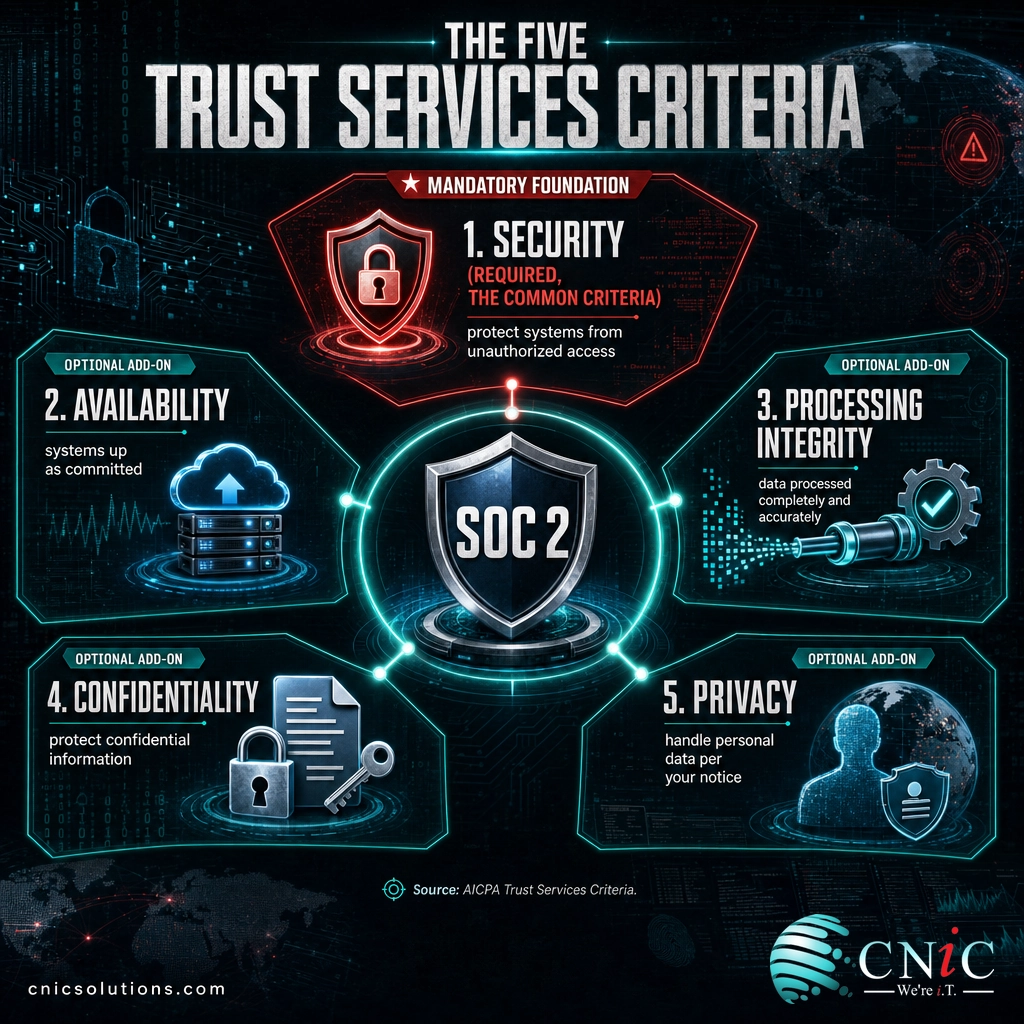
- Security (required). Also called the Common Criteria, this is the foundation of every SOC 2 report. It covers protecting systems and data against unauthorized access, from firewalls and multi-factor authentication to access reviews and monitoring.
- Availability. Are your systems up and reachable as committed in your service-level agreements? This category leans on redundancy, monitoring, and tested backup and disaster recovery.
- Processing Integrity. Does the system process data completely, accurately, and on time? Most relevant to platforms that calculate, transact, or transform data.
- Confidentiality. Is information labeled confidential (contracts, business plans, internal data) protected and disposed of properly?
- Privacy. Is personal information collected, used, retained, and deleted in line with your privacy notice and applicable rules?
Security is included in every engagement because you cannot make any other promise credibly without it. Most service providers start with Security alone, then add Availability and Confidentiality as customer contracts demand them.
Source: AICPA Trust Services Criteria
SOC 2 Type 2 vs. SOC 2 Type 1
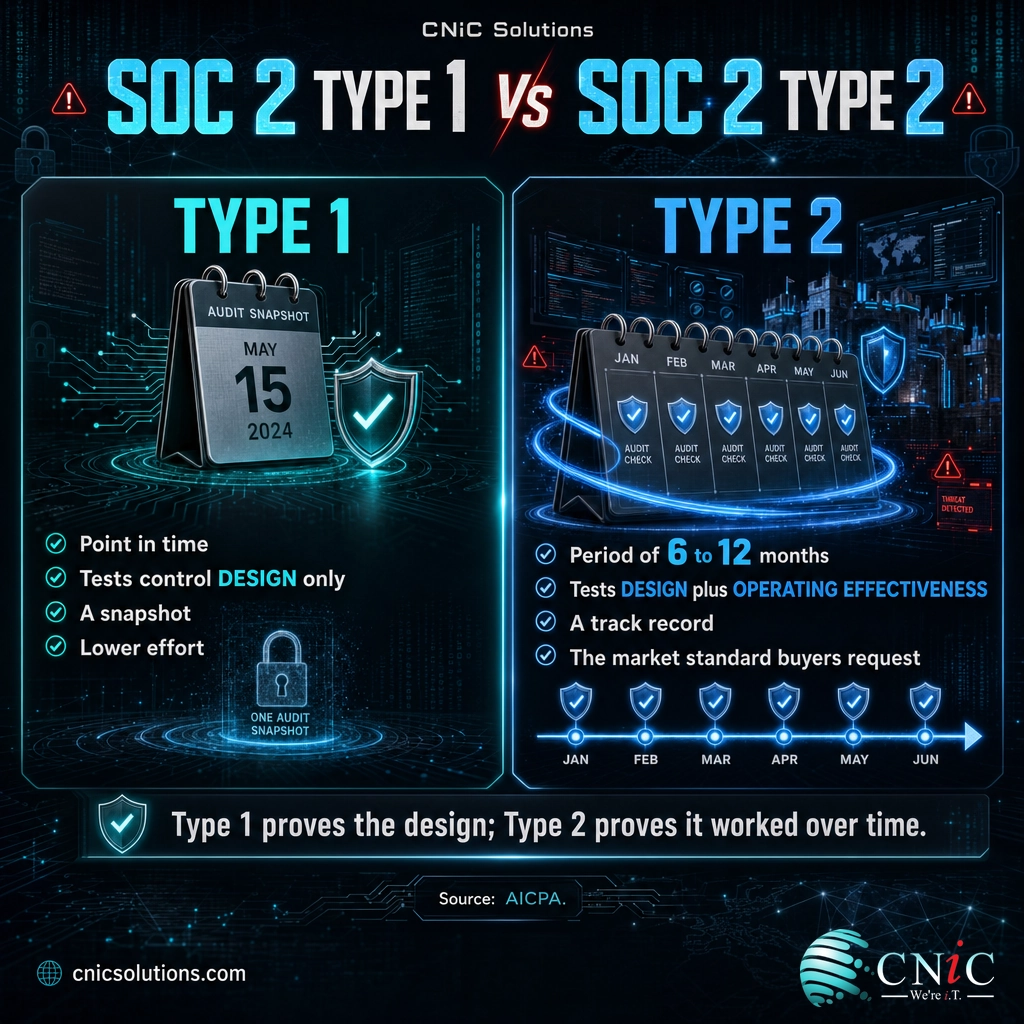
This is the single most common point of confusion, and getting it wrong can cost you a deal. Both reports use the same Trust Services Criteria and the same underlying controls. The difference is entirely about time.
A Type 1 report answers one question: on this specific date, are the controls designed appropriately? It is a snapshot. A Type 2 report answers a harder question: across this period of months, did the controls actually operate effectively? It is a movie. Because a Type 2 requires the organization to prove sustained performance, buyers trust it far more, and it is requested far more often.
| SOC 2 Type 1 | SOC 2 Type 2 | |
|---|---|---|
| Question answered | Are controls designed correctly? | Did controls operate effectively? |
| Timeframe | A single point in time | A period, usually 6 to 12 months |
| Evidence | Control design as of one date | Sampled evidence across the whole period |
| Effort and cost | Lower | Higher |
| Buyer trust | Moderate | Strong, the market standard |
| Best used as | A fast first step toward Type 2 | The report enterprise customers ask for |
Many organizations start with a Type 1 to show momentum, then complete a Type 2 covering the months that follow. That is a reasonable path, but be clear with prospects about which one you hold. A Type 1 offered in place of a requested Type 2 reads as a red flag to an experienced procurement team.
Source: AICPA SOC 2 reporting overview
What’s Inside a SOC 2 Type 2 Report
A finished SOC 2 Type 2 report is a formal document, often 40 to 100 pages, with a consistent structure. Knowing the sections helps whether you are producing one or reviewing a vendor’s. Every report contains these parts.
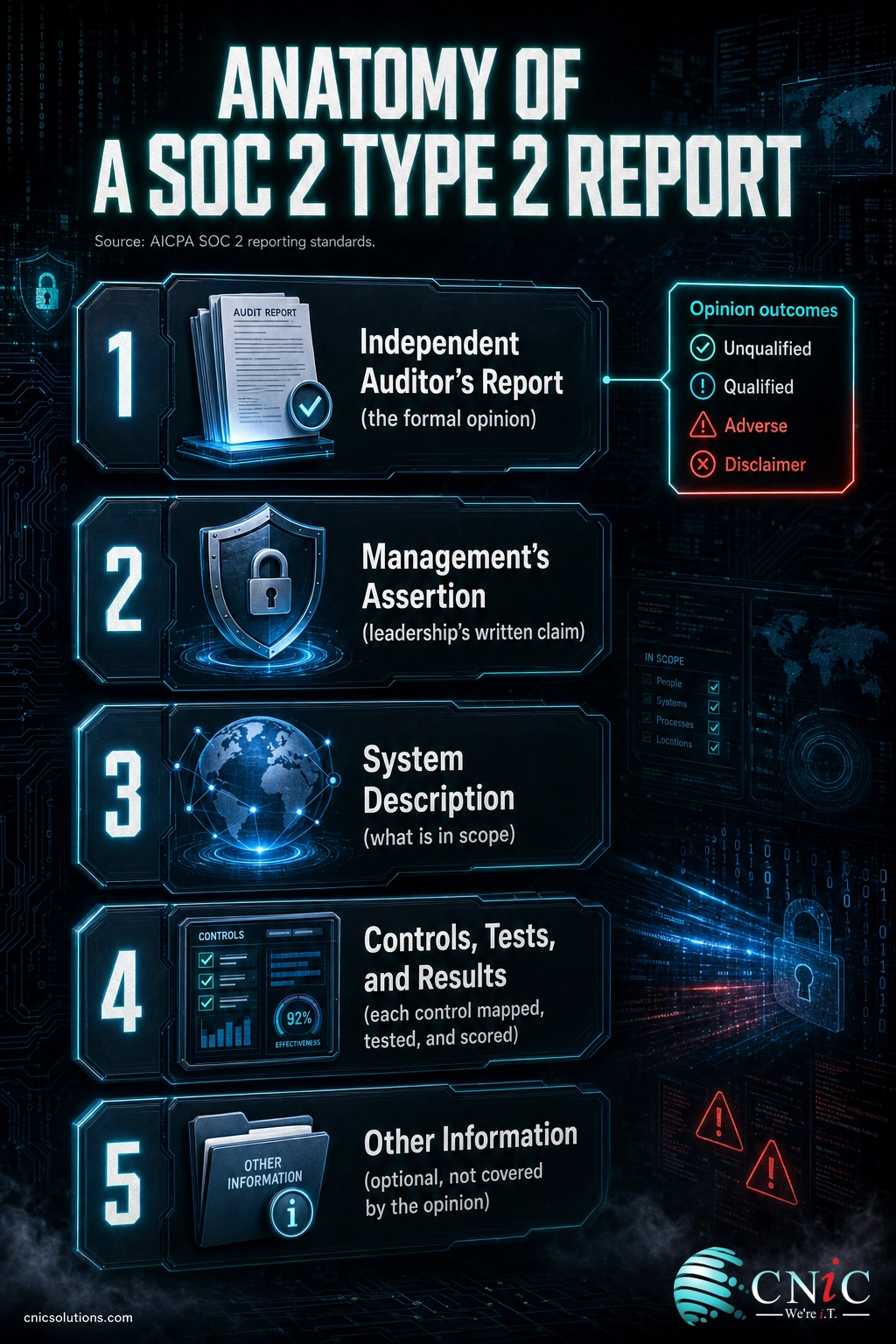
- The independent auditor’s report. The CPA firm’s letter and formal opinion. This is the part everyone reads first because it states the verdict.
- Management’s assertion. A written statement from your leadership claiming the system description is accurate and the controls meet the selected criteria. You are putting your name to it.
- The system description. A detailed narrative of the service, the infrastructure, the people, the data flows, and the controls in place. It defines exactly what was and was not in scope.
- The controls, tests, and results. The heart of the report. It lists each control, maps it to the Trust Services Criteria, describes how the auditor tested it, and records the result, including any exceptions found.
- Other information (optional). A place for management to respond to exceptions or share context, such as a roadmap. This section is not covered by the auditor’s opinion.
The four opinions you can receive
The auditor’s opinion in section one falls into one of four buckets. Reading it correctly is the whole point of the exercise.
- Unqualified: a clean opinion. Controls were suitably designed and operated effectively. This is the goal.
- Qualified: mostly clean, but one or more controls had issues. Readable, but read the exceptions carefully.
- Adverse: controls did not operate effectively. A serious warning.
- Disclaimer: the auditor could not gather enough evidence to form an opinion at all.
A report is not automatically “good” because one exists. A qualified or adverse opinion with unaddressed exceptions can be worse than no report, because it documents a known gap in writing.
Source: AICPA SOC 2 reporting overview
Why SOC 2 Type 2 Matters for Your Business
The business case sits on two facts: buyers are done taking security promises on faith, and the cost of getting security wrong keeps climbing. A SOC 2 Type 2 report answers a procurement questionnaire before it is even sent, and it does so with independent evidence rather than marketing language.
Average Cost of a Data Breach, 2025 (IBM)
There is a sales dimension too. When a vendor cannot produce a SOC 2 Type 2 report, the deal often stalls in security review or dies quietly. When you can hand over a clean report on day one, you shorten the sales cycle and remove a reason to say no. Because SOC 2 is now a baseline expectation rather than a differentiator, the report increasingly keeps you in the running rather than winning the race outright. The absence of one is what stands out.
It also forces good habits. Preparing for a Type 2 means your team runs access reviews, tests backups, patches on a schedule, and documents incidents month after month, precisely the routines that shorten the 241-day average it took organizations to identify and contain a breach in 2025.
Source: IBM Cost of a Data Breach Report 2025 | A-LIGN 2025 Compliance Benchmark Report
How to Become SOC 2 Type 2 Compliant
The audit itself is the easy part. The work is building and running controls that will hold up to a year of testing. Here is the path most service organizations follow.
- Scope the report. Decide which systems are in scope and which Trust Services Criteria you will include. Start with Security, and add Availability, Confidentiality, Processing Integrity, or Privacy only where you make that specific promise to customers.
- Run a readiness assessment. Before the clock starts, compare your current controls to the criteria and find the gaps. This is where a fresh set of expert eyes pays for itself.
- Remediate the gaps. Stand up the missing controls: multi-factor authentication everywhere, formal access reviews, endpoint protection, logging and monitoring, a written incident response plan, and tested backups.
- Operate through the observation period. Run the controls, and generate the evidence, for the full 6 to 12 months. Consistency during this window is what the auditor tests.
- Complete the audit. A licensed CPA firm reviews your evidence, tests the controls, and issues the report. The fieldwork is short compared to the months of operation behind it.
The most expensive mistake: treating SOC 2 as a documentation project you rush the month before the audit. Type 2 tests what actually happened across the whole period. You cannot back-date a quarter of access reviews you never performed, and inventing evidence turns a compliance problem into a far more serious one. Build the habits early, or the exceptions will write themselves.
Most small and midsize businesses do not have a full-time security leader to own this program, which is where a virtual CIO who owns your compliance roadmap earns their keep. A managed security partner can also run the day-to-day controls, from monitoring to access reviews, that the audit will measure.
Build audit-ready security controls with CNiC Solutions
How to Read a Vendor’s SOC 2 Type 2 Report
The other half of SOC 2 is receiving one. If you are evaluating a SaaS platform, a cloud host, or an outsourced provider, their report is a gift, but only if you actually read it. Skip the marketing summary and check five things.
- The opinion. Confirm it is unqualified. If it is qualified or adverse, read every exception and the management response before you rely on the vendor.
- The period dates. A Type 2 covers a window. If the window ended eight months ago, ask for a bridge letter covering the gap to today.
- The scope. Check which systems and which Trust Services Criteria were tested. A report that only covers Security says nothing about Availability or Privacy.
- The exceptions. Read section four for controls that failed testing and whether they were remediated. Exceptions are normal; ignored ones are not.
- The complementary user entity controls (CUECs). These are the controls the vendor expects you to run on your side. The vendor’s report is only valid if you actually perform them.
Reviewing vendor reports well is a core part of a mature third-party risk program. For the wider regulatory picture, see our 2026 cybersecurity compliance statistics covering GDPR, HIPAA, PCI, and CMMC.
Get help vetting vendors and managing IT risk
Frequently Asked Questions
Is SOC 2 Type 2 a certification?
How long does a SOC 2 Type 2 report cover?
What is the difference between SOC 2 Type 1 and Type 2?
How much does a SOC 2 Type 2 audit cost?
Who needs a SOC 2 Type 2 report?
Related Compliance Terms
- SOC 1: A report on controls relevant to a customer’s financial reporting, not security. Different purpose, same report family.
- SOC 3: A short, public-facing summary of a SOC 2 that carries the seal without the confidential detail. Good for posting on a website.
- Trust Services Criteria: The five AICPA categories (Security, Availability, Processing Integrity, Confidentiality, Privacy) a SOC 2 is measured against.
- ISO 27001: An international certification for an information security management system, often pursued alongside SOC 2.
- Bridge letter: A short statement from a vendor covering the gap between the end of their report period and today.
- HIPAA: U.S. healthcare data protection rules. Businesses handling protected health information can explore our healthcare IT and compliance support.
- Virtual CISO (vCISO): An outsourced security leader who builds and owns a compliance program like SOC 2 for organizations without a full-time CISO.
Sources and Methodology
Framework definitions, the Trust Services Criteria, and report structure are drawn from the American Institute of Certified Public Accountants (AICPA), which owns and governs the SOC reporting standards under attestation standard SSAE 18. Breach-cost and detection figures are from the IBM Cost of a Data Breach Report 2025. Framework adoption data is from the A-LIGN 2025 Compliance Benchmark Report. This article is educational and is not audit, legal, or accounting advice; a SOC 2 examination can only be performed by a licensed CPA firm.



related posts
Zero Trust Statistics for 2026: Adoption, Maturity, and Breach Impact
November 3, 2026Zero trust has become the default security strategy on paper, but not yet in practice. Okta's…
What Is ZTNA (Zero Trust Network Access)?
November 3, 2026Zero Trust Network Access (ZTNA) is a security service that grants a verified user access to…
What Is Zero Trust Security? A Guide for Small Businesses
November 2, 2026Zero Trust security is a cybersecurity model built on one rule: never trust, always verify. Instead…
What Is XDR (Extended Detection and Response) and How Does It Protect…
November 2, 2026Extended detection and response (XDR) is a security platform that collects and correlates threat data from…