

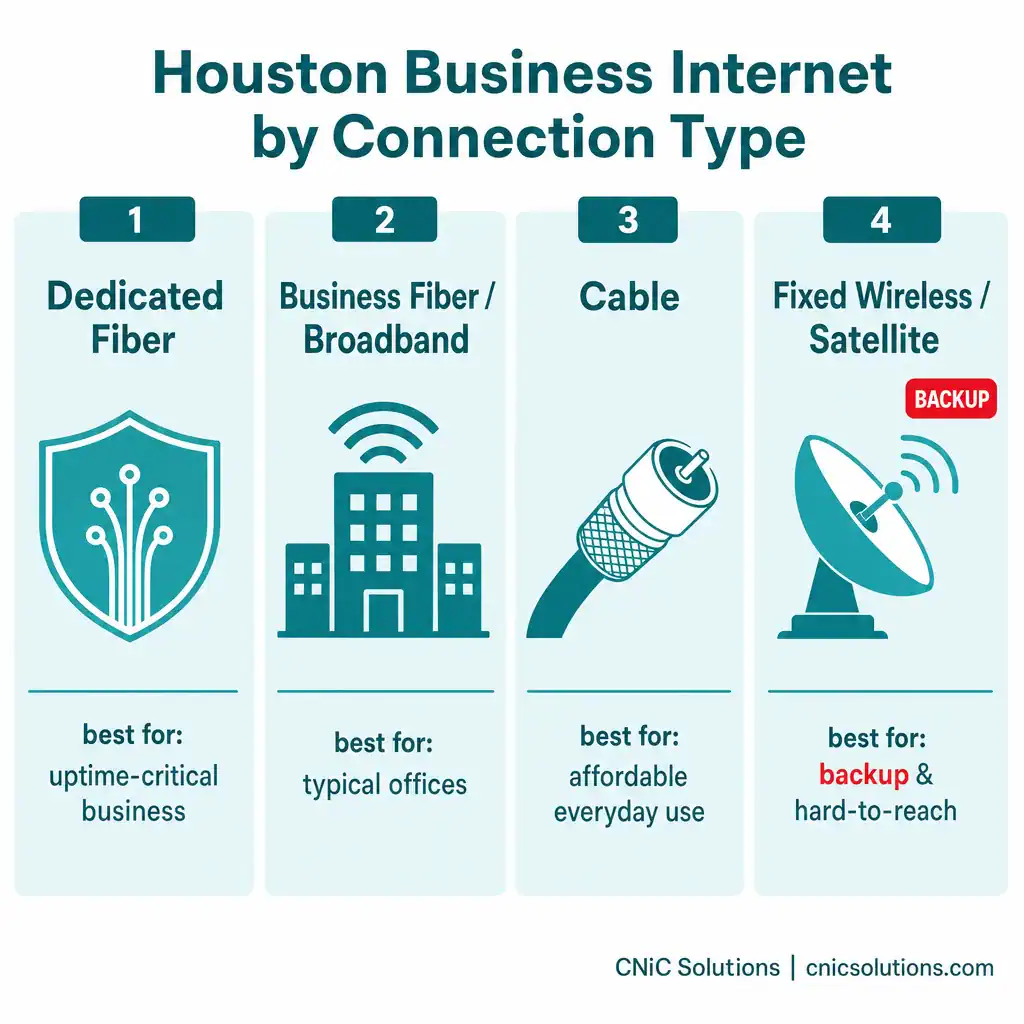
Choosing a business internet provider in Houston is not really about who has the flashiest ad. It is about matching the right connection type to how much your business depends on staying online. The wrong choice shows up fast: dropped VoIP calls, frozen cloud apps, and downtime that costs you customers. Because availability and pricing in Houston vary block to block, the honest answer to “who is best” is “it depends on your address and your needs.” This guide ranks the leading providers by the type of business they serve best, so you can shortlist the right ones for your location, then verify availability and pricing for your exact address.
How We Evaluated Providers
We assessed Houston’s business internet options against the criteria that actually matter to a business buyer, not a home user:
- Reliability and SLAs: Does the provider guarantee uptime in writing, with credits if they miss it?
- Speed and symmetry: Are upload and download speeds symmetrical (critical for cloud, VoIP, and file sharing)?
- Dedicated vs shared bandwidth: Is the connection yours alone, or shared with neighbors during peak hours?
- Houston availability: How widely is the service actually deployable across the metro and its business districts?
- Support quality: Is support business-grade, with fast repair priority and real account management?
- Scalability: Can the connection grow with you and support redundancy or failover?
An important note on our approach: CNiC Solutions is not an internet provider, so we have no horse in this race. We are a Houston managed IT and telecom partner that helps businesses select, procure, and manage the right connectivity. That makes this a genuinely vendor-neutral ranking. We have also intentionally avoided quoting specific prices and speeds, because both change constantly and vary by exact address. Always confirm current figures for your location.
Key Takeaways
- There is no single “best” provider, only the best fit for your location, uptime needs, and budget.
- Dedicated fiber with an SLA is the strongest choice for businesses that cannot afford downtime.
- National carriers offer the widest availability; regional and dedicated-fiber providers often offer stronger business-grade service and support.
- Availability is hyper-local in Houston. A provider that is ideal one block over may not reach your building.
- The smartest move is to shortlist by fit, then verify availability, pricing, and SLA terms for your exact address before signing.
What’s in This Guide
- AT&T Business: Best for Wide Availability and Fiber Reach
- Lumen and Zayo: Best for Dedicated and High-Capacity Fiber
- Logix Fiber Networks: Best for Houston-Focused Business Fiber
- Comcast Business: Best for Affordable Business Broadband
- Fixed Wireless and Satellite: Best for Backup and Hard-to-Reach Sites
- Side-by-Side Comparison
- How to Choose the Right Provider
- Frequently Asked Questions
1AT&T Business: Best for Wide Availability and Fiber Reach
Best for: Businesses that want broad fiber availability across the Houston metro from a single national carrier.
AT&T Business is one of the most widely available providers in Houston, offering both business fiber and dedicated internet access. Its fiber footprint reaches a large share of the metro, and its dedicated tier adds symmetrical speeds with guaranteed performance for businesses that need it.
Strengths:
- Among the widest fiber and overall availability across Houston neighborhoods and business districts.
- Offers a true dedicated internet option with SLAs alongside its standard business fiber.
- Symmetrical speeds available on fiber tiers, which suits cloud and VoIP-heavy workloads.
- Established national infrastructure and 24/7 business support.
Fit considerations:
- As a large national carrier, support can feel less personal than a regional, business-only provider.
- Availability and top speeds still vary by exact address, so the fiber tier you want may not reach every building.
| Criterion | Rating | Notes |
|---|---|---|
| Houston availability | Excellent | Among the broadest fiber reach in the metro |
| Reliability / SLA | Strong | SLA available on dedicated tier |
| Speed / symmetry | Strong | Symmetrical on fiber |
| Support | Good | 24/7, but national-scale |
2Lumen and Zayo: Best for Dedicated and High-Capacity Fiber
Best for: Larger businesses, multi-site operations, and data-intensive workloads that need guaranteed, high-capacity dedicated circuits.
Lumen and Zayo are transport and dedicated-fiber specialists rather than mass-market ISPs. They serve Houston’s carrier hotels, data centers, and enterprises with high-capacity dedicated circuits and private connectivity, including direct cloud on-ramps. For businesses moving serious data or requiring guaranteed performance, this tier is built for them.
Strengths:
- High-capacity dedicated fiber and private-wave circuits with strong SLAs.
- Direct cloud connectivity options for low-latency access to major cloud platforms.
- Built for enterprise reliability and multi-site or carrier-grade needs.
- Symmetrical, unshared bandwidth by design.
Fit considerations:
- Oriented to larger or data-heavy organizations; likely more capacity and cost than a small office needs.
- Deployment can require longer lead times and on-net availability at your building.
| Criterion | Rating | Notes |
|---|---|---|
| Reliability / SLA | Excellent | Enterprise-grade dedicated circuits |
| Speed / symmetry | Excellent | High-capacity, symmetrical, unshared |
| Houston availability | Selective | Strong in business cores; on-net dependent |
| Best-fit size | Mid to large | Overbuilt for very small offices |
3Logix Fiber Networks: Best for Houston-Focused Business Fiber
Best for: Houston-area businesses that want a regional, business-only fiber provider with local support.
Logix is a Texas-based fiber provider built specifically for business customers, with a network and support operation focused on the region. For businesses that value local account management and a provider whose entire focus is business connectivity (not a residential side business), Logix is a strong regional option.
Strengths:
- Business-only focus, with a fiber network designed for commercial reliability.
- Regional, Texas-based support and account management.
- Symmetrical business fiber with SLAs.
- Local presence and familiarity with the Houston market.
Fit considerations:
- As a regional provider, its network footprint is narrower than the national carriers, so availability depends heavily on your address.
- Smaller scale than national carriers for very large multi-state deployments.
| Criterion | Rating | Notes |
|---|---|---|
| Support | Excellent | Regional, business-only focus |
| Reliability / SLA | Strong | Business fiber with SLAs |
| Speed / symmetry | Strong | Symmetrical business fiber |
| Houston availability | Good | Regional footprint; address-dependent |
4Comcast Business: Best for Affordable Business Broadband
Best for: Small to midsize offices that want widely available, cost-effective business internet with flexible terms.
Comcast Business offers broadly available cable and fiber-based business internet across Houston, often with flexible, month-to-month gig tiers. For smaller offices whose needs are real but not mission-critical to the minute, it balances availability, cost, and decent business features well.
Strengths:
- Wide availability across the metro, filling gaps where dedicated fiber is off-net.
- More affordable entry points than dedicated-fiber circuits.
- Flexible terms, including month-to-month options on some tiers.
- Business-grade support and add-on services like backup connectivity.
Fit considerations:
- Cable-based tiers are typically shared and asymmetrical (slower upload), which can strain heavy cloud or VoIP use.
- Best-effort tiers carry weaker uptime guarantees than dedicated fiber, so confirm SLA terms for your needs.
| Criterion | Rating | Notes |
|---|---|---|
| Affordability | Excellent | Lower entry cost than dedicated fiber |
| Houston availability | Excellent | Broad metro coverage |
| Speed / symmetry | Mixed | Cable tiers often asymmetrical/shared |
| Reliability / SLA | Good | Stronger on fiber tiers than cable |
5Fixed Wireless and Satellite: Best for Backup and Hard-to-Reach Sites
Best for: Locations where wired fiber is unavailable, and as a failover connection for business continuity.
Fixed wireless and modern satellite services (such as business-grade low-earth-orbit options) are not usually a first choice for a primary business connection, but they fill two important roles: serving sites where fiber simply has not been built, and acting as a redundant backup so a single fiber cut does not take your business offline.
Strengths:
- Reach locations that wired providers cannot economically serve.
- Excellent as a failover/backup link for redundancy.
- Faster to deploy than trenching new fiber.
- Increasingly capable speeds on newer satellite and fixed-wireless services.
Fit considerations:
- Generally higher latency and more variability than fiber, which can affect real-time apps.
- Weather and line-of-sight can affect some services, so they suit backup or last-resort primary use more than mission-critical sole connectivity.
| Criterion | Rating | Notes |
|---|---|---|
| Availability / reach | Excellent | Works where fiber is not built |
| As backup/failover | Excellent | Ideal redundancy layer |
| As primary (critical) | Limited | Higher latency/variability than fiber |
| Deployment speed | Fast | No trenching required |
Side-by-Side Comparison
| Provider / Type | Best For | Connection | SLA | Houston Availability |
|---|---|---|---|---|
| AT&T Business | Wide fiber availability | Business + dedicated fiber | On dedicated tier | Excellent |
| Lumen / Zayo | High-capacity dedicated | Dedicated fiber / waves | Enterprise-grade | Selective (on-net) |
| Logix Fiber Networks | Houston-focused business fiber | Business fiber | Yes | Good (regional) |
| Comcast Business | Affordable broadband | Cable / fiber | Varies by tier | Excellent |
| Fixed wireless / satellite | Backup / hard-to-reach | Wireless / LEO | Varies | Excellent reach |
How to Choose the Right Provider
The right provider depends less on the brand name and more on three questions about your business. Before you commit, get clear answers to each, for your exact address:
- How much does downtime actually cost you? If an hour offline means lost revenue or missed customer commitments, prioritize dedicated fiber with a written SLA. If a brief slowdown is tolerable, business broadband may be enough.
- What runs on the connection? Heavy VoIP, cloud apps, and large file transfers demand symmetrical, low-latency bandwidth. Light web and email use is far more forgiving.
- Do you need redundancy? A single connection is a single point of failure. Many businesses pair a primary fiber line with a wireless backup so one cut does not stop work.
Red Flags When Evaluating a Provider
- No written SLA for a connection you depend on. “We’re usually reliable” is not a guarantee.
- Only asymmetrical, shared options offered for a VoIP-heavy or cloud-heavy business.
- Quoted speeds and prices without confirming availability at your exact address. Houston availability changes block to block.
- No clear path to redundancy or scaling as you grow.
- Vague support terms, with no defined repair priority or escalation for outages.
The Vendor-Neutral Advantage
Here is where it pays to have an advisor who does not sell the circuits. Because availability, pricing, and SLA terms vary so much by address in Houston, choosing well means comparing real quotes across providers and reading the fine print on uptime and support. As a Houston managed IT and telecom partner, CNiC Solutions helps businesses evaluate options, negotiate the right service for their location and needs, and then manage the connection, the network behind it, and the VoIP and cloud systems that depend on it. You get the best-fit provider without having to become a telecom expert yourself.
Get help choosing and managing your business internet
For a deeper walkthrough of how to evaluate connection types, SLAs, and the questions to ask any provider, see our companion business internet buyer’s guide for Houston offices.

Frequently Asked Questions
Who are the main business internet providers in Houston?
What is the best type of internet for a business in Houston?
How much does business internet cost in Houston?
What is the difference between business and residential internet?
Do I need dedicated internet or is shared business internet enough?
Methodology and Sources
This guide ranks providers by best-fit business use case rather than a single overall score, because the right choice in Houston depends heavily on your exact address, uptime needs, and budget. Assessments reflect each provider’s network type, business-service orientation, SLA availability, and Houston-area footprint as generally documented. We intentionally avoid quoting specific prices and speeds, which change frequently and vary by location; confirm current figures and availability directly with each provider for your address. CNiC Solutions is a managed IT and telecom partner, not an internet provider, so this comparison is vendor-neutral.



related posts
What Is Calendar Phishing and How to Prevent It
October 13, 2026Calendar phishing is a scam that hides a malicious link inside a calendar invitation instead of…
What Is BYOD? Bring Your Own Device Explained for Businesses
October 13, 2026BYOD (Bring Your Own Device) is a policy that lets employees use their own personal devices,…
What Is an IP Address? A Plain-English Guide for Business
October 12, 2026An IP address (Internet Protocol address) is a unique number assigned to every device on a…
What Is an Evil Twin Attack? How Fake Wi-Fi Hotspots Steal Your…
October 12, 2026An evil twin attack is a fake Wi-Fi hotspot that copies the name of a network…