

Data encryption is the process of converting readable information into a scrambled, unreadable format using a mathematical algorithm and a secret key. Only someone holding the correct key can reverse it and read the data. It is a foundational security control that protects sensitive information even if a device is stolen or a network is intercepted.
Encryption is the difference between a stolen laptop being a minor inconvenience and a reportable data breach. When information is encrypted, anyone who gets hold of it without the key sees only meaningless characters. That single property makes encryption one of the most important and most misunderstood tools in business security. This guide explains the main types and methods in plain language, then translates them into what your business actually needs to have in place.
Key Takeaways
- Encryption turns readable data (plaintext) into unreadable data (ciphertext) that only the right key can unlock.
- There are two core types: symmetric (one shared key, fast, ideal for bulk data) and asymmetric (a public/private key pair, slower, ideal for secure exchange).
- AES is the workhorse standard. AES-256, approved by NIST, is strong enough to protect classified government information and underpins most business encryption.
- Coverage matters more than any single algorithm. A real strategy encrypts data at rest, in transit, and increasingly in use.
- The weakest link is usually key management, not the algorithm. How keys are stored, rotated, and controlled determines whether encryption actually protects you.
What’s in This Guide
- How Data Encryption Works
- The Two Main Types of Encryption
- Common Encryption Methods and Algorithms
- The Three States: At Rest, In Transit, In Use
- Why Encryption Matters for Your Business
- What Your Business Actually Needs
- The Part Most Businesses Get Wrong: Key Management
- Related Terms
- Frequently Asked Questions
How Data Encryption Works
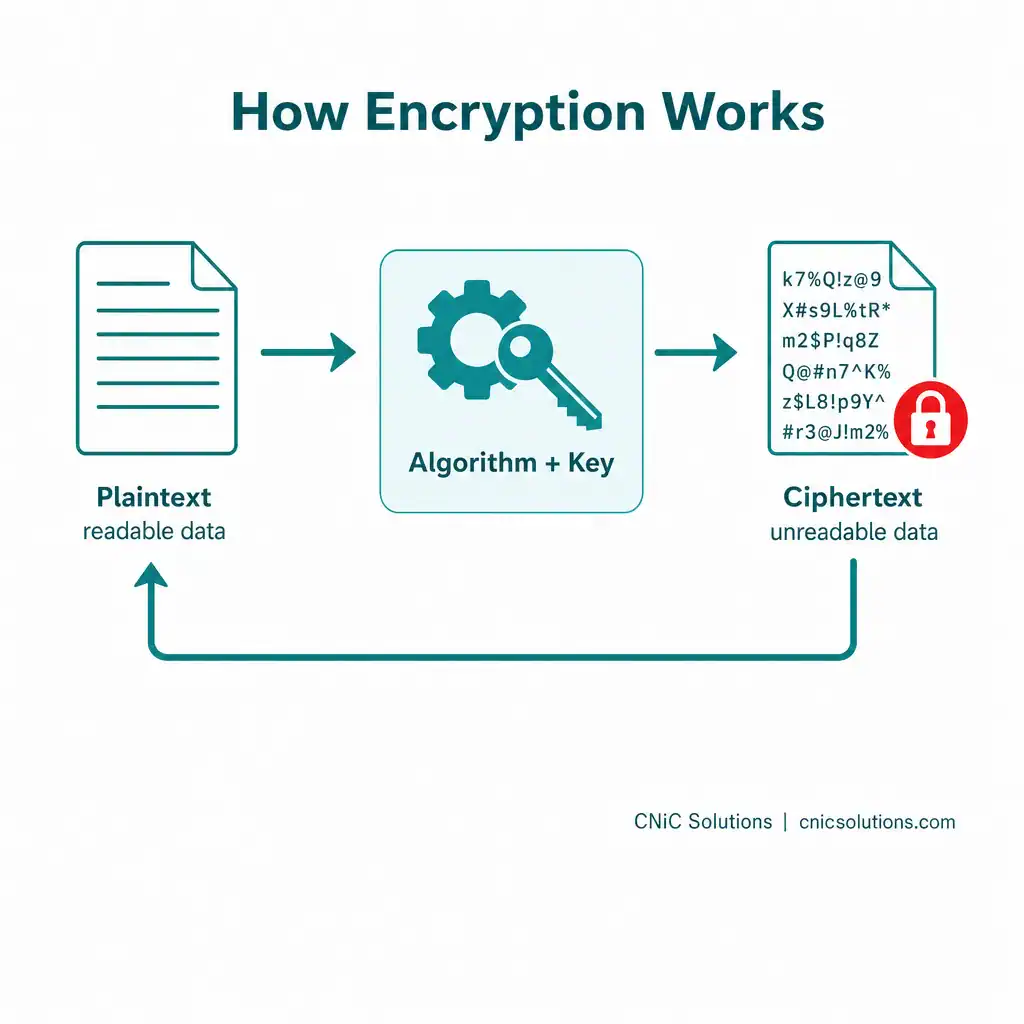
At its core, encryption is a reversible scrambling process built on two ingredients: an algorithm (the mathematical recipe for scrambling) and a key (the secret value that controls how the scrambling happens). Run readable plaintext through the algorithm with a key, and you get ciphertext, an unreadable jumble. Run that ciphertext back through with the correct key, and you recover the original.
A simple analogy: think of encryption like a locked safe. The algorithm is the safe’s locking mechanism, and the key is, well, the key. Anyone can see the safe sitting there, but without the key, its contents are useless to them. The strength comes not from hiding the safe, but from how hard the lock is to pick and how carefully the key is guarded.
That second point is the one businesses most often miss. A military-grade algorithm protects nothing if the key is left taped to the side of the safe. Encryption is only as strong as the secrecy of its keys, which is why key management, covered later, matters as much as the algorithm you choose.
Source: NIST: FIPS 197, Advanced Encryption Standard
The Two Main Types of Encryption
Nearly all encryption falls into one of two categories, distinguished by how they handle keys.
Symmetric Encryption (One Shared Key)
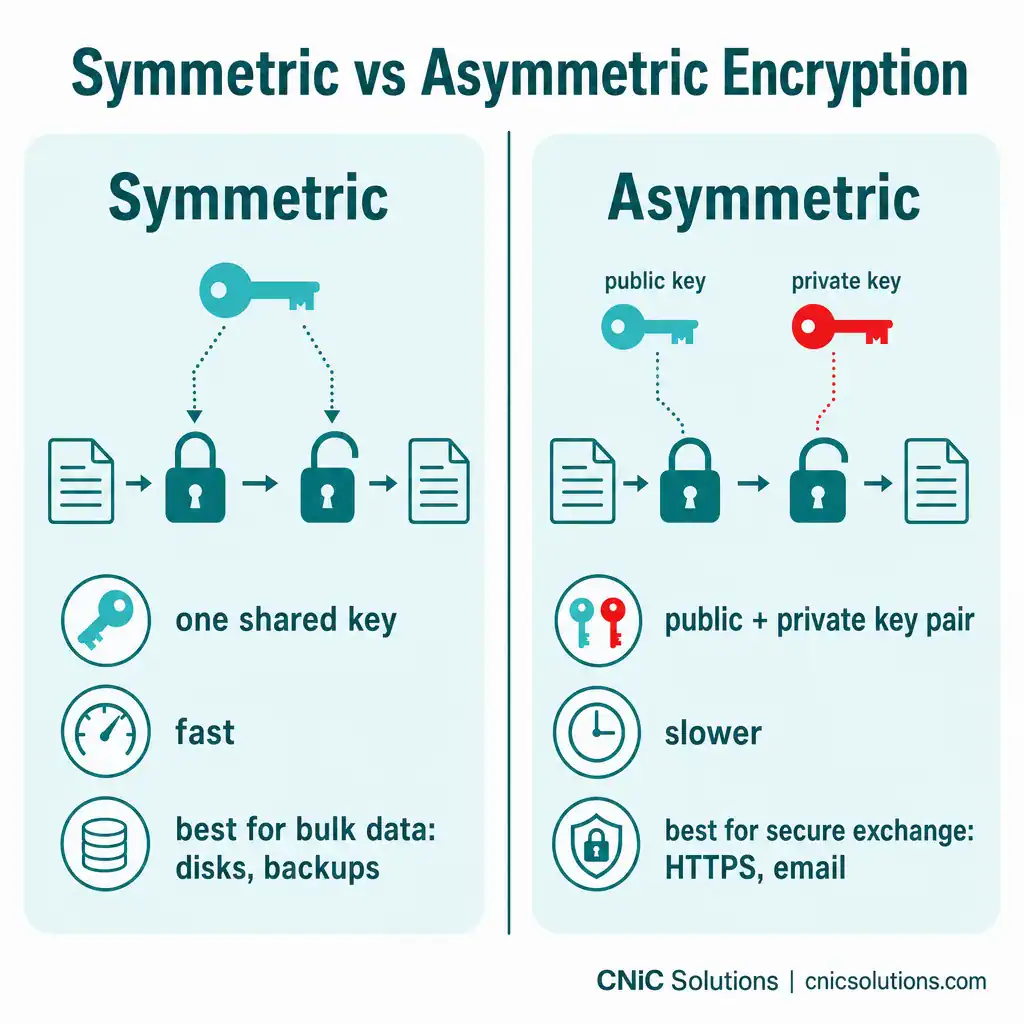
Symmetric encryption uses a single key to both encrypt and decrypt. The same secret locks and unlocks the data. Its advantage is speed: symmetric algorithms are fast and efficient, which makes them ideal for encrypting large volumes of data, such as entire drives, databases, and backups.
The challenge is key distribution. Because both parties need the same secret key, you have to get that key to the other side without anyone intercepting it. For data you are storing yourself (like an encrypted backup), this is a non-issue. For data you are sending to someone else, it becomes the central problem, and that is exactly what asymmetric encryption solves.
Asymmetric Encryption (Public and Private Keys)
Asymmetric encryption, also called public-key encryption, uses a pair of mathematically linked keys: a public key that anyone can use to encrypt, and a private key that only the recipient holds to decrypt. You can share your public key freely; data encrypted with it can only be unlocked by the matching private key you keep secret.
This elegantly solves the key-sharing problem and is the foundation of secure communication on the internet, including the HTTPS connection securing this page. The trade-off is speed: asymmetric encryption is slower and more computationally heavy, so it is typically used to securely exchange a symmetric key, which then does the heavy lifting of encrypting the actual data. This hybrid approach is how most real-world systems work.
Source: NIST: Cryptography
Common Encryption Methods and Algorithms
Within those two types, a handful of named algorithms do most of the work in business environments.
| Algorithm | Type | What it’s used for |
|---|---|---|
| AES (Advanced Encryption Standard) | Symmetric | The global standard for bulk data: disk, database, and backup encryption. AES-256 is the common business benchmark. |
| RSA | Asymmetric | Secure key exchange, digital signatures, and securing data in transit. One of the most widely used public-key systems. |
| ECC (Elliptic Curve Cryptography) | Asymmetric | A modern alternative to RSA that delivers comparable security with smaller keys, common on mobile and resource-limited devices. |
| TLS (Transport Layer Security) | Hybrid protocol | Not an algorithm but a protocol that combines asymmetric and symmetric encryption to secure data moving across networks (the “S” in HTTPS). |
| 3DES (Triple DES) | Symmetric | A legacy standard now being retired in favor of AES. Worth recognizing, but not recommended for new systems. |
The headline name to know is AES. Approved by NIST as Federal Information Processing Standard 197, AES is a symmetric block cipher that encrypts data in 128-bit blocks using keys of 128, 192, or 256 bits. AES-256 is strong enough that the U.S. government approved it to protect classified information up to the SECRET level, which is why “AES-256” has become shorthand for serious encryption in the business world.
Myth: “More bits always means I’m safer.”
Key length matters, but it is not the whole story, and obsessing over it distracts from the real risks. AES-256 is not meaningfully “crackable” by brute force with today’s technology, and neither is AES-128 for most purposes. Breaches almost never happen because someone broke AES. They happen because data was left unencrypted, a key was poorly managed, or a system was misconfigured. Choose a respected standard, then put your energy into covering all your data and protecting your keys.
Source: NIST: FIPS 197, Advanced Encryption Standard (AES)
The Three States: At Rest, In Transit, In Use
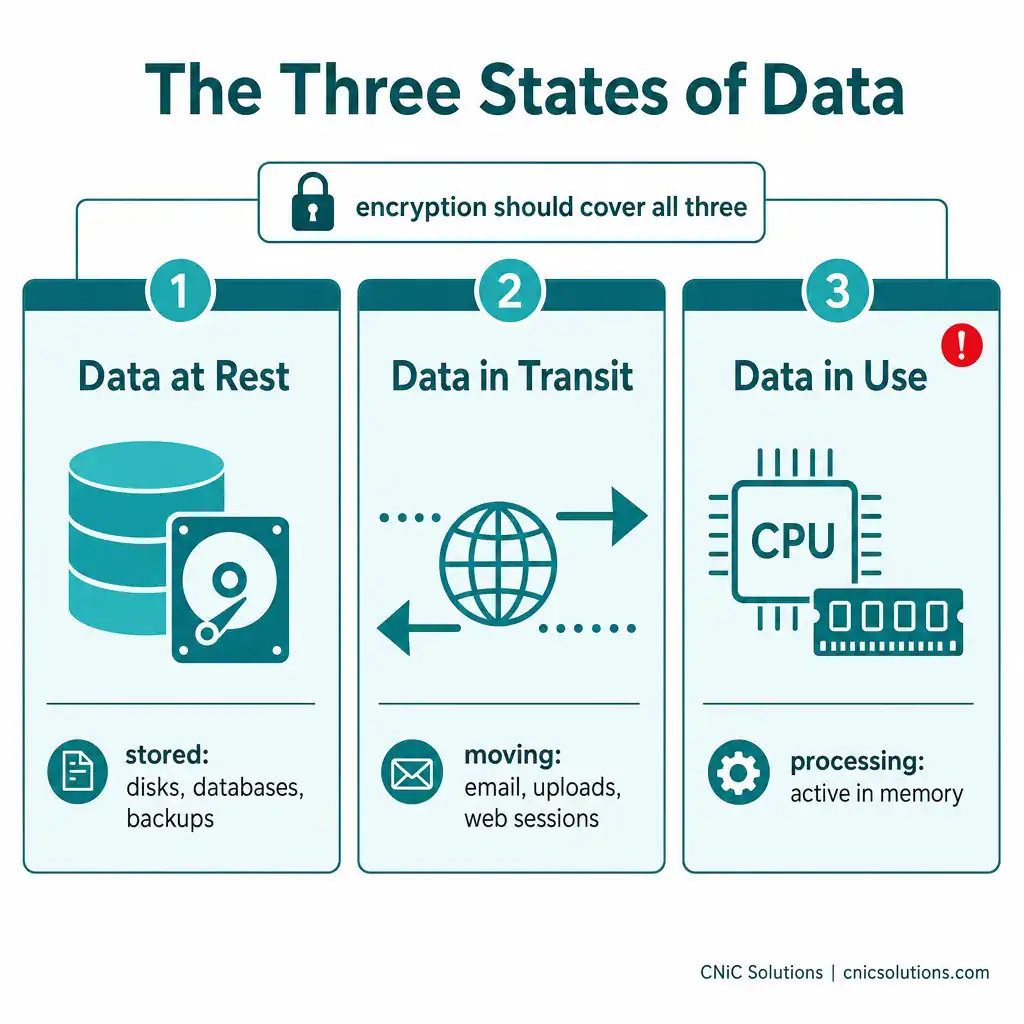
Choosing an algorithm is only half the picture. The more important business question is where your data is protected. Information exists in three states, and a complete strategy addresses all of them.
- Data at rest: information sitting in storage, such as files on a hard drive, records in a database, or a backup archive. Encrypting data at rest means that a stolen laptop, server, or backup drive yields nothing but ciphertext. This is what full-disk and database encryption provide.
- Data in transit: information moving across a network, such as an email being sent, a file being uploaded, or a web session. Encrypting data in transit (typically with TLS or a VPN) means that even if traffic is intercepted, it cannot be read.
- Data in use: information actively being processed in memory by an application. This is the hardest state to protect and the most often overlooked, but it is an area of growing focus as more work moves to the cloud.
A frequent and dangerous mistake is securing one state and assuming the job is done. Encrypting your laptops (at rest) does nothing for sensitive data emailed in plaintext (in transit), and a perfectly encrypted connection does not help if the database on the other end is stored unprotected. Coverage across all three is what actually reduces risk.
Source: CISA: Cybersecurity Best Practices
Why Encryption Matters for Your Business
Beyond the obvious benefit of keeping secrets secret, encryption delivers concrete business value in three areas.
Breach damage control. When a breach happens, encryption is what stands between “attackers accessed our systems” and “attackers accessed our data.” Properly encrypted data that is stolen is often unusable, which can be the difference between a contained incident and a catastrophic, reportable loss.
Regulatory compliance. Frameworks that govern regulated industries, including HIPAA for healthcare, PCI-DSS for payment data, and SOC 2 for service providers, expect encryption as a baseline safeguard for sensitive data. For many businesses, encryption is not optional; it is a documented requirement.
Customer trust. Demonstrating that you protect client data with strong encryption is increasingly a competitive differentiator, especially for businesses that handle financial, legal, or health information. It signals that you take stewardship of their information seriously.
What Your Business Actually Needs
You do not need to become a cryptographer. You need to make sure a short list of practical protections is actually in place and verified. For most small and midsize businesses, that means:
- Full-disk encryption on every device, especially laptops and mobile devices that can be lost or stolen. Built-in tools like BitLocker (Windows) and FileVault (Mac) make this straightforward at scale.
- Encrypted data in transit for all sensitive communication, meaning TLS on your websites and applications, and a VPN for remote workers connecting to internal resources.
- Encrypted backups, so your safety net is not itself a liability. Reputable backup systems encrypt data at rest using AES-256.
- Email encryption for messages containing sensitive or regulated data.
- Disciplined key management, covered below, so the keys protecting all of the above are themselves secure.
- Alignment with your compliance obligations, so your encryption choices satisfy HIPAA, PCI-DSS, or SOC 2 if they apply to you.
The hard part is rarely turning encryption on for one device. It is making sure it is enabled everywhere, configured correctly, kept current as standards evolve, and verified rather than assumed. A single unencrypted laptop or a backup left in plaintext can undo an otherwise solid posture. This is precisely the kind of consistent, fleet-wide oversight that managed IT and cybersecurity services exist to provide: deploying encryption across every device, maintaining it, and proving it holds up under a compliance audit.
Secure your business data with managed cybersecurity
The Part Most Businesses Get Wrong: Key Management
If there is one idea to take away, it is this: encryption is only as strong as the keys that protect it. The strongest algorithm in the world fails instantly if the key is exposed, lost, or poorly controlled.
Strong key management covers how keys are generated, stored, distributed, rotated, and eventually retired. The common failures are mundane but devastating: keys hard-coded into software, stored alongside the data they protect, never rotated, or held by people who should not have them. Lose a key, and you may permanently lose access to your own encrypted data. Expose a key, and the encryption protecting your business becomes decorative.
For a business, this is the strongest argument for treating encryption as a managed discipline rather than a checkbox. Centralized key management, enforced policies, and regular review are what turn encryption from a feature you switched on once into protection you can actually rely on. A Virtual CIO or managed security partner builds this into your overall security strategy rather than leaving it to chance.
Get encryption managed across your entire business
Related Terms
- Plaintext: Readable, unencrypted information before it is scrambled.
- Ciphertext: The scrambled, unreadable output of encryption.
- Encryption key: The secret value that controls encryption and decryption.
- AES-256: A widely used symmetric encryption standard considered strong enough for classified data.
- TLS/SSL: The protocol that encrypts data in transit across the web (the padlock in your browser).
- End-to-end encryption: Encryption where only the communicating parties can read the data, not any intermediary.
- Key management: The practice of securely generating, storing, rotating, and retiring encryption keys.
Frequently Asked Questions
What is data encryption in simple terms?
What is the difference between symmetric and asymmetric encryption?
What is the most secure encryption method?
What does it mean to encrypt data at rest and in transit?
Does my small business really need encryption?
Sources
This explainer anchors its technical claims to primary standards documentation. The AES specification, key lengths, block size, and approval status follow NIST’s Federal Information Processing Standard 197. The classified-data approval level reflects U.S. government policy on AES. The three-states model and business best practices align with CISA cybersecurity guidance. Definitions of symmetric and asymmetric encryption reflect established, standards-based cryptographic concepts.
Primary and authoritative sources: NIST FIPS 197 (AES), NIST Cryptography, CISA Cybersecurity Best Practices.



related posts
What Is a Firmware Update and Why It Matters for Security
October 6, 2026A firmware update is a manufacturer-issued revision to the low-level software built into a device, such…
What Is a Human Firewall? Turning Employees Into Your Best Defense
October 6, 2026A human firewall is the group of employees who, through security awareness and good habits, act…
What Is a Firewall? How It Protects Your Business Network
October 5, 2026A firewall is a network security device or software that monitors incoming and outgoing traffic and…
What Is a Distributed System? How It Works and Why It Matters
October 5, 2026A distributed system is a collection of independent computers, called nodes, that are connected over a…