

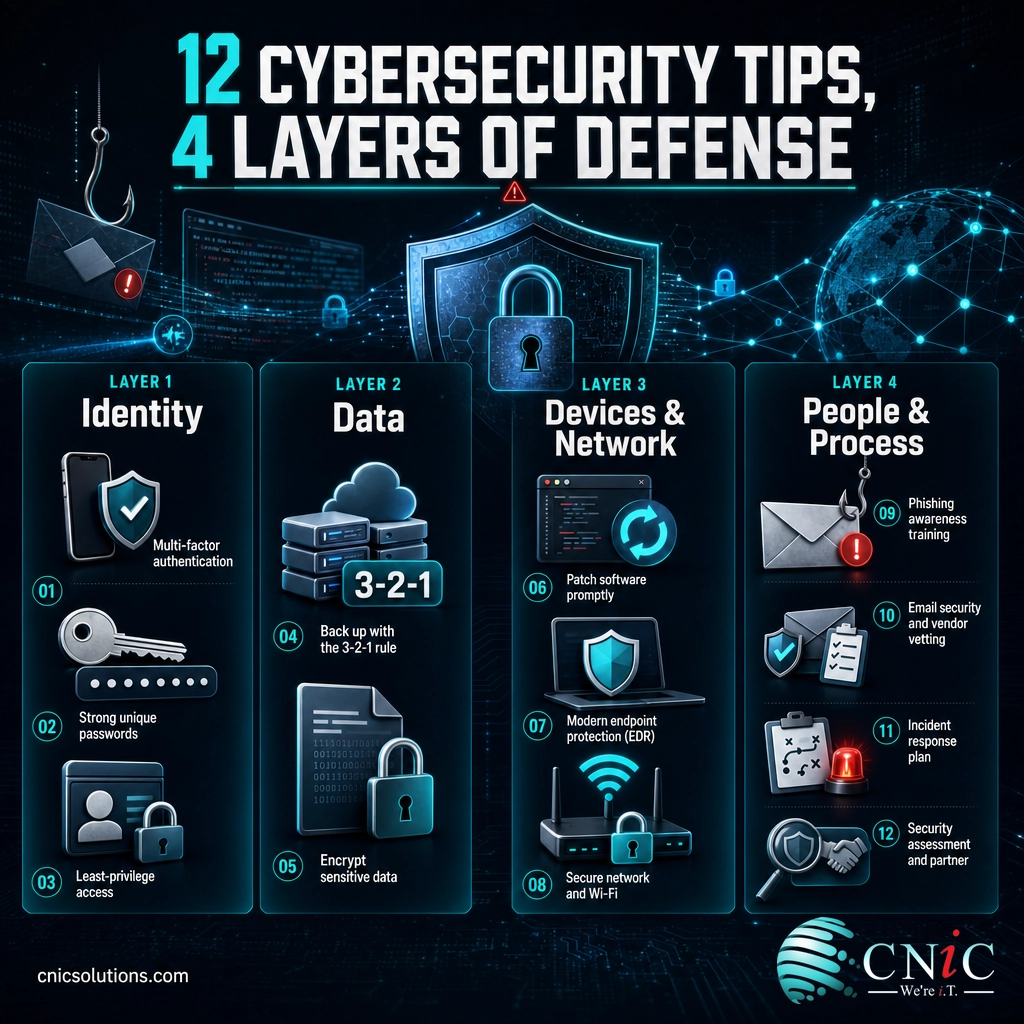
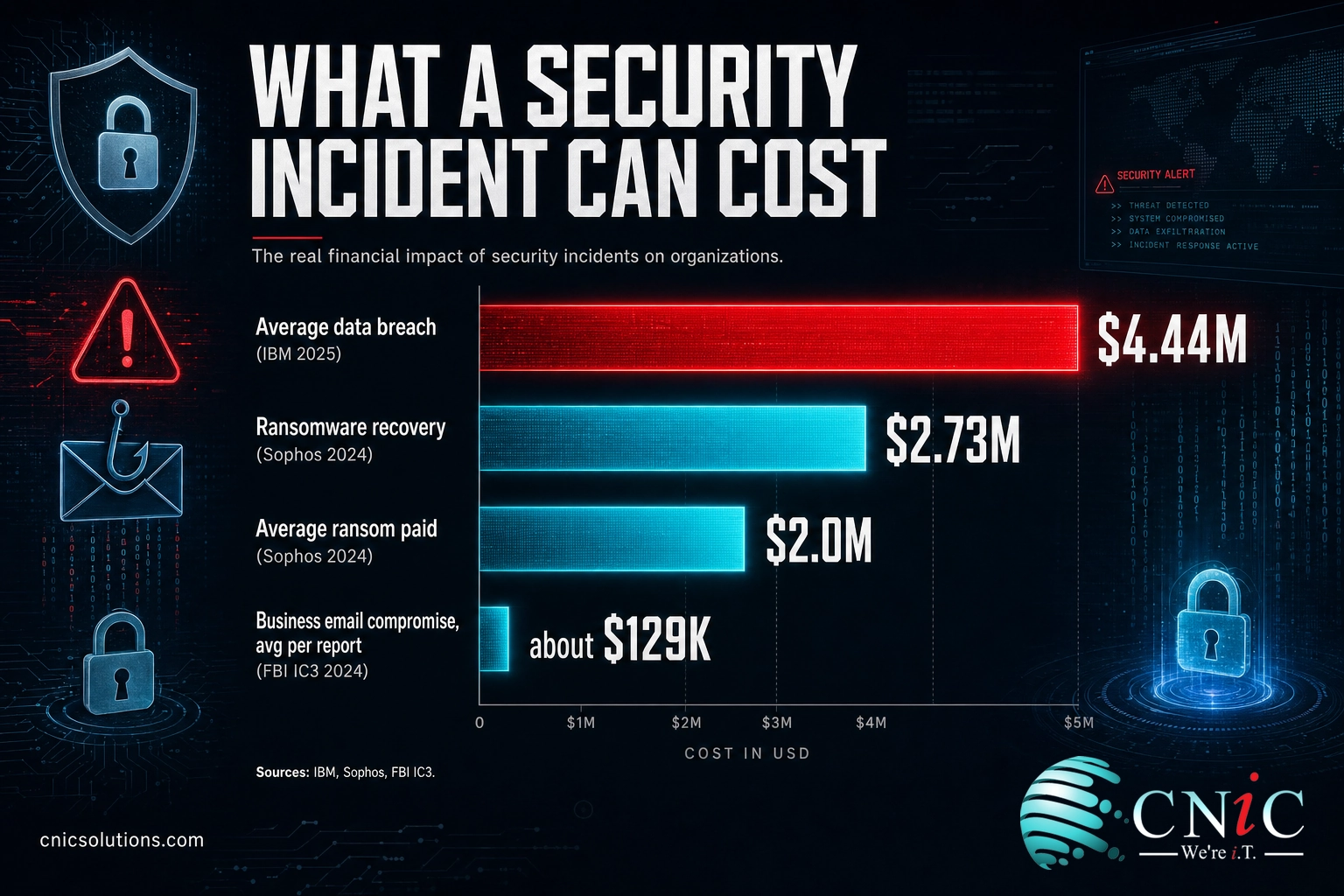
The most effective cybersecurity tips are not exotic tools, they are a handful of well-run basics that close the paths attackers actually use. Roughly 60% of data breaches involve a human element such as a stolen password or a phishing click, according to the Verizon 2025 Data Breach Investigations Report, and the average breach now costs $4.44 million per the IBM 2025 Cost of a Data Breach Report. The good news for business owners is that the same short list of controls blocks the overwhelming majority of attacks, and most of them are affordable or free. Below are 12 cybersecurity tips to protect your business, ordered so you can start with the highest-impact moves first.
Key Takeaways
- Attackers target weak security, not big names. Most breaches exploit common gaps like reused passwords and missing MFA, which puts small and midsize businesses squarely in scope.
- Identity is the front door. Stolen and abused credentials are the number-one way breaches start, so MFA and strong access controls deliver the biggest return.
- People are part of your defense. Since the majority of breaches involve human error, training staff to spot phishing is as important as any software.
- Backups are your ransomware insurance. Tested, offline backups turn a business-ending attack into a bad afternoon.
- Consistency beats spending. A few controls enforced everywhere, every day, outperform expensive tools used inconsistently.
What’s in This Guide
- 1. Turn On Multi-Factor Authentication Everywhere
- 2. Train Your Team to Spot Phishing
- 3. Keep Software and Systems Patched
- 4. Back Up Your Data With the 3-2-1 Rule
- 5. Use Strong, Unique Passwords and a Password Manager
- 6. Protect Every Device With Modern Endpoint Security
- 7. Secure Your Network and Wi-Fi
- 8. Give People Only the Access They Need
- 9. Encrypt Sensitive Data
- 10. Write an Incident Response Plan Before You Need It
- 11. Lock Down Email and Vet Your Vendors
- 12. Get a Security Assessment and a Partner
Put it into action:
1Turn On Multi-Factor Authentication Everywhere
Multi-factor authentication (MFA) requires a second proof of identity, such as a code from an app or a hardware key, on top of a password. It is the single most valuable control most businesses can turn on, because it defeats stolen passwords, which are behind more breaches than anything else.
Why it matters: Credential abuse is the most common way breaches begin, accounting for 22% of them, according to the Verizon 2025 Data Breach Investigations Report. Microsoft has reported that MFA blocks more than 99% of account-compromise attacks, so enabling it neutralizes the exact attack that starts most incidents.
How to start: Turn on MFA first for email, remote access, and any administrator accounts, then extend it to every application that supports it. Prefer an authenticator app or a hardware security key over text-message codes, which can be intercepted. Make MFA mandatory in policy so it cannot be quietly skipped.
Source: Verizon 2025 Data Breach Investigations Report | Microsoft Security
Get a free security assessment for your business
2Train Your Team to Spot Phishing
Your employees decide the outcome of most attacks, because the majority of breaches start with someone being tricked, not a firewall being breached. Regular, practical security awareness training turns your staff from the softest target into an active layer of defense.
Why it matters: About 60% of breaches involve a human element, and phishing remains a leading way attackers gain their first foothold, per the Verizon 2025 DBIR. A single convincing email that harvests a password or delivers malware can undo every technical control you own.
How to start: Run short security awareness training when people are hired and refresh it a few times a year. Send simulated phishing emails so staff practice spotting the real thing, and make it safe and normal to report a suspicious message. Teach the classic red flags: urgency, unexpected attachments, requests to change payment details, and links that do not match the sender.
The myth of the “obvious” phishing email
Many owners assume their team would never fall for a scam. Modern phishing is well written, brand-accurate, and often personalized using public information, and attackers increasingly use AI to remove the old spelling-and-grammar tells. Assuming your staff can spot every attempt on instinct is exactly the gap attackers count on. Practice, not confidence, is what builds real resilience.
Source: Verizon 2025 Data Breach Investigations Report | CISA Secure Our World
3Keep Software and Systems Patched
Every piece of unpatched software is a known, published door into your business. Attackers scan the internet for systems missing security updates, so keeping software current is one of the most reliable ways to stay out of reach.
Why it matters: Exploiting an unpatched vulnerability was the initial access route in 20% of breaches, a 34% jump over the prior year, according to the Verizon 2025 DBIR. Once a fix is public, the clock starts, and businesses that patch slowly are the ones that get caught.
How to start: Turn on automatic updates for operating systems, browsers, and applications wherever you safely can. Keep an inventory of your hardware and software so nothing is forgotten, and prioritize anything internet-facing. Replace end-of-life systems that no longer receive security updates, since those cannot be patched at all.
Source: Verizon 2025 Data Breach Investigations Report | CISA Known Exploited Vulnerabilities Catalog
4Back Up Your Data With the 3-2-1 Rule
Backups are the control that decides whether ransomware is a catastrophe or an inconvenience. If you can restore clean copies of your data, an attacker’s main source of pressure largely disappears. The widely used 3-2-1 rule is a simple target to aim for.
Why it matters: The average cost to recover from a ransomware attack reached $2.73 million in 2024, separate from any ransom paid, according to Sophos. Businesses without reliable backups often face the impossible choice of paying criminals or losing their data permanently.
How to start: Follow the 3-2-1 rule: keep at least three copies of your data, on two different types of media, with one copy stored offline or off-site where ransomware cannot reach it. Automate backups so they never depend on someone remembering, and, most importantly, test a restore regularly. An untested backup is only a hope, not a safeguard.
Source: Sophos State of Ransomware 2024 | CISA StopRansomware
Set up backup and disaster recovery that actually restores
5Use Strong, Unique Passwords and a Password Manager
Passwords are still the foundation of most accounts, and reused or weak passwords are a gift to attackers. When one service is breached, criminals try those same credentials everywhere else, a tactic that succeeds only because people reuse passwords.
Why it matters: Because stolen credentials drive so many breaches, a single reused password can cascade across your email, banking, and business systems. Length and uniqueness matter far more than forcing frequent, complicated changes that people work around.
How to start: Give every employee a business password manager so each account gets a long, unique, randomly generated password nobody has to memorize. Follow modern guidance from NIST that favors longer passphrases over constant forced resets, and combine strong passwords with the MFA from tip one. Never allow shared logins, so every action can be traced to a person.
Source: NIST Digital Identity Guidelines (SP 800-63B)
6Protect Every Device With Modern Endpoint Security
Every laptop, desktop, phone, and server is a potential entry point, and traditional antivirus alone no longer keeps pace with modern threats. Endpoint detection and response (EDR) watches for suspicious behavior, not just known malware signatures, and can contain a threat before it spreads.
Why it matters: Attacks often slip past signature-based antivirus by using legitimate tools or brand-new malware. Behavior-based endpoint protection catches the activity that older tools miss, and it gives you the ability to isolate a compromised machine quickly. If you are weighing your options, see our comparison of EDR versus traditional antivirus to understand which fits your business.
How to start: Deploy reputable endpoint protection on every device that touches business data, including mobile phones, and keep it updated automatically. Turn on features that isolate a device when a threat is detected, and make sure someone actually reviews the alerts. Maintain an inventory so no device is left unprotected, including personal devices if you allow them.
Source: CISA Cross-Sector Cybersecurity Performance Goals
How Breaches Start: Top Initial Access Vectors (2025)
Share of data breaches by initial access vector. Source: Verizon 2025 Data Breach Investigations Report.
7Secure Your Network and Wi-Fi
Your network is the perimeter around everything else, and the devices that guard it, firewalls, VPNs, and routers, have become prime targets themselves. A poorly configured network gives attackers room to move once they are inside.
Why it matters: Among breaches that started by exploiting a vulnerability, 22% targeted edge devices such as firewalls and VPN gateways, an eightfold increase over the prior year, according to the Verizon 2025 DBIR. The equipment meant to protect you is now squarely in the crosshairs.
How to start: Change default passwords on all network hardware and keep its firmware patched. Encrypt and hide your business Wi-Fi, and put guests and untrusted devices on a separate network segment. Use a business-grade firewall, and give remote staff a secure VPN or zero-trust access rather than exposing internal systems directly to the internet.
Source: Verizon 2025 Data Breach Investigations Report | CISA Secure Our World
Design a secure, segmented network for your office
8Give People Only the Access They Need
The principle of least privilege means every person and system gets only the access their role genuinely requires, and nothing more. It limits the blast radius: if one account is compromised, the attacker inherits only that account’s limited reach.
Why it matters: Over-permissioned accounts and forgotten logins from former employees are a recurring cause of serious breaches. When everyone has administrator rights, a single stolen password can expose the entire business rather than one small corner of it.
How to start: Review who can access what, and remove anything that is not needed for someone’s job. Revoke access the same day an employee leaves or changes roles, keep administrator accounts to a strict minimum, and use separate accounts for administrative work. Re-check access on a regular schedule rather than letting permissions quietly pile up.
The account nobody remembered to close
One of the most common findings in real security reviews is an active account belonging to someone who left months ago, still holding access to email or files. Offboarding is a security control, not just an HR task. Build a checklist that revokes every credential the moment someone departs.
Source: CISA Cross-Sector Cybersecurity Performance Goals
9Encrypt Sensitive Data
Encryption scrambles your data so it is useless to anyone without the key. It protects information both where it is stored and while it travels, so a lost laptop or intercepted connection does not become a breach.
Why it matters: A stolen or misplaced device is only a hardware loss if the data on it is encrypted. Without encryption, that same device becomes a full-blown data breach, complete with notification obligations and potential penalties for regulated data.
How to start: Turn on full-disk encryption on every laptop and phone using built-in tools like BitLocker or FileVault. Require encrypted connections (HTTPS and a VPN) for data in transit, and encrypt sensitive files and email that contain regulated or confidential information. For a deeper look at how it works and what your business needs, read our explainer on how data encryption protects your business.
Source: NIST Cybersecurity resources
10Write an Incident Response Plan Before You Need It
Sooner or later, something will go wrong, and the businesses that recover fastest are the ones that decided what to do in advance. An incident response plan is a simple, written playbook for who does what when an attack hits.
Why it matters: Reported cybercrime losses hit a record $16.6 billion in 2024, a 33% increase over the prior year, according to the FBI’s Internet Crime Complaint Center. In the chaos of an active incident, a plan is the difference between a coordinated response and a costly scramble.
How to start: Write down the steps for containment, investigation, notification, and recovery, and name who is responsible for each. Include emergency contacts, your cyber-insurance details, and any legal breach-notification timelines that apply to you. Rehearse the plan with a tabletop exercise at least once a year, because a plan nobody has practiced rarely works under pressure.
Source: FBI IC3 2024 Internet Crime Report
Let a managed IT team monitor and respond around the clock
11Lock Down Email and Vet Your Vendors
Email is both your most important business tool and your most exploited one. Business email compromise (BEC), where an attacker impersonates an executive or a supplier to redirect a payment, is one of the costliest scams in existence, and your vendors’ security is now part of your own risk.
Why it matters: BEC alone drained $2.77 billion from businesses in 2024, according to the FBI IC3. These attacks rarely involve malware at all: they exploit trust, routine, and a rushed approval, which is what makes verification habits so powerful.
How to start: Configure email authentication (SPF, DKIM, and DMARC) so attackers cannot easily spoof your domain, and turn on advanced email filtering. Create a firm rule that any change to payment or banking details is verified by phone using a known number, never by email reply. Review the security of the vendors and cloud services that touch your data, since a breach at a supplier can quickly become yours.
Source: FBI IC3 2024 Internet Crime Report | CISA Secure Our World
12Get a Security Assessment and a Partner
You cannot protect what you have not measured. A security assessment shows you exactly where your gaps are, so your effort and budget go where they reduce the most risk, rather than being spread thin on guesswork.
Why it matters: With the average data breach costing $4.44 million, per IBM, the return on getting security right is enormous, and the cost of doing it piecemeal is high. Most small and midsize businesses do not have the time or in-house depth to keep every control enforced, patched, monitored, and documented around the clock, which is exactly the work that slips.
How to start: Get a professional security assessment to benchmark where you stand against these controls and find the gaps you cannot see from the inside. Decide honestly what your team can maintain versus what should be handled by a managed IT and security provider. A good partner keeps the whole program running continuously, so security is a steady operation rather than an annual scramble.
Source: IBM 2025 Cost of a Data Breach Report
How to Prioritize These Tips
You do not have to do all twelve at once, and you should not try. Some controls deliver far more protection per hour invested than others. Use the matrix below to sequence the work by impact and effort, then knock out the highest-impact, lowest-difficulty items first.
| Tip | Priority | Difficulty | Impact |
|---|---|---|---|
| 1. Multi-factor authentication | Critical | Low | Very High |
| 4. Backups (3-2-1, tested) | Critical | Low-Medium | Very High |
| 3. Patch software promptly | Critical | Low | High |
| 2. Phishing awareness training | Critical | Low | High |
| 5. Password manager, unique passwords | High | Low | High |
| 6. Modern endpoint protection (EDR) | High | Medium | High |
| 8. Least-privilege access | High | Medium | High |
| 7. Secure network and Wi-Fi | High | Medium | High |
| 11. Email authentication, vendor checks | High | Medium | High |
| 9. Encrypt sensitive data | Medium | Low-Medium | Medium-High |
| 10. Incident response plan | Medium | Medium | High (when needed) |
| 12. Security assessment and partner | Ongoing | Low | Very High |
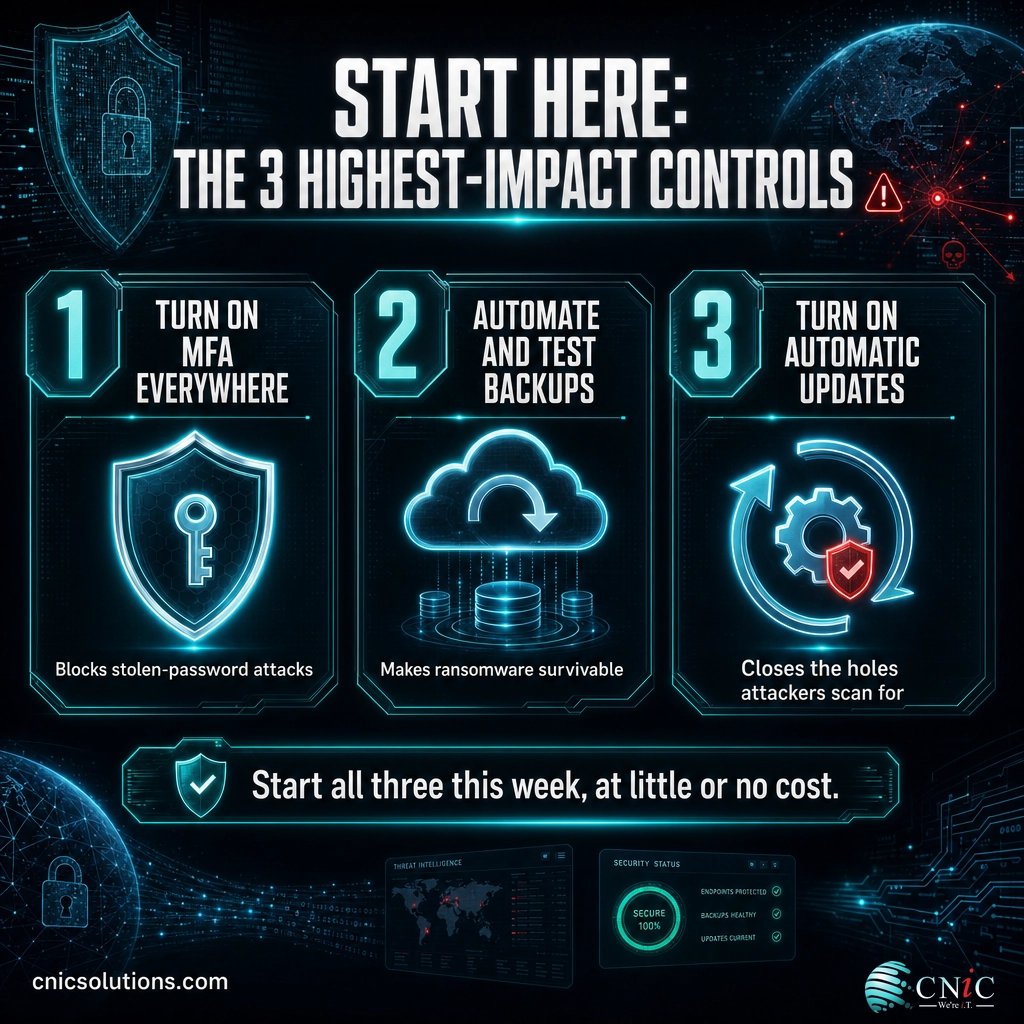
If you only do three things from this list, do these: turn on MFA everywhere, get automatic backups running and test a restore, and enable automatic updates so software stays patched. Those three controls close the attack paths behind the clear majority of breaches, and you can start all three this week at little or no cost.
Quick-Reference Summary Table
Here is the full list at a glance, with the core reason each tip earns its place and a rough sense of the effort involved.
| # | Cybersecurity Tip | Why It Matters | Difficulty |
|---|---|---|---|
| 1 | Multi-factor authentication | Blocks the stolen-credential attacks behind most breaches | Low |
| 2 | Phishing awareness training | Most breaches involve human error; people are your first line | Low |
| 3 | Patch software and systems | Closes the known holes attackers actively scan for | Low |
| 4 | Back up with the 3-2-1 rule | Turns ransomware from disaster into recovery | Low-Medium |
| 5 | Strong, unique passwords | Stops one leak from unlocking every account | Low |
| 6 | Modern endpoint protection | Catches threats that slip past basic antivirus | Medium |
| 7 | Secure network and Wi-Fi | Protects the perimeter devices now under heavy attack | Medium |
| 8 | Least-privilege access | Limits the damage any one compromised account can do | Medium |
| 9 | Encrypt sensitive data | Makes a lost device a non-event instead of a breach | Low-Medium |
| 10 | Incident response plan | Speeds recovery and cuts the cost of an attack | Medium |
| 11 | Email security and vendor vetting | Defends against costly BEC and supply-chain risk | Medium |
| 12 | Security assessment and partner | Finds the gaps you cannot see and keeps controls running | Low |
Working through these cybersecurity tips is well within reach for any business, but the hard part is not turning the controls on, it is keeping every one of them enforced, updated, monitored, and documented month after month. That ongoing discipline is precisely what a managed IT and security partner provides: patching your systems, watching for threats, verifying your backups restore, and standing ready when something goes wrong. If security has become one more thing that never quite gets done, that is the signal it should be managed rather than left to chance.
Build a security roadmap with a Virtual CIO
Frequently Asked Questions
What is the single most important cybersecurity tip for a business?
How much does a cyberattack actually cost a business?
Do small businesses really need to worry about cyberattacks?
What should a business do first if it has no formal cybersecurity in place?
Is it better to handle cybersecurity in-house or hire an IT provider?
A Note on Sources
The statistics in this article come from primary industry and government sources: the Verizon 2025 Data Breach Investigations Report (human element, initial access vectors, edge-device targeting), the IBM 2025 Cost of a Data Breach Report (average breach cost), the Sophos State of Ransomware 2024 (recovery cost), the FBI IC3 2024 Internet Crime Report (total and BEC losses), and Microsoft Security (MFA effectiveness). Implementation guidance aligns with the CISA and NIST cybersecurity frameworks.



related posts
What Is IT Monitoring? A Guide for Businesses
October 23, 2026IT monitoring is the continuous practice of collecting and analyzing data from a business's technology, its…
What Is Log Analysis? How It Works and Why It Matters
October 23, 2026Log analysis is the practice of reviewing and interpreting the log files that computers, applications, and…
What Is IT Asset Management (ITAM)? A Guide for Businesses
October 22, 2026IT asset management (ITAM) is the practice of tracking and managing an organization's hardware, software, and…
What Is ISO 27001? A Guide to the Information Security Standard
October 22, 2026ISO 27001 is the world's best-known standard for managing information security, and increasingly the certification customers…