

Cyber safety is the everyday habits and precautions people use to protect themselves, their information, and their employer’s systems while working online. It focuses on human behavior: spotting scams, using strong logins, and handling data carefully. Cybersecurity is the technology that defends systems; cyber safety is how people use it responsibly. Both are needed to keep a business protected.
Most people picture firewalls and antivirus software when they think about staying protected online. Those tools matter, but they are only half of the picture. The other half is human: the split-second decision to click a link, reuse a password, or trust a message that looks like it came from the boss. That human side has a name, cyber safety, and at work it is often the difference between a normal Tuesday and a costly breach. This guide explains what cyber safety is, how it differs from cybersecurity (the distinction that trips up a lot of teams), why it matters so much in a business setting, and the practical habits that keep employees and company data safe online.
Key Takeaways
- Cyber safety is about people, not just technology. It is the behavior and awareness that keep employees from being tricked or making costly mistakes.
- Cyber safety and cybersecurity are not the same. Cybersecurity defends the systems; cyber safety governs how people use them. A business needs both.
- Attacks target humans first. Phishing and spoofing were the most-reported cybercrime type to the FBI in 2024, with 193,407 complaints.
- A handful of habits cover most of the risk: strong logins with MFA, thinking before clicking, securing devices, safe networks, careful data handling, and fast reporting.
- It is a shared responsibility. Attackers only need one person to slip, so cyber safety belongs to everyone, not only the IT department.
What’s in This Guide
What Cyber Safety Is
Cyber safety, sometimes called online safety or internet safety, is the set of everyday practices that keep people secure while they use connected devices and the internet. In a workplace, that means protecting three things at once: yourself, your personal information, and the systems and data that belong to your employer.
The key idea is that cyber safety lives in behavior. It is the pause before you open an attachment, the choice to use a password manager instead of “Company2026!”, the instinct to verify an unexpected wire request by phone. Technology can block a lot, but it cannot make those judgment calls for you. Public-awareness programs like CISA’s Secure Our World guidance exist precisely because so much of staying safe online comes down to a few consistent human habits rather than any single product.
At work, the stakes are higher than they are at home. A mistake on a personal account might expose one person. The same mistake on a work account can expose customer records, financial systems, and every colleague’s data at once. That is why cyber safety is not a nice-to-have for businesses; it is a core part of keeping the whole operation running.
Cyber Safety vs Cybersecurity
This is the single most common point of confusion, and getting it straight makes everything else clearer. People often use “cyber safety” and “cybersecurity” as if they mean the same thing. They are closely related, but they are not identical.
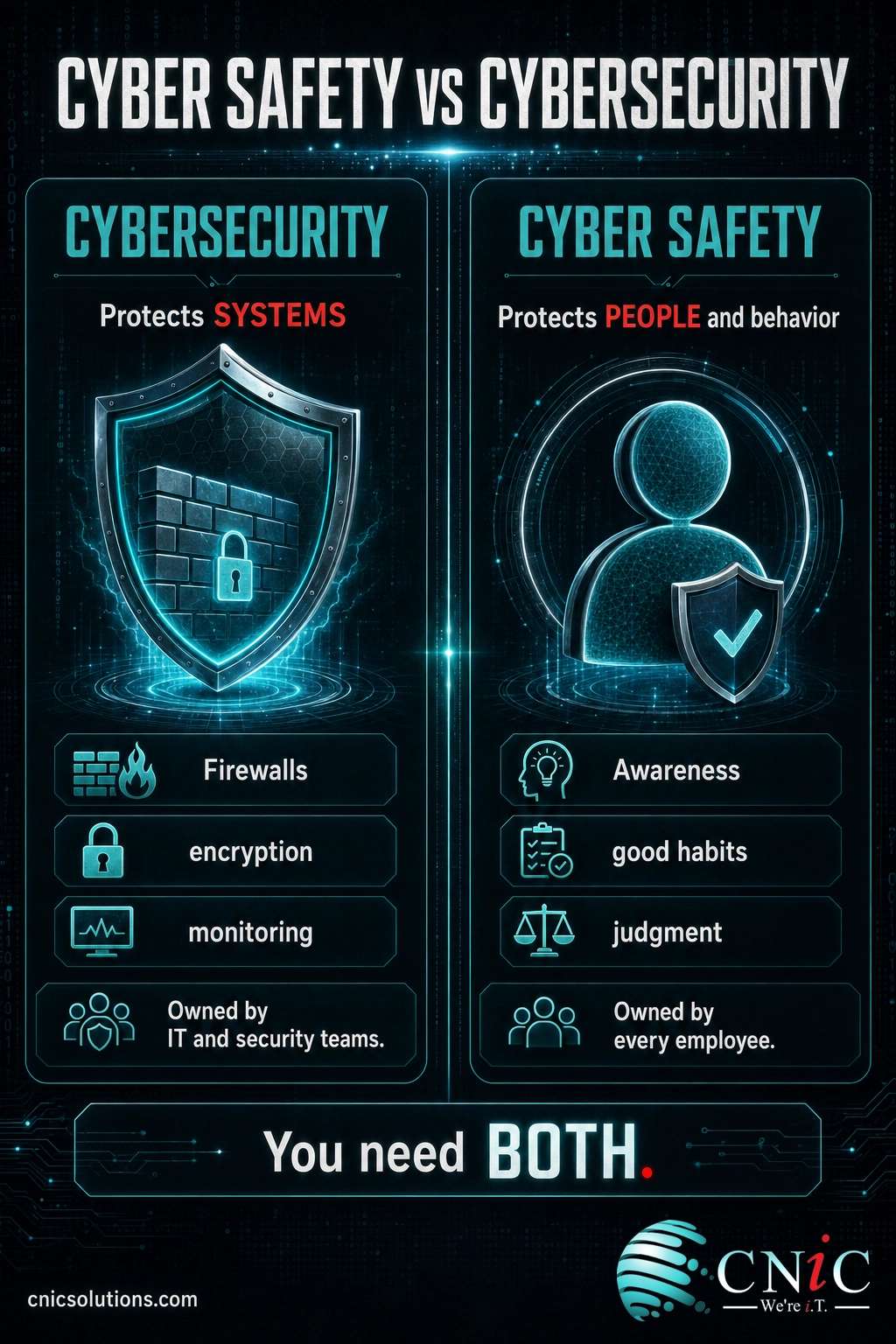
Cybersecurity is the technology, tools, and processes that defend systems and data: firewalls, encryption, endpoint protection, patching, monitoring, and access controls. It is largely built and managed by IT and security professionals. Cyber safety is the human layer that sits on top of all that: the awareness and daily behavior that determine whether those defenses actually hold up when a real attack arrives.
| Cybersecurity | Cyber Safety | |
|---|---|---|
| Focus | Systems and technology | People and behavior |
| What it protects | Networks, servers, data, devices | The person using them and the data they touch |
| Main tools | Firewalls, encryption, monitoring, access controls | Awareness, good habits, judgment, training |
| Who owns it | IT and security teams | Every employee, every day |
| Example | A spam filter blocks a malicious email | An employee spots and reports the one that slipped through |
In short, cybersecurity defends the systems, and cyber safety governs how people use them. The two work as a pair. The strongest technical defenses in the world can be undone by one person clicking the wrong link, and the most careful employee is still exposed if the underlying systems are not secured. A healthy business invests in both, which is exactly what a well-run managed cybersecurity program is designed to deliver.
Why Cyber Safety Matters at Work
The reason cyber safety deserves real attention is simple: modern attacks are aimed at people. Rather than breaking through hardened technical defenses, most attackers find it far easier to trick a human into opening the door for them. The numbers make the point.
Phishing sits at the top of that list for a reason: it targets behavior, not code. A convincing email, text, or phone call asks a person to click, log in, or pay, and no firewall can fully stop a legitimate-looking request that a real employee chooses to act on. Verizon’s annual Data Breach Investigations Report has repeatedly found that the human element, meaning people being deceived, making errors, or misusing access, is involved in a majority of breaches. In other words, the weakest point in most organizations is not the technology. It is the moment a busy person makes a fast decision.
For a business, the consequences of that moment ripple outward: stolen funds, exposed customer data, regulatory penalties in fields like healthcare or finance, downtime, and lasting damage to reputation and trust. This is why employee cyber safety is not a soft topic. It is a direct, measurable form of risk management. If you want the deeper data behind the threat, our latest phishing statistics break down how these attacks are trending.
Source: FBI IC3 2024 Internet Crime Report | CISA Secure Our World
How to Stay Safe Online at Work
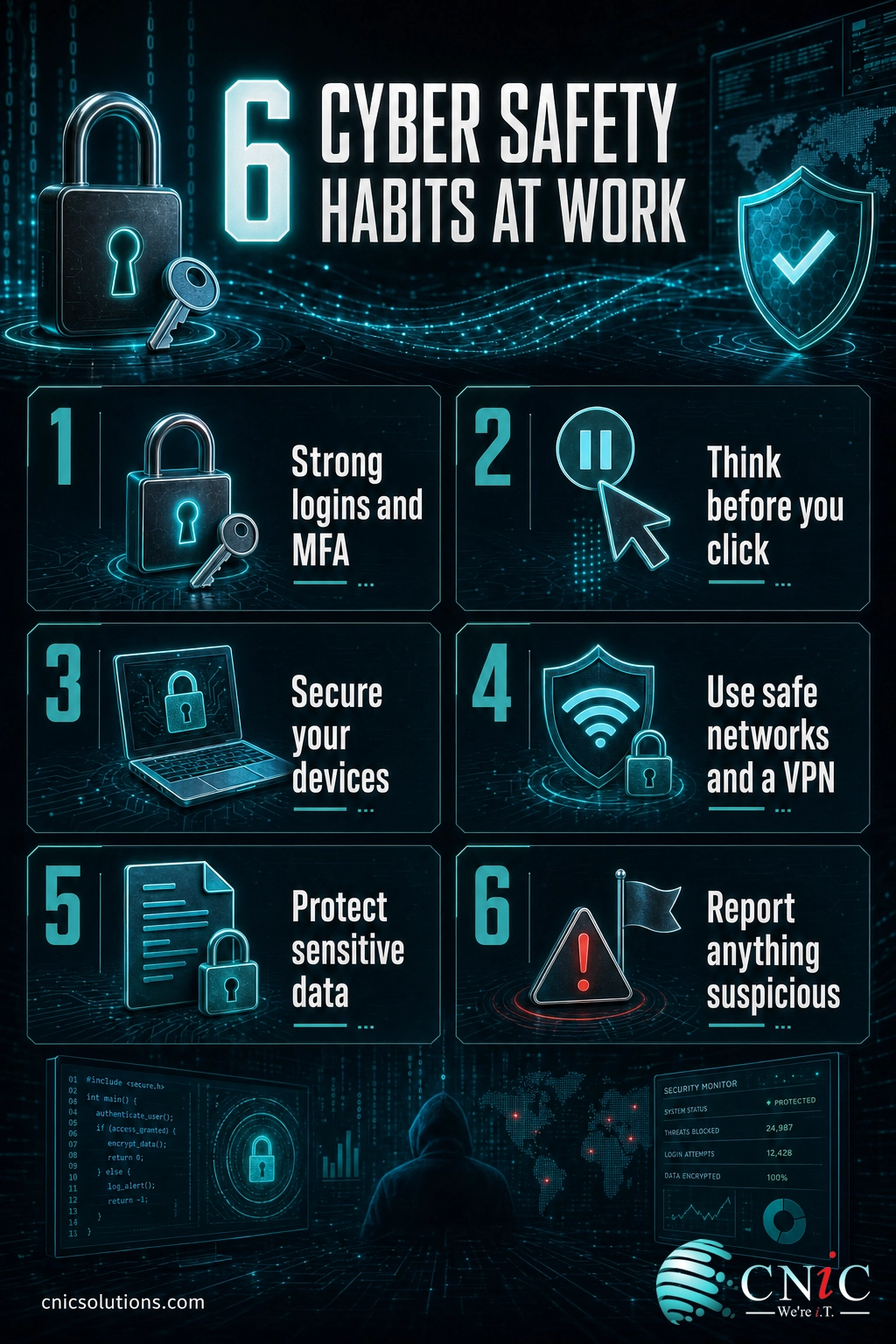
Good cyber safety is not about memorizing hundreds of rules. A short list of consistent habits covers the large majority of real-world risk. Here are the ones that matter most in a work setting.
1. Use strong, unique logins and multi-factor authentication
Passwords are still the front door to most work accounts. Use long, unique passwords for every account, ideally generated and stored in a password manager so no one is reusing “Summer2026” across a dozen systems. Just as important, turn on multi-factor authentication (MFA) wherever it is offered. MFA adds a second check, such as a code or an app approval, so a stolen password alone is not enough to get in. It is one of the highest-impact habits on this list.
2. Think before you click
Most attacks begin with a message. Before clicking a link or opening an attachment, slow down and check: Do you actually know the sender? Does the request make sense? Hover over links to see where they really lead before clicking. Be especially wary of urgency (“act now or your account will be closed”) and of unexpected requests to log in, change payment details, or buy gift cards. When something feels off, verify it through a separate channel. Learning to recognize the warning signs of a phishing email is one of the most valuable cyber safety skills any employee can build.
3. Secure your devices
Keep work laptops, phones, and tablets updated, since software updates patch the security holes attackers exploit. Lock your screen whenever you step away, use antivirus or endpoint protection, and never leave devices unattended in public. Physical access is a real threat too: an unlocked laptop or an unattended badge can be as dangerous as a weak password.
4. Be careful on networks
Public Wi-Fi in airports, hotels, and coffee shops is convenient and risky, because others on the same network may be able to intercept your activity. Avoid logging into sensitive work accounts on unsecured public Wi-Fi, and use a company VPN when working remotely so your connection is encrypted. Treat any network you do not control as untrusted.
5. Protect sensitive data
Handle customer records, financial details, and confidential files with care. Share them only through approved, secure channels, avoid sending sensitive information over personal email or messaging apps, and follow your company’s rules for storing and disposing of data. If your business handles regulated information under frameworks like HIPAA or PCI-DSS, careful data handling is not just good practice, it is a compliance requirement.
6. Report anything suspicious, fast
If you notice something wrong, an odd email, a device acting strangely, a login alert you did not trigger, report it to IT immediately. Fast reporting is a superpower in cyber safety: the sooner a potential incident is flagged, the smaller the damage. Employees should never feel embarrassed to report a mistake. A clicked link reported in five minutes is a manageable problem; the same link hidden for a week can become a crisis.
The Myth: “Cyber Safety Is IT’s Job, Not Mine”
It is tempting to assume that the IT department has everything covered, so individual employees do not need to worry. That belief is exactly what attackers count on. IT builds and maintains the defenses, but no team can click “verify” on your behalf when a spoofed email lands in your inbox. Attackers only need one person, on one day, to slip. That makes every employee a genuine part of the defense, which is why cyber safety is a shared responsibility rather than a task you can fully delegate.
Cyber Safety Is Everyone’s Job
Because attacks target people, cyber safety cannot live in a single department. The front desk, the sales team, remote staff, and the executive suite are all potential entry points, and attackers deliberately probe every one of them. Executives are frequent targets of tailored scams because they have authority and access, while newer or busier employees may be easier to rush into a mistake.
The practical upshot is that good cyber safety becomes part of a company’s culture, not a one-time training video. That includes simple norms everyone follows: verifying unusual requests, not holding secure doors open for unknown people (a tactic known as tailgating), and treating security as a normal, expected part of the workday rather than an interruption. When safe behavior is the default, the whole organization gets harder to attack.
Building Cyber Safety Into Your Business
Turning cyber safety from a hope into a habit takes a bit of structure. A few building blocks make the biggest difference:
- Ongoing awareness training: Short, regular refreshers keep threats top of mind and teach people to recognize the latest scams. One session a year is not enough when tactics change monthly.
- Clear, simple policies: Employees follow rules they understand. Spell out expectations for passwords, devices, data handling, and reporting in plain language.
- The right technical foundation: Human habits work best on top of solid defenses, MFA, endpoint protection, patching, and monitoring, so a single mistake is less likely to be catastrophic.
- An easy way to report: Make it fast and blame-free for anyone to flag something suspicious, so problems surface early.
If your team does not have the time or in-house expertise to run all of that, this is where a managed IT and security partner earns its keep. CNiC Solutions helps small and midsize businesses put these pieces in place, from employee awareness and phishing simulations to the underlying technical controls, through professional cybersecurity services. It is also worth strengthening the fundamentals in parallel; our guide on mastering the cybersecurity basics and the essential security measures every small business should implement pair naturally with the human habits covered here.
Get a free security assessment from CNiC Solutions
For businesses weighing how cyber safety fits into a broader technology and risk strategy, our managed IT services tie security awareness, day-to-day support, and long-term planning together under one roof.
Frequently Asked Questions
What is cyber safety?
What is the difference between cyber safety and cybersecurity?
Why is cyber safety important at work?
What are the basic rules of cyber safety at work?
Whose responsibility is cyber safety?
Related Terms
- Cybersecurity: The technology, tools, and processes that defend systems, networks, and data from attack, the technical counterpart to cyber safety.
- Phishing: A scam that uses fake emails, texts, or calls to trick people into revealing information, clicking malicious links, or sending money.
- Multi-factor authentication (MFA): A login method that requires a second proof of identity, like a code or app approval, so a stolen password alone cannot grant access.
- Tailgating: A physical social-engineering tactic where an unauthorized person follows an employee through a secure door.
- Endpoint protection: Security software on laptops, phones, and other devices that detects and blocks threats at the point where people actually work.
- Security awareness training: Ongoing education that teaches employees to recognize and respond to threats, the structured way businesses build cyber safety habits.
About This Guide and Sources
The definitions in this guide, including the distinction between cyber safety (human behavior and awareness) and cybersecurity (technical systems and defenses), reflect standard, widely consistent characterizations used across the security-awareness field, including public guidance from CISA’s Secure Our World program and the National Cybersecurity Alliance. The statistics cited are drawn from the FBI Internet Crime Complaint Center (IC3) 2024 Internet Crime Report: total reported losses of 16.6 billion dollars (a record, up 33 percent from 2023), 859,532 total complaints, and 193,407 phishing and spoofing complaints, the most-reported crime type by victim count. The characterization of the human element in breaches reflects the general, repeated findings of Verizon’s annual Data Breach Investigations Report; specific year-over-year percentages vary by report edition and are not cited as a single figure here. Businesses should treat the habits described as a starting framework and adapt them to their own systems, industry, and compliance obligations.



related posts
What Is Cybersecurity? A Business Guide
October 16, 2026Cybersecurity is the practice of protecting computers, networks, data, and accounts from digital attacks and unauthorized…
What Is Containerization? Benefits and How It Works
October 15, 2026Containerization is a form of operating system virtualization that packages an application together with everything it…
What Is Cloud Security Posture Management (CSPM)?
October 15, 2026Cloud Security Posture Management (CSPM) is a category of security tools that continuously scan cloud environments…
What Is Cloud Computing? A Beginner’s Guide for Businesses
October 14, 2026Cloud computing is the on-demand delivery of computing resources (servers, storage, databases, software, and networking) over…