

A technology roadmap is a strategic plan that maps out the technology a business will adopt, upgrade, or retire over the next one to three years, and ties each move to a specific business goal. It turns scattered IT decisions into a sequenced, budgeted plan so every investment supports where the company is headed.
Most technology spending does not fail because a business bought the wrong product. It fails because the purchases were never connected to a plan. A firewall renewal here, a cloud migration there, a new phone system because the old one broke: each decision is reasonable on its own, yet together they drift with no destination. A technology roadmap fixes that by turning reactive IT into a deliberate sequence of moves, each one chosen because it advances a business goal you actually care about.
- A roadmap is a plan, not a purchase list. It sequences technology decisions over one to three years and ties each one to a business outcome, not to a gadget.
- It sits between strategy and budget. The IT strategy sets direction, the roadmap sets the timeline, and the budget funds it. All three have to agree.
- The cost of no plan is well documented. Roughly 70% of large change and transformation efforts fall short of their goals, per McKinsey, and organizations estimate about 30% of their cloud spend is wasted, per Flexera.
- A roadmap is built around horizons. Near-term work is firm and detailed, later years stay directional, and everything is reviewed on a regular cadence.
- It is a core virtual CIO deliverable. Businesses without a full-time CIO get their roadmap from a strategic advisor who owns and updates it, usually at each quarterly review.
What’s in This Guide
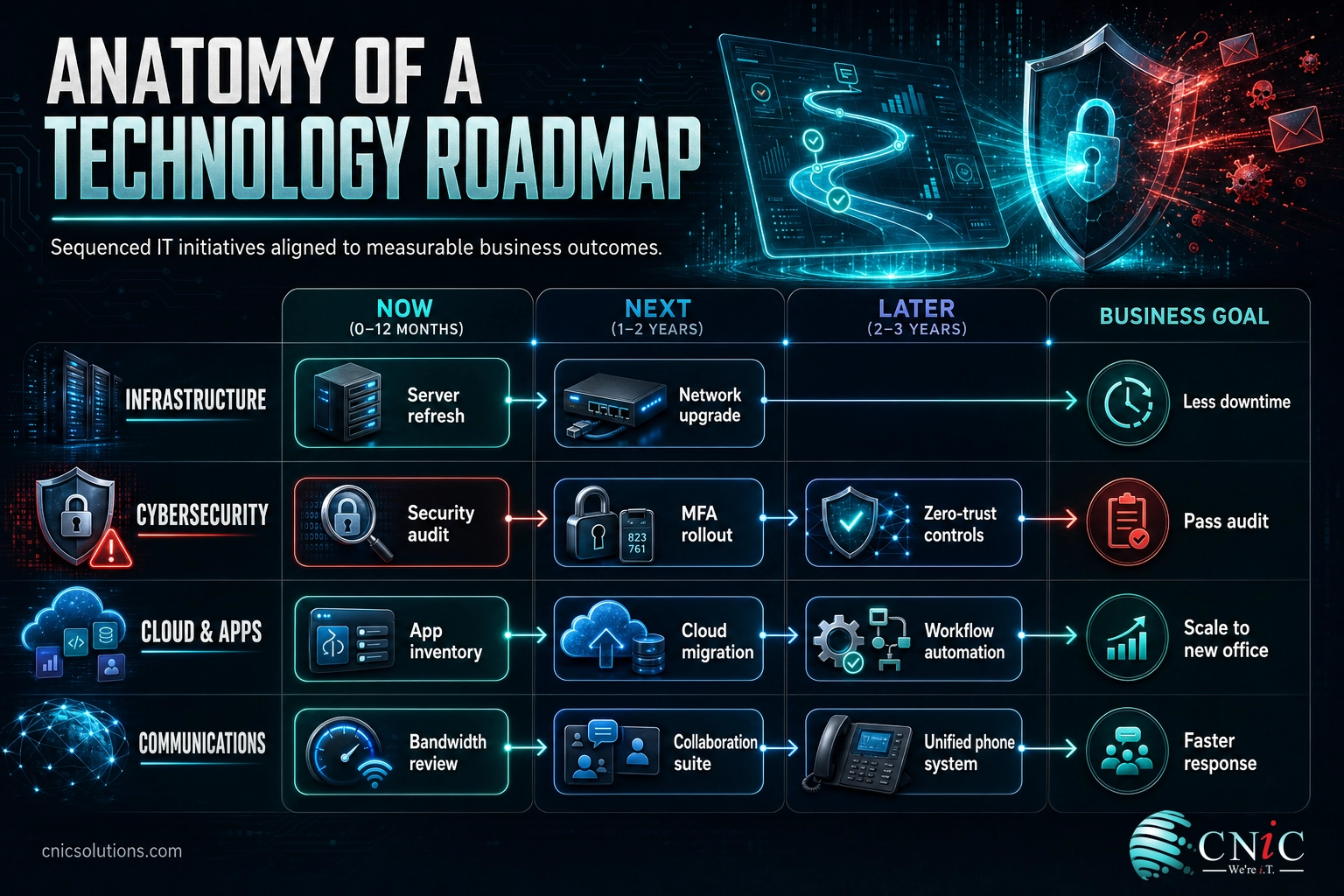
What Is a Technology Roadmap?
A technology roadmap is a strategic planning document that lays out, on a timeline, the technology initiatives a business will pursue and the order it will pursue them in. Instead of deciding on each system as it comes up for renewal or breaks down, you decide in advance how your infrastructure, security, software, and communications will evolve, and you connect each of those moves to a goal such as opening a new location, meeting a compliance deadline, or supporting more remote staff.
The concept comes out of formal strategic planning. Gartner, the technology research firm whose frameworks guide many corporate IT departments, treats the technology roadmap as a bridge between long-range strategy and the specific projects that execute it. The roadmap answers three questions at once: where the business is today, where it needs its technology to be, and the sequence of steps that gets it there without wasted spend or dangerous gaps.
Think of it like a renovation plan for a house. You would not replace the roof, rewire the electrical, and knock down a wall in random order as each one occurred to you. You would sequence them so the structural work happens before the finishes, the budget is spread sensibly across the year, and nothing you install now has to be torn out later. A technology roadmap does the same thing for the systems your business runs on.
Crucially, a roadmap is a living document, not a one-time report that gets filed and forgotten. The near-term portion is firm and detailed, later years stay directional, and the whole plan is revisited on a regular schedule as budgets, threats, and priorities change.
Source: Gartner information technology glossary and strategic planning research
Technology Roadmap vs. IT Strategy vs. IT Budget
The fastest way to understand a roadmap is to separate it from the two things it is most often confused with. An IT strategy, a technology roadmap, and an IT budget are three different documents that answer three different questions, and a healthy business needs all three to agree with one another.
| Document | Question it answers | Time frame | Level of detail |
|---|---|---|---|
| IT strategy | What role should technology play in reaching our business goals? | 3 to 5 years, directional | High level, few specifics |
| Technology roadmap | Which initiatives happen, in what order, and by when? | 1 to 3 years, sequenced | Specific projects on a timeline |
| IT budget | How much will each initiative cost and when do we spend it? | Usually 1 year, annual cycle | Line-item dollars |
The strategy is the direction. The roadmap is the route. The budget is the fuel. If you have a budget but no roadmap, you are funding purchases with no destination. If you have a strategy but no roadmap, you have ambition with no schedule. The roadmap is the piece in the middle that turns intent into a dated, ordered, fundable plan, which is exactly why it is the document most businesses are missing. It should be built hand in hand with your annual IT budget so the timeline and the dollars line up.
Myth: a technology roadmap is just a shopping list for new gadgets. A real roadmap starts with business goals, not products. It is just as likely to say “retire this aging server,” “consolidate three tools into one,” or “do nothing here until next year” as it is to recommend a purchase. If a roadmap reads like a vendor wish list, it was built backward. The technology should always be chosen to serve a documented outcome, never the other way around.
Why Your Business Needs a Technology Roadmap
The case for a roadmap is really the case against unplanned technology spending, and the cost of that unplanned spending is well documented.
Start with big initiatives. McKinsey research has found for years that roughly 70% of large-scale change and digital transformation efforts fall short of their stated goals. Poor planning and weak alignment between technology work and business objectives are repeatedly among the reasons. A roadmap is the antidote to exactly that failure mode, because it forces each initiative to be justified against a goal before anyone commits money to it.
The same pattern shows up at the project level. The Standish Group, whose long-running CHAOS research has tracked software and IT project outcomes for decades, has consistently found that fewer than a third of projects are delivered fully successfully, meaning on time, on budget, and meeting their original goals. Projects without a clear plan and clear priorities are the ones most likely to slip into the challenged or failed columns.
Waste is the other half of the story. The Project Management Institute, in its Pulse of the Profession research, has reported that organizations waste around 11.4% of every dollar they invest because of poor project performance. And in the cloud specifically, Flexera’s annual State of the Cloud Report finds that organizations consistently estimate roughly 30% of their cloud spend is wasted, often on idle resources, duplicate tools, and services no one remembers buying. Both are symptoms of the same disease: money committed without a plan to guide it.
A technology roadmap attacks all of this from the front. It prevents the surprise capital expense, because upgrades are scheduled instead of triggered by a failure. It stops duplicate and overlapping purchases, because every tool is chosen against a plan the whole business can see. It closes security and compliance gaps before they become incidents, because risks are mapped and addressed on a timeline. And it makes technology spending defensible to owners and boards, because every dollar traces back to a business goal. That is the difference between IT as an unpredictable cost center and IT as a planned investment, which is the same shift that separates old-school break-fix support from a modern managed relationship.
Source: McKinsey transformation research | Standish Group CHAOS research | PMI Pulse of the Profession | Flexera State of the Cloud Report
What Goes Into a Technology Roadmap
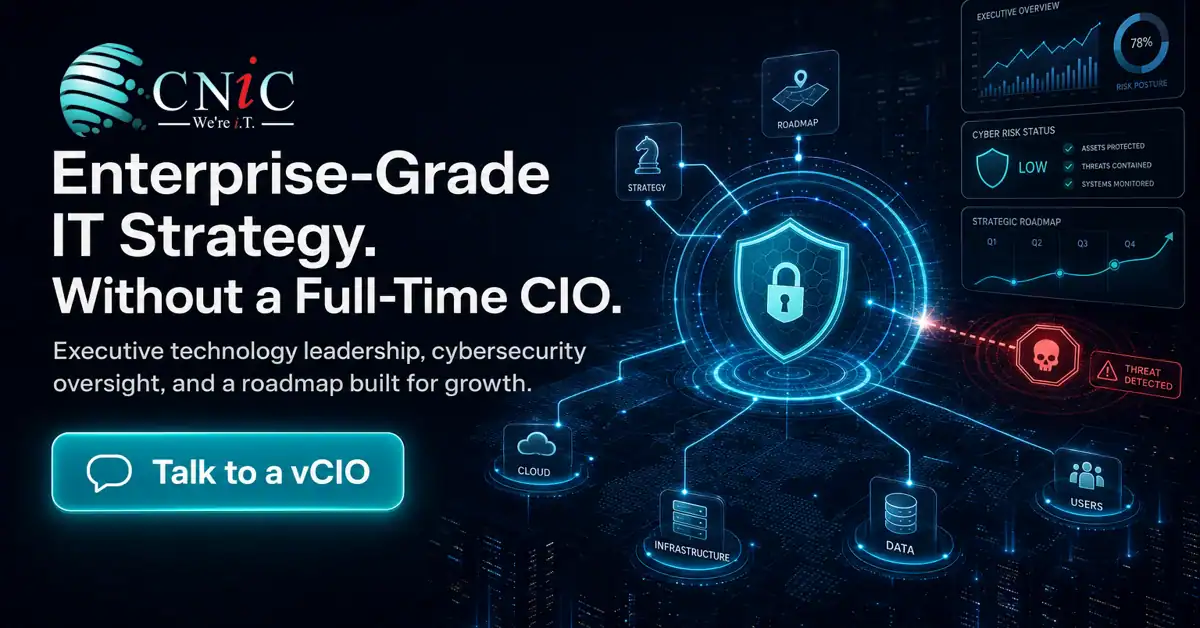
Roadmaps vary by business, but strong ones share a common anatomy. They are organized by time horizon and broken into lanes for the different parts of your technology, with each item tied back to a goal.
1Time Horizons
The backbone of a roadmap is its horizons. A common structure is Now, Next, and Later:
- Now (0 to 12 months): firm, funded, detailed initiatives with owners and dates.
- Next (1 to 2 years): planned work that is likely but not yet locked, pending results and budget.
- Later (2 to 3 years): directional intentions that set expectations without committing dollars yet.
This is what keeps a roadmap honest. It commits firmly to the near term while leaving the far term flexible, so the plan guides decisions without pretending to predict three years of detail.
2Technology Lanes
Within those horizons, most business roadmaps track several parallel lanes so nothing gets overlooked:
- Infrastructure and hardware: servers, endpoints, network gear, and their refresh cycles.
- Cybersecurity: defenses, monitoring, and compliance milestones mapped to real deadlines.
- Cloud and applications: migrations, software consolidation, and platform upgrades.
- Communications: phone systems and collaboration tools, such as a move to a unified cloud platform.
- Data and continuity: backup, disaster recovery, and the plans that keep the business running through disruption.
Different businesses weight these lanes differently. A regulated healthcare or legal firm may lead with security and compliance, while a fast-growing company may lead with infrastructure and communications that can scale. The lanes are the same, but the priorities follow the strategy.
3The Link to Business Goals
The element that separates a roadmap from a project list is the goal column. Every initiative on a good roadmap names the business outcome it serves: “reduce downtime,” “pass the annual audit,” “support 30 more remote employees,” “cut duplicate software spend.” If an item cannot be tied to a goal, that is a signal it may not belong on the plan at all.
How to Build a Technology Roadmap
Building a roadmap is a repeatable process. Whether you run it internally or with an outside advisor, the sequence is the same.
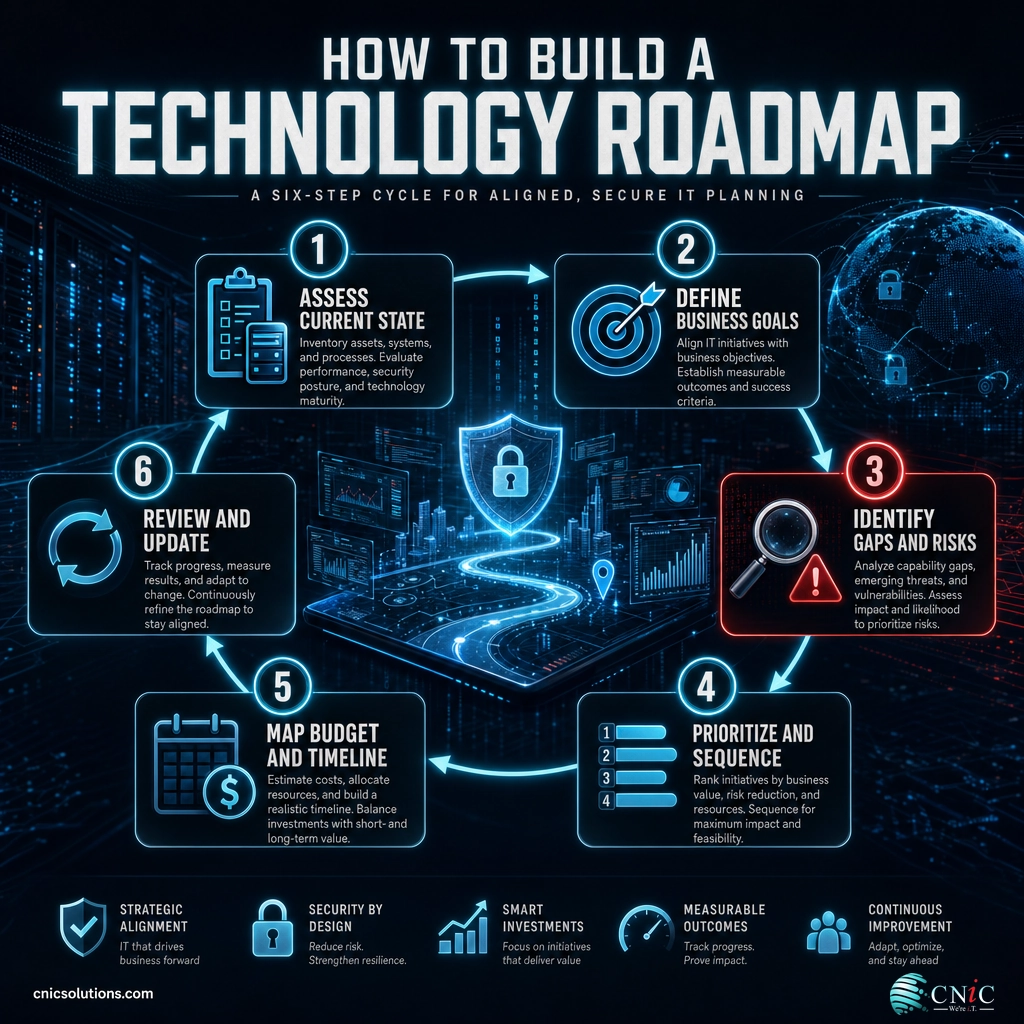
- Assess the current state. Inventory what you run today: hardware and its age, software and licenses, security posture, and where the pain and risk already live. You cannot plan a route without knowing the starting point.
- Define the business goals. Sit down with leadership, not just IT, and capture where the business is going over the next few years. Growth, new locations, hiring, compliance obligations, and cost targets all shape the plan.
- Identify the gaps and risks. Compare today’s technology against those goals. Aging servers, unsupported software, security holes, and tools that will not scale become the raw material of the roadmap.
- Prioritize and sequence. Rank the initiatives by urgency, risk, dependency, and value. Some work has to happen before other work can start, and a roadmap makes those dependencies visible.
- Map budget and timeline. Place each initiative into a Now, Next, or Later horizon and attach costs, so the plan aligns with the annual budget and spreads spending sensibly.
- Review and update. Revisit the roadmap on a set cadence, most naturally at a recurring strategy meeting such as a quarterly business review, and adjust as results come in and priorities shift.
This is exactly the kind of work a full-time chief information officer would own, which is why it maps so closely to the CIO and CTO leadership roles. The challenge is that most small and midsize businesses cannot justify a six-figure CIO salary for a function they need a few days a month. That gap is what the virtual CIO model exists to fill: a virtual CIO (vCIO) brings the strategic planning of an executive without the full-time cost, and the technology roadmap is one of the central deliverables they own and keep current.
See How a Virtual CIO Builds Your Roadmap
Common Questions About Technology Roadmaps
What is a technology roadmap?
What is the difference between a technology roadmap and an IT strategy?
How far out should a technology roadmap plan?
Who creates a technology roadmap?
How often should you update a technology roadmap?
Related Terms
- Virtual CIO (vCIO): an outsourced strategic technology advisor who provides executive-level IT leadership, including the roadmap, without the cost of a full-time hire.
- IT strategy: the high-level plan for what role technology plays in the business, one level above the roadmap.
- IT budget: the annual, line-item funding plan that pays for the initiatives on the roadmap.
- Digital transformation: the broader effort to modernize how a business runs using technology, often organized and paced by a roadmap.
- Quarterly business review (QBR): the recurring strategy meeting where a roadmap is reviewed and updated with your provider.
- Technology stack: the full set of hardware, software, and services a business currently runs, and the starting point a roadmap plans from.
- Gap analysis: the comparison of current technology against business goals that surfaces what a roadmap needs to address.
- CIO vs. CTO: the two senior technology leadership roles that traditionally own strategy and roadmapping.
About This Guide
Definitions and the strategic-planning framing follow established IT planning practice, including Gartner research on technology roadmaps and strategic planning. Failure, success, and waste figures are drawn from their original publishers: McKinsey research on large-scale change and transformation, the Standish Group’s CHAOS research on IT project outcomes, the Project Management Institute’s Pulse of the Profession, and Flexera’s State of the Cloud Report. Figures are cited to illustrate the cost of unplanned technology spending and the value of a roadmap, not as guaranteed outcomes for any specific business. Source links point to each organization’s research; specific report editions are updated periodically by the publishers.
Sources: Gartner IT glossary | McKinsey transformation research | Standish Group CHAOS | PMI Pulse of the Profession | Flexera State of the Cloud Report
Get a Free Consultation on Your Technology Plan



related posts
What Is a DDoS Attack? How DDoS Attacks Work and How to…
October 4, 2026A DDoS attack (distributed denial-of-service attack) is an attempt to take a website, application, or network…
What Is a Data Center? Types, Components, and How They Work
October 4, 2026A data center is a physical facility that houses the servers, storage, and networking equipment a…
What Is a Brute Force Attack? How It Works and How to…
October 3, 2026A brute force attack is a trial-and-error method for cracking a password, PIN, or encryption key…
What Is a Checksum? How It Verifies Data Integrity
October 3, 2026A checksum is a small value calculated from a block of digital data, used to detect…