

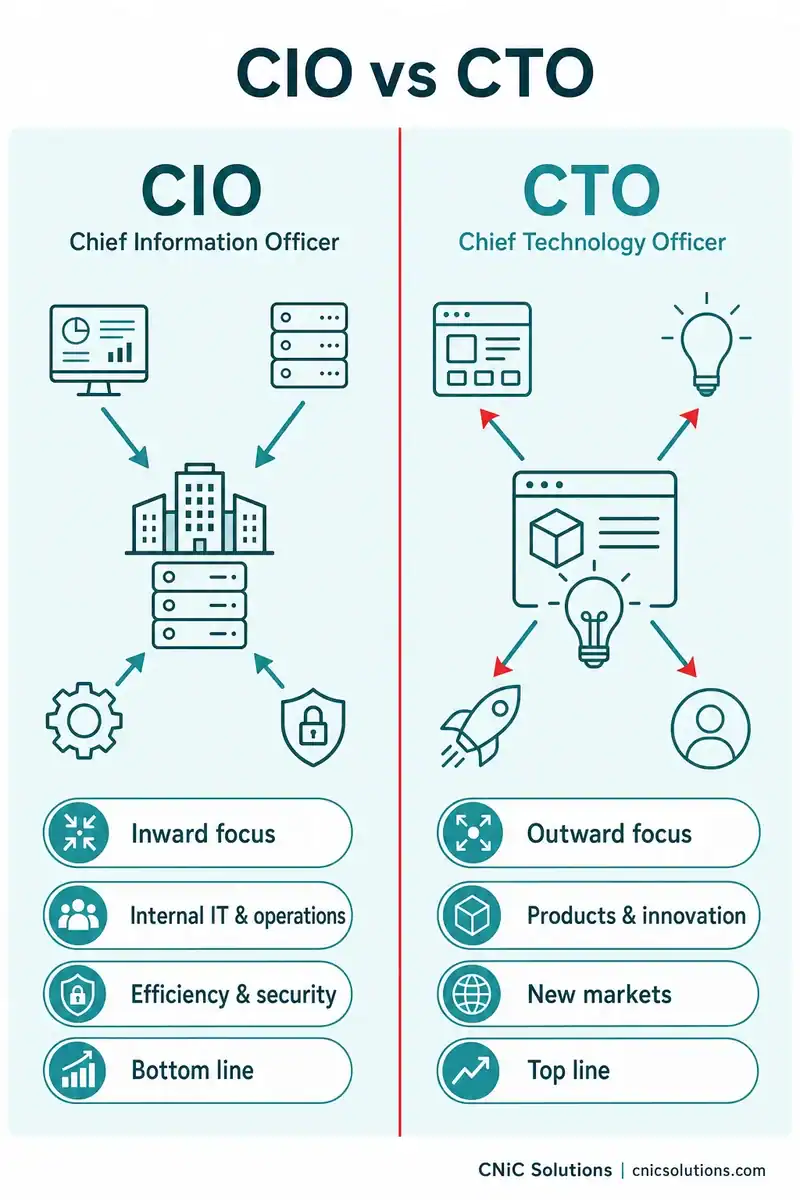
A CIO (Chief Information Officer) leads the technology that runs inside a business: internal IT systems, operations, infrastructure, and security. A CTO (Chief Technology Officer) leads the technology a business takes outside to its market: products, customer-facing technology, and innovation. The simplest distinction is that a CIO looks inward at operations, while a CTO looks outward at products.
CIO and CTO sound interchangeable, and they are constantly confused, but they are two distinct executive roles with different focuses, different goals, and different ideas of success. Understanding the difference matters whether you are mapping out a career, structuring a leadership team, or simply trying to figure out what kind of technology leadership your business actually needs. This guide breaks down what each role does, where the two overlap, how they work together, and (the question most business owners are really asking) whether your company needs a CIO, a CTO, both, or neither.
Key Takeaways
- CIO looks inward. Internal IT, operations, infrastructure, security, and efficiency, the “bottom line.”
- CTO looks outward. Customer-facing technology, products, and innovation, the “top line.”
- They overlap and collaborate. In companies that have both, the roles must work closely; if they do not, it is a failure.
- Many companies have only one, or neither. Smaller businesses and those outside the tech sector often combine the roles or do without.
- Most SMBs need the leadership, not the hire. Fractional options deliver executive-level IT strategy without a full-time C-suite salary.
What’s in This Guide
What a CIO Does
The Chief Information Officer owns the technology that keeps the business running. The CIO’s focus is internal: the IT systems, infrastructure, and operations that let employees and business units work efficiently, securely, and productively. As McKinsey frames it, the CIO is generally more involved with the technologies that support and facilitate information and knowledge management within a company than with those driving product strategy.
In practice, that means a CIO is responsible for things like:
- Internal IT operations, infrastructure, and enterprise systems
- Aligning technology with business goals to improve efficiency and productivity
- Cost control and getting value from technology investments
- Security, compliance, and the reliable flow of information across the company
- Vendor relationships and the IT department itself
A useful shorthand: the CIO tends to focus on the bottom line, trimming costs and raising productivity by making internal technology run well. TechTarget puts it simply: CIOs tend to have an inward focus, looking for ways to reduce the cost of IT infrastructure while ensuring compliance and boosting productivity.
What a CTO Does
The Chief Technology Officer owns the technology the business brings to the world. Where the CIO looks inward, the CTO looks outward, toward the products, services, and customer-facing technology that a company offers to its market. The CTO is the person responsible for knowing which new and potentially disruptive technologies are emerging, and for turning those opportunities into products and growth.
A CTO is typically responsible for:
- The technology products and services a company delivers to customers and partners
- Research, evaluation, and adoption of new and emerging technologies
- The technical roadmap for products and the engineering teams that build them
- Driving innovation and new market opportunities
- Representing the company’s technology direction externally
The shorthand here: the CTO tends to focus on the top line, using technology to grow revenue, open new opportunities, and build what customers buy. TechTarget’s framing mirrors this: CTOs tend to have an outward focus, looking for ways new technologies can grow opportunities.
CIO vs CTO: Side by Side
The clearest way to see the distinction is head to head. Keep in mind these are general tendencies; real-world responsibilities shift with company size, industry, and structure.
| Factor | CIO (Chief Information Officer) | CTO (Chief Technology Officer) |
|---|---|---|
| Primary focus | Inward, internal systems | Outward, products and market |
| Core mission | Run the business efficiently and securely | Build the technology the business sells |
| Typical goal | Bottom line (cost, productivity) | Top line (revenue, growth) |
| Technology scope | Internal IT, infrastructure, operations | Customer-facing products and innovation |
| Orientation | Efficiency, reliability, compliance | Innovation, opportunity, new markets |
| Works mostly with | Internal teams and business units | Product, engineering, external partners |
Where the Roles Overlap
The clean inward/outward split is a helpful model, but the reality is messier, and the two roles overlap a great deal. Both are senior technology leaders working toward the same company’s success, and the line between them moves depending on the organization.
In companies that have both, collaboration is not optional. As one industry expert quoted by TechTarget puts it, the two roles must be very collaborative, and if they are not, it is a failure. The CIO’s internal systems have to support the CTO’s customer-facing initiatives, especially as those scale, and both share responsibility for security and the flow of data between internal operations and market-facing products.
The roles are also evolving. At some organizations the focuses have begun to blur or even reverse, with CIOs taking on outward, business-strategy responsibilities. And there is no fixed hierarchy: depending on the company, a CIO and CTO may be peers, or one may report to the other. Which sits higher usually reflects whether the business is driven more by its internal operations or by its technology products.
Do You Need a CIO, a CTO, Both, or Neither?
Here is the practical question underneath all of this. The answer depends less on a revenue figure and more on what kind of company you are and what role technology plays in it. A few honest signals:
- You likely lean toward needing a CTO if technology is your product, if you build software, hardware, or a tech-driven service that customers buy, and you have (or are building) engineering teams to lead.
- You likely lean toward needing a CIO if technology primarily runs your business rather than being what you sell, and your internal IT environment has grown complex enough to need executive-level ownership of operations, infrastructure, and security.
- You likely need both if you are a larger organization that both runs significant internal IT and brings technology products to market, the point at which one person can no longer credibly own both the inward and outward mission.
- You may need neither as a full-time hire if you are a small or midsize business where technology is essential but is a support function, not your product. You still need the strategic leadership these roles provide, you just may not need it as a full-time executive on payroll.
That last case describes the majority of small and midsize businesses, and it deserves its own section, because “you don’t need a full-time CIO or CTO” is not the same as “you don’t need technology leadership.”
What About Small and Midsize Businesses?
Most small and midsize businesses are in a genuine bind here. They depend on technology completely, and the cost of getting it wrong (a poorly planned investment, a security gap, a stalled project) is real. But hiring a full-time CIO or CTO is a major executive expense that is hard to justify until the company reaches real scale. So they often end up with no strategic technology leadership at all, making major decisions by guesswork.
There is a better answer for businesses below that threshold, and it works for any size of organization that does not have full in-house technology leadership:
- For most SMBs: a Virtual CIO delivers the strategic, inward-facing leadership of a CIO, technology roadmap, IT budgeting, security strategy, and business-IT alignment, on a fractional basis. You get executive-level guidance for the slice of time you actually need it, paired with managed IT services that handle the day-to-day execution. That combination covers the CIO function for a fraction of a full-time hire.
- For larger or scaling organizations: even companies approaching the point where a full-time CIO or CTO makes sense often co-source. They use an outside partner to extend a lean in-house team, cover areas they do not staff for, or provide strategic guidance and a roadmap while internal staff focus on execution. The leadership model scales with you rather than forcing an all-or-nothing hiring decision.
In other words, the full-time CIO/CTO question is not binary. Strategic technology leadership is available on a spectrum, and for the large share of businesses that need the function without the full-time executive, that flexibility is the point.
See how CNiC delivers CIO-level IT leadership for your business

Frequently Asked Questions
What is the main difference between a CIO and a CTO?
Does a CIO or CTO rank higher?
Does a company need both a CIO and a CTO?
Do small businesses need a CIO or CTO?
What is the difference between a CTO and a CIO in simple terms?
About This Guide and Sources
The distinction between the CIO and CTO roles described here, the CIO’s inward focus on internal systems and operations versus the CTO’s outward focus on products and market innovation, reflects characterizations from McKinsey & Company and TechTarget, and is broadly consistent across technology-leadership sources. Exact responsibilities, reporting structure, and whether a company employs one role, both, or neither vary considerably by organization size, industry, and strategy. Compensation for both roles is senior executive level and varies widely by source, company, and region; specific salary figures are therefore not cited here.
Sources: McKinsey: CIO vs CTO; TechTarget: CIO vs CTO Key Differences.



related posts
What Is NIST Compliance? Frameworks, Requirements, and Who Needs It
October 25, 2026NIST compliance means aligning your organization's security program with the cybersecurity standards published by the National…
What Is Network Penetration Testing? Types and Process
October 25, 2026Network penetration testing is a controlled, authorized simulation of a real cyberattack on your network, run…
What Is Mobile Device Management (MDM)? A Guide for Businesses
October 24, 2026Mobile Device Management (MDM) is software that lets an organization remotely enroll, configure, secure, and monitor…
What Is MFA? How Multi-Factor Authentication Protects Your Accounts
October 24, 2026Multi-factor authentication (MFA) is a security method that requires two or more separate proofs of identity…