

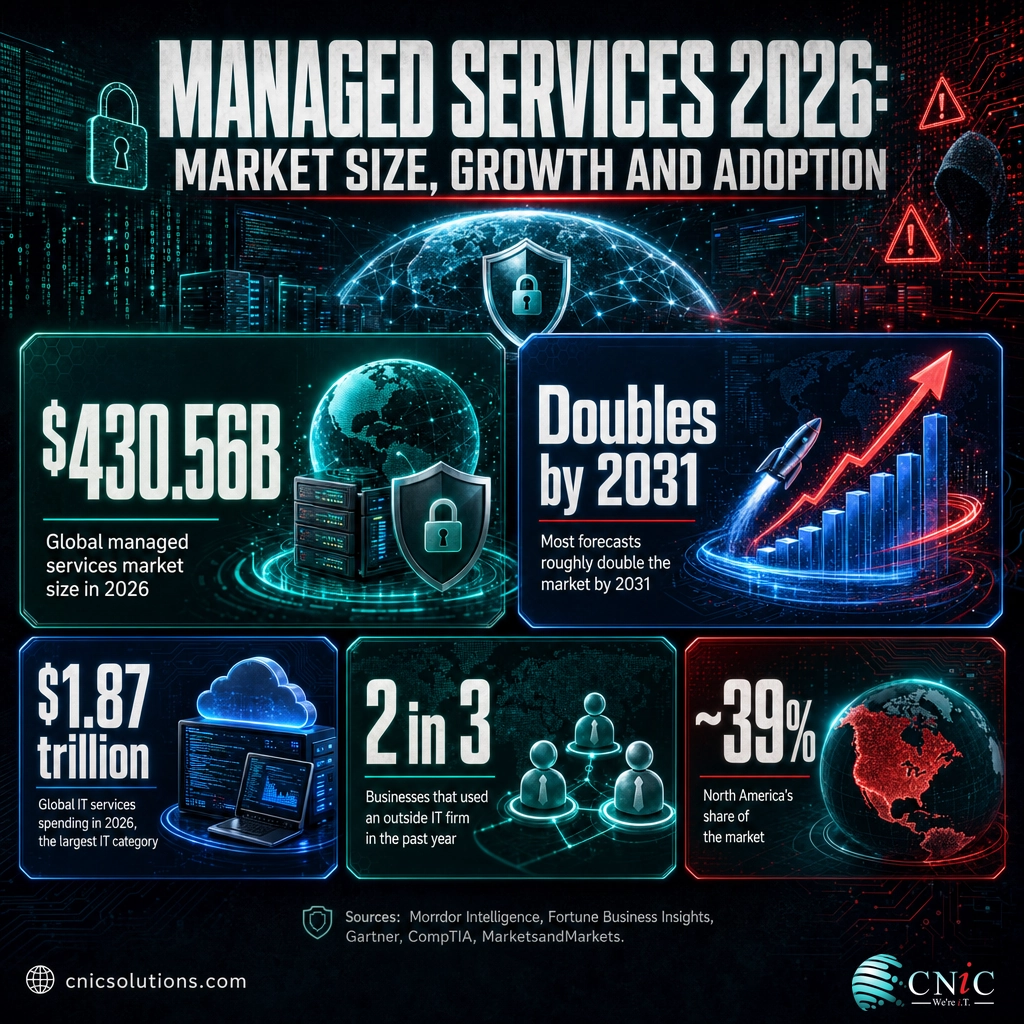
The global managed services market is on track to pass $430 billion in 2026, and by nearly every major forecast it will roughly double before the end of the decade. Driving that growth is a straightforward shift: businesses of every size, small companies most of all, are handing day-to-day IT to outside providers. Here is what the 2026 data says about market size, growth, and adoption.
- The market is huge and still climbing: managed services are valued at roughly $370 billion to $431 billion in 2026 depending on the analyst. (Fortune Business Insights, Mordor Intelligence)
- Growth is double-digit: forecast CAGRs range from about 9% to 15%, and Canalys measured 13% actual growth in 2025 to $595 billion globally. (Grand View Research, Fortune Business Insights, Canalys)
- Security leads the pack: managed detection and response is compounding at 21.95% a year, more than twice the overall market rate. (Mordor Intelligence)
- IT services dominate global tech spend: IT services, which include managed services, will top $1.87 trillion in 2026, the largest slice of a $6.37 trillion IT budget. (Gartner)
- Small businesses adopt fastest: companies with fewer than 100 employees are more than twice as likely to outsource IT to an MSP than larger firms. (CompTIA)
- The talent gap is the tailwind: ISC2 estimated a global shortfall of 4.7 million cybersecurity professionals, and 95% of security teams now report at least one skills gap. (ISC2)
- Downtime is expensive: a single hour of downtime tops $300,000 for more than 90% of mid-size and large enterprises. (ITIC)
What’s in This Report
- How Big Is the Managed Services Market?
- How Fast Is It Growing?
- Managed Services by Segment: Security, Cloud, and Network
- Where the Money Is: Global IT Spending and Regions
- Why Businesses Adopt Managed Services
- The Forces Driving Growth
- Every Statistic in One Table
- Frequently Asked Questions
- Methodology and Sources
1 How Big Is the Managed Services Market?
There is no single official figure for the size of the managed services market, because each research firm draws the boundary in a slightly different place. What they agree on is the order of magnitude: this is a market measured in the hundreds of billions of dollars, and it is one of the largest categories in all of enterprise technology.
| Research firm | Near-term size | Forecast | Target year |
|---|---|---|---|
| Fortune Business Insights | $370.5B (2026) | $1,118.2B | 2034 |
| Mordor Intelligence | $430.56B (2026) | $704.2B | 2031 |
| Grand View Research | n/a | $731.08B | 2030 |
| MarketsandMarkets | ~$460.6B (2026) | $705.22B | 2031 |
| Precedence Research | n/a | $1,272.95B | 2035 |
| Canalys (actual, channel) | $595B (2025) | n/a | 2025 |
Managed Services Market Forecasts by Research Firm (USD)
Forecasts use different end years, so the bars are not a like-for-like comparison, but every firm sees a market at or above $700 billion. Sources: Precedence Research, Fortune Business Insights, Grand View Research, MarketsandMarkets, Mordor Intelligence.
The practical takeaway for a business owner is not the exact dollar figure. It is that outsourcing IT has become the default operating model for companies under a few hundred employees, which is why the market is this large in the first place. When you engage a provider for managed IT services, you are joining the majority, not the exception.
Explore CNiC’s managed IT services
Source: Fortune Business Insights | Mordor Intelligence | Grand View Research
2 How Fast Is It Growing?
Market size tells you where the industry is today. Growth rate tells you where it is heading, and here the story is consistent: double-digit expansion, year after year, for the rest of the decade. The disagreement among analysts is only about how fast, not whether.
Managed Services Market CAGR by Source
Even the most conservative forecast has managed services growing faster than the broader economy. Sources: Fortune Business Insights, Grand View Research, Canalys, Mordor Intelligence, MarketsandMarkets.
Why the growth is durable. These are not one-time projects that finish and stop billing. Managed services are recurring, contract-based relationships, so each new client compounds on the last. That subscription structure is exactly why analysts model the category as steady double-digit growth rather than a boom-and-bust cycle, and it is why so much of the market has shifted from break-fix repair toward always-on infrastructure management.
Source: Fortune Business Insights | Grand View Research | Canalys MSP Trends and Predictions
3 Managed Services by Segment: Security, Cloud, and Network
“Managed services” is an umbrella over several distinct markets, and they are not growing at the same speed. Security-related services are pulling ahead as threats multiply and compliance requirements tighten, while cloud management remains the largest single slice.
| Segment | 2025 size | Forecast (2030) | CAGR |
|---|---|---|---|
| Cloud managed services | $140.96B | $222.81B | 9.59% |
| Managed security services | $38.31B | $69.16B | 12.54% |
| Managed threat intelligence | $13.63B | $31.76B | 18.44% |
| Managed detection & response (MDR) | n/a | n/a | 21.95% |
CNiC Solutions Analysis: Security is compounding faster than the market it sits inside. Take Mordor Intelligence’s projected 12.54% CAGR for managed security services and divide it by the 10.34% CAGR the same firm forecasts for the overall managed services market: 12.54 ÷ 10.34 = 1.21. In other words, security managed services are growing about 21% faster than the market as a whole, and the managed detection and response niche, at 21.95%, is compounding at more than double the overall rate. The signal for buyers is that security is no longer a bolt-on to managed IT; it is the part of the market pulling everything else forward. Calculation and interpretation original to CNiC Solutions.
This is why security has moved to the center of most managed IT relationships, and why we treat it as a first-class service rather than an upsell. If you want the underlying threat numbers behind this growth, our companion 2026 cybersecurity statistics report breaks down the attack data, and our ransomware recovery statistics cover the cost side. Voice and collaboration follow the same managed model through hosted UCaaS platforms.
See CNiC’s managed cybersecurity services
Source: Mordor Intelligence, Cloud Managed Services | Mordor Intelligence, Managed Security Services | MarketsandMarkets
4 Where the Money Is: Global IT Spending and Regions
Managed services do not grow in isolation. They ride on top of the largest technology-spending wave on record, and they are concentrated in the regions where that spending is heaviest.
| Spending metric | Figure | Source (year) |
|---|---|---|
| Worldwide IT spending, 2026 | $6.37 trillion | Gartner (2026) |
| IT services spending, 2026 (incl. managed services) | Over $1.87 trillion | Gartner (2026) |
| IT services share of total IT spend | ~30% | Gartner (2026) |
| North America share of managed services market | ~39% | MarketsandMarkets (2025) |
When IT services alone account for nearly a third of a $6.37 trillion global budget, and managed services are the recurring core of that category, the scale of the opportunity becomes clear. Much of the fresh spending is going toward cloud and AI-ready infrastructure, work that is complex to run in-house and a natural fit for a managed cloud partner.
Explore CNiC’s managed cloud solutions
Source: Gartner IT Spending Forecast | MarketsandMarkets

5 Why Businesses Adopt Managed Services
Behind the market numbers are millions of individual decisions to stop running IT alone. The adoption data from CompTIA’s Trends in Managed Services research shows both how common the choice has become and why owners make it.
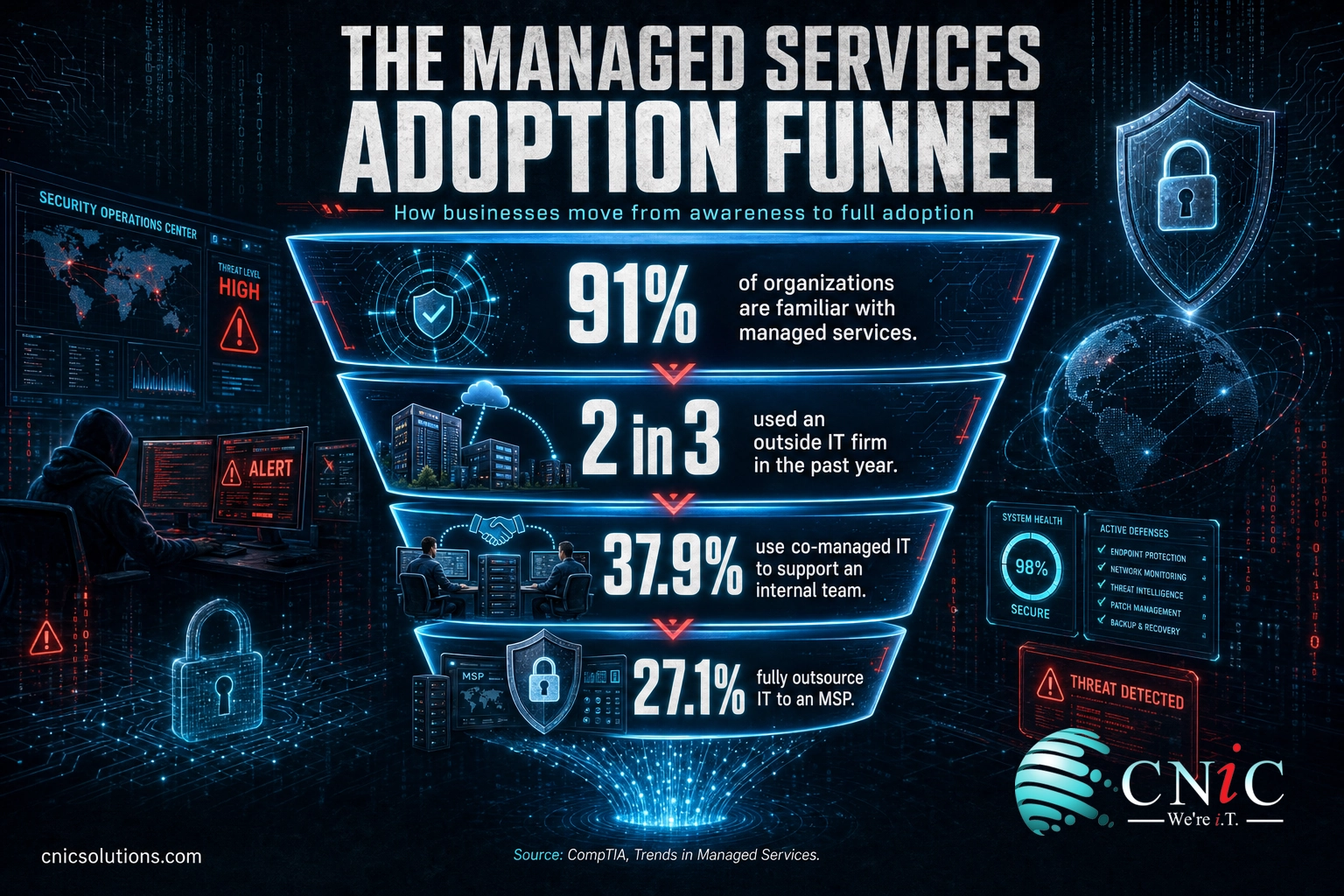
When CompTIA asked why, the leading answer was not cost cutting. It was reliability. Improving the efficiency and reliability of IT operations was the main driver for the majority of respondents, and the effect was strongest among larger teams that feel downtime most acutely.
Top Reason for Using an MSP: Improve IT Efficiency and Reliability
Efficiency and reliability, not price, is the top reason businesses hire an MSP. Source: CompTIA, Trends in Managed Services.
Myth: “Managed services are only for big companies.” The data says the opposite. CompTIA found that organizations with fewer than 100 employees were more than twice as likely to outsource their IT to an MSP than larger organizations. Small businesses adopt managed services precisely because they cannot justify a full in-house IT and security team, so a provider gives them enterprise-grade coverage at a fraction of the cost. Being small is a reason to use an MSP, not a reason to skip one.
That pattern matches what we see day to day. A growing company hits a point where one overworked internal person, or no IT person at all, can no longer keep pace, and a virtual CIO plus a managed team fills the gap without the cost of a full department.
Learn how a virtual CIO fits your business
Source: CompTIA Trends in Managed Services | CompTIA IT Industry Outlook 2026
6 The Forces Driving Growth
The market forecasts and the adoption data point at the same underlying causes. Two structural pressures, a shortage of skilled people and the rising cost of downtime, make outsourcing less a preference and more a necessity for most small and midsize businesses.
| Growth driver | Figure | Source (year) |
|---|---|---|
| Global cybersecurity workforce gap | 4.7 million | ISC2 (2024) |
| Security teams reporting at least one skills gap | 95% | ISC2 (2025) |
| Enterprises where one hour of downtime tops $300K | Over 90% | ITIC (2024) |
| Enterprises with hourly downtime losses of $1M to $5M | 41% | ITIC (2024) |
| Business leaders positive on 2026 prospects | Net 77% | CompTIA (2026) |
What ties it together. A business cannot hire its way out of a 4.7 million-person talent shortage, and it cannot afford six-figure hourly downtime. Managed services resolve both at once: a provider spreads scarce expertise across many clients and delivers the around-the-clock monitoring and backup and recovery that keep outages short. That is the economic logic underneath every forecast in this report, and it is why CompTIA found a net 77% of business leaders feeling positive about their prospects heading into 2026 even amid economic uncertainty.
Source: ISC2 Cybersecurity Workforce Study | ITIC Hourly Cost of Downtime | CompTIA IT Industry Outlook 2026
Every Statistic in One Table
The full set of managed services statistics from this report, with the primary source and year for each, in one place for easy reference and citation.
| Statistic | Figure | Source | Year |
|---|---|---|---|
| Managed services market size | $370.5B | Fortune Business Insights | 2026 |
| Managed services market size | $430.56B | Mordor Intelligence | 2026 |
| Managed services market size (2025 prior year) | $330.4B | Fortune Business Insights | 2025 |
| Managed services channel size (actual) | $595B | Canalys | 2025 |
| Managed services market forecast | $731.08B | Grand View Research | 2030 |
| Managed services market forecast | $705.22B | MarketsandMarkets | 2031 |
| Managed services market forecast | $1,118.2B | Fortune Business Insights | 2034 |
| Managed services market forecast | $1,272.95B | Precedence Research | 2035 |
| Managed services market CAGR | 14.80% | Fortune Business Insights | 2026-2034 |
| Managed services market CAGR | 14.1% | Grand View Research | 2025-2030 |
| Managed services market CAGR | 10.34% | Mordor Intelligence | 2026-2031 |
| Managed services channel growth (actual) | 13% | Canalys | 2025 |
| Cloud managed services market size | $140.96B | Mordor Intelligence | 2025 |
| Managed security services market size | $38.31B | Mordor Intelligence | 2025 |
| Managed security services CAGR | 12.54% | Mordor Intelligence | 2025-2030 |
| Managed detection & response (MDR) CAGR | 21.95% | Mordor Intelligence | to 2030 |
| Managed threat intelligence CAGR | 18.44% | Mordor Intelligence | 2025-2030 |
| Worldwide IT spending | $6.37T | Gartner | 2026 |
| IT services spending (incl. managed services) | Over $1.87T | Gartner | 2026 |
| North America share of managed services market | ~39% | MarketsandMarkets | 2025 |
| Organizations using an outside IT firm | Over 2 in 3 | CompTIA | 2022 |
| Organizations using co-managed IT | 37.9% | CompTIA | 2022 |
| Organizations fully outsourcing IT to an MSP | 27.1% | CompTIA | 2022 |
| Global cybersecurity workforce gap | 4.7 million | ISC2 | 2024 |
| One-hour downtime cost, mid/large enterprises | Over $300K (90%+ of firms) | ITIC | 2024 |
Frequently Asked Questions
How big is the managed services market in 2026?
How fast is the managed services market growing?
What is the fastest-growing part of the managed services market?
How many small businesses use a managed service provider?
Why are businesses adopting managed IT services?
Methodology and Sources
How we compiled this report
Every figure in this report traces to a named primary source: a major market-research firm, an industry analyst, or a professional association study with disclosed methodology. Where analysts disagree on market size, we present the range rather than a single number and attribute each figure to its source, because differing market definitions are the main reason the estimates vary. No statistic is drawn from a secondary blog or an unsourced aggregate, and no figures were invented or estimated by CNiC Solutions except the clearly labeled analysis box, which shows its formula and inputs.
Primary sources:
- Fortune Business Insights, Managed Services Market (market size, CAGR)
- Grand View Research, Managed Services Market (2030 forecast, CAGR)
- MarketsandMarkets, Managed Services Market (2031 forecast, regional share)
- Mordor Intelligence, Global Managed Services Market (market size, segment sizes and CAGRs)
- Precedence Research, Managed Services Market (2035 forecast)
- Canalys, MSP Trends and Predictions 2025 (actual 2025 growth and size)
- Gartner, Worldwide IT Spending Forecast (IT and IT services spending)
- CompTIA, Trends in Managed Services and IT Industry Outlook 2026 (adoption and sentiment)
- ISC2 Cybersecurity Workforce Study (workforce gap, skills gap)
- ITIC, Hourly Cost of Downtime Survey (downtime cost)
Market-size figures reflect the most recent published reports available at the time of writing and are subject to revision as firms update their models. Segment growth rates are drawn from each firm’s dedicated report for that segment. Figures are presented in U.S. dollars.
For journalists and researchers. You are welcome to cite the statistics in this report with attribution to CNiC Solutions and a link back to this page, alongside the original primary source named for each figure. The CNiC Solutions analysis box (managed security growing about 21% faster than the overall market) is original derived data and may be cited as such. For interviews or additional Houston and Texas managed IT context, contact CNiC Solutions at (713) 637-9700.



related posts
Microsoft 365 Business Premium vs Office 365 E3: Which Is Right for…
September 20, 2026Here is the short answer most buyers do not expect: Microsoft 365 Business Premium costs less…
McAfee Scam Emails: How to Spot Fake Renewal Notices
September 20, 2026A fake McAfee renewal email is one of the most common scams landing in business inboxes…
Malware Statistics for 2026: Volume, Variants, and the Shift to Malware-Free Attacks
September 19, 2026Security vendors now track more than 1.5 billion known malware samples, and the AV-TEST Institute registers…
IT Risk Management Frameworks Explained: NIST RMF, ISO 31000, and FAIR
September 18, 2026An IT risk management framework is a structured system of principles, processes, and controls that helps…