

Extended detection and response (XDR) is a security platform that collects and correlates threat data from across your endpoints, network, cloud, email, and identity systems into one place. Instead of scattered alerts from separate tools, XDR connects them into a single incident, so your team can detect, investigate, and stop an attack faster.
Modern attacks rarely stay in one place. A stolen password logs into email, pivots to a cloud app, then reaches for a server, and each step trips a different security tool that only sees its own corner. The result is a pile of disconnected alerts and an attacker who is already three moves ahead. XDR was built to solve exactly that problem. It takes the signals your separate defenses generate, ties them together into one story, and gives your team a single place to see the whole attack and shut it down. For a small or midsize business without a room full of analysts, that shift from scattered alerts to one connected view is what makes fast detection realistic.
- XDR unifies your defenses. It pulls threat data from endpoints, network, cloud, email, and identity into one console and correlates it, replacing scattered alerts with connected incidents.
- It is the next step beyond EDR. Endpoint detection and response watches your devices. XDR watches the devices plus everything around them, and links the signals together.
- Speed is the whole point. Organizations still took an average of 241 days to identify and contain a breach in IBM’s 2025 report, and every day an attacker stays hidden raises the cost.
- It fights alert fatigue. In the 2025 SANS Detection and Response Survey, 73% of teams named false positives their top detection challenge. XDR correlates noise into fewer, higher-confidence incidents.
- It comes in flavors. Native, open, and managed (MXDR) versions let a business match XDR to the team and tools it already has.
What’s in This Guide
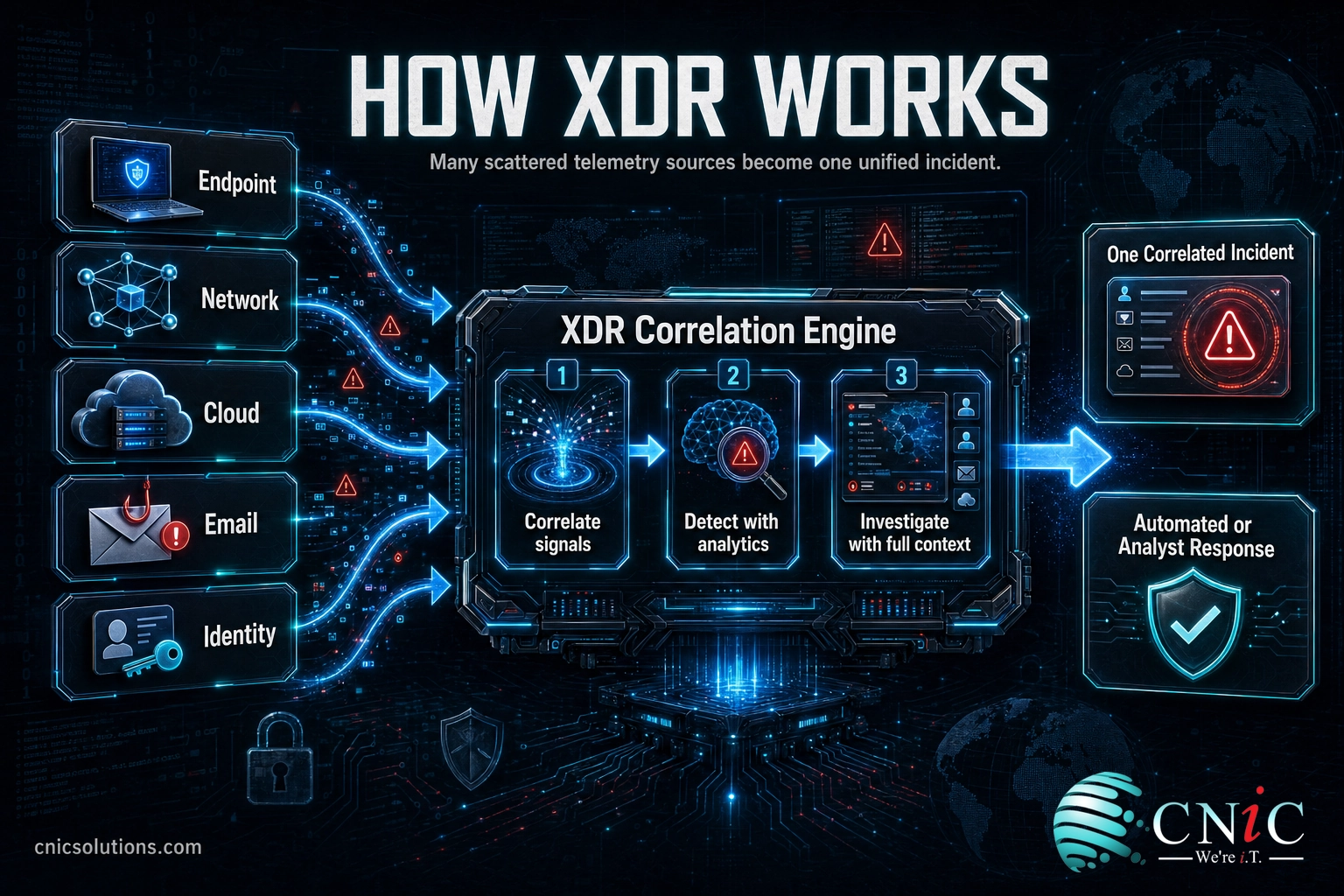
How XDR Works
Picture a building with a separate guard at every door, and each guard can only see their own doorway. A single intruder walks through the parking lot, slips in a side entrance, and heads for the server room. To the three guards who glimpsed him, he is three unrelated strangers. Now put one guard in a control room with every camera feed on the wall. Same intruder, but this time it is obvious: it is one person, moving with purpose, and the guard can lock the right door before he reaches the server. Traditional security tools are the guards at each door. XDR is the control room.
Underneath that idea, XDR runs as a continuous pipeline across your security layers:
- Collect telemetry from every layer. XDR ingests activity from endpoints, network traffic, cloud workloads and apps, email, and identity systems. Rather than each tool keeping its data to itself, everything flows into one platform.
- Correlate the signals. This is the core of XDR. It links related events across those layers, so a suspicious login, an unusual process on a laptop, and a strange outbound connection are recognized as one attack instead of three separate alerts.
- Detect with analytics. XDR applies behavioral analytics and machine learning to the combined data to surface threats a single-source tool would miss, especially attacks that leave no malware file behind and only reveal themselves across systems.
- Investigate with full context. When something is flagged, an analyst sees the entire chain in one timeline: where the attacker entered, what they touched, and where they went next. No stitching together five dashboards.
- Respond, automatically or with a human. XDR can act. It can isolate an endpoint, disable a compromised account, block a malicious domain, or trigger a playbook, either on its own for clear-cut threats or through an analyst who confirms and remediates.
The thread running through all five stages is a single source of truth. Because the data lives in one platform, detection is smarter (it sees the whole picture) and response is faster (it can act everywhere at once). That combination, wide visibility plus the ability to act on it, is what separates XDR from a tool that only raises an alarm and leaves you to chase it.
Source: Gartner Extended Detection and Response market definition | NIST Cybersecurity Framework (Detect and Respond functions)
XDR vs. EDR (and SIEM)
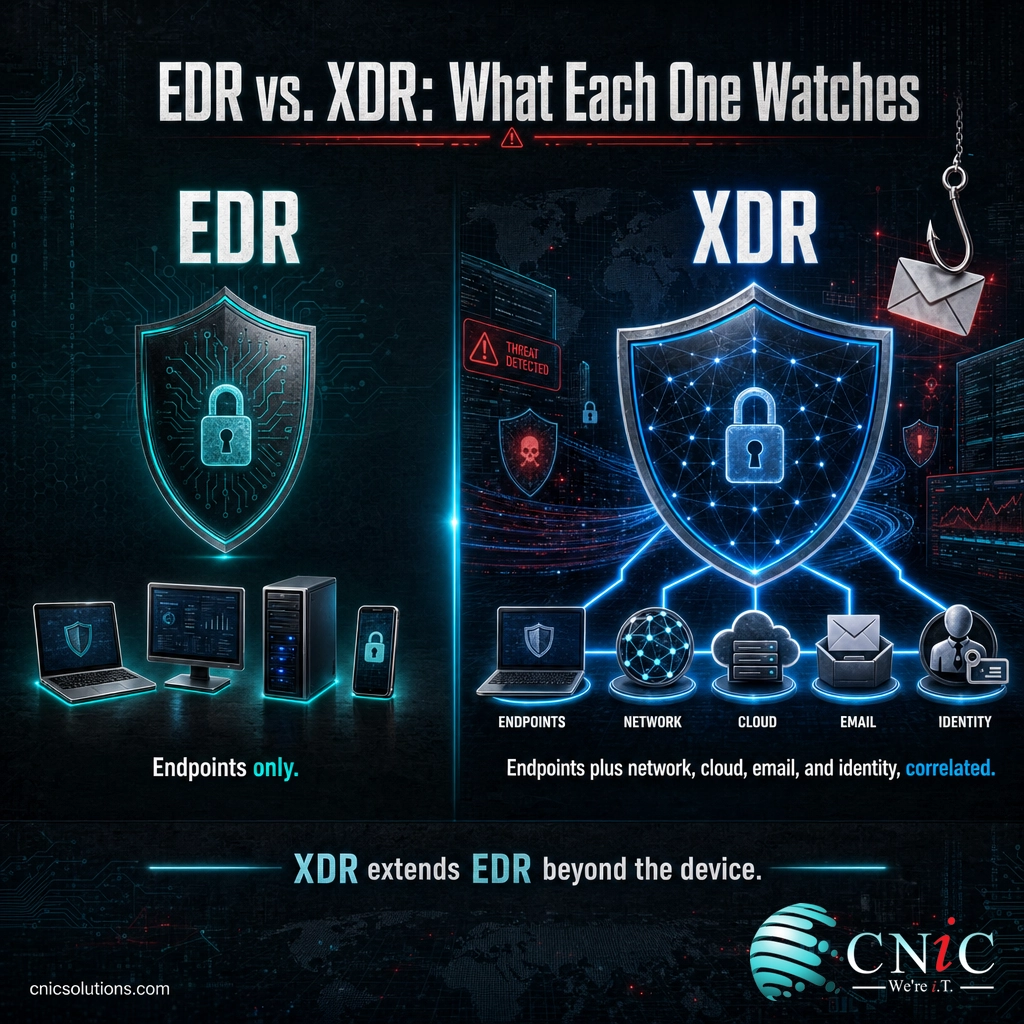
The fastest way to understand XDR is to see what it grew out of. Endpoint detection and response, or EDR, watches your devices closely: the processes they run, the connections they make, the files they change. EDR is powerful, but it has a fixed horizon. It sees the endpoint and nothing beyond it. When an attack begins in email, moves through a cloud app, and only later lands on a laptop, EDR joins the story late and misses the earlier chapters.
XDR keeps everything EDR does and widens the horizon. The “X” stands for extended, and what it extends is the range of data being watched and correlated. Where EDR asks “what is happening on this device,” XDR asks “what is happening across all of my systems, and how do those events connect.” It is the difference between a good EDR solution for a small business and a platform that treats your whole environment as one attack surface.
| Capability | EDR (Endpoint Detection and Response) | XDR (Extended Detection and Response) |
|---|---|---|
| What it watches | Endpoints only (laptops, servers, phones) | Endpoints plus network, cloud, email, and identity |
| How it detects | Behavior and analytics on a single device | Correlated analytics across every connected layer |
| Alert experience | Device-level alerts you connect yourself | Related events grouped into one incident |
| Cross-system attacks | Seen only once they reach an endpoint | Caught earlier by linking signals across systems |
| Response reach | Isolate or remediate the device | Act across endpoint, identity, email, and network |
People also confuse XDR with a SIEM (security information and event management). A SIEM is a log warehouse: it collects and stores events from across your environment so you can search them, meet compliance requirements, and build your own detection rules. That flexibility is useful, but it puts the analysis burden on you, and SIEMs are famous for the tuning and staffing they demand. XDR is narrower and more opinionated. It is built specifically to correlate security signals and drive detection and response out of the box, with far less manual rule-writing. Many mature security programs run both, using XDR for fast, focused detection and a SIEM for broad log retention. XDR also complements, rather than replaces, prevention layers such as antivirus software and a managed firewall, which stop known threats before detection ever has to.
Source: Gartner Extended Detection and Response market definition

Why XDR Matters for Your Business
The case for XDR is not about buying the newest acronym. It is about closing two gaps that quietly cost businesses the most: attacks that hide too long, and analysts who are drowning in noise. Both are measurable, and both are exactly what correlation is designed to fix.
Start with time. In IBM’s 2025 Cost of a Data Breach Report, which studied breaches at more than 600 organizations, companies took an average of 241 days to identify and contain a breach: 158 days to spot it and another 83 to shut it down. That was the lowest figure in nine years, and IBM tied the improvement directly to faster detection and containment powered by security AI and automation, the very things a correlation-driven platform provides.
Average Data Breach Lifecycle, 2025 (IBM)
A breach still lasts 241 days on average from first intrusion to containment. Source: IBM Cost of a Data Breach 2025.
Why does that matter in dollars? Because dwell time drives cost. IBM’s global average breach cost eased to $4.44 million in 2025, down 9% from the year before, while the United States hit a record $10.22 million. The reductions showed up where organizations detected and contained faster. For a small or midsize business, a threat that moves from email to cloud to server undetected for months is not a line item, it is an existential risk, and it is precisely the kind of cross-system attack that XDR is built to catch early.
The second gap is human. Security teams are buried in alerts, and most of them lead nowhere. In the 2025 SANS Detection and Response Survey, 73% of organizations named false positives their single biggest challenge in threat detection, a sharp rise from the year before. Every false alarm an analyst chases is time not spent on the real intrusion, and a stack of disconnected tools generates exactly that flood. By correlating events into fewer, higher-confidence incidents, XDR is designed to cut through the noise so the real threats surface instead of hiding inside it.
These pressures are not theoretical for Texas businesses. Ransomware campaigns hitting local organizations and the steady drumbeat of phishing that opens the door both tend to start in one system and spread to others, the exact pattern XDR is meant to catch before it becomes a full breach.
Myth: “XDR is just EDR with a new name.” They share DNA, but the difference is real. EDR is confined to the endpoint. XDR correlates endpoint activity with network, cloud, email, and identity data, which is what lets it catch attacks that never touch a device early or that jump between systems to stay hidden. Calling XDR a rebrand of EDR misses the entire point of the “extended,” and it is the extension that closes the visibility gap attackers exploit.
Source: IBM Cost of a Data Breach 2025 | 2025 SANS Detection and Response Survey
Types of XDR: Native, Open, and Managed
XDR is not a single product you switch on. It comes in a few models, and the right one depends on the tools you already run and the team you have to run them.
Native XDR
Native XDR uses a single vendor’s stack. The endpoint agent, email security, cloud protection, and identity tools all come from one provider and are built to share data natively. The upside is tight integration and quick setup, because everything is designed to work together. The tradeoff is lock-in: you commit to that vendor’s ecosystem, and adding a best-of-breed tool from someone else can be harder.
Open (hybrid) XDR
Open XDR is built to integrate the tools you already own, regardless of who makes them. It pulls telemetry from third-party endpoint, network, email, and cloud products into one correlation layer. The upside is flexibility and protecting existing investments. The tradeoff is that integrations take more work to set up and maintain than a single-vendor stack.
Managed XDR (MXDR)
Technology raises alerts, but someone has to watch them at 2 a.m. Managed XDR pairs the platform with a provider’s security team who monitor, investigate, and respond on your behalf around the clock. For a business with no in-house 24/7 security staff, MXDR is how you get expert eyes on a correlated view of your whole environment without hiring a night shift. It is closely related to the model behind a managed security services provider (MSSP), and for many small and midsize businesses it is the most realistic path to XDR-grade coverage.
Source: Gartner Extended Detection and Response market definition
How to Get Started with XDR
You do not adopt XDR by flipping a switch. You build toward it in an order that closes your biggest visibility gaps first without overloading your team. A practical path for a small or midsize business looks like this:
- Map your security layers and data sources. List what you already run for endpoints, email, cloud, network, and identity. XDR is only as good as the telemetry it can see, so knowing your sources tells you what it will correlate and what is still a blind spot.
- Get the endpoint foundation right. XDR extends detection outward from strong endpoint coverage. If your devices are not yet on solid EDR, start there, because it is the anchor the extended layers build on.
- Choose native or open. If you are consolidating vendors and want speed, native XDR is simplest. If you have tools worth keeping, open XDR protects those investments. Match the model to your reality, not the marketing.
- Plan for response and recovery, not just detection. Detection buys you time only if you can act. Pair XDR with tested backups you can actually restore from so a contained incident stays an inconvenience instead of a shutdown.
- Decide who watches it. Attackers do not keep business hours. If you have no team to monitor overnight, managed XDR or an MSSP fills that gap so alerts get answered when they fire, not on Monday morning.
For most small and midsize businesses, the honest answer is that running all of this in-house is more than the staff can carry alongside their day jobs. That is where a managed IT and security partner earns its keep: choosing the right XDR model, wiring in your data sources, and watching the correlated view so your people do not have to. A virtual CISO can own the roadmap, making sure detection and response line up with how your business actually operates and what your industry requires.
Get a Free Security Audit From CNiC Solutions
Source: CISA Cybersecurity Best Practices
Common Questions About XDR
What is XDR in simple terms?
What is the difference between XDR and EDR?
What is the difference between XDR and SIEM?
What does the extended in XDR mean?
Do small businesses need XDR?
Related Security Terms
- Endpoint detection and response (EDR): the layer that records device activity and detects intrusions on endpoints by behavior, then contains them; it is the foundation XDR extends outward.
- Endpoint security: the broader practice of protecting network-connected devices with prevention, detection, and response, explained in our guide to what endpoint security covers.
- Managed detection and response (MDR): detection technology paired with a security team that monitors and responds around the clock; MXDR is MDR delivered on top of an XDR platform.
- SIEM (security information and event management): a platform that collects and stores logs from across your environment for search, compliance, and custom detection rules, often run alongside XDR.
- SOAR (security orchestration, automation, and response): tooling that automates response steps through playbooks; XDR platforms increasingly build SOAR-style automation in.
- Managed security services provider (MSSP): a partner that designs, monitors, and responds to your security program on your behalf, covered in our guide to MSSPs.
- Zero Trust: a security model that grants no implicit trust and verifies every request, using the identity and device signals XDR helps collect and correlate.
About This Guide
The definition and market framing of extended detection and response draw on Gartner’s XDR market definition and the Detect and Respond functions of the NIST Cybersecurity Framework. The 241-day average breach lifecycle (158 days to identify, 83 to contain), the $4.44 million global and $10.22 million United States average breach costs, and the link between faster detection and lower cost are from IBM’s 2025 Cost of a Data Breach Report, which studied breaches at more than 600 organizations. The figure that 73% of organizations name false positives their top threat-detection challenge is from the 2025 SANS Detection and Response Survey. Statistics are cited to their original sources and used to explain how XDR protects a business, not as a guarantee of any specific outcome.
Sources: Gartner XDR market definition | NIST Cybersecurity Framework | IBM Cost of a Data Breach 2025 | 2025 SANS Detection and Response Survey
Explore Managed IT Services
Talk to a Virtual CIO



related posts
Zero Trust Statistics for 2026: Adoption, Maturity, and Breach Impact
November 3, 2026Zero trust has become the default security strategy on paper, but not yet in practice. Okta's…
What Is ZTNA (Zero Trust Network Access)?
November 3, 2026Zero Trust Network Access (ZTNA) is a security service that grants a verified user access to…
What Is Zero Trust Security? A Guide for Small Businesses
November 2, 2026Zero Trust security is a cybersecurity model built on one rule: never trust, always verify. Instead…
What Is the Cyber Kill Chain? The 7 Stages Explained
November 1, 2026The cyber kill chain is a model that breaks a cyberattack into seven sequential stages, from…