

The AI conversation for most businesses has quietly shifted from “which chatbot is smartest” to “which size of model actually fits the job.” Large language models like GPT-4 and Claude are extraordinary generalists, but running a 175-billion-parameter model to classify support tickets or extract fields from an invoice is like renting a data center to run a calculator. Small language models flip that math: they are cheaper, faster, private enough to run on your own hardware, and, on narrow tasks, every bit as accurate. Get the choice wrong and you either overpay for capability you never use or underpower a task that needed real reasoning. This guide compares SLMs and LLMs on the criteria that decide the bill and the outcome, so you can match the right model to the right work.
SLM vs LLM at a glance
| Small Language Model (SLM) | Large Language Model (LLM) | |
|---|---|---|
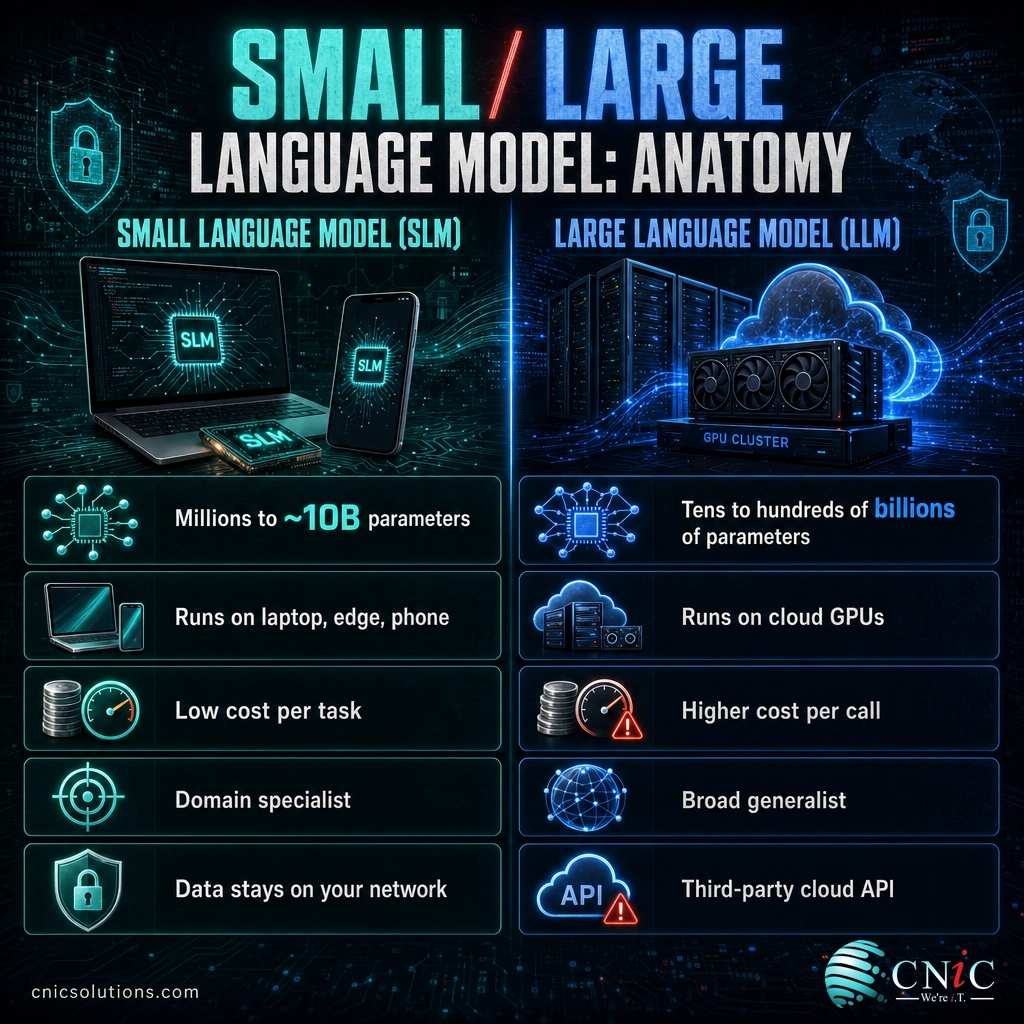
| Size | Millions to ~10 billion parameters | Tens to hundreds of billions of parameters |
| Best at | Narrow, repeatable, domain-specific tasks | Open-ended reasoning and broad general knowledge |
| Where it runs | Laptops, edge devices, phones, on-premise servers | Cloud GPUs and large-scale infrastructure |
| Cost profile | Low per task, cheap to fine-tune | Higher per call, expensive to train |
| Data control | Can stay entirely on your network | Usually a third-party cloud API |
- Size is the whole story. SLMs run from millions to roughly ten billion parameters; LLMs run from tens to hundreds of billions. Cost, speed, hardware, and privacy all follow from that gap.
- Small does not mean weak. Microsoft’s 3.8-billion-parameter Phi-3-mini scores 69% on the MMLU benchmark, on par with GPT-3.5, while running on a phone.
- SLMs win on cost, speed, and privacy. Fewer parameters mean cheaper hardware, faster responses, and the option to keep data on your own network.
- LLMs win on breadth. For open-ended reasoning, long context, and tasks you cannot fully define in advance, a large model is still the stronger choice.
- The real answer is usually hybrid. Gartner expects task-specific small models to be used three times more than general-purpose LLMs by 2027, with each handling the work it fits.
What’s in This Guide
- Understanding Small Language Models (SLMs)
- Understanding Large Language Models (LLMs)
- Head-to-Head: SLM vs LLM on Six Criteria
- SLM vs LLM Comparison Table
- Who Should Choose a Small Language Model
- Who Should Choose a Large Language Model
- The Hybrid Answer Most Businesses Land On
- Frequently Asked Questions
- Methodology and Sources
Understanding Small Language Models (SLMs)
A small language model is a language model with a compact parameter count, typically from a few million up to around ten billion, often trained or fine-tuned to be very good at a specific domain rather than at everything. Parameters are the internal values a model learns during training; they are the closest thing a model has to knowledge and skill. Fewer parameters means a smaller memory footprint, less computation per response, and the ability to run on hardware you already own.
The common assumption is that fewer parameters must mean a weaker model. Recent results have broken that assumption. Microsoft’s Phi-3-mini has just 3.8 billion parameters, yet its published technical report shows it scoring 69% on the MMLU knowledge-and-reasoning benchmark and 8.38 on MT-bench, performance the researchers describe as rivaling models such as Mixtral 8x7B and GPT-3.5, despite being small enough to run locally on a phone. The gain came not from more parameters but from higher-quality, more carefully filtered training data.
How SLMs work
An SLM is trained on a smaller, often domain-focused dataset and then frequently fine-tuned on a company’s own documents, tickets, or records. Because the model is compact, that fine-tuning is fast and inexpensive, and the resulting model becomes a specialist: it does not know everything, but it knows your task deeply. This is the pattern behind on-device assistants, document classifiers, extraction tools, and internal knowledge chatbots.
Where SLMs shine
- Narrow, repeatable tasks. Summarizing tickets, tagging documents, extracting fields, routing requests, and answering questions from a fixed knowledge base.
- On-device and on-premise deployment. Running on laptops, edge hardware, or your own servers so data never leaves your control.
- High-volume, cost-sensitive workloads. Tasks performed thousands of times a day where per-request cost is what matters.
Where SLMs fall short
- Open-ended reasoning. Complex, multi-step problems that were not anticipated during training or fine-tuning.
- Broad general knowledge. Questions that range far outside the model’s trained domain.
- Very long context. Some, though not all, small models handle less context than the largest frontier models.
Best for: well-defined, high-volume tasks where cost, speed, and data control matter more than open-ended breadth.
Source: Microsoft Phi-3 Technical Report (arXiv 2404.14219)
Understanding Large Language Models (LLMs)
A large language model is trained with tens to hundreds of billions of parameters on an enormous, broad corpus, which gives it wide general knowledge and the ability to handle problems it was never explicitly trained for. LLMs are the models behind the well-known general-purpose assistants, and they remain the strongest option for open-ended work. The scale that makes them capable is also what makes them expensive.
To picture the gap, consider OpenAI’s GPT-3, whose foundational research paper documents 175 billion parameters. That is roughly forty-six times the size of Phi-3-mini, and today’s frontier models are larger still. Serving a model of that size means renting high-end GPUs and sending each request to a data center, which is why almost all LLM use happens through a cloud API rather than on local hardware.
How LLMs work
An LLM learns broad patterns of language, reasoning, and world knowledge from a very large and diverse training set. Because it has seen so much, it can generalize to new tasks with little or no task-specific training, often from a plain-language instruction alone. That flexibility is the reason a single LLM can draft an email, explain a contract clause, write code, and brainstorm a strategy without being retrained for each.
Where LLMs shine
- Open-ended reasoning. Complex, ambiguous, or novel problems that resist a fixed definition.
- Broad general knowledge. Wide-ranging questions across many domains at once.
- Creative and long-form generation. Drafting, research synthesis, and multi-step tool use.
Where LLMs fall short
- Cost at volume. A per-call price that is trivial once becomes significant across millions of requests.
- Latency. Larger models generally take longer to respond, which matters for real-time and high-throughput uses.
- Data control. Sending prompts to a third-party API raises privacy and compliance questions for regulated data.
- Overkill on simple tasks. Paying frontier-model prices for work a small model handles just as well.
Best for: open-ended, high-variety, reasoning-heavy work where breadth and capability outweigh cost per request.
Myth: “Bigger is always better, so we should just use the biggest model for everything.” Bigger is better at breadth, not at every job. For a narrow, well-defined task, a fine-tuned small model can match a much larger one at a fraction of the cost, and it can run where a frontier model cannot, on your own hardware. NVIDIA researchers argue in a 2025 paper that for the repetitive, specialized tasks that dominate real business AI use, small models are sufficiently capable, better suited, and more economical than defaulting to a large model for every request. Reaching for the biggest model by reflex is how AI budgets quietly balloon without a matching gain in results.
Source: Brown et al., Language Models are Few-Shot Learners (arXiv 2005.14165) | Belcak et al., Small Language Models are the Future of Agentic AI, NVIDIA Research (arXiv 2506.02153)
Head-to-Head: SLM vs LLM on Six Criteria
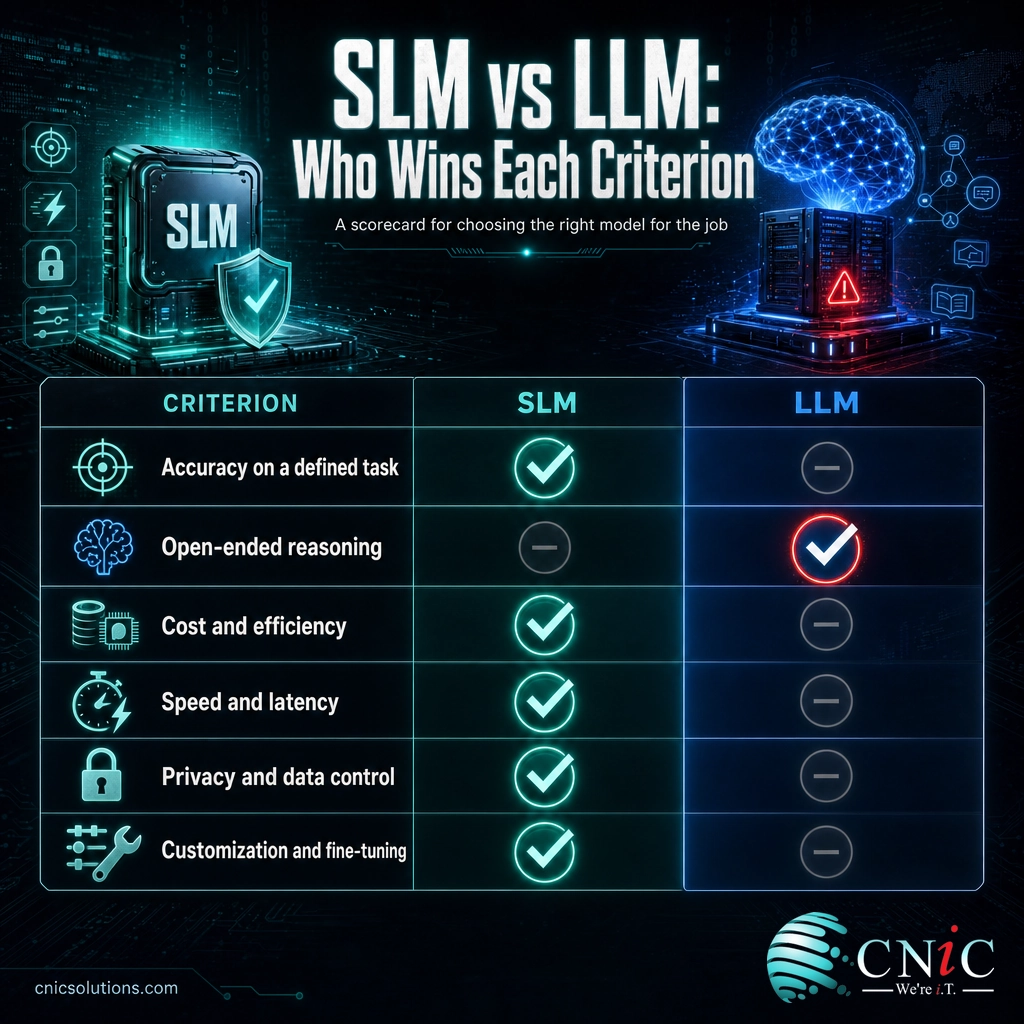
Neither model type is a single “winner,” because they are built for different halves of the problem. But on each individual criterion that a business buyer cares about, one clearly leads. Here is where each earns its place.
1. Accuracy and capability
On broad, open-ended, and unpredictable tasks, the LLM wins: more parameters and a wider training set translate into stronger general reasoning. On a narrow, well-defined task, though, a small model fine-tuned on the right data can match or exceed a much larger one, because it has specialized in exactly that job. The Phi-3 results make the point: a 3.8-billion-parameter model reaching 69% on MMLU shows that careful training closes much of the gap that raw size used to guarantee.
MMLU benchmark score across the Phi-3 model family
Source: Microsoft, Phi-3 Technical Report (2024). Quality rises with size, but even the smallest model is already strong, which is why fit to the task often matters more than parameter count.
Winner: LLM for breadth, SLM for a defined task. If you can describe the task precisely, a small model can own it. If you cannot, lean large.
2. Cost and efficiency
Fewer parameters mean less memory, less compute, and less energy per response, so a small model is dramatically cheaper to operate at volume. That is the heart of the NVIDIA argument for small models in agentic systems: when a language model performs the same narrow task thousands of times, the economical choice is a right-sized small model, not a frontier model billed per call. Large models still justify their cost for work only they can do, but paying that premium for simple, repetitive tasks is where budgets leak.
Winner: SLM. On cost per task and energy efficiency, small models lead by a wide margin.
3. Speed and latency
A smaller model has less to compute for each token it produces, so it generally responds faster. For anything interactive or high-throughput, a customer-facing chat, a real-time routing decision, an on-device assistant, that lower latency is a direct part of the user experience. Large models can be fast enough for many uses, but as volume and real-time demands rise, the efficiency of a small model becomes a competitive advantage rather than a footnote.
Winner: SLM, particularly for real-time and high-volume workloads.
4. Privacy, data control, and security
Because a small model can run on your own servers or devices, sensitive data never has to leave your network to be processed. For regulated data, protected health information, financial records, legal files, or anything under a data-residency requirement, that is a meaningful advantage over sending every prompt to a third-party cloud API. Keeping the model in-house does not remove the need for good security, but it puts you in control of where your data lives, which is exactly the ground where a strong cybersecurity program earns its keep.
Winner: SLM, for any workload where data must stay on-premise or under strict control.
5. Deployment and infrastructure
An LLM effectively requires cloud infrastructure: high-end GPUs, scaling, and the operational work that comes with them. A small model can run on modest hardware, including equipment you already have, which lowers the barrier to getting started and to keeping a workload running. The tradeoff is that self-hosting any model means owning its uptime, updates, and scaling, which is where planning your cloud and hosting strategy up front pays off regardless of which size you choose.
Winner: SLM for lightweight and edge deployment; LLM when you want a managed cloud API and no infrastructure of your own.
6. Customization and fine-tuning
Adapting a model to your specific domain is far cheaper and faster with a small model, because there are fewer parameters to update and lighter hardware requirements to do it. That makes it practical to maintain several specialized small models, one per task, and to retrain them as your data changes. Fine-tuning a frontier LLM is possible but costly, so most businesses adapt LLMs through prompting and retrieval rather than full fine-tuning.
Winner: SLM, for teams that want a model shaped tightly around their own data.
Projected enterprise usage by 2027, task-specific small models vs general-purpose LLMs
Source: Gartner (April 2025). Gartner expects task-specific small models to be used roughly three times more than general-purpose LLMs by 2027.
Source: Gartner press release, April 2025

SLM vs LLM Comparison Table
The two model types line up cleanly once you compare them on the criteria that drive a real decision. The pattern is consistent: small models lead on cost, speed, privacy, and customization, while large models lead on breadth and open-ended reasoning.
| Criterion | Small Language Model (SLM) | Large Language Model (LLM) | Winner |
|---|---|---|---|
| Parameters | Millions to ~10 billion | Tens to hundreds of billions | Depends on task |
| Accuracy on a defined task | Matches or beats larger models when fine-tuned | Strong, but often more than needed | SLM |
| Open-ended reasoning | Limited outside its domain | Strongest available | LLM |
| Cost per request | Low | Higher | SLM |
| Speed / latency | Faster | Slower at scale | SLM |
| Where it runs | Laptop, edge, phone, on-premise | Cloud GPUs required | SLM |
| Data privacy / control | Can stay on your network | Usually a third-party API | SLM |
| Customization / fine-tuning | Cheap and fast | Expensive; usually prompt or retrieval instead | SLM |
| Breadth of knowledge | Narrow, domain-specific | Broad and general | LLM |
| Best fit | High-volume, well-defined tasks | Open-ended, high-variety work | Both, by job |
Who Should Choose a Small Language Model
A small language model is the right primary choice when your AI workload is defined, repetitive, and cost- or privacy-sensitive. It fits the buyer who knows exactly what the model needs to do and wants it done efficiently at scale.
- You run a high-volume, narrow task. Classifying documents, extracting data, tagging tickets, or answering questions from a fixed knowledge base, thousands of times a day.
- Data cannot leave your network. You handle regulated or sensitive information and need processing to stay on-premise or on-device.
- Cost per request is the constraint. The task is simple enough that frontier-model pricing would be waste, not value.
- You want a specialist tuned to your data. Cheap, fast fine-tuning lets you shape the model tightly around your own documents and language.
- You need low latency or edge deployment. Real-time responses or devices in the field where a cloud round trip is impractical.
Who Should Choose a Large Language Model
A large language model is the right choice when the work is open-ended, varied, or hard to define in advance, and when breadth and reasoning matter more than cost per call.
- Your tasks are open-ended. Drafting, research synthesis, strategy, and problems you cannot script ahead of time.
- You need broad general knowledge. Wide-ranging questions across many domains from a single model.
- Variety beats volume. Many different one-off requests rather than one task repeated at massive scale.
- You want zero infrastructure. A managed cloud API you can call without hosting or maintaining a model yourself.
- Reasoning depth is the priority. Complex, multi-step work where the strongest available capability is worth the premium.
The Hybrid Answer Most Businesses Land On
Framed as “SLM or LLM,” the question has no single answer, because the smartest architecture usually uses both. A common and effective pattern is a hybrid system: a fast, cheap small model handles the routine, high-volume work and decides what it can answer on its own, and it escalates only the genuinely hard or open-ended requests to a large model. Most traffic is served by the efficient specialist, and the expensive generalist is called only when it is truly needed. That keeps the cost curve flat while preserving full capability for the cases that require it.
This is exactly the direction the research points. NVIDIA’s 2025 paper argues that heterogeneous systems, ones that call different models for different jobs, are the natural design for agentic AI, with small models doing the repetitive specialized work and large models reserved for tasks that need general conversational ability. Gartner’s projection of task-specific models outpacing general-purpose LLMs three to one by 2027 describes the same shift from the enterprise side.
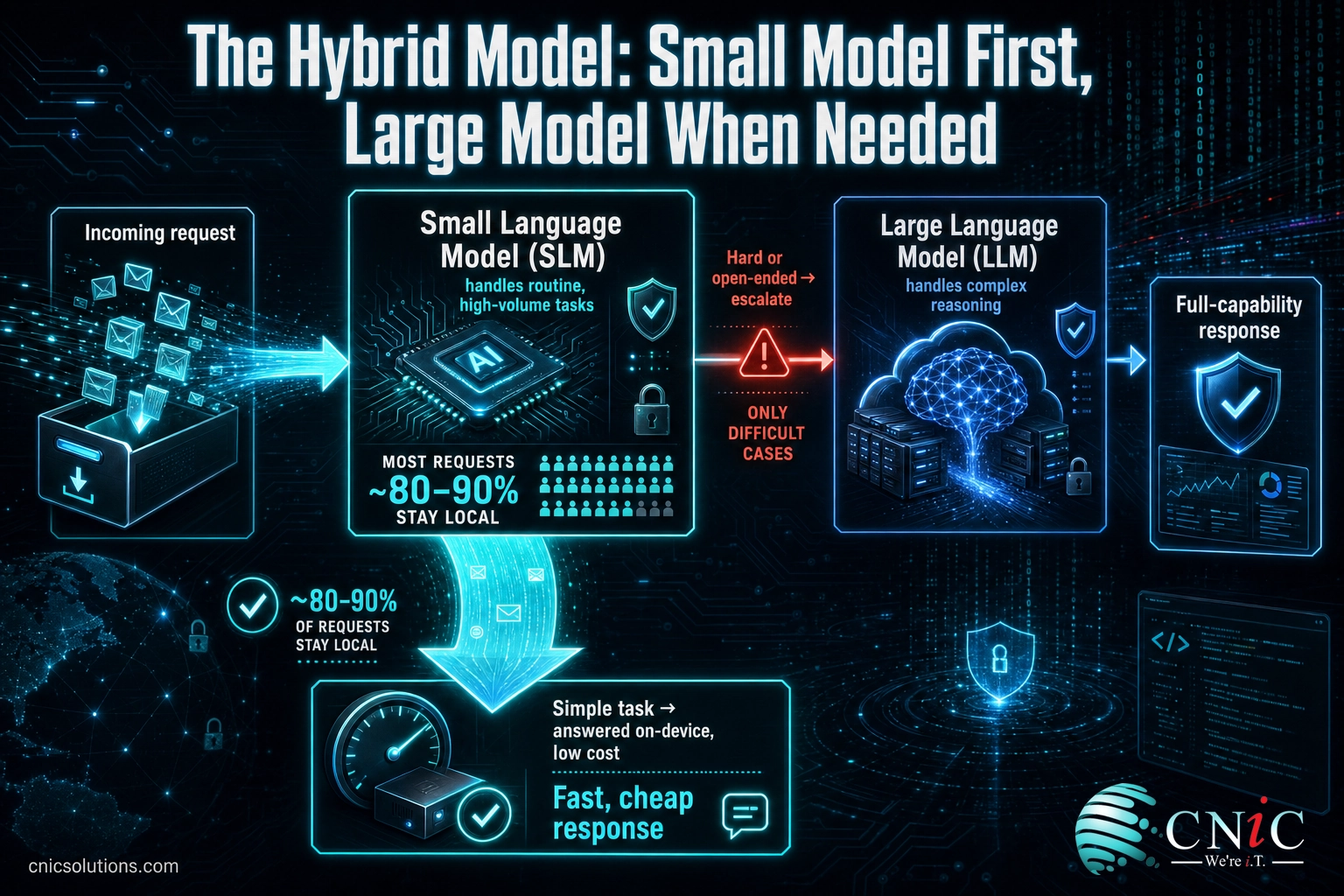
The practical takeaway is that the model decision is really an architecture decision, and getting it right is where the savings and the results live. The work is mapping which of your workflows fit a small specialized model, which genuinely need a large one, and how to deploy them securely on the right infrastructure rather than defaulting to the biggest model and the biggest bill. Choosing the right AI model for each task is not about picking a side in SLM versus LLM; it is about matching the tool to the job.
Get a Free AI Strategy Consultation
Frequently Asked Questions
What is the difference between an SLM and an LLM?
Are small language models less accurate than large ones?
Can a small language model run without the cloud?
Is an SLM cheaper to run than an LLM?
Should my business use an SLM or an LLM?
Methodology and Sources
How we compiled this comparison
This guide compares small and large language models using vendor-neutral definitions and figures drawn only from primary sources: peer-reviewed and published research papers, an official model technical report, and a named analyst-firm forecast. Every statistic is cited inline and listed below. No figures were estimated or invented, and no number is used that could not be traced to its original source.
Parameter counts and benchmark scores for the Phi-3 family (3.8B, 7B, and 14B parameters; 69%, 75%, and 78% MMLU) are from Microsoft’s Phi-3 Technical Report. The 175-billion-parameter figure for GPT-3 is from the original OpenAI research paper. The argument that small models are more suitable and economical for repetitive, specialized tasks is from NVIDIA Research. The projection that organizations will use task-specific small models three times more than general-purpose LLMs by 2027 is from Gartner.
- Microsoft, Phi-3 Technical Report: A Highly Capable Language Model Locally on Your Phone (2024) (SLM parameter counts and MMLU benchmarks)
- Brown et al., Language Models are Few-Shot Learners (2020) (GPT-3 175B parameter count)
- Belcak et al., Small Language Models are the Future of Agentic AI, NVIDIA Research (2025) (SLM suitability and economics for specialized tasks)
- Gartner press release, April 2025 (2027 usage projection)



related posts
What Is a Firmware Update and Why It Matters for Security
October 6, 2026A firmware update is a manufacturer-issued revision to the low-level software built into a device, such…
What Is a Human Firewall? Turning Employees Into Your Best Defense
October 6, 2026A human firewall is the group of employees who, through security awareness and good habits, act…
What Is a Distributed System? How It Works and Why It Matters
October 5, 2026A distributed system is a collection of independent computers, called nodes, that are connected over a…
What Is a Firewall? How It Protects Your Business Network
October 5, 2026A firewall is a network security device or software that monitors incoming and outgoing traffic and…