

Cloud Security Posture Management (CSPM) is a category of security tools that continuously scan cloud environments (AWS, Azure, Google Cloud, and SaaS) for misconfigurations, policy violations, and compliance gaps, then alert your team or fix the issue automatically. Because most cloud breaches trace back to customer setup mistakes, CSPM has become a baseline layer of cloud defense.
Moving to the cloud does not hand your security over to Amazon, Microsoft, or Google. Under the shared responsibility model, those providers secure the cloud itself, but you are on the hook for how you configure it, and one forgotten setting can expose an entire database to the open internet. CSPM exists because that single category of mistake, the quiet misconfiguration, is behind more cloud breaches than any exotic hacker technique.
- CSPM watches your cloud configuration around the clock, comparing every setting against security benchmarks and flagging risky ones like public storage buckets or over-permissive access.
- Misconfiguration is the core problem it solves. Gartner forecasts that through 2025, 99% of cloud security failures will be the customer’s fault, not the provider’s.
- The cost of getting it wrong is real: the global average data breach reached $4.88 million in 2024, and breaches spanning multiple environments topped $5 million (IBM).
- CSPM is not CWPP or CNAPP. CSPM covers posture and configuration; workload and runtime protection are separate layers that roll up together under a CNAPP.
- Any business running cloud or Microsoft 365 benefits, and smaller teams without a dedicated cloud specialist benefit most, because that is where misconfigurations hide longest.
What’s in This Guide
How Cloud Security Posture Management Works
Think of CSPM as a building inspector who never clocks out. Instead of walking through once and signing off, this inspector keeps circling the property, checking that every door is locked, every window is latched, and every alarm is armed, and either radioing you or locking the door the moment something is left open. In cloud terms, the “doors and windows” are the thousands of configuration settings spread across your accounts, and the inspector is software that reads them through the provider’s own APIs.
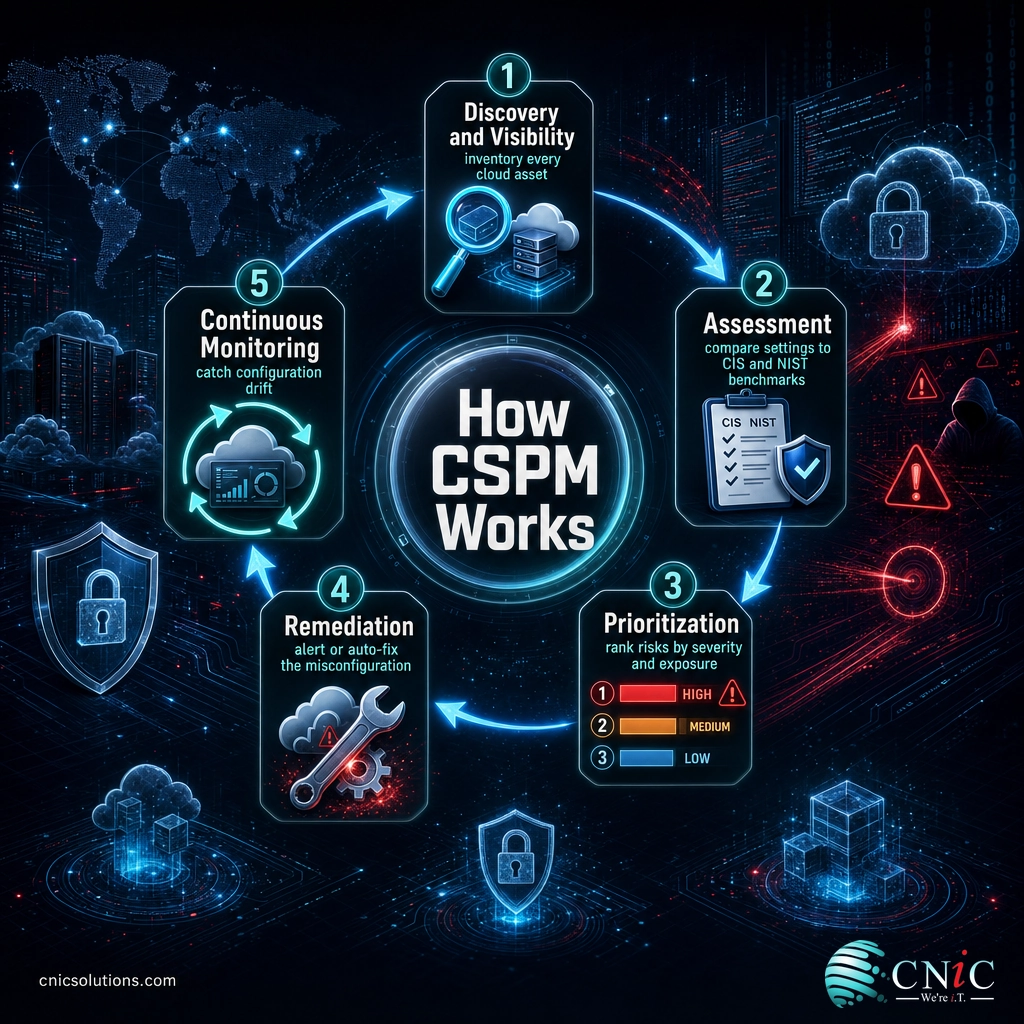
CSPM is agentless. Rather than installing anything on your servers, it connects to your cloud accounts through read access and inspects the control plane, the settings layer where you decide who can access what and how resources are exposed. That is why it can cover a sprawling, multi-cloud footprint quickly. The process runs in a continuous loop:
- Discovery and visibility. CSPM inventories every asset across every connected account and cloud, including the resources teams spin up without telling anyone. You cannot secure what you cannot see, and shadow cloud usage is common.
- Assessment. Each setting is measured against established benchmarks (such as the CIS Benchmarks and NIST guidance) and your own internal policies to find where reality drifts from a secure baseline.
- Prioritization. Not every finding is an emergency. CSPM ranks risks by severity and exposure, pushing an internet-facing database with no encryption to the top and a low-impact internal setting to the bottom.
- Remediation. For each issue, CSPM either opens an alert with step-by-step guidance or, where you allow it, fixes the misconfiguration automatically. This is where posture actually improves rather than just being measured.
- Continuous monitoring. The loop repeats constantly, catching “configuration drift,” the slow slide back into risk as engineers make day-to-day changes that quietly reopen a gap.
That last step is the whole point. A one-time cloud audit is a photograph; CSPM is a live video feed. Cloud environments change by the hour, and a setting that was safe on Monday can be exposed by Friday after a routine deployment.
Source: NIST SP 800-145 cloud computing definition | NSA and CISA joint advisory on top misconfigurations
CSPM vs. CWPP: Clearing Up the Biggest Confusion
The most common mix-up in cloud security is CSPM versus CWPP (Cloud Workload Protection Platform). They sound similar and often ship together, but they answer two different questions. CSPM asks, “Is my cloud set up securely?” CWPP asks, “Are the things running inside my cloud secure?”
Put plainly: CSPM watches the settings, CWPP watches the workloads. CSPM is agentless and reads configuration through APIs; CWPP typically runs closer to the workload to catch vulnerabilities, malware, and suspicious behavior inside virtual machines, containers, and serverless functions at runtime. You need both, and in modern platforms they are combined, but understanding the split helps you know what a CSPM tool will and will not catch.
| Dimension | CSPM (Cloud Security Posture Management) | CWPP (Cloud Workload Protection Platform) |
|---|---|---|
| Question it answers | Is my cloud configured securely? | Are my running workloads secure? |
| Focus | Configuration and the control plane (settings) | Workloads: VMs, containers, serverless (runtime) |
| How it deploys | Agentless, via cloud provider APIs | Usually agent-based or runtime sensors |
| Typical findings | Public storage, disabled logging, over-permissive access, missing MFA | Unpatched vulnerabilities, malware, anomalous process behavior |
| Best at preventing | Accidental exposure and compliance drift | Active exploitation of a running workload |
If you only remember one line, make it this: a misconfigured, world-readable storage bucket is a CSPM problem, and a compromised container quietly mining cryptocurrency is a CWPP problem. Most real cloud incidents start with the first kind, which is why posture management is usually the first control businesses put in place.
Source: Gartner: Is the Cloud Secure?
Once you can see and manage your cloud posture, the next question is whether the investment is worth it. The numbers make that case quickly.
Why CSPM Matters for Growing Businesses
The reason CSPM went from a niche tool to a standard control is simple: the failures it prevents are both common and expensive. Cloud misconfiguration is not a rare, sophisticated attack. It is an everyday clerical mistake that criminals scan for constantly, and the financial fallout is well documented.
The through-line is human error, and cloud configuration is one of the easiest places for it to happen. Cloud platforms give you enormous flexibility, but every toggle you can flip is a toggle you can flip the wrong way. Most established IT professionals have far more experience securing on-premises systems than cloud ones, which widens the odds of an accidental slip. CSPM narrows those odds by catching the mistake in minutes instead of the 258-day average breach lifecycle IBM recorded in 2024.
Myth: “My cloud provider handles all of the security.” This is the single most expensive misunderstanding in cloud computing. Under the shared responsibility model, AWS, Azure, and Google secure the underlying infrastructure, but you are responsible for your data, your access controls, and your configuration. That is exactly why Gartner forecasts that through 2025, 99% of cloud security failures will be the customer’s fault. CSPM is how you hold up your end of that bargain.
For a small or midsize business, the appeal is not just risk reduction. It is doing the work without hiring a full cloud security team. A CSPM platform, often delivered through a managed security services provider (MSSP), gives you continuous coverage that would otherwise require specialists you may not have on staff.
Explore Managed Cybersecurity Services
Source: IBM Cost of a Data Breach Report 2024 | Verizon 2024 DBIR
What CSPM Actually Checks For
CSPM tools vary, but the categories of risk they hunt for are consistent. Understanding them helps you translate a scan report into plain-language action items.
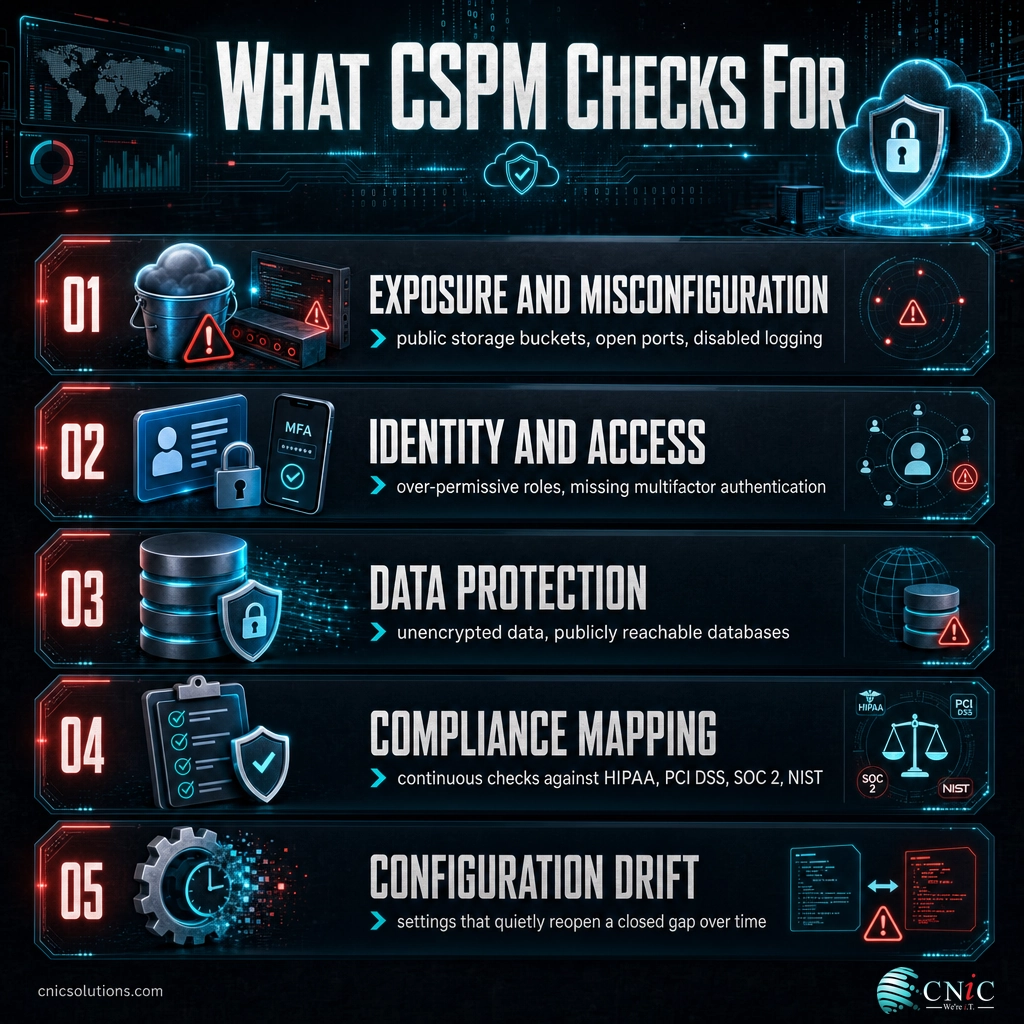
- Exposure and misconfiguration. Publicly accessible storage buckets, open management ports, disabled logging, and default settings left in place. This is the classic “we didn’t mean to make that public” category.
- Identity and access. Over-permissive roles, unused accounts with standing access, and missing multifactor authentication. Weak or misconfigured MFA is one of the systemic weaknesses NSA and CISA flagged across even mature organizations.
- Data protection. Unencrypted data at rest or in transit, and databases reachable from the public internet without justification.
- Compliance mapping. Continuous checks against frameworks like HIPAA, PCI DSS, SOC 2, and NIST, so an audit becomes a report you can pull rather than a fire drill you dread.
- Configuration drift. Changes over time that reopen a previously closed gap, the slow erosion that manual reviews almost always miss.
Each of these maps to a real breach headline you have probably read. The value of CSPM is turning that reactive lesson into a proactive alert, ideally before an attacker’s automated scanner finds the same open door. Pairing CSPM findings with a broader cybersecurity risk assessment gives you the full picture of where your exposure sits.
Source: NSA and CISA: Top Ten Cybersecurity Misconfigurations
CSPM and the Cloud Security Family
CSPM rarely works alone. It is one member of a family of acronyms that have grown up around cloud security, and vendors increasingly bundle them. Knowing the roles keeps you from paying twice for the same coverage or leaving a gap between tools.
- CNAPP (Cloud-Native Application Protection Platform) is the umbrella. It combines posture, workload, and identity protection into one platform. CSPM is a core component of a CNAPP, not a competitor to it.
- CWPP (Cloud Workload Protection Platform) secures the running workloads, as covered above.
- CIEM (Cloud Infrastructure Entitlement Management) zeroes in on permissions, answering “who can do what” and trimming excess access.
- CASB (Cloud Access Security Broker) sits between users and SaaS apps to enforce access and data policies.
- DSPM (Data Security Posture Management) applies the posture idea to the data itself, finding sensitive data and checking how it is protected.
The practical takeaway: CSPM is usually the starting point because misconfiguration is the most common entry point. From there, businesses layer on the pieces that match their risk, frequently as part of a broader cloud strategy rather than a scramble of standalone tools.
Source: Gartner cloud security guidance
How to Get Started With CSPM
Adopting CSPM does not have to be a massive project. The most effective rollouts follow a simple order of operations that delivers value in the first week.
- Establish a baseline. Connect your cloud accounts and run an initial posture scan. The first report is almost always eye-opening, and it tells you where the real risk lives instead of where you assume it does.
- Fix the internet-facing and identity issues first. Public exposure and weak access controls are the highest-impact fixes. Clear those before chasing low-severity findings.
- Turn on continuous monitoring. A single scan ages instantly. Set CSPM to run continuously so drift is caught as it happens, not at the next quarterly review.
- Map to your compliance needs. If you handle regulated data, align the tool to the relevant framework so posture and audit readiness improve together.
- Prevent, do not just detect. Extend checks into your deployment pipeline so misconfigurations are caught in infrastructure-as-code before they ever reach production.
Many businesses run this through a partner rather than staffing it internally. That is where virtual CIO leadership and managed security come together: someone owns the strategy, the tooling runs continuously, and your team stays focused on the business. If your cloud footprint is growing, a managed cloud solutions engagement can fold CSPM into the way your environment is designed from the start.
Get a Free Cloud Security Consultation
Source: NIST cloud computing framework
Common Questions About CSPM
What is CSPM in simple terms?
What problem does CSPM solve?
Is CSPM the same as a CASB?
Do small and midsize businesses need CSPM?
What is the difference between CSPM and CNAPP?
Related Terms
- Shared Responsibility Model: the division of security duties between a cloud provider and its customer. See our complete guide to cloud computing for business.
- Cloud Misconfiguration: an insecure cloud setting, and the risk CSPM is built to eliminate.
- CNAPP: the platform that unifies posture, workload, and identity protection.
- CWPP: workload and runtime protection for VMs, containers, and serverless functions.
- Cybersecurity Risk Assessment: the broader evaluation of your security gaps. Read what a risk assessment is and why you need one.
- MSSP: a managed security services provider that can run CSPM for you. See what an MSSP is.
- Virtual CISO (vCISO): outsourced security leadership. Learn what a vCISO is and whether you need one.
- Configuration Drift: the gradual return to insecure settings that continuous CSPM monitoring is designed to catch.
About This Guide and Its Sources
This explainer draws only on primary, verifiable sources. Breach cost and lifecycle figures come from IBM’s Cost of a Data Breach Report 2024. The human-element figure comes from Verizon’s 2024 Data Breach Investigations Report. The cloud-security-failure forecast is from Gartner. Misconfiguration guidance references the joint NSA and CISA advisory, and cloud computing definitions reference NIST. No statistics were estimated or invented.
Talk to CNiC About Securing Your Cloud Infrastructure



related posts
What Is Cyber Safety? Staying Safe Online at Work
October 16, 2026Cyber safety is the everyday habits and precautions people use to protect themselves, their information, and…
What Is Cybersecurity? A Business Guide
October 16, 2026Cybersecurity is the practice of protecting computers, networks, data, and accounts from digital attacks and unauthorized…
What Is Containerization? Benefits and How It Works
October 15, 2026Containerization is a form of operating system virtualization that packages an application together with everything it…
What Is Cloud Computing? A Beginner’s Guide for Businesses
October 14, 2026Cloud computing is the on-demand delivery of computing resources (servers, storage, databases, software, and networking) over…