

Ransomware is not a distant, big-city problem for Texas businesses. It is a local one. Texas ranks second in the nation for cybercrime complaints, and attackers have hit Texas cities, school districts, hospitals, utilities, and thousands of small businesses, often all at once through a shared vendor. This guide lays out what the data actually shows about ransomware in Texas, the incidents worth learning from, what an attack really costs, and the specific steps that keep a business off the victim list.
- Texas is a top target. The FBI’s 2024 Internet Crime Report ranked Texas second nationally in cybercrime complaints, with about 1.35 billion dollars in reported losses in 2024.
- Ransomware is still climbing. Ransomware complaints to the FBI rose 9 percent year over year and remained the most pervasive threat to U.S. critical infrastructure.
- Small businesses are the target, not collateral. 88 percent of SMB breaches involved ransomware in the 2025 Verizon DBIR, more than double the 39 percent rate at large organizations.
- The ransom is the small number. Average recovery cost was 1.53 million dollars in 2025 (excluding ransom), and breaches took an average of 241 days to identify and contain.
- Preventable with basics. Tested backups, multi-factor authentication, endpoint detection and response, and a rehearsed incident plan stop or contain the large majority of attacks.
What’s in This Guide
- The Texas ransomware picture right now
- Notable ransomware incidents in Texas
- Why Texas businesses are in the crosshairs
- What a Texas ransomware attack actually costs
- What Texas businesses should do right now
- How CNiC helps Texas businesses stay ahead of ransomware
- Frequently asked questions
- Methodology and sources
The Texas Ransomware Picture Right Now
Texas carries a disproportionate share of the country’s cybercrime, and ransomware sits at the center of it. In its 2024 Internet Crime Report, the FBI’s Internet Crime Complaint Center ranked Texas second in the nation for complaint volume, behind only California. Victims across the state reported roughly 1.35 billion dollars in losses that year, part of a record 16.6 billion dollars in losses reported nationwide.
Ransomware is not fading as newer threats emerge. The FBI reported that ransomware complaints rose 9 percent year over year and remained the single most pervasive threat to organizations in critical infrastructure sectors, the same sectors that anchor Texas employment: healthcare, energy, manufacturing, education, and government. The agency logged more than 4,800 complaints from critical infrastructure organizations, with ransomware and data breaches the most reported.
One honest caveat: the FBI does not publish a Texas-only ransomware dollar figure. The 1.35 billion dollars above covers all reported cybercrime in the state, and the ransomware-specific numbers here are national. What the combined data makes clear is the direction of travel. Texas absorbs an outsized volume of attacks, and ransomware remains the most damaging category for the organizations that get hit. For a deeper breakdown of the national numbers, see our roundup of the latest ransomware attack data.
| Statistic | Figure | Source | Year |
|---|---|---|---|
| Texas national rank, cybercrime complaints | #2 | FBI IC3 | 2024 |
| Losses reported by Texas victims | $1.35 billion | FBI IC3 | 2024 |
| Total U.S. cybercrime losses reported | $16.6 billion | FBI IC3 | 2024 |
| Change in ransomware complaints, year over year | +9% | FBI IC3 | 2024 |
| Complaints from critical infrastructure orgs | 4,800+ | FBI IC3 | 2024 |
| New ransomware variants tracked | 67 | FBI IC3 | 2024 |
| SMB breaches that involved ransomware | 88% | Verizon DBIR | 2025 |
| Large-org breaches that involved ransomware | 39% | Verizon DBIR | 2025 |
| Average ransomware recovery cost (excl. ransom) | $1.53 million | Sophos | 2025 |
| Prior-year average recovery cost | $2.73 million | Sophos | 2024 |
| Organizations that paid the ransom | ~50% | Sophos | 2025 |
| Average time to identify and contain a breach | 241 days | IBM | 2025 |
| Texas entities hit in one coordinated attack | 22 | Texas DIR | 2019 |
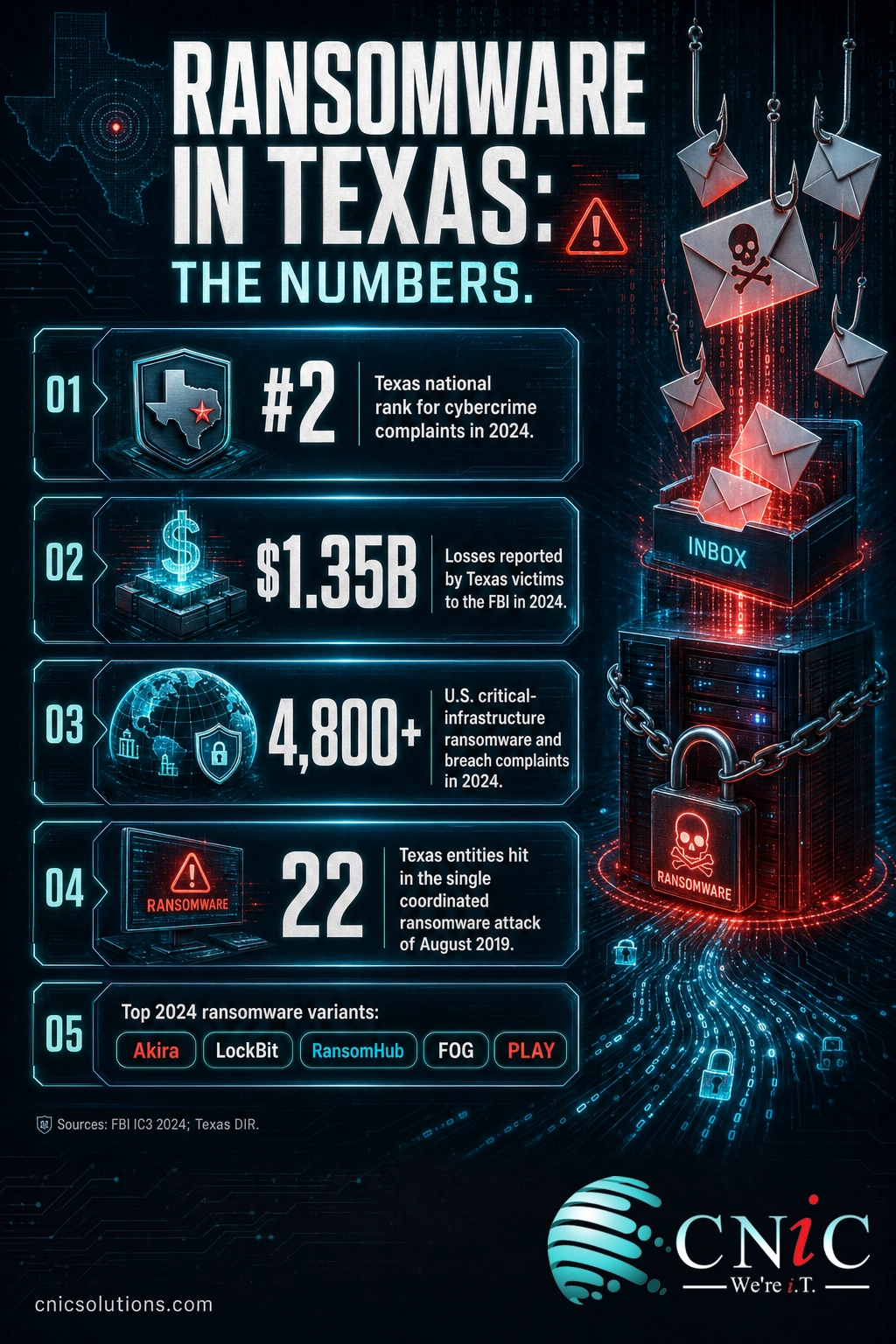
Source: FBI Internet Crime Complaint Center, 2024 Internet Crime Report
Notable Ransomware Incidents in Texas
The most instructive Texas ransomware event is still the coordinated attack of August 16, 2019. In the early morning hours, 22 Texas entities reported ransomware infections at nearly the same time, most of them smaller local governments in towns like Borger and Keene. State investigators concluded a single threat actor was behind all of them. The Texas Department of Information Resources activated the State Operations Center, and by roughly a week later every affected entity had moved from response into recovery with business-critical services restored.
The lesson for private businesses is the mechanism, not the target. Attacking 22 organizations on one morning is only efficient if you can reach them through a common door. Investigators pointed to shared IT infrastructure and managed service provider access as the likely path. That same pattern, one compromised vendor cascading to many downstream clients, is exactly what threatens small businesses that outsource IT without confirming their provider’s own security posture.
The pattern that keeps repeating in Texas
Since 2019, the targets have broadened but the playbook has not. Texas public school districts have been among the most frequently hit public entities, with attacks knocking out phone systems, security cameras, and student information systems. Hospitals and clinics face double exposure: operational shutdown plus HIPAA breach-notification duties the moment protected health information is accessed. Utilities and municipal services have seen billing and payment systems disrupted. In almost every case, the organizations that recovered fastest were the ones with tested backups and a response plan already in place.
These incidents rarely make national headlines the way a Fortune 500 breach does, which creates a dangerous false comfort for local business owners. If you want a wider view of what has been hitting organizations across the state, we track other recent Texas hacks and the defenses that would have blunted them.
Source: Texas Department of Information Resources, coordinated ransomware attack advisory
Why Texas Businesses Are in the Crosshairs
There is a persistent myth that ransomware crews only chase large enterprises with deep pockets. The data says the opposite. Verizon’s 2025 Data Breach Investigations Report found that 88 percent of breaches at small and midsize businesses involved ransomware, compared with 39 percent at large organizations. Attackers are not skipping small companies; they are prioritizing them.
Share of breaches that involved ransomware (Verizon 2025 DBIR)
The reasons are structural. A midsize accounting firm in Sugar Land or a manufacturer in San Antonio typically runs lean, without a dedicated security team watching alerts overnight. Backups may exist but go untested. Multi-factor authentication may be enabled for some accounts and not others. Each gap is a foothold, and automated attacks scan for them at scale. Texas’s economic mix compounds the exposure: the state is dense with the exact sectors attackers favor, including healthcare, energy, construction, logistics, and professional services that hold sensitive client data.
Myth: “We’re too small to be a target”
Being small is not camouflage. It is the qualification. Ransomware is largely automated and opportunistic, and it rewards attackers for hitting the least-defended door, not the richest one. A business with 15 employees, no tested backups, and a flat network is a faster payout than a hardened enterprise. The businesses that get skipped are not the small ones; they are the prepared ones.
Understanding your own risk posture is the job of a strategic IT leader, which is why many Texas businesses that cannot justify a full-time CISO bring in one on a fractional basis.
Get a strategic security roadmap with Virtual CIO services
Source: Verizon 2025 Data Breach Investigations Report
What a Texas Ransomware Attack Actually Costs
Owners tend to fixate on the ransom demand, but that is usually the smallest line on the invoice. Sophos’s State of Ransomware 2025 report, based on responses from 3,400 IT and security leaders at organizations with 100 to 5,000 employees, put the average recovery cost, excluding any ransom paid, at 1.53 million dollars. That figure actually fell from 2.73 million the year before, but it still represents a business-ending number for many small companies.
The real damage is time. IBM’s 2025 Cost of a Data Breach report found breaches took an average of 241 days to identify and contain. For a Texas business, that translates into weeks of halted operations, staff overtime, emergency consultants, legal and notification costs, lost contracts, and customers who quietly move on. Paying the ransom does not shortcut this, and Sophos found roughly half of hit organizations paid anyway, often without getting all their data back cleanly. Recovery speed is dictated almost entirely by preparation, especially whether backups were tested and isolated before the attack.
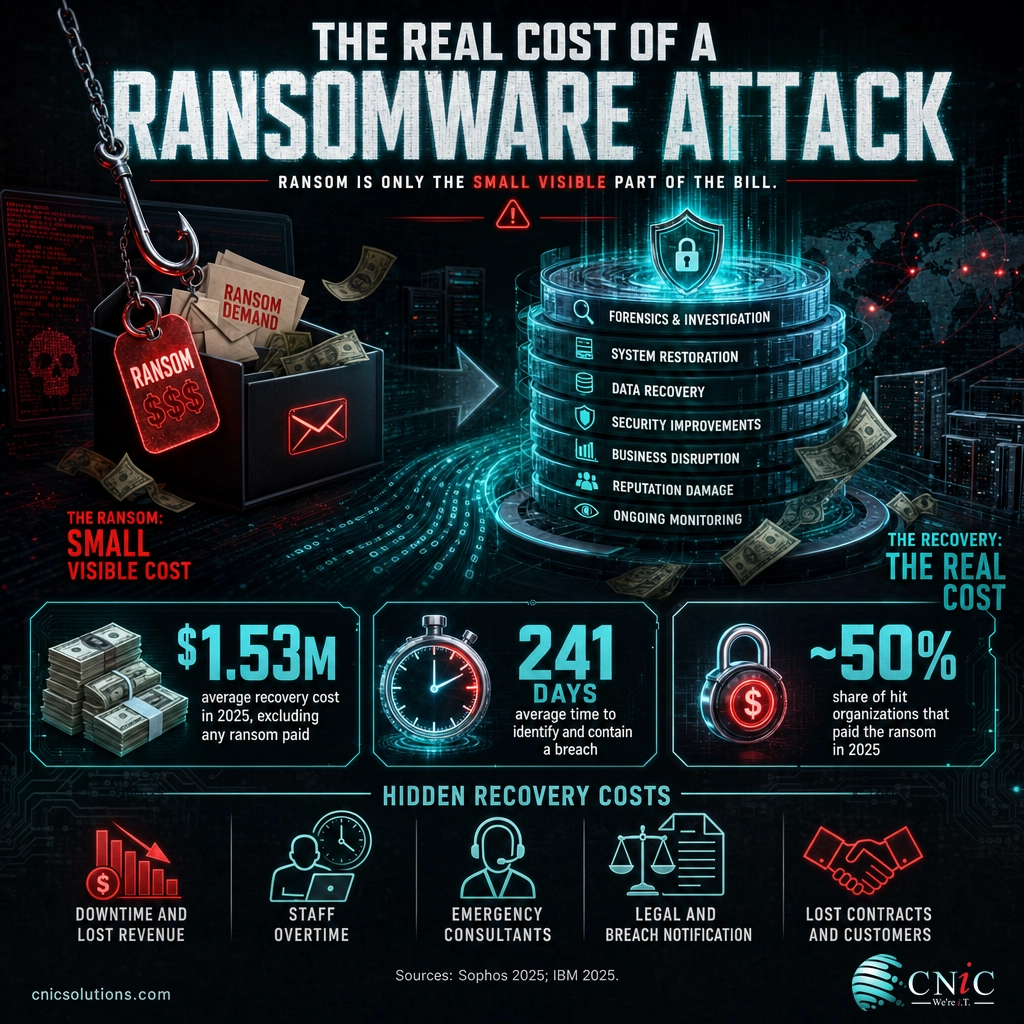
How long recovery drags on, and how much it ultimately costs, comes down to the plan you had in place beforehand. Our data on how long ransomware recovery actually takes shows just how wide the gap is between prepared and unprepared organizations.
See how tested backups cut ransomware downtime
Source: Sophos State of Ransomware 2025 | IBM Cost of a Data Breach 2025
What Texas Businesses Should Do Right Now
The defenses that stop or contain ransomware are well understood and, for a small business, achievable. The gap is almost never awareness; it is execution and consistency. Here is the priority order that gives a Texas business the most protection per dollar.
- Keep tested, isolated backups. Follow a 3-2-1 approach: three copies of your data, on two types of media, with one copy offline or immutable so ransomware cannot encrypt it. Then test a restore on a schedule. An untested backup is a hope, not a plan.
- Enforce multi-factor authentication everywhere. Email, VPN, remote desktop, and admin accounts are the front doors attackers pick. MFA blocks the large majority of credential-based intrusions and is the single highest-value control most businesses are still missing on some accounts.
- Deploy endpoint detection and response with 24/7 monitoring. Signature-based antivirus misses modern ransomware. EDR watches behavior and can isolate an infected machine, but only if someone is watching the alerts at 2 a.m. That is why many businesses buy it as a managed service.
- Patch quickly and shrink the attack surface. Keep operating systems, firewalls, and internet-facing services current, and close remote access ports that do not need to be open. Most ransomware exploits a known, already-patched vulnerability.
- Train your people on phishing. A large share of ransomware still starts with one clicked email. Short, regular training plus simulated phishing measurably lowers click rates.
- Write and rehearse an incident response plan. Decide in advance who to call, how to isolate systems, where backups live, and what your legal and notification duties are. The businesses that recover fastest rehearsed the bad day before it arrived.
Don’t do this: pay first, plan later
The worst response to a ransomware attack is treating the ransom as the plan. Paying is no guarantee of clean recovery, it funds the next attack, and it does nothing to close the hole that let attackers in. If you do not already have tested backups and an incident response plan, that is the work to do this quarter, before an attacker forces the decision for you.
If building and maintaining all six layers in-house is not realistic, the practical path is a managed cybersecurity partner that runs them for you and monitors around the clock.
Protect your business with managed cybersecurity
Source: CISA StopRansomware guidance
How CNiC Helps Texas Businesses Stay Ahead of Ransomware
CNiC Solutions is a Texas-based managed IT and cybersecurity provider with offices in the Houston area and San Antonio, working with small and midsize businesses across the state. The reason we lead with the 2019 coordinated attack is that we see the same vendor-access risk it exposed play out constantly: businesses inherit their IT provider’s security posture, for better or worse. Our model is built to be the better half of that equation.
That means tested backup and disaster recovery, managed endpoint detection and response with round-the-clock monitoring, multi-factor authentication and patch management enforced as standard, phishing awareness training, and an incident response plan rehearsed before it is needed, not drafted during a crisis. For businesses that want senior security strategy without a full-time hire, our Virtual CIO service sets the roadmap and keeps it current as threats change.
Explore fully managed IT and security for Texas businesses
Frequently Asked Questions
Are ransomware attacks common in Texas?
What was the 2019 Texas ransomware attack?
Why are Texas small businesses targeted by ransomware?
How much does a ransomware attack cost a business?
What should a Texas business do to prevent ransomware?
Methodology and Sources
How this article was built
Every statistic in this article traces to a primary source and is dated. National ransomware and cybercrime figures come from the FBI’s Internet Crime Complaint Center, breach-composition data from the Verizon Data Breach Investigations Report, recovery and ransom-payment data from Sophos’s annual State of Ransomware survey, and breach-lifecycle and cost data from IBM’s Cost of a Data Breach report. The 2019 coordinated attack details come from the Texas Department of Information Resources, which led the state response. Where a Texas-specific figure is not separately published, that limitation is stated in the text rather than estimated.
- FBI Internet Crime Complaint Center, 2024 Internet Crime Report: Texas complaint rank and losses, national ransomware trend, critical-infrastructure complaints, ransomware variants.
- Verizon 2025 Data Breach Investigations Report: share of SMB versus large-organization breaches involving ransomware.
- Sophos State of Ransomware 2025: average recovery cost and ransom-payment rate.
- IBM Cost of a Data Breach 2025: average time to identify and contain a breach.
- Texas Department of Information Resources: 2019 coordinated attack and state response.
- CISA StopRansomware: prevention and response best practice.
CNiC Solutions is a Texas-based managed IT and cybersecurity provider. Where this article recommends managed services, that reflects CNiC’s own service model, disclosed for transparency.
Journalists and researchers are welcome to cite this article with attribution to CNiC Solutions.



related posts
Password Statistics for 2026: Reuse, Cracks, and the Passkey Shift
September 22, 2026Weak and stolen passwords are still the number one way attackers get in. In 2025, stolen…
OKRs vs. KPIs: What’s the Difference?
September 22, 2026An OKR (Objective and Key Results) is a goal-setting framework that pairs an ambitious objective with…
15 Microsoft Teams Tips and Tricks to Boost Team Productivity
September 21, 2026Microsoft Teams is where most of the workday now happens: it passed 320 million monthly active…
Mobile Security Software for Business: A Buyer’s Guide
September 21, 2026Choosing mobile security software for business comes down to two decisions: how you will manage the…