

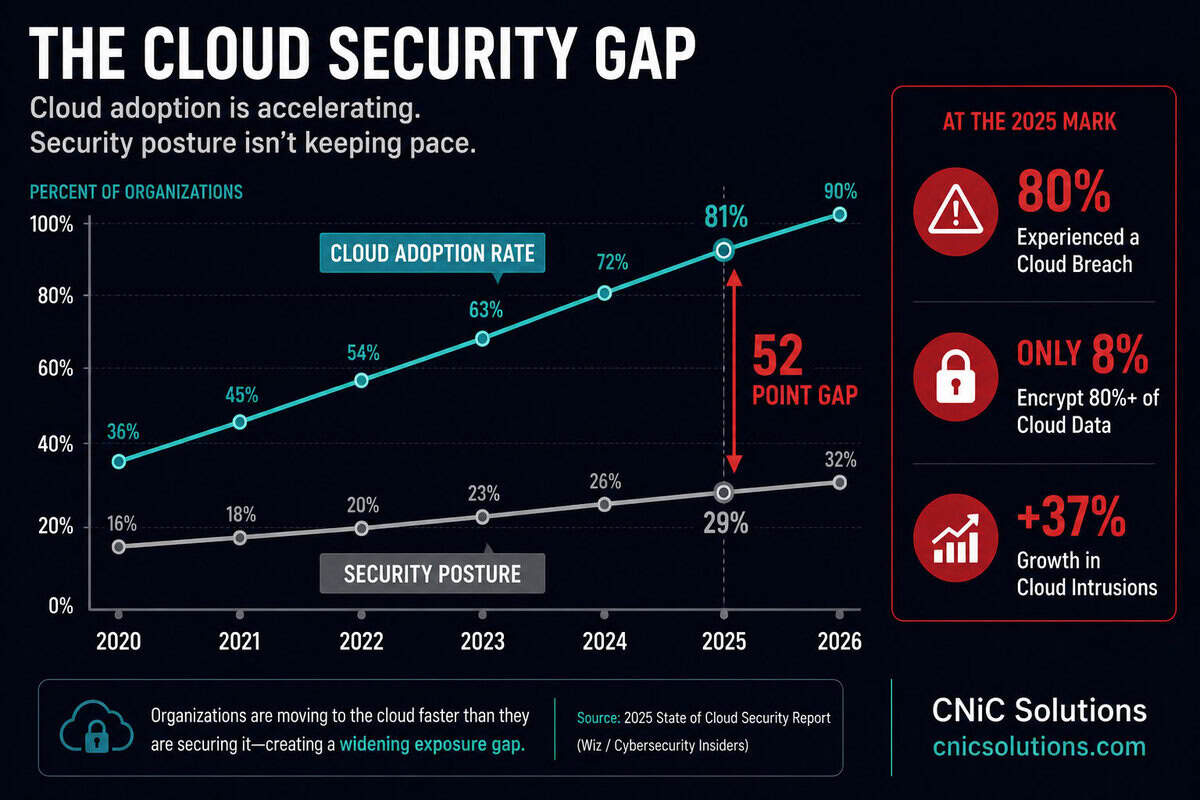
The cloud is now where most enterprise data lives — and increasingly, where most breaches happen. Eighty percent of organizations experienced at least one cloud security breach in the past year. Cloud-conscious intrusions jumped 37% year-over-year in 2025, accelerating from 26% growth the year before. And despite 54% of cloud data being classified as sensitive, only 8% of organizations encrypt 80% or more of their cloud data. The gap between cloud adoption speed and cloud security maturity is widening in both directions simultaneously: organizations are moving more data to the cloud faster than ever, while attackers are developing cloud-specific capabilities at an equal or greater pace. This article compiles the definitive cloud security statistics for 2026 from Tier 1 primary sources — IBM, Thales/S&P Global 451 Research, CrowdStrike, Grand View Research, Tenable, and Gartner — covering breach rates, misconfiguration data, breach costs, encryption gaps, multi-cloud risks, and market investment trends.
Key Takeaways: Cloud Security Statistics 2026
- 80% of organizations experienced a cloud security breach in the past year — making cloud breaches more common than not (industry consensus across multiple studies).
- Cloud intrusions grew 37% year-over-year in 2025, accelerating from 26% growth in 2024 — the rate of growth is itself increasing (CrowdStrike 2026 Global Threat Report).
- Only 8% of organizations encrypt 80% or more of their cloud data — despite 54% of cloud data being classified as sensitive (Thales 2025 Cloud Security Study).
- Multi-environment breaches cost more than $5 million on average and take 283 days to identify and contain — the most expensive and slowest-resolved breach type (IBM Cost of a Data Breach 2024).
- 40% of all breaches involve data stored across multiple environments — cloud, on-premises, and hybrid — creating complex, slow-to-detect attack chains (IBM 2024).
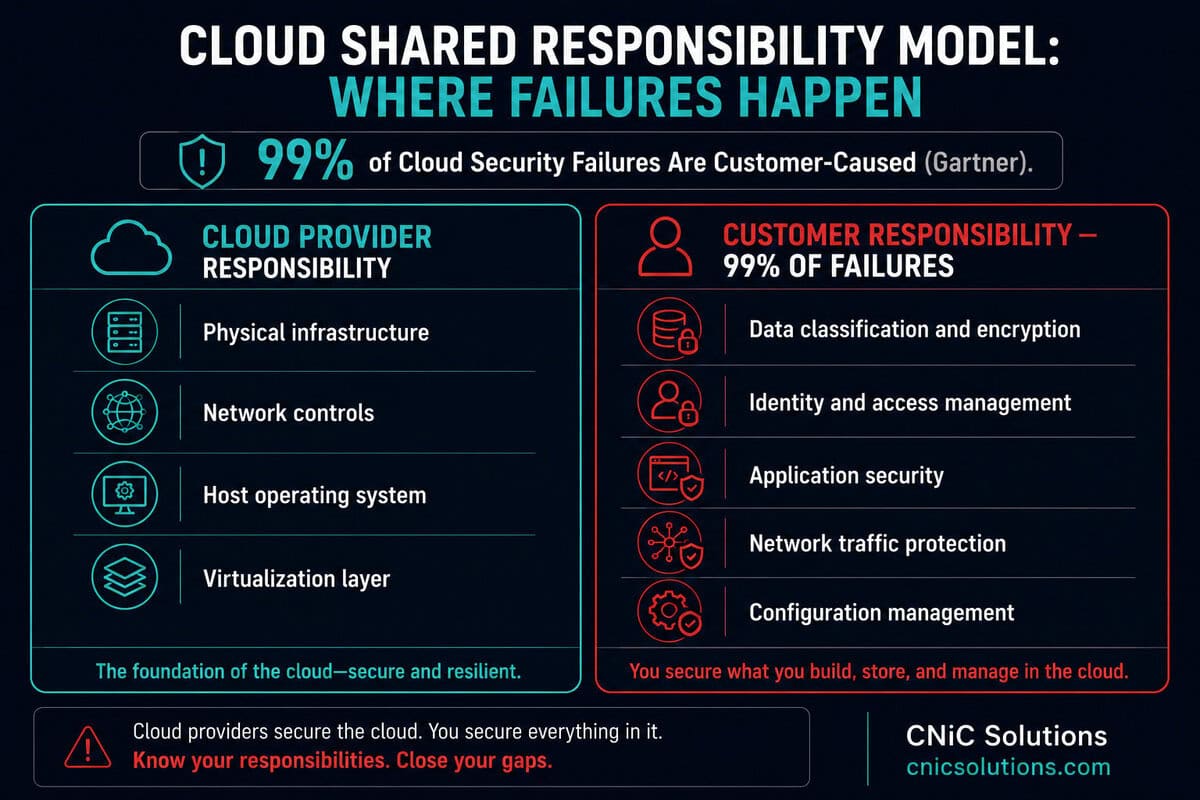
- Gartner projects 99% of cloud security failures will be the customer’s fault through 2025 — misconfiguration and human error, not cloud provider vulnerabilities (Gartner).
- The cloud security market reaches $40.36 billion in 2025 and is projected to hit $75.26 billion by 2030 at a 13.3% CAGR (Grand View Research).
Cloud Adoption and Breach Rates: How Widespread Is the Problem?
To understand the cloud security threat landscape, you first need to understand the scale of cloud adoption — because the attack surface grows in direct proportion to how much of the enterprise has moved to the cloud. In 2025, the answer is: most of it.
Cloud adoption has become the default infrastructure strategy. Fortinet’s 2026 research found 88% of organizations now operate across hybrid or multi-cloud environments. The average enterprise uses 2.1 public cloud providers simultaneously while also maintaining on-premises infrastructure (Thales 2025). SaaS application usage has surged to an average of 85 applications per enterprise — up 6% from 2024 (Thales 2025 Cloud Security Study). This complexity is the source of most cloud security problems: when policies, permissions, and configurations must be maintained consistently across dozens of applications and multiple cloud providers, the probability of an exploitable gap approaches certainty.
Cloud Security Breach Rates by Environment Type
Cloud-conscious intrusions — attacks where threat actors specifically target cloud infrastructure and services — grew 26% year-over-year in 2024 and then accelerated to 37% growth in 2025 (CrowdStrike 2026 Global Threat Report). Particularly alarming: cloud-conscious intrusions by state-nexus actors rose 266% in 2025, reflecting the strategic interest nation-state groups have in cloud-hosted data, intellectual property, and critical infrastructure. New and unattributed cloud intrusions increased 26% year-over-year in 2024, indicating more threat actors are developing cloud-specific capabilities (CrowdStrike 2025).
The Thales 2025 Cloud Security Study — based on 3,200 respondents across 20 countries conducted by S&P Global Market Intelligence 451 Research — found 55% of organizations report cloud environments are harder to secure than on-premises, up 4 percentage points from 2024. Four of the top five most targeted assets in reported attacks are cloud-based. Only 64% of security professionals rank cloud security among their top five security priorities — a concerning signal given the breach rate data.
If 80% of organizations experienced a cloud breach in the past year, and the average total cost of a cloud breach runs $4.67 million (IBM 2025), the expected annual loss from cloud security incidents across a sample of 100 mid-market organizations is approximately $373.6 million (80 breached organizations × $4.67M average). For a single mid-market organization with $50M in annual revenue, a cloud breach averaging $4.67M represents 9.3% of annual revenue in a single incident. The investment case for cloud security tools — even aggressive ones — requires only preventing one breach per several years of deployment to achieve positive ROI.
CNiC-derived calculation: 80% breach probability × $4.67M average cloud breach cost = $3.74M expected annual cloud breach cost per organization. Sources: Industry breach rate consensus; IBM Cost of a Data Breach 2025. Interpretation original to CNiC Solutions.
Source: Thales 2025 Cloud Security Study (S&P Global 451 Research) | CrowdStrike 2026 Global Threat Report
Explore Secure Cloud Solutions from CNiC →
Cloud Misconfiguration Statistics: The #1 Self-Inflicted Threat
The most important thing to understand about cloud security failures is that most of them are not caused by sophisticated attacker techniques breaking through well-designed defenses. They are caused by organizations leaving doors open that should be closed. Misconfiguration — incorrect settings, excessive permissions, exposed storage, weak access controls — is the defining cloud security problem of 2025.
Gartner’s projection that 99% of cloud security failures are customer-caused is perhaps the most significant single finding in cloud security research — because it fundamentally reframes the problem. Cloud providers invest billions in securing their infrastructure. The failure point is almost never the cloud itself. It is the combination of policies, permissions, access controls, and configurations that customers apply on top of that infrastructure. This is the shared responsibility model in practice: cloud providers secure the infrastructure; customers are responsible for securing what they put on it.
The misconfiguration problem manifests in predictable patterns. The most dangerous include: S3 buckets and equivalent object storage left publicly accessible; IAM policies granting excessive permissions (the “overprivilege” problem); API keys and secrets embedded in code repositories; missing or misconfigured encryption for data at rest; and inadequate logging and monitoring configurations that leave breaches undetected for months. A single Toyota Motor Corporation misconfiguration in 2023 exposed 260,000 customer records. The National Public Data breach in 2024 exposed 2.9 billion records — in part through misconfigured data handling systems.
Primary Causes of Cloud Security Incidents
Identity and access management (IAM) misconfiguration deserves specific emphasis. SentinelOne’s research found 70% of cloud breaches originate from compromised identities — making IAM the most consequential single security domain in cloud environments. Thales’s 2025 study found that 68% of respondents cited credential theft and stolen secrets as the fastest-growing cloud attack tactics. Yet 35% of organizations still lack adequate MFA protection for cloud access (Thales 2025), and one in three enterprises now uses 500+ APIs, each representing a potential credential exposure point.
The visibility problem compounds misconfiguration risk. 70% of organizations lack full visibility into their cloud environments (industry research). 32% of cloud assets sit completely unmonitored, each hiding an average of 115 vulnerabilities (Orca Security). Security teams cannot fix what they cannot see — which is why Cloud Security Posture Management (CSPM) tools have become foundational investments, yet only 33% of companies have deployed a dedicated CSPM solution.
Source: Thales 2025 Cloud Security Study | Tenable 2025 Cloud Security Risk Report
Identify Cloud Configuration Gaps with CNiC Network Services →
Cloud Security Breach Costs: What Organizations Actually Pay
Cloud breaches carry premium cost tags compared to on-premises incidents, and the complexity of multi-cloud environments pushes those costs even higher. IBM’s longitudinal Cost of a Data Breach research provides the most rigorous view of cloud-specific financial impact available.
| Cloud Deployment Model | Average Breach Cost | Detection / Containment Time | Source |
|---|---|---|---|
| Multi-environment (cloud + on-prem) | $5.00M+ (highest) | 283 days (longest) | IBM Cost of a Data Breach 2024 |
| Public cloud only | $5.17M average | 276–277 days avg | IBM / SentinelOne |
| Hybrid cloud (public + private) | $3.98M average | Faster than public-only | IBM Cost of a Data Breach |
| Private cloud only | Lower than public cloud | Shorter detection time | IBM |
| Global average (all environments) | $4.44M (2025) | 241 days (2025) | IBM Cost of a Data Breach 2025 |
| U.S. cloud breach average | $10.22M (record high) | Higher than global avg | IBM 2025 |
The finding that multi-environment breaches take 283 days to identify and contain is not surprising when you understand the underlying dynamic. When attackers compromise a credential that has access to both cloud and on-premises systems, they can move laterally across environment boundaries — pivoting from a compromised cloud workload to an on-premises Active Directory server or vice versa. Security tools that monitor only one environment miss the cross-boundary movement entirely, extending dwell time dramatically and increasing both data exfiltration volume and remediation complexity.
IBM’s research also reveals that breaches identified by internal security teams cost nearly $1 million less than breaches discovered by the attacker (in extortion scenarios). In 2024, 42% of organizations identified breaches with their own security teams and tools — up from 33% the prior year — demonstrating that security operations investment is translating into faster internal detection. For cloud environments specifically, this means 24/7 monitoring tools with cloud-specific threat detection capabilities represent one of the highest-ROI security investments available.
Source: IBM Cost of a Data Breach Report 2024 (multi-environment data) | IBM Cost of a Data Breach Report 2025
Get 24/7 Cloud Monitoring with CNiC Managed IT →
Cloud Encryption and Data Protection Statistics: The Security Gap That Shouldn’t Exist
Encryption is the most fundamental data protection control in cloud environments. If data is properly encrypted with keys the attacker cannot access, a breach of the storage layer alone does not result in data exposure. The 2025 data on actual cloud encryption rates reveals an alarming gap between this fundamental principle and industry practice.
The Thales 2025 Cloud Security Study — based on nearly 3,200 respondents across 20 countries conducted by S&P Global Market Intelligence 451 Research — found that while 68% of organizations now encrypt 40% or more of their sensitive data (an improvement from prior years), the fraction achieving comprehensive encryption coverage remains distressingly small. Only 8% encrypt 80% or more of their cloud data. The 2026 Thales Data Threat Report, released in March 2026, found that the unencrypted fraction of sensitive cloud data is rising as AI tools are granted broad access without proportionate encryption controls.
Cloud Data Encryption Status (Thales 2025 / 2026)
Key management compounds the encryption problem. Thales found 57% of organizations use five or more enterprise key management systems — creating silos where encryption keys may be stored in the same cloud ecosystem as the data they protect. If an attacker compromises cloud tenant access, they may obtain both the encrypted data and the keys. Tenable’s 2025 Cloud Security Risk Report found that 9% of publicly accessible cloud storage services contain sensitive data — a direct consequence of inadequate access controls and encryption practices. CISA issued Binding Operational Directive 25-01 in December 2024 specifically mandating federal agencies secure cloud environments through 2025, citing widespread misconfigured cloud exposures of sensitive government data.
Source: Thales 2025 Cloud Security Study | Thales 2026 Data Threat Report
Implement Proper Cloud Data Encryption with CNiC →
Multi-Cloud Security and Identity Statistics: Where Complexity Creates Catastrophe
The shift to multi-cloud and hybrid architectures — driven by legitimate business needs for resilience, vendor independence, and cost optimization — has created a security environment where consistent policy enforcement is extraordinarily difficult. Identity and access management across multiple clouds is where most of the real-world damage is happening.
The Microsoft 365 and cloud SaaS attack surface deserves specific attention. CrowdStrike’s 2025 research found SharePoint and Outlook were accessed in 22% and 17%, respectively, of relevant cloud intrusions in the first half of 2024 — demonstrating that Microsoft 365 is a primary cloud attack target. Organizations using Microsoft 365 as their primary productivity platform must treat it as a critical security asset, not just an email service. Microsoft processes 78 trillion security signals daily across its platforms — and still sees significant credential-based attacks succeeding against its customers.
| Multi-Cloud Challenge | Data Point | Source |
|---|---|---|
| Orgs in hybrid/multi-cloud | 88% | Fortinet 2026 |
| Avg public cloud providers per org | 2.1 providers | Thales 2025 |
| Avg SaaS apps per enterprise | 85 (up 6% from 2024) | Thales 2025 |
| Orgs using 5+ key mgmt systems | 57% | Thales 2025 |
| Orgs using 5+ data discovery tools | 61% | Thales 2025 |
| Cloud harder to secure than on-prem | 55% of respondents | Thales 2025 |
| Lack staff for multi-cloud security | 45% of organizations | Exabeam / Fortinet |
| Multi-env breach detection time | 283 days (longest of any model) | IBM Cost of a Data Breach 2024 |
| Multi-env breach cost premium | 23% more than single-cloud breaches | IBM / industry analysis |
| Cloud breaches from identity compromise | 70% | SentinelOne |
| Fastest-growing attack tactic (cloud) | Credential theft and stolen secrets (68% cite) | Thales 2025 |
| MFA adoption for cloud access | 65% (35% without) | Thales 2025 |
Source: Thales 2025 Cloud Security Study
Consolidate Cloud Security with CNiC’s AI-Enhanced Platform →
Cloud Security Market Size and Investment Trends 2025–2030
The scale of investment flowing into cloud security reflects both the severity of the threat and the commercial opportunity. The market is one of the fastest-growing segments in all of technology, driven by escalating attack volumes, regulatory pressure, and the ongoing migration of enterprise workloads to cloud infrastructure.
Global Cloud Security Market Size (Grand View Research / Precedence Research)
Investment is accelerating across specific cloud security categories driven by the threat data. AI-specific security has emerged as a top enterprise spending priority — second only to general cloud security in the Thales 2025 study — with 52% of respondents prioritizing AI security investments. The IAM market’s 16.6% CAGR reflects the recognition that identity is the primary cloud attack surface. CNAPP (Cloud-Native Application Protection Platform) solutions are gaining traction as organizations consolidate separate CSPM, CWPP, and CIEM tools — Palo Alto Networks reported over 60% of Prisma Cloud customers adopting integrated CNAPP capabilities in October 2025.
North America holds over 38% of the global cloud security market, reflecting both the concentration of cloud-dependent enterprises and the maturity of the regulatory environment driving security investment. The U.S. cloud security software market alone is projected at $6.4 billion in 2024, with a 10.6% CAGR through 2030. Large enterprises account for over 74% of cloud security revenues — but the SMB segment is experiencing rapid growth as cloud-native attack activity targeting smaller organizations increases and insurance mandates push security investment downstream.
Source: Grand View Research: Cloud Security Market Analysis | Precedence Research: Cloud Security Market Size 2026–2035
Start Your Secure Cloud Journey with CNiC Solutions →
Cloud Security Statistics Summary (2026 Reference Table)
| Statistic | Data Point | Source | Year |
|---|---|---|---|
| Organizations in hybrid/multi-cloud | 88% | Fortinet 2026 | 2025–2026 |
| Avg public cloud providers per org | 2.1 | Thales 2025 Cloud Security Study | 2025 |
| Avg SaaS applications per enterprise | 85 (+6% from 2024) | Thales 2025 | 2025 |
| Organizations breached (past year) | 80% | Industry consensus | 2024–2025 |
| Significant cloud breach surge YoY | +154% (61% major incidents in 2024 vs 24% in 2023) | SentinelOne | 2024 |
| Cloud intrusion growth (2025) | +37% YoY (from +26% in 2024) | CrowdStrike 2026 Global Threat Report | 2025 |
| State-nexus cloud intrusion growth | +266% in 2025 | CrowdStrike 2026 | 2025 |
| All data breaches involving cloud | 45% | Industry research | 2024–2025 |
| Breaches across multiple environments | 40% of all breaches | IBM Cost of a Data Breach 2024 | 2024 |
| Multi-environment breach cost | $5.00M+ (highest of any model) | IBM Cost of a Data Breach 2024 | 2024 |
| Multi-environment detection time | 283 days (longest of any model) | IBM Cost of a Data Breach 2024 | 2024 |
| Public cloud breach cost | $5.17M average | IBM / SentinelOne | 2024 |
| U.S. cloud breach average | $10.22M (record high) | IBM Cost of a Data Breach 2025 | 2025 |
| Global average breach cost (all) | $4.44M | IBM Cost of a Data Breach 2025 | 2025 |
| Cloud failures customer-caused | 99% (Gartner projection) | Gartner | Through 2025 |
| Avg misconfigurations per cloud account | 43 | SentinelOne / industry research | 2024 |
| Public cloud users with incidents | 27% (up 10% YoY) | SentinelOne | 2024 |
| Breaches from misconfiguration/human error | 31% | Thales 2024 Cloud Security Study | 2024 |
| Cloud assets unmonitored | 32% (avg 115 vulnerabilities each) | Orca Security | 2024–2025 |
| Orgs lacking full cloud visibility | 70% | Industry research | 2024–2025 |
| Cloud data classified as sensitive | 54% (up from 47% in 2024) | Thales 2025 Cloud Security Study | 2025 |
| Orgs encrypting 80%+ of cloud data | Only 8% | Thales 2025 Cloud Security Study | 2025 |
| Sensitive cloud data unencrypted | 47% | Thales 2026 Data Threat Report | 2026 |
| MFA adoption for cloud access | 65% use MFA; 35% do not | Thales 2025 | 2025 |
| Cloud breaches from compromised identities | 70% | SentinelOne | 2024–2025 |
| Fastest-growing cloud attack tactic | Credential theft / stolen secrets (68% cite) | Thales 2025 | 2025 |
| Orgs with CSPM tool deployed | Only 33% | Industry research | 2024–2025 |
| Lack staff for multi-cloud security | 45% of organizations | Exabeam / Fortinet | 2024–2025 |
| Cloud security market (2025) | $40.36 billion | Grand View Research | 2025 |
| Cloud security market (2030 projected) | $75.26 billion (13.3% CAGR) | Grand View Research | 2030 projection |
| IAM market size (2024) | $36.96 billion (16.6% CAGR) | Market research consensus | 2024 |
Frequently Asked Questions: Cloud Security
Methodology & Sources
All statistics in this article are sourced directly from Tier 1 primary sources: original research reports, government agencies, and organizations that collect raw security incident or market data. No blog-to-blog citations were used as primary references. CNiC-derived calculations are clearly labeled.
Primary Sources Referenced:
- Thales 2025 Cloud Security Study — Survey of nearly 3,200 IT and security professionals across 20 countries, conducted by S&P Global Market Intelligence 451 Research. cpl.thalesgroup.com
- Thales 2026 Data Threat Report — Annual global research on data security threats and encryption gaps. thalesgroup.com
- IBM Cost of a Data Breach Report 2024 — Multi-environment breach cost and detection timeline data. ibm.com
- IBM Cost of a Data Breach Report 2025 — Global and U.S. average breach costs, AI impact data. ibm.com
- CrowdStrike 2026 Global Threat Report — Cloud-conscious intrusion growth rates and state-nexus actor activity. crowdstrike.com
- CrowdStrike 2025 Global Threat Report — Cloud intrusion growth data and Microsoft 365 targeting statistics.
- Grand View Research: Cloud Security Market — Market sizing and growth projections. grandviewresearch.com
- Precedence Research: Cloud Security Market 2026–2035 — Long-range market size projections. precedenceresearch.com
- Gartner Cloud Security Research — Cloud failure attribution analysis (99% customer-caused projection).
- Tenable 2025 Cloud Security Risk Report — Cloud storage exposure data and vulnerability statistics.
- SentinelOne Cloud Security Research — Breach rates, identity-based breach data, and cloud attack statistics.
- Fortinet 2026 Cloud Security Research — Multi-cloud adoption rates and AI detection maturity data.
- Orca Security Research — Unmonitored cloud asset statistics and vulnerability data.
This article was researched and published by CNiC Solutions, a Houston-based managed IT and cybersecurity provider. Content is updated as new primary source data becomes available. Last updated: May 2026.



related posts
How to Restart the Graphics Driver in Windows
September 14, 2026To restart the graphics driver in Windows, press Windows + Ctrl + Shift + B. The…
How to Reboot Your Router: A Step-by-Step Guide to Fixing Connection Issues
September 14, 2026When your internet drops, slows to a crawl, or refuses to load a single page, rebooting…
How to Open the Local Group Policy Editor
September 13, 2026The Local Group Policy Editor is the built-in Windows console that lets you control how a…
How to Prevent Phishing Attacks: A Practical Guide for Businesses
September 13, 2026Phishing is now the single most common way attackers break into a business, and it works…