

Cybersecurity compliance is no longer a back-office checklist — it is a board-level financial risk with measurable, enforced consequences. European regulators issued €1.2 billion in GDPR fines in 2025 alone, with cumulative penalties since 2018 exceeding €7.1 billion. The HHS Office for Civil Rights closed 22 HIPAA investigations with financial penalties in 2024 — one of its busiest enforcement years on record. Defense contractors face a November 2026 CMMC enforcement deadline with only 8% currently certified. And IBM’s research quantifies the penalty for getting it wrong: noncompliance adds $174,538 to the average data breach cost, on top of fines, reputational damage, and remediation. This article compiles the definitive cybersecurity compliance statistics for 2026 from Tier 1 primary sources — DLA Piper, HHS OCR, Verizon, IBM, IBSS Corporation, and A-LIGN — covering GDPR, HIPAA, PCI DSS, CMMC, SOC 2, and the quantified cost of getting compliance wrong. For breach cost context, see our companion article on the Average Cost of a Data Breach Statistics 2026.
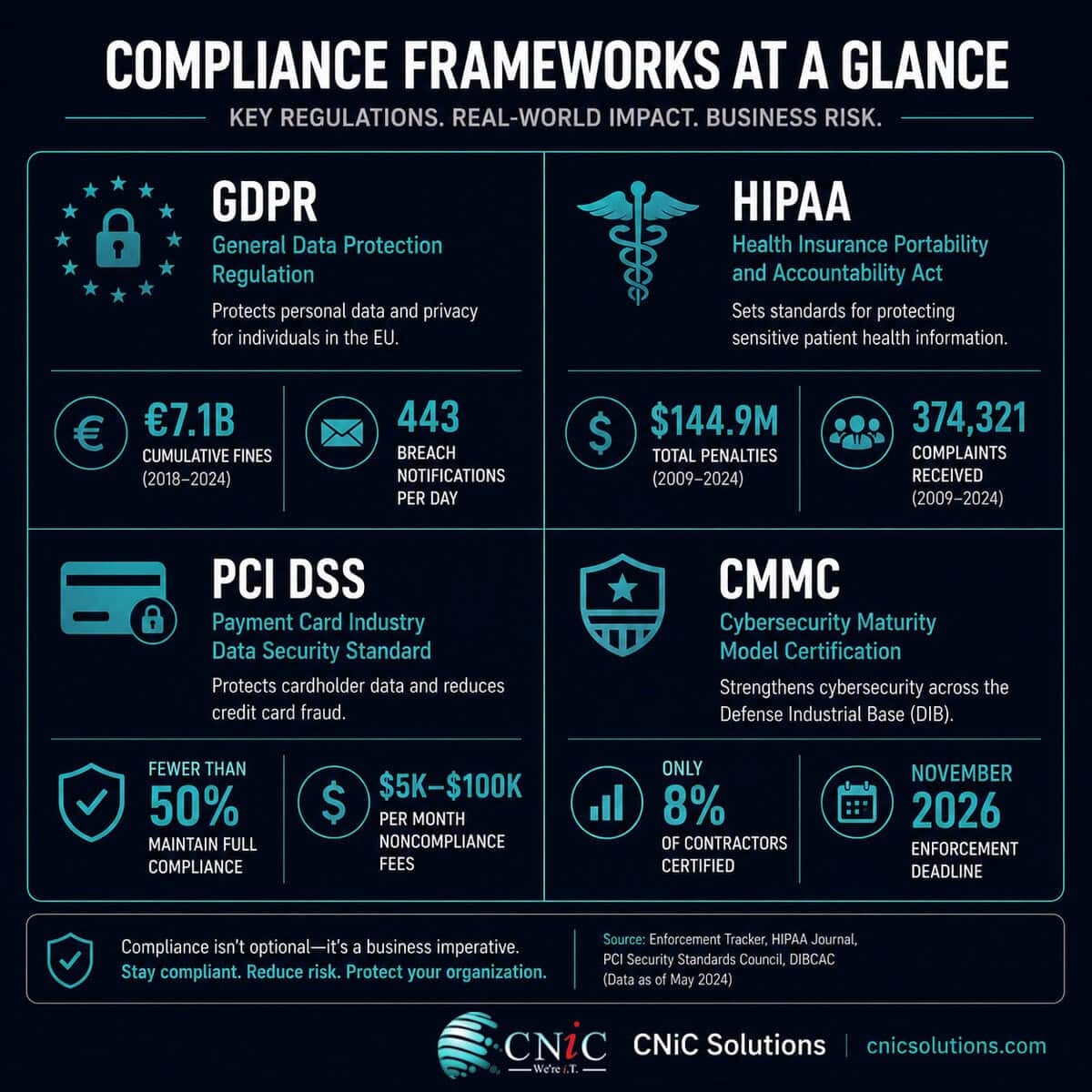
Key Takeaways: Cybersecurity Compliance Statistics 2026
- €7.1 billion in cumulative GDPR fines since 2018, with €1.2 billion issued in both 2024 and 2025 — enforcement is not slowing (DLA Piper GDPR Fines and Data Breach Survey, January 2026).
- 443 GDPR breach notifications per day in 2025 — a 22% year-over-year increase and the first time daily notifications exceeded 400 since GDPR took effect (DLA Piper 2026).
- Noncompliance costs 2.71× more than compliance — including regulatory penalties, breach remediation, lawsuits, and lost productivity (Ponemon Institute).
- Fewer than 50% of organizations maintain full PCI DSS compliance year-over-year, and Verizon’s forensics team has never found a fully compliant organization at the time of a breach (Verizon PSR 2024).
- Only 8% of defense contractors requiring CMMC Level 2 certification have achieved it as of February 2026, with the enforcement deadline approaching in November 2026 (IBSS Corporation).
- HHS OCR closed 22 HIPAA investigations with financial penalties in 2024 — one of its most active enforcement years, totaling $9.16 million in fines (HIPAA Journal).
- Noncompliance adds $174,538 to the average data breach cost on top of fines — making compliance investment a direct cost-reduction strategy (IBM Cost of a Data Breach 2025).
The Financial Case for Compliance: Noncompliance Costs 2.71× More
Before diving into framework-specific statistics, the most important single compliance data point is the economic one: maintaining compliance programs costs significantly less than suffering the consequences of noncompliance. The research across multiple studies is consistent and compelling.
The Ponemon Institute’s research on compliance costs found that the cost of business disruptions, lost productivity, revenue loss, and regulatory fines from noncompliance is 2.71 times higher than the cost of proactively maintaining compliance programs. In practical terms: every dollar an organization invests in compliance infrastructure saves an average of $2.71 in downstream noncompliance costs. IBM’s data adds granularity at the breach level — organizations that fail regulatory compliance requirements pay $174,538 more per incident than compliant counterparts, reflecting faster regulatory scrutiny, mandatory notification costs, and larger exposure windows.
Compliance vs. Noncompliance: Financial Impact Comparison
The compliance cost equation extends beyond direct fines. Regulatory penalties represent only one component. Additional costs from noncompliance include: mandatory breach notification expenses (legal, notification letters, credit monitoring); extended breach lifecycle and detection times (noncompliant organizations detect breaches more slowly); reputational damage affecting customer retention and deal velocity; loss of contract eligibility (particularly acute for government and DoD contractors); increased cyber insurance premiums; and litigation costs from class action lawsuits enabled by breach disclosure.
These costs are accelerating. In Q1 2025 alone, U.S. agencies issued over $220 million in cybersecurity-related penalties — led by multi-million dollar fines against digital health organizations and fintech companies for failing to disclose breaches in time. The DOJ’s Civil Cyber-Fraud Initiative is applying the False Claims Act to companies that falsely certify compliance with federal cybersecurity requirements, creating potential criminal as well as civil exposure for noncompliance.
IBM adds $174,538 to breach cost for noncompliant organizations. The average breach costs $4.44 million globally (IBM 2025). A compliant organization faces $4.44M average breach cost; a noncompliant organization faces $4.61M — plus regulatory fines on top. For a Houston-area mid-market organization spending $150,000 annually on compliance programs (reasonable for 50–500 employees), the break-even requires avoiding just one compliance-related cost event every 4–5 years. Given that 50% of organizations faced at least one compliance issue in the past three years (NAVEX), the expected ROI on compliance investment is strongly positive across virtually all organization sizes and industries. Compliance is not overhead — it is risk capital.
CNiC-derived calculation: $174,538 IBM noncompliance penalty per breach × estimated annual breach probability + avoided fine exposure. Sources: IBM Cost of a Data Breach 2025; Ponemon Institute; NAVEX State of Risk & Compliance Report. Interpretation original to CNiC Solutions.
Source: IBM Cost of a Data Breach Report 2025 | IBSS Corporation Cybersecurity Compliance Statistics 2025–2026
Build a Compliance-Ready Security Posture with CNiC →
GDPR Compliance and Enforcement Statistics 2025–2026
The EU’s General Data Protection Regulation remains the world’s most consequential data privacy enforcement framework. Its reach extends far beyond European borders — any organization that processes personal data of EU residents must comply, regardless of where the organization is headquartered. For U.S. businesses with European customers, partners, or operations, GDPR is a direct operational reality.
DLA Piper’s annual GDPR Fines and Data Breach Survey — the most authoritative annual assessment of GDPR enforcement — documented a sustained enforcement environment in 2025 matching 2024’s €1.2 billion annual fine total. The Irish Data Protection Commission (DPC) continues to dominate enforcement, having issued cumulative fines of €4.04 billion since 2018 — primarily because Ireland serves as the lead supervisory authority for major technology companies with European headquarters in Dublin. The Irish DPC’s largest fine of 2025 was €530 million against a social media company for international data transfer violations.
| GDPR Enforcement Milestone | Data Point | Source |
|---|---|---|
| Cumulative fines since 2018 | €7.1 billion+ | DLA Piper GDPR Survey Jan. 2026 |
| Annual fines (2025) | €1.2 billion (~$1.42B USD) | DLA Piper GDPR Survey Jan. 2026 |
| Annual fines (2024) | €1.2 billion (~$1.26B USD) | DLA Piper GDPR Survey Jan. 2025 |
| Largest fine ever (GDPR) | €1.2 billion — Meta (2023) | Irish DPC |
| Largest fine in 2025 | €530 million — social media company | Irish DPC, April 2025 |
| LinkedIn fine (2024) | €310 million | Irish DPC, October 2024 |
| Meta fine (Dec. 2024) | €251 million | Irish DPC, December 2024 |
| Uber fine (Dutch DPA, 2024) | €290 million | Dutch DPA, August 2024 |
| Breach notifications per day (2025) | 443 average (+22% YoY) | DLA Piper GDPR Survey Jan. 2026 |
| Documented GDPR fines on record | 2,245 (CMS Enforcement Tracker) | CMS GDPR Tracker, early 2026 |
| Irish DPC cumulative fines since 2018 | €4.04 billion | DLA Piper GDPR Survey Jan. 2026 |
| Maximum fine (severe violation) | €20M or 4% of global annual revenue | GDPR Article 83 |
| Maximum fine (minor violation) | €10M or 2% of global annual revenue | GDPR Article 83 |
A critical trend emerging from the 2026 survey: enforcement is expanding beyond Big Tech. Finance, healthcare, telecommunications, and public sector organizations are now firmly in the enforcement crosshairs — not just technology giants. The 22% surge in daily breach notifications (from under 400 to 443 per day) reflects both an increase in actual incidents and stricter interpretation of reporting obligations. Under GDPR, organizations have 72 hours from becoming aware of a breach to notify their supervisory authority — a requirement that creates intense pressure on incident response capabilities. In 19 U.S. states, comprehensive data privacy laws modeled on GDPR principles are now in effect, with more states expected to enact similar legislation through 2026.
Source: DLA Piper GDPR Fines and Data Breach Survey, January 2026
Understand Your Data Privacy Compliance Obligations with CNiC →
HIPAA Compliance and Enforcement Statistics 2025–2026
For healthcare organizations, business associates, and any organization that touches protected health information (PHI), HIPAA compliance is not optional. The HHS Office for Civil Rights has significantly increased enforcement activity, launched targeted initiatives against specific violation types, and proposed Security Rule updates that will impose new technical requirements across the industry.
OCR’s 2024 enforcement activity totaled $9.16 million in penalties across 22 actions — more than double the total from 2023. This surge reflects two active enforcement initiatives: the HIPAA Right of Access initiative (targeting organizations that fail to provide patients timely access to records) and a newer initiative specifically targeting noncompliance with the risk analysis requirement of the HIPAA Security Rule. Risk analysis failures are the most commonly identified HIPAA Security Rule violation in OCR’s investigations — and they are now the primary trigger for investigations of hacking-related data breaches.
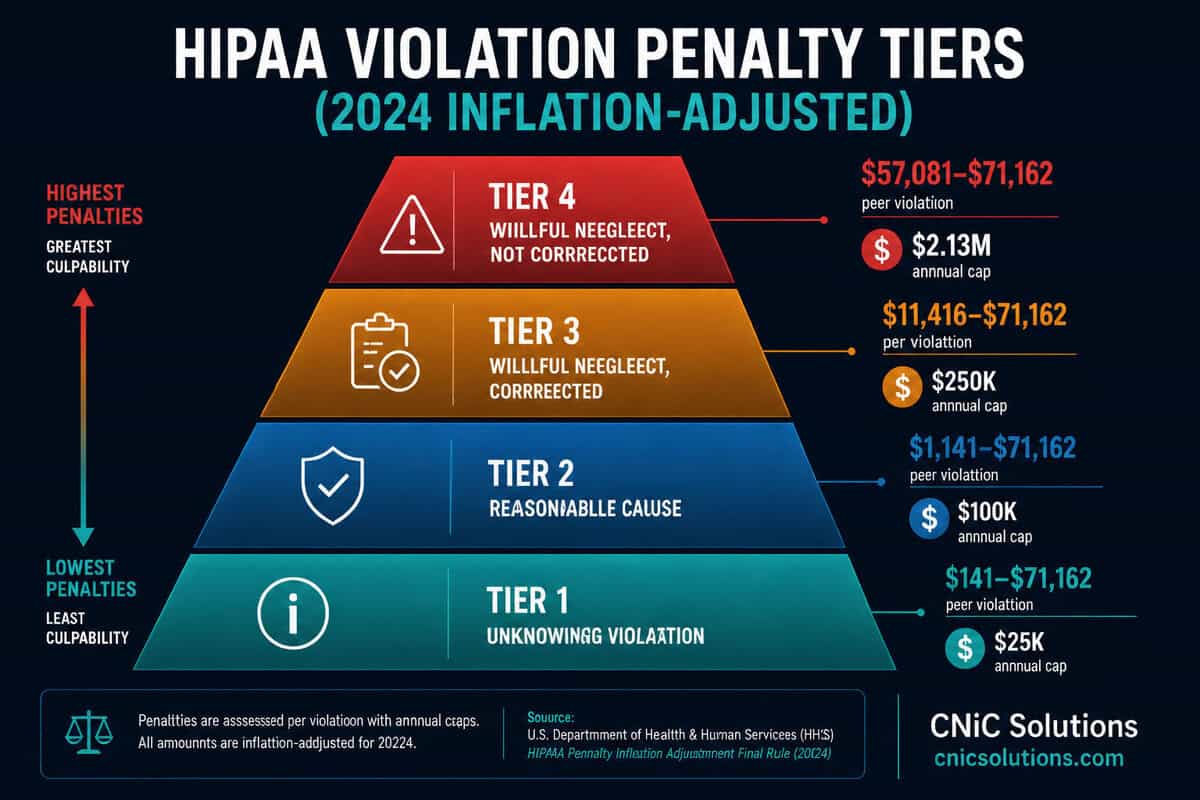
| HIPAA Penalty Tier | Culpability Level | Per-Violation Range (2024) | Annual Cap |
|---|---|---|---|
| Tier 1 | Unknowing violation | $141–$71,162 | $25,000 (OCR enforcement discretion) |
| Tier 2 | Reasonable cause | $1,141–$71,162 | $100,000 (OCR enforcement discretion) |
| Tier 3 | Willful neglect — corrected | $11,416–$71,162 | $250,000 (OCR enforcement discretion) |
| Tier 4 | Willful neglect — not corrected | $57,081–$71,162 | $2,134,831 (inflation-adjusted 2024) |
A significant policy development in 2024: in December 2024, OCR proposed updates to the HIPAA Security Rule adding new cybersecurity-specific requirements — including technical safeguards more aligned with modern threat realities. These proposed updates would, if finalized, require covered entities to implement multi-factor authentication, network segmentation, vulnerability scanning, and incident response testing that go significantly beyond the current Security Rule’s technology-neutral language. OCR is also expanding its risk analysis enforcement initiative to include risk management in 2026, deepening the scrutiny applied to organizations’ ongoing security programs, not just their point-in-time assessments.
Notable 2024 enforcement actions included a $4.75 million settlement with Montefiore Medical Center for insider theft affecting 12,517 patients, a $1.19 million penalty against Gulf Coast Pain Consultants for Security Rule violations, and a $548,265 penalty against Children’s Hospital Colorado. HIPAA enforcement is now firmly addressing ransomware: OCR has established that encrypted data without proof of containment constitutes a breach under the Breach Notification Rule — shifting the burden of proof to the organization to demonstrate data was not accessed.
Source: HHS OCR Enforcement Highlights (official) | HIPAA Journal: Penalty Updates 2026
Healthcare Compliance Solutions from CNiC Solutions →
PCI DSS Compliance Statistics: Payment Card Security in 2025–2026
Any organization that accepts, processes, transmits, or stores credit card data must comply with the Payment Card Industry Data Security Standard. PCI DSS v4.0, which took effect in April 2024 with all future-dated requirements due by March 31, 2025, represents the most significant update in over a decade — and compliance rates remain troublingly low.
PCI DSS Full Compliance Rate by Key Requirement (Verizon PSR 2024)
Verizon’s 2024 Payment Security Report found that Requirement 11 — which mandates security testing including penetration testing and vulnerability scanning — has the lowest full compliance rate at just 47.6%. This is particularly alarming given that Requirement 11 is explicitly targeted for expanded requirements in PCI DSS v4.0 and v4.0.1, meaning organizations that struggled with security testing under the old standard now face even stricter testing obligations under the new one. The compliance control gap is widening precisely in the areas regulators are tightening.
PCI DSS noncompliance carries direct financial penalties administered by card brands. Organizations can expect monthly penalties ranging from $5,000 to $10,000 or more for violations, along with increased transaction processing fees and, in severe cases, revocation of payment processing privileges. A 2023 Verizon estimate found only approximately 43% of American merchants were fully PCI compliant — meaning millions of businesses are paying monthly noncompliance fees without knowing it, as these charges often appear as generic line items on processing statements.
PCI DSS v4.0, which became mandatory in April 2024, introduces 13 new immediately effective requirements and 51 future-dated requirements that became mandatory on March 31, 2025. Key new areas include enhanced authentication requirements (aligned with MFA mandates), e-commerce and phishing protections, and more rigorous validation of targeted risk analyses. Organizations that completed PCI DSS v3.2.1 certification must now undergo fresh assessments against the new standard.
Source: Verizon 2024 Payment Security Report | Verizon Industry Guide to PCI Security Compliance
Secure Your Network Infrastructure for PCI DSS Compliance →
CMMC 2.0 Compliance Statistics: The Defense Contractor Deadline Crisis
The Cybersecurity Maturity Model Certification (CMMC) 2.0 represents the most significant compliance mandate change for U.S. defense contractors in a generation. With enforcement deadlines approaching and only a tiny fraction of required contractors certified, the CMMC landscape in 2026 is defined by urgency, bottlenecks, and escalating legal consequences for noncompliance.
IBSS Corporation’s research on the defense industrial base reveals a compliance crisis in slow motion. As of February 2026, only 8% of defense contractors requiring CMMC Level 2 certification have achieved it. 42% are “in progress” — meaning they have not yet achieved a state ready for a C3PAO third-party assessment. The remaining 50% are essentially unengaged with the certification process despite the November 2026 enforcement deadline.
| CMMC Level | Requirements | Self-Attestation or 3rd Party | Estimated Cost Range |
|---|---|---|---|
| Level 1 (Foundational) | 17 practices from FAR 52.204-21 | Annual self-attestation | $5,000–$15,000/yr |
| Level 2 (Advanced) | 110 practices from NIST SP 800-171 | C3PAO third-party assessment (most contractors) | $100,000–$500,000+ (assessment + remediation) |
| Level 3 (Expert) | 110+ practices, NIST 800-172 subset | DCSA government-led assessment | $1M+ (ongoing program) |
The DOJ’s Civil Cyber-Fraud Initiative has fundamentally changed the legal landscape for defense contractor noncompliance. Under the False Claims Act, contractors who falsely self-attest compliance with federal cybersecurity requirements — including CMMC — face qui tam whistleblower suits, treble damages, and criminal referrals. Cybersecurity-related FCA cases increased 156% between 2024 and 2025, signaling the DOJ’s aggressive posture. Organizations spent an average of $5.47 million to maintain compliance in 2024, yet the average cost of noncompliance — including FCA exposure, contract loss, and remediation — reached $14.82 million.
The C3PAO (Certified Third-Party Assessment Organization) bottleneck is the most immediate operational risk. There are not enough qualified assessors to certify the hundreds of thousands of defense contractors before enforcement deadlines. Analysts project assessment backlogs of 24–30 months by late 2026 — meaning contractors who haven’t already scheduled their assessments may be unable to obtain certification before critical contract renewal windows. For Texas-based defense and aerospace contractors — a significant portion of the Houston and DFW business communities — this deadline is not theoretical. DoD contracts requiring CMMC Level 2 compliance will not be awarded to uncertified organizations after November 2026.
Source: IBSS Corporation Cybersecurity Compliance Statistics: Federal Contractor Data Hub 2025–2026
Get CMMC Readiness Guidance from CNiC’s Texas vCIO Team →
Compliance Framework Adoption Rates and Industry Trends
Organizations don’t operate under a single compliance framework. Most face overlapping obligations across multiple standards simultaneously — and the data on framework adoption, compliance investment, and organizational challenges reveals how the compliance burden is evolving across industries.
Most Common Compliance Frameworks by Organization Adoption (A-LIGN 2024 / Vanta 2025)
SOC 2 has emerged as the de facto compliance baseline for technology companies and SaaS providers. A-LIGN’s 2024 Compliance Benchmark Report found SOC 2 is the most common audit framework at 76% adoption and the most impactful certification by 35% of respondents. SOC 2 adoptions increased 40% in 2024. The cost of SOC 2 Type I certification ranges from $91,000 for companies under 50 employees to $186,000 for companies with 50–250 employees (UnderDefense), with the average total cost at approximately $147,000 (StrongDM). Sixty percent of companies are more likely to do business with a startup that holds SOC 2 compliance, and 70% of venture capitalists prefer to invest in SOC 2-compliant companies — making certification a business development asset, not just a legal obligation.
The compliance complexity challenge is real and growing. PwC’s Global Compliance Survey 2025 found 47% of organizations cite regulatory complexity as the top factor making compliance more difficult, followed by organizational complexity (34%), culture (29%), and limited resource capacity (28%). Organizations now report spending 1,500+ staff hours annually on compliance reporting alone. AI is increasingly being deployed to address this burden: 89% of compliance professionals say AI helps speed up internal compliance functions (Thomson Reuters 2024), and 71% of respondents say AI will positively affect compliance effectiveness (PwC 2025).
For Texas businesses specifically — where the state’s economy spans energy, healthcare, technology, defense contracting, and financial services — compliance obligations typically include multiple overlapping frameworks. Energy companies face NERC CIP requirements. Healthcare organizations face HIPAA plus state privacy laws. Defense contractors face CMMC. Any company processing payments faces PCI DSS. And any organization with European customers or data faces GDPR applicability.
Source: Vanta 2025 Security and Compliance Statistics | A-LIGN 2024 Compliance Benchmark Report
Automate Compliance Evidence Collection with CNiC’s AI-Enhanced Services →
Cybersecurity Compliance Statistics Summary (2026 Reference Table)
| Statistic | Data Point | Source | Year |
|---|---|---|---|
| Noncompliance cost multiplier | 2.71× more expensive than compliance | Ponemon Institute | 2024–2025 |
| Added breach cost (noncompliant) | +$174,538 per breach | IBM Cost of Breach 2025 | 2025 |
| Avg cost of maintaining compliance | $5.47M/year | IBSS Corporation | 2024 |
| Avg cost of noncompliance | $14.82M/year (2.7× compliance cost) | IBSS Corporation | 2024 |
| Orgs with ≥1 compliance issue (3 yrs) | 50% | NAVEX State of Risk & Compliance | 2024 |
| GDPR cumulative fines since 2018 | €7.1 billion+ | DLA Piper GDPR Survey Jan. 2026 | Through 2025 |
| GDPR annual fines (2025) | €1.2 billion (~$1.42B) | DLA Piper GDPR Survey Jan. 2026 | 2025 |
| GDPR annual fines (2024) | €1.2 billion (~$1.26B) | DLA Piper GDPR Survey Jan. 2025 | 2024 |
| Largest GDPR fine ever | €1.2B — Meta (2023) | Irish DPC | 2023 |
| Largest GDPR fine of 2025 | €530M — social media company | Irish DPC, April 2025 | 2025 |
| GDPR breach notifications per day (2025) | 443/day (+22% YoY) | DLA Piper GDPR Survey Jan. 2026 | 2025 |
| GDPR maximum fine (severe violation) | €20M or 4% global annual revenue | GDPR Article 83 | Ongoing |
| Documented GDPR fines on record | 2,245 cases | CMS GDPR Tracker, 2026 | 2018–2026 |
| HIPAA complaints received (total) | 374,321 | HHS OCR | 2003–2024 |
| HIPAA total civil money penalties | $144,878,972 (152 cases) | HHS OCR Enforcement Highlights | Cumulative |
| HIPAA investigations with penalties (2024) | 22 cases / $9.16M total | HIPAA Journal | 2024 |
| HIPAA Tier 4 annual cap (2024) | $2,134,831 per violation category | HHS / HIPAA Journal 2026 | 2024 |
| Largest HIPAA settlement ever | $16M — Anthem (2018) | HHS OCR | 2018 |
| PCI DSS full compliance (year-over-year) | <50% maintain compliance year-over-year | Verizon PSR 2024 | 2024 |
| PCI Requirement 11 compliance rate | 47.6% (lowest of all 12 requirements) | Verizon PSR 2024 | 2023 |
| PCI Requirement 4 compliance rate | 90.5% (highest requirement) | Verizon PSR 2024 | 2023 |
| PCI compliance control gap | 4.5% gap (up from 3.2%) | Verizon PSR 2024 | 2023 |
| U.S. merchants PCI compliant | ~43% | Verizon PSR (Sprinto analysis) | 2023 |
| PCI noncompliance monthly fee | $5,000–$100,000+/month | Card brand enforcement guidelines | 2024–2025 |
| CMMC Level 2 certified contractors | Only 8% as of Feb. 2026 | IBSS Corporation | Feb. 2026 |
| CMMC: contractors in progress | 42% | IBSS Corporation | Feb. 2026 |
| FCA cybersecurity cases increase | +156% (2024–2025) | IBSS Corporation | 2024–2025 |
| C3PAO assessment backlog (projected) | 24–30 months by late 2026 | IBSS Corporation / industry analysts | 2026 projection |
| SOC 2 adoption rate | 76% most common framework | A-LIGN Benchmark 2024 | 2024 |
| ISO 27001 adoption (2025) | 81% (up from 67% in 2024) | A-LIGN / Bright Defense | 2025 |
| Compliance complexity increasing | 85% say requirements more complex (3 yrs) | PwC Global Compliance Survey 2025 | 2025 |
| Compliance budget growth plans | 63% expect budget increases; 72% expanding teams | Hyperproof | 2025 |
| AI in compliance functions | 89% say AI speeds compliance; 71% expect positive impact | Thomson Reuters 2024 / PwC 2025 | 2024–2025 |
| GDPR applicability among surveyed orgs | 92% must comply | Kiteworks | 2024 |
| SOC 2 Type I cost (under 50 employees) | ~$91,000 | UnderDefense | 2024 |
| SOC 2 preference: buyers | 60% more likely to buy from SOC 2 compliant vendor | AWA | 2024 |
Frequently Asked Questions: Cybersecurity Compliance
Methodology & Sources
All statistics in this article are sourced directly from Tier 1 primary sources: government enforcement agencies, law firms that compile primary enforcement data, and research organizations that survey compliance professionals directly. No blog-to-blog citations were used as primary references. CNiC-derived calculations are clearly labeled with formulas and source attribution.
Primary Sources Referenced:
- DLA Piper GDPR Fines and Data Breach Survey, January 2026 — Annual analysis of GDPR enforcement data from European supervisory authorities. dlapiper.com
- HHS Office for Civil Rights Enforcement Highlights — Official U.S. government HIPAA enforcement data. hhs.gov
- HHS OCR Resolution Agreements and Civil Money Penalties — Official listing of all HIPAA enforcement actions. hhs.gov
- Verizon 2024 Payment Security Report — Annual research on PCI DSS compliance rates, control gaps, and program management. verizon.com
- IBSS Corporation Cybersecurity Compliance Statistics: Federal Contractor Data Hub 2025–2026 — CMMC certification rates, FCA enforcement trends, and contractor compliance costs. ibsscorp.com
- IBM Cost of a Data Breach Report 2025 — Compliance impact on breach costs and detection timelines. ibm.com
- A-LIGN 2024 Compliance Benchmark Report — Framework adoption rates, audit spending, and preparation timelines from compliance professionals.
- Ponemon Institute Compliance Cost Research — Noncompliance cost multiplier research.
- PwC Global Compliance Survey 2025 — Compliance complexity, budget trends, and AI adoption in compliance functions.
- Vanta 2025 Security and Compliance Statistics — Framework adoption by organization maturity level. vanta.com
- HIPAA Journal — Ongoing tracking of HHS OCR enforcement actions and penalty updates. hipaajournal.com
- CMS GDPR Enforcement Tracker — Comprehensive database of GDPR fine decisions across EU jurisdictions.
This article was researched and published by CNiC Solutions, a Houston-based managed IT and cybersecurity provider. Content is updated as new primary source data becomes available. Last updated: May 2026.



related posts
What Is Infrastructure Security? A Guide for Businesses
October 21, 2026Infrastructure security is the practice of protecting the core technology systems a business runs on: its…
What Is Infrastructure as Code (IaC)? A Guide for Businesses
October 21, 2026Infrastructure as Code (IaC) is the practice of managing and provisioning IT infrastructure, such as servers,…
What Is Homomorphic Encryption? A Simple Explanation
October 20, 2026Homomorphic encryption is a form of encryption that lets you perform calculations directly on encrypted data…
What Is GDPR? A Data Protection Compliance Guide for Businesses
October 20, 2026GDPR (the General Data Protection Regulation) is a European Union law that governs how organizations collect,…