

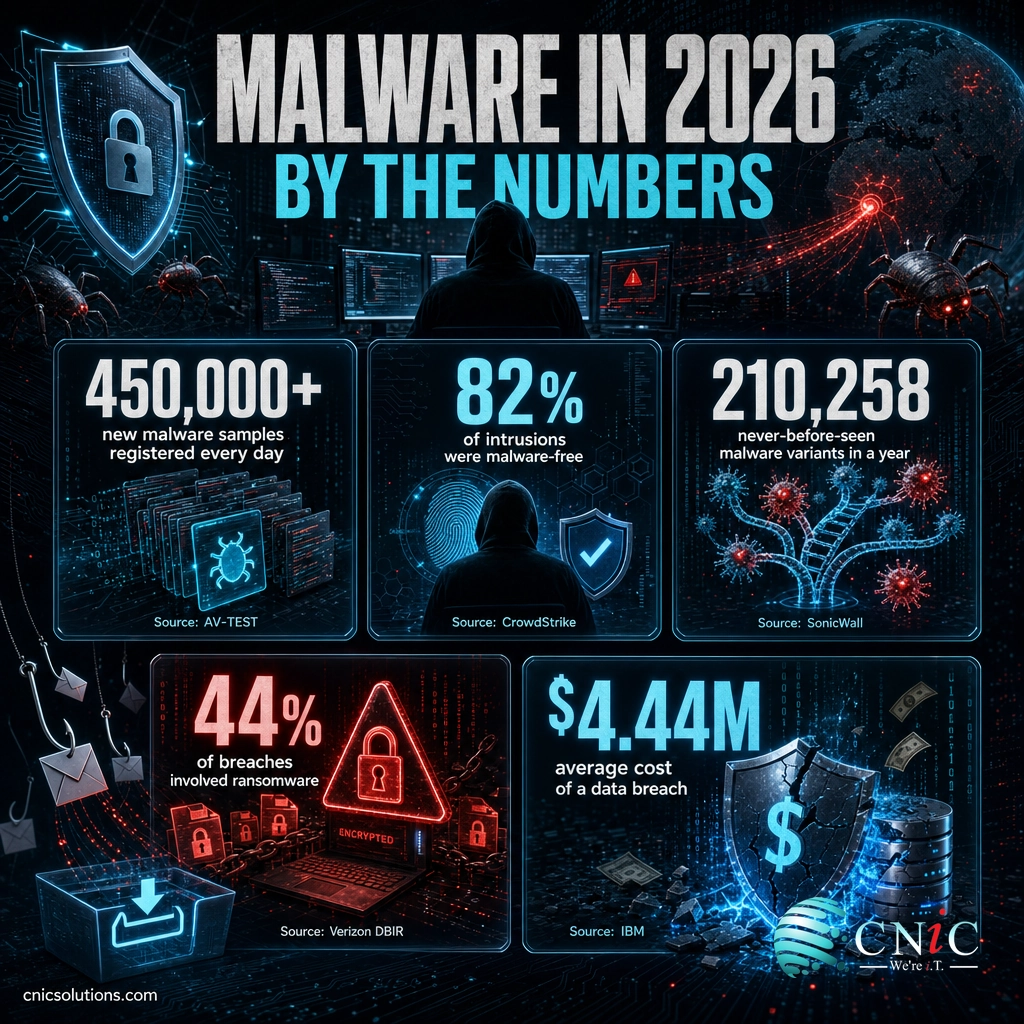
Security vendors now track more than 1.5 billion known malware samples, and the AV-TEST Institute registers over 450,000 new ones every single day in 2026. Yet the most important malware statistic this year is not a count at all: 82% of detected intrusions used no malware file whatsoever, as attackers shifted to stolen passwords and trusted tools.
- Volume keeps climbing. AV-TEST logs 450,000+ new malware and unwanted-app samples per day, against a cumulative library of over 1.5 billion (AV-TEST, 2026).
- Novel variants are the real threat. SonicWall identified 210,258 never-before-seen malware variants in a year, about 637 a day, designed to slip past signature detection.
- The malware-free pivot is the headline of 2026. CrowdStrike found 82% of detections were malware-free, driven by stolen credentials rather than payloads.
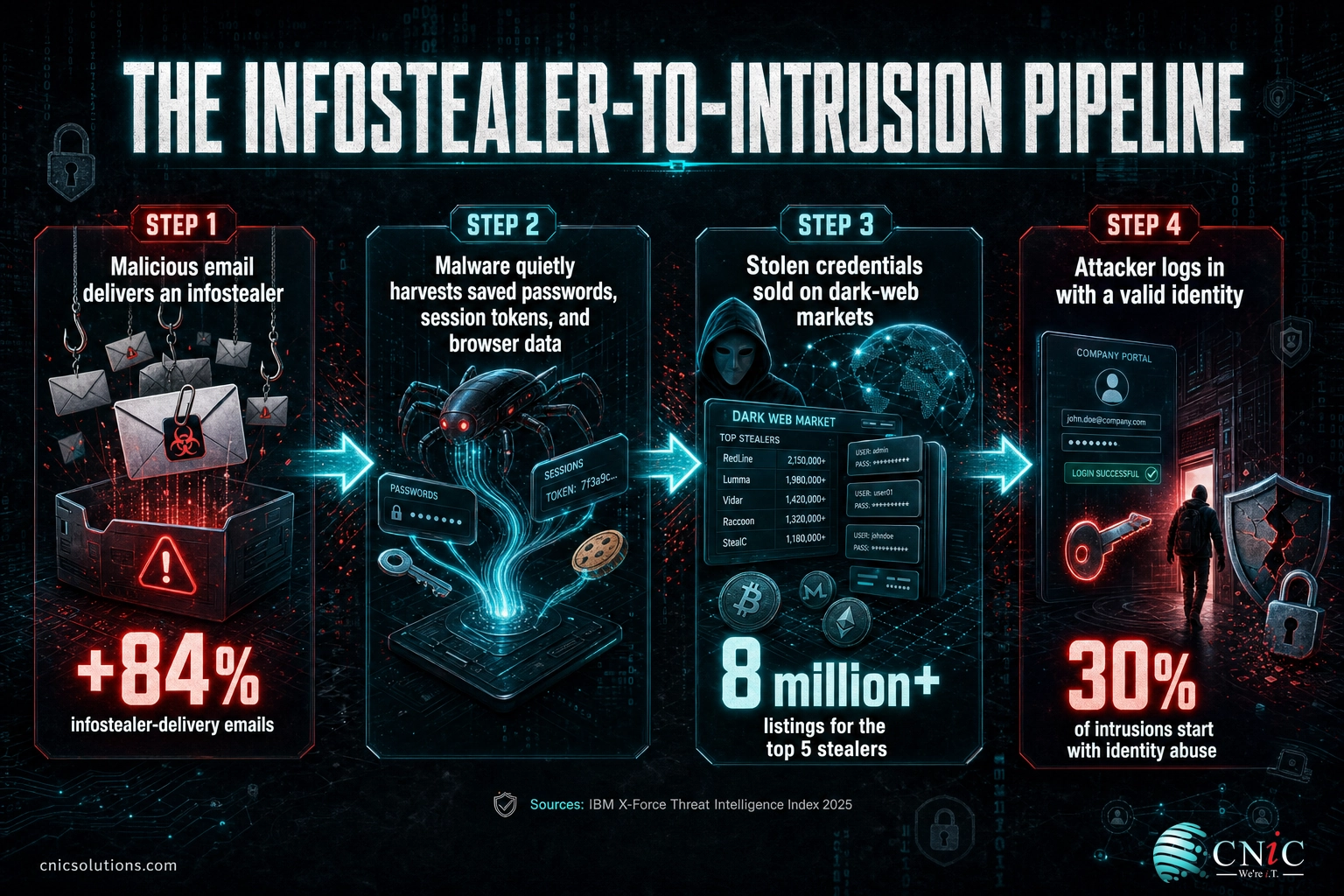
- Infostealers power the shift. IBM X-Force logged an 84% jump in infostealer-delivery emails, and 8 million+ dark-web listings for the top five stealer families.
- Intrusions move in minutes. The average time from break-in to lateral movement fell to 29 minutes, and the fastest was 27 seconds (CrowdStrike, 2025).
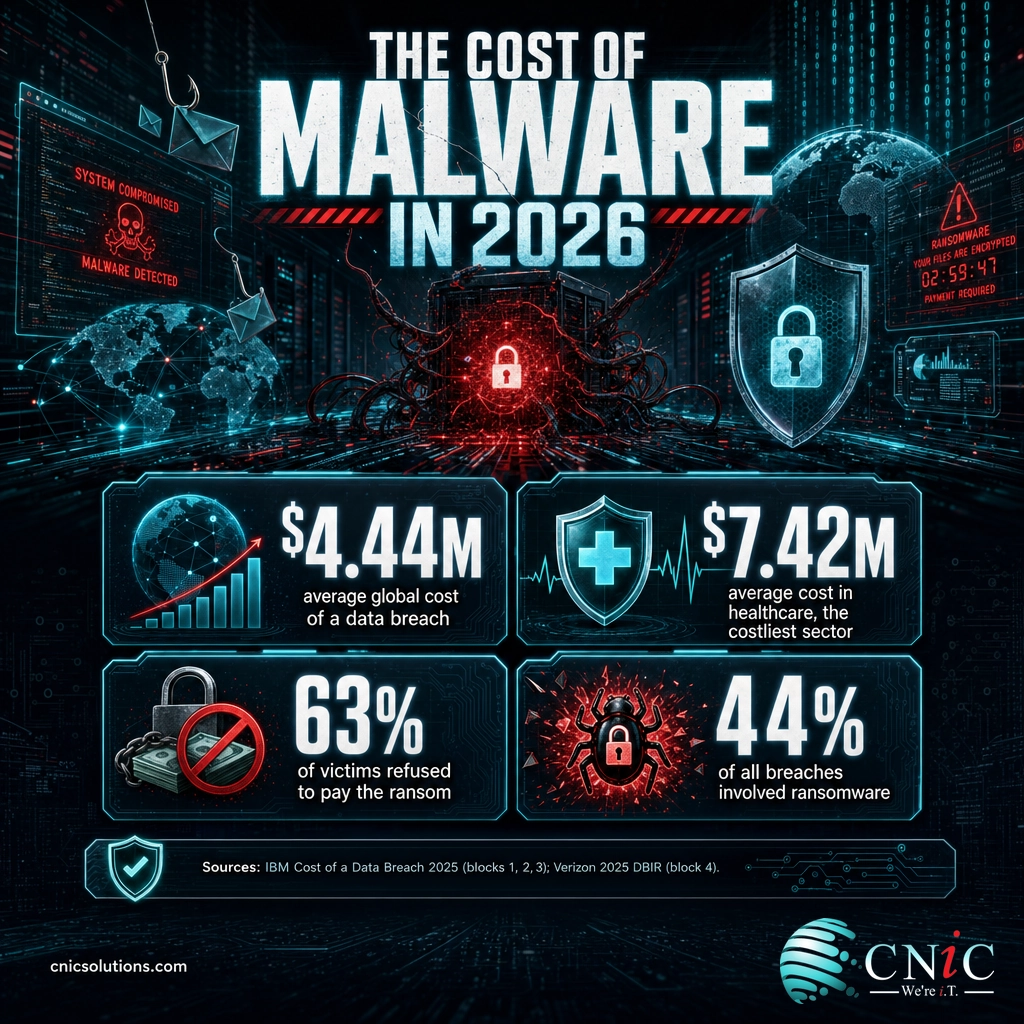
- Infection is expensive. The global average breach hit $4.44 million, ransomware incidents $5.08 million, and healthcare $7.42 million (IBM, 2025).
- Small businesses take the brunt. Ransomware appeared in 88% of SMB breaches versus 39% of large-enterprise breaches (Verizon DBIR, 2025).
What’s in This Guide
- How Much Malware Is Out There in 2026
- Malware Growth: New Variants and Rising Volume
- The Malware-Free Shift: Attackers Ditch the Payload
- Infostealers: The Malware Behind the Credential Economy
- Speed and AI: How Fast Modern Intrusions Move
- New Attack Surfaces: IoT and Encrypted Malware
- What a Malware Infection Actually Costs
- Malware Statistics Summary Table
- Frequently Asked Questions
- Methodology and Sources
How Much Malware Is Out There in 2026
The raw scale of malware is hard to picture. The AV-TEST Institute, which has catalogued malicious code since the 1980s, now registers more than 450,000 new malicious programs and potentially unwanted applications every day, on top of a running library that has passed 1.5 billion known samples. That is the ambient background noise every business network sits inside.
| Metric | Figure | Source |
|---|---|---|
| New malware and PUA samples per day | 450,000+ | AV-TEST |
| Total known malware samples on record | 1.5 billion+ | AV-TEST / AV-ATLAS |
| Never-before-seen variants in a year | 210,258 | SonicWall |
| New variants per day | 637 | SonicWall |
CNiC Solutions Analysis: How fast is “450,000 a day”? Taking AV-TEST’s stated rate of 450,000 new malware and unwanted-application samples per day, that works out to roughly 164 million new samples per year (450,000 x 365), or about 5 brand-new samples every second of every day. Formula: 450,000 / 86,400 seconds per day. Calculation and interpretation original to CNiC Solutions, derived from AV-TEST registration data.
The takeaway for a business is not the headline number but what it implies: signature-based antivirus, which recognizes malware it has seen before, is fighting a volume it cannot fully keep up with. Layered defenses and proactive monitoring, the core of modern managed cybersecurity, exist precisely because no single tool can match this pace.
Source: AV-TEST Malware Statistics | SonicWall 2025 Cyber Threat Report
Get a Free Security Assessment
Malware Growth: New Variants and Rising Volume
Total volume is only half the story. What worries defenders is the pace of new variants, code reworked just enough to defeat detection tools that rely on recognizing known threats. SonicWall reported overall malware volume up 8% year over year, but the sharper signal is in fresh Windows samples. AV-ATLAS data shows the Windows malware catalogue grew from roughly 920 million to 995 million samples in a single year, an increase of just over 8% and closing in on the one-billion mark.
Source: AV-ATLAS, Windows malware sample counts.
Windows remains the primary target because it dominates the business desktop, but the growth is not confined to one platform. The practical effect of 637 new variants a day is that detection built only on known signatures ages quickly. Behavior-based tools that flag what a file does, rather than whether it matches a fingerprint, have become the baseline, and they are a standard component of outsourced IT management.
The reason variant counts matter more than raw totals comes down to polymorphism. Modern malware kits automatically rewrite their own code with every build, so two copies of the same threat can look completely different to a scanner while behaving identically once they run. That is how a family with a handful of authors produces hundreds of thousands of unique fingerprints in a year. For a business, the lesson is that “we block known-bad files” is a shrinking layer of protection. The variants created today were, by definition, unknown yesterday, so any defense that waits for a signature update is always a step behind the people writing the code.
Source: SonicWall 2025 Cyber Threat Report | AV-TEST / AV-ATLAS
The Malware-Free Shift: Attackers Ditch the Payload
Here is the paradox that defines 2026. Malware volume keeps climbing, yet the majority of intrusions no longer involve a malware file at all. CrowdStrike found that 82% of detections in 2025 were malware-free, meaning the attacker signed in with valid credentials, abused a legitimate remote-access tool, or used built-in system utilities rather than dropping a virus or trojan. When there is no malicious file to catch, traditional antivirus has nothing to detect.
Source: CrowdStrike 2026 Global Threat Report.
Myth: “Our antivirus catches most attacks.” Not anymore. With 82% of intrusions arriving as valid logins rather than malware files, antivirus never gets a signal to fire. This is why identity protection, multi-factor authentication, and continuous monitoring matter as much as endpoint scanning. The count of malware samples tells you the threat still exists, but it badly understates how attackers actually get in. This trend runs alongside the latest ransomware attack trends, where operators increasingly buy access rather than break in.
The strategic response is to stop treating malware detection as the whole of security. A fractional IT leadership engagement typically reprioritizes budget toward identity and access controls once leaders see how the entry data has shifted.
What should a business measure instead of malware blocked? The metrics that map to a malware-free world are different: how quickly a suspicious login is spotted, whether multi-factor authentication is enforced on every account rather than most, how many privileged credentials sit unused and unrotated, and how fast access can be revoked when an employee leaves. None of those show up in an antivirus dashboard. They are the difference between an attacker being stopped at the door and an attacker roaming for weeks because their login looked exactly like a real one.
Source: CrowdStrike 2026 Global Threat Report | IBM X-Force Threat Intelligence Index 2025
Infostealers: The Malware Behind the Credential Economy
If most intrusions are malware-free, where do the stolen credentials come from? Largely from a category of malware that is booming precisely because it feeds the shift: infostealers. These lightweight programs quietly harvest saved passwords, session tokens, and browser data, then hand them to a criminal marketplace. IBM X-Force logged an 84% year-over-year rise in emails delivering infostealers, with early-2025 data pointing to a 180% increase over 2023.
| Infostealer Metric | Figure | Source |
|---|---|---|
| Increase in infostealer-delivery emails (year over year) | +84% | IBM X-Force |
| Increase in phishing delivering infostealers (2025 vs 2023) | +180% | IBM X-Force |
| Dark-web ads for the top five stealer families | 8 million+ | IBM X-Force |
| Intrusions starting with valid-identity abuse | 30% | IBM X-Force |
Why this loop matters. Infostealer malware is the on-ramp to the malware-free intrusions in the previous section. One employee opens a boobytrapped attachment, the stealer collects every saved login, and days later an attacker walks in through a legitimate portal using those exact credentials. Because most infostealers arrive by email, the same defenses that stop phishing attacks, email filtering, user training, and enforced MFA, are also your best protection against credential theft.
Infostealers reach users through more than just email. Malicious search ads that impersonate popular software, fake browser-update prompts, and cracked or pirated applications are all common delivery routes, which is why the threat reaches home devices and personal accounts that then bridge into work systems. A single reused password, captured once by a stealer on an employee’s personal laptop, can unlock a business account months later. That blurring of personal and corporate risk is exactly why device management and enforced, unique credentials have moved from nice-to-have to baseline hygiene.
Source: IBM X-Force Threat Intelligence Index 2025
Speed and AI: How Fast Modern Intrusions Move
Once malware or a stolen credential provides a foothold, the clock starts, and it runs faster every year. CrowdStrike measured the average eCrime breakout time, the gap between initial access and moving to a second system, at just 29 minutes in 2025, a 65% acceleration over the prior year. The fastest observed breakout was 27 seconds. Defenders now have minutes, not days, to detect and respond.
Source: CrowdStrike 2026 Global Threat Report.
Artificial intelligence is accelerating both sides. Attackers used generative AI to write convincing lures and even injected malicious prompts into legitimate AI tools, while a 563% jump in fake CAPTCHA lures shows how effective machine-assisted social engineering has become. Matching that speed requires detection that responds in near real time, which is one reason businesses fold AI-assisted monitoring into their defense stack.
A 29-minute average breakout time has a blunt operational consequence: a security model that relies on someone noticing an alert during business hours is already too slow. Attacks do not wait for Monday morning, and the fastest intrusions are finished before a human could open the first ticket. This is the case for continuous detection and response that can isolate a compromised machine automatically, at 2 a.m. on a holiday weekend, without waiting for a person to log in. Speed on the defense has to match speed on the offense, and in 2026 the offense is measured in minutes and seconds.
Source: CrowdStrike 2026 Global Threat Report
New Attack Surfaces: IoT and Encrypted Malware
Malware is not only growing in volume, it is spreading into places older defenses were never designed to watch. SonicWall recorded a 124% surge in attacks on Internet-of-Things devices, the cameras, sensors, and smart hardware that rarely receive patches. At the same time, 93% more threats arrived hidden inside encrypted traffic, and CrowdStrike noted a 37% rise in cloud-focused intrusions. Each of these routes bypasses a network perimeter that assumed threats would look like obvious malware on a managed laptop.
Source: SonicWall 2025 Cyber Threat Report (IoT, encrypted); CrowdStrike 2026 Global Threat Report (cloud).
Encrypted traffic is now the default across the web, which means malware hides in the same secure channels as legitimate business data. Inspecting that traffic without breaking privacy, segmenting IoT devices onto isolated networks, and hardening cloud identities are exactly the gaps that business network design and security is built to close.
The common thread across IoT, encrypted traffic, and cloud is that each expands the attack surface into territory the average business does not actively watch. A smart thermostat, a security camera, and a marketing team’s unsanctioned SaaS app all share one trait: nobody is checking them for compromise. Attackers know this, and the growth figures show them following the path of least resistance. Practical defense starts with an honest inventory of what is actually connected, followed by network segmentation so that a breached camera cannot reach the accounting server. You cannot protect what you have not counted.
Source: SonicWall 2025 Cyber Threat Report | CrowdStrike 2026 Global Threat Report

What a Malware Infection Actually Costs
The final statistic every decision-maker asks about is the price of getting it wrong. IBM’s 2025 Cost of a Data Breach Report put the global average breach at $4.44 million. An extortion or ransomware incident averaged $5.08 million, healthcare stayed the costliest sector at $7.42 million, and the average breach in the United States set a record at $10.22 million. Encouragingly, 63% of organizations hit by ransomware refused to pay in 2025, up from 59% the year before, a sign that reliable backups are changing the math.
Source: IBM Cost of a Data Breach 2025.
The cost gap by company size is stark. The Verizon 2025 DBIR found ransomware present in 88% of breaches at small and midsize businesses, against 39% at large enterprises, a reminder that smaller organizations carry outsized malware risk. The single biggest lever on that final invoice is recovery: tested, isolated backups let a business restore instead of pay, and they are the reason a growing share of victims now walk away from ransom demands.
What lowers the number. IBM found breaches contained faster now take a smaller financial toll, with the average time to identify and contain a breach falling to 241 days, the quickest in nine years. Speed of detection and clean, recoverable backups are the two variables a business can most directly control. For the broader picture across every threat type, see the full 2026 cybersecurity statistics.
It is worth putting these numbers next to a prevention budget. When the average incident runs into the millions and the average small business recovery stretches for weeks, the annual cost of layered defense, monitoring, and tested backups is a rounding error by comparison. The math almost always favors prevention, and it favors it more every year as breakout times shrink and costs climb. The businesses that come through a malware event intact are rarely the ones that spent the most. They are the ones that could detect quickly and restore from a clean backup instead of negotiating with an attacker.
There is a hopeful signal buried in the cost data. Breach expenses fell 9% globally year over year, and the share of ransomware victims who refused to pay kept climbing. Both trends point the same direction: organizations that invested in faster detection and reliable recovery are spending less when the worst happens, and more of them can refuse extortion outright. The gap between a prepared business and an unprepared one is widening, and it shows up directly on the invoice.
Source: IBM Cost of a Data Breach 2025 | Verizon 2025 Data Breach Investigations Report
Malware Statistics Summary Table
Every headline figure in this article, gathered in one place for quick reference and citation. All figures trace to the Tier 1 sources listed in the methodology below.
| Statistic | Figure | Source | Year |
|---|---|---|---|
| New malware and PUA samples registered daily | 450,000+ | AV-TEST | 2026 |
| Total known malware samples on record | 1.5 billion+ | AV-TEST / AV-ATLAS | 2026 |
| Never-before-seen malware variants (per year) | 210,258 | SonicWall | 2024 |
| New malware variants per day | 637 | SonicWall | 2024 |
| Year-over-year malware volume growth | +8% | SonicWall | 2024 |
| Windows malware samples on record | 995 million | AV-ATLAS | 2025 |
| Detections that were malware-free | 82% | CrowdStrike | 2025 |
| Average eCrime breakout time | 29 minutes | CrowdStrike | 2025 |
| Fastest recorded breakout time | 27 seconds | CrowdStrike | 2025 |
| Increase in AI-enabled adversary attacks | +89% | CrowdStrike | 2025 |
| Increase in fake CAPTCHA lure incidents | +563% | CrowdStrike | 2025 |
| Increase in spam email volume | +141% | CrowdStrike | 2025 |
| Increase in cloud-conscious intrusions | +37% | CrowdStrike | 2025 |
| Increase in infostealer-delivery emails | +84% | IBM X-Force | 2024 |
| Dark-web ads for top five infostealer families | 8 million+ | IBM X-Force | 2024 |
| IoT device malware attack increase | +124% | SonicWall | 2024 |
| Encrypted (TLS) threat increase | +93% | SonicWall | 2024 |
| Ransomware present in all breaches | 44% | Verizon DBIR | 2025 |
| Ransomware present in SMB breaches | 88% | Verizon DBIR | 2025 |
| Global average data breach cost | $4.44 million | IBM | 2025 |
| Average ransomware / extortion incident cost | $5.08 million | IBM | 2025 |
| Healthcare average breach cost | $7.42 million | IBM | 2025 |
| Organizations that refused to pay ransom | 63% | IBM | 2025 |
Frequently Asked Questions
How much new malware is created in 2026?
What is a malware-free attack?
What is the fastest-growing type of malware in 2026?
How much does a malware infection cost a business?
Are small businesses really targeted by malware?
Methodology and Sources
How we compiled these statistics
Every figure in this article is drawn from a Tier 1 primary source: a security vendor’s own annual telemetry, a government or industry research body, or a peer-reviewed dataset. We do not cite blog-to-blog statistics or unverified aggregations. Where a figure is derived, it is labeled as a CNiC Solutions analysis with its formula and inputs shown. Figures reflect the most recent full-year reporting available at the time of writing in 2026; each report’s own reporting year is noted in the summary table.
Primary sources:
For journalists and researchers: You are welcome to cite the statistics and the CNiC Solutions analysis in this article with attribution and a link to this page. For the original figures, please attribute the underlying primary source named beside each statistic in the summary table.



related posts
Microsoft 365 Business Premium vs Office 365 E3: Which Is Right for…
September 20, 2026Here is the short answer most buyers do not expect: Microsoft 365 Business Premium costs less…
McAfee Scam Emails: How to Spot Fake Renewal Notices
September 20, 2026A fake McAfee renewal email is one of the most common scams landing in business inboxes…
Managed Services Statistics: Market Size, Growth, and Adoption Data
September 19, 2026The global managed services market is on track to pass $430 billion in 2026, and by…
IT Risk Management Frameworks Explained: NIST RMF, ISO 31000, and FAIR
September 18, 2026An IT risk management framework is a structured system of principles, processes, and controls that helps…