

Structured cabling is the standardized network foundation of a commercial building: the organized system of copper and fiber cabling, patch panels, and connecting hardware that carries every phone call, cloud login, camera feed, and Wi-Fi connection in the space. When it is designed and installed to standard, it quietly does its job for years. When it is not, it becomes the hidden reason a business fights slow networks, mystery outages, and costly rewiring every time it grows.
Structured cabling is a building-wide cabling system, built to the ANSI/TIA-568 standard, that organizes all of a facility’s voice, data, video, and low-voltage connections into a single predictable framework instead of a patchwork of one-off cable runs. It gives a commercial space one reliable physical layer that every application can share.
- Structured cabling replaces improvised, device-to-device wiring with a standardized system organized around patch panels and labeled runs.
- The ANSI/TIA-568 standard defines it as six connected subsystems, from the point service enters the building to the outlet at each desk.
- Downtime is expensive: 54% of operators say their most recent significant outage cost more than $100,000, and one in five say more than $1 million (Uptime Institute, 2024).
- The real payoff is lower total cost of ownership: a good cabling plant is built once and reused across several generations of network equipment.
- It is the shared foundation for cloud, VoIP, wireless, and physical security, so its quality sets a ceiling on every one of those systems.
What’s in This Guide
- What Structured Cabling Actually Is
- The Six Subsystems of a Structured Cabling System
- Structured Cabling vs. Point-to-Point Cabling
- Why Structured Cabling Matters in Commercial Spaces
- Cabling Sets the Ceiling on Network Speed
- The Standards That Keep It Reliable
- Signs a Commercial Space Has Outgrown Its Cabling
- What a Structured Cabling Project Involves
- Frequently Asked Questions
- Related Guides
What Structured Cabling Actually Is
Every commercial building carries three utilities everyone plans for: power, water, and HVAC. Connectivity has quietly become the fourth. Cloud software, VoIP phone systems, IP cameras, badge readers, and wireless access points all depend on one thing underneath them, which is the cabling that ties them back to the network. Structured cabling is the disciplined way to build that layer.
The word that matters is “structured.” Instead of running a fresh cable from each device to wherever it needs to connect, a structured system organizes all of those connections around a common framework: standardized cable, central patch panels, labeled runs, and defined hand-off points. A workstation does not connect directly to a switch. It connects to a wall outlet, which runs back to a patch panel, which is then patched to the switch. Every device follows the same predictable path.
That discipline is what turns a pile of wire into infrastructure. It is documented, testable, and repeatable, which means the next change, the next audit, and the next technician all start from a known baseline rather than guesswork.
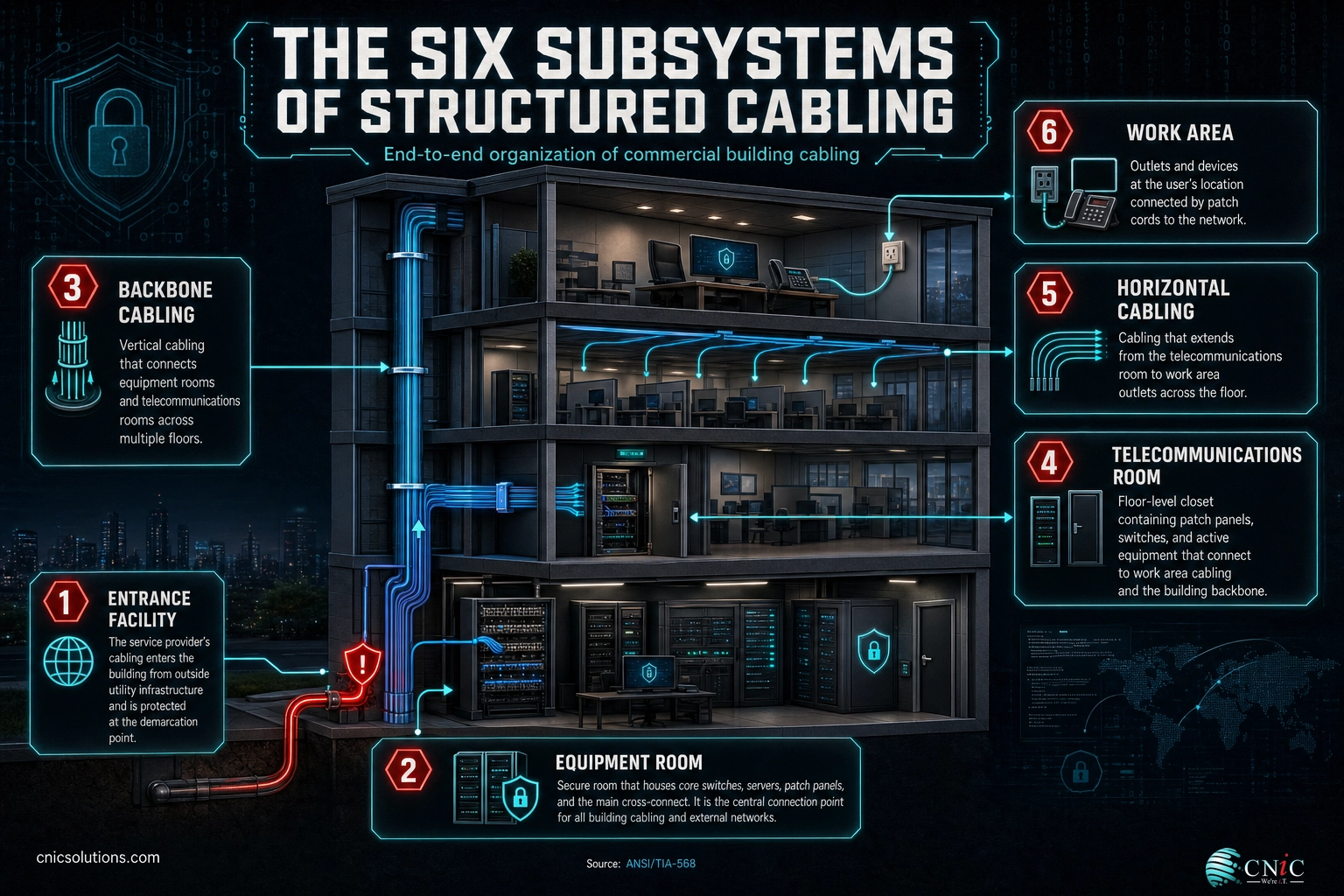
The Six Subsystems of a Structured Cabling System
The ANSI/TIA-568 standard breaks a building’s cabling into six subsystems. Understanding them makes it obvious why the system stays organized as a business grows, because every cable has a defined place and purpose.
- Entrance facility: where the service provider’s connection enters the building and meets the internal cabling. This is the demarcation point between the carrier and your network.
- Equipment room: the central hub that houses core switches, servers, and the main cross-connect for the whole facility.
- Backbone cabling: the high-capacity runs, often fiber, that connect the equipment room to each floor and, in a campus, between buildings.
- Telecommunications room: the floor-level closet where backbone cabling meets the horizontal cabling that fans out to that floor.
- Horizontal cabling: the runs from each telecommunications room to the individual outlets throughout the workspace.
- Work area: the outlets, faceplates, and patch cords at each desk, camera, phone, or access point where people and devices actually connect.
Because the standard defines clear boundaries between these pieces, a problem or a change is contained. Adding a row of desks touches the horizontal cabling and work area, not the backbone or the equipment room. That separation is the quiet source of most of the benefits below.
Structured Cabling vs. Point-to-Point Cabling
The alternative to structured cabling is point-to-point cabling, sometimes called “jack-and-cable” or, less kindly, spaghetti wiring. In a point-to-point setup, each device gets its own cable run straight to wherever it connects. It looks cheaper on day one and works fine with a handful of devices. The trouble starts the moment the space changes.
| Consideration | Structured Cabling | Point-to-Point Cabling |
|---|---|---|
| Design | Standardized runs through central patch panels | Separate cable for each device pair |
| Moves, adds, changes | Re-patch at the panel in minutes | Pull and re-run physical cable |
| Troubleshooting | Labeled, documented, traceable | Trace each cable by hand |
| Scalability | Designed for growth from the start | Every addition adds clutter and risk |
| Standards | Built and tested to ANSI/TIA-568 | Typically none |
| Long-term cost | Higher upfront, lower over time | Lower upfront, higher over time |
The comparison is not really about wire quality. It is about whether the system is organized. Point-to-point cabling pushes the cost into the future, where every change is slower, every fault is harder to find, and the closet eventually becomes a wall of cable no one wants to touch.
Myth: cabling is just wire, so buy the cheapest bid. Cabling is usually a small slice of a network budget, but it is the one layer you cannot patch remotely and rarely replace without disruption. Choosing the lowest bid on materials and labor is where hidden downtime, failed certifications, and premature re-cabling are born. The cabling plant is the part of the network you live with the longest.
Why Structured Cabling Matters in Commercial Spaces
For a business owner or operations manager, the value of structured cabling shows up as fewer problems and more flexibility. Here is where that comes from.
Reliability and less downtime. A standardized, certified cabling plant removes an entire category of intermittent faults: the loose, mislabeled, or out-of-spec connections that cause the network to work one minute and drop the next. Those failures are expensive. In the Uptime Institute’s 2024 Outage Analysis, 54% of operators said their most recent significant outage cost more than $100,000, and one in five said it topped $1 million. Cabling alone does not cause every outage, but it is the physical foundation every other layer sits on, so its quality directly limits how reliable the whole network can be.
Scalability and painless change. Commercial spaces are never static. Teams grow, floors get reconfigured, and new devices arrive constantly. With structured cabling, most of those changes happen at the patch panel rather than inside the walls. Adding people or moving a department becomes a re-patch, not a construction project, which keeps the business moving.
Simpler troubleshooting. When every run is labeled and documented, finding a fault is a matter of following the map instead of chasing a cable through the ceiling. That shortens the time to resolution on the exact incidents that would otherwise stretch into hours of lost productivity.
Lower total cost of ownership. This is the benefit that decision-makers feel most. A structured system is built once and reused across several generations of switches, phones, and access points. Point-to-point wiring, by contrast, tends to be rebuilt every few years as the mess becomes unworkable. Spread over the life of the building, the organized system almost always costs less.
For commercial spaces that depend on a stable, well-planned physical network, these benefits compound year after year, and they all trace back to how the cabling was designed and installed in the first place.
Get a Structured Cabling Assessment
One foundation for every system. Modern buildings converge voice, data, video, wireless, and physical security onto shared cabling. A structured plant is designed to carry all of it, which is why the quality of the cabling sets a ceiling on the performance of everything that plugs into it. Weak cabling turns even premium switches and cameras into underperformers.
Cabling Sets the Ceiling on Network Speed
The category of copper cable a building is wired with decides the maximum speed and distance the network can support, no matter how fast the equipment on either end is. This is why cabling choices made during construction still shape performance a decade later.
Maximum data rate by copper cable category
Cat6 reaches 10 Gbps only to about 55 meters, while Cat6a holds 10 Gbps across a full 100-meter channel. Source: ANSI/TIA-568 and IEEE 802.3.
Choosing the right category during design is the cheapest form of future-proofing there is. The cost difference between categories is small compared with the labor to pull cable, and the labor is the same whether the wire inside the wall is entry-level or ready for the next generation of equipment. If you are weighing options, the practical trade-offs come down to the difference between Cat6 and Cat6a cable for your run lengths and growth plans.
The Standards That Keep It Reliable
What makes structured cabling dependable is not any single product. It is the shared rulebook that installers, manufacturers, and testers all follow. Three bodies define that rulebook for commercial spaces.
- ANSI/TIA-568 is the North American standard that defines the subsystems, the recognized copper and fiber media, and the performance each cable category must meet.
- ISO/IEC 11801 is the international equivalent, used for buildings and organizations that operate globally.
- BICSI publishes the installation best practices and credentials that turn the standards into disciplined field work.
Standards matter to a business owner for one practical reason: they make quality verifiable. A properly installed system is tested and certified against these standards, which produces documentation you can hand to an auditor, a landlord, or the next IT provider. It is the difference between “the network seems fine” and proof that every run performs to spec.
Signs a Commercial Space Has Outgrown Its Cabling
Cabling problems rarely announce themselves. They show up as symptoms that get blamed on other things. A few patterns usually mean the physical layer needs attention.
- Wi-Fi and wired connections that slow down or drop under load, especially as the office fills up.
- A telecommunications closet where no one can tell which cable goes where without tracing it by hand.
- Every desk move or new hire turning into a wiring project instead of a quick change.
- Recurring “it works sometimes” faults that never fully resolve.
- Plans for VoIP, more cameras, or higher-density Wi-Fi that the current cabling was never designed to carry.
If several of these sound familiar, the fix is usually a cabling assessment rather than another round of replacement switches. The equipment is often fine. The foundation underneath it is the constraint.
What a Structured Cabling Project Involves
A well-run structured cabling project follows a clear sequence, whether it is a new build, a renovation, or a cleanup of an existing space.
- Assessment and design: map current and future device counts, choose cable categories, and lay out subsystem locations against the floor plan.
- Pathways and installation: run cable through proper trays and conduit, keeping it separated from electrical interference and within standard distance limits.
- Termination and labeling: land every cable on patch panels and outlets, then label both ends to a consistent scheme.
- Testing and certification: test each run against ANSI/TIA-568 and document the results, so performance is proven, not assumed.
- As-built documentation: hand over records and diagrams that make every future change and repair faster.
The design and documentation stages are where good cabling projects separate from cheap ones. Done well, the result is a physical network that supports the business for years and connects cleanly to the rest of your network infrastructure that keeps a business running.
CNiC Solutions has designed, installed, and certified commercial cabling since 2007, and pairs it with the switching, wireless, and monitoring that ride on top of it.
See IT Infrastructure Management
Frequently Asked Questions
What is structured cabling?
What are the main benefits of structured cabling for a commercial space?
How is structured cabling different from point-to-point cabling?
How long does a structured cabling system last?
Does a small office really need structured cabling?
Related Guides
- What Is a Network Infrastructure?: how the physical and logical pieces of a business network fit together.
- Cat6 vs. Cat6a: Which Cable Should You Run? (guide coming soon)
Sources
Standards and figures in this article come from primary industry and standards sources:



related posts
What Is NIST Compliance? Frameworks, Requirements, and Who Needs It
October 25, 2026NIST compliance means aligning your organization's security program with the cybersecurity standards published by the National…
What Is Network Penetration Testing? Types and Process
October 25, 2026Network penetration testing is a controlled, authorized simulation of a real cyberattack on your network, run…
What Is Mobile Device Management (MDM)? A Guide for Businesses
October 24, 2026Mobile Device Management (MDM) is software that lets an organization remotely enroll, configure, secure, and monitor…
What Is MFA? How Multi-Factor Authentication Protects Your Accounts
October 24, 2026Multi-factor authentication (MFA) is a security method that requires two or more separate proofs of identity…