

NIST compliance means aligning your organization’s security program with the cybersecurity standards published by the National Institute of Standards and Technology (NIST). It is an ongoing practice, not a one-time certificate. For federal agencies and contractors it is often mandatory, and for private businesses it has become the leading benchmark for proving security maturity.
If you have shopped for cyber insurance, bid on a government contract, or answered a client security questionnaire lately, you have probably run into “NIST.” It shows up as a requirement, a checkbox, and a buzzword, often without anyone explaining what it actually asks of you. This guide clears that up: what NIST compliance is, the frameworks behind it, what the requirements involve, and exactly who needs to care.
- NIST is a U.S. government agency that publishes cybersecurity standards. “NIST compliance” means following the relevant one for your situation.
- The three you will hear most are the Cybersecurity Framework (CSF) 2.0, SP 800-171, and SP 800-53. Each serves a different audience.
- CSF 2.0 added a sixth core function, Govern, in 2024, putting leadership and accountability at the center of a security program.
- For federal agencies and defense contractors, NIST alignment is legally required. For everyone else it is voluntary but increasingly expected by customers, insurers, and auditors.
- NIST compliance is continuous. It relies on ongoing monitoring, documentation, and improvement rather than a single pass or fail.
What’s in This Guide
How NIST Compliance Works
NIST does not run a compliance program the way an auditor or a licensing board does. It is a standards body inside the U.S. Department of Commerce, and its job is to publish detailed, well-researched guidance on how to secure information systems. “Being NIST compliant” means you have adopted the specific NIST publication that applies to you and can demonstrate that your controls meet it.
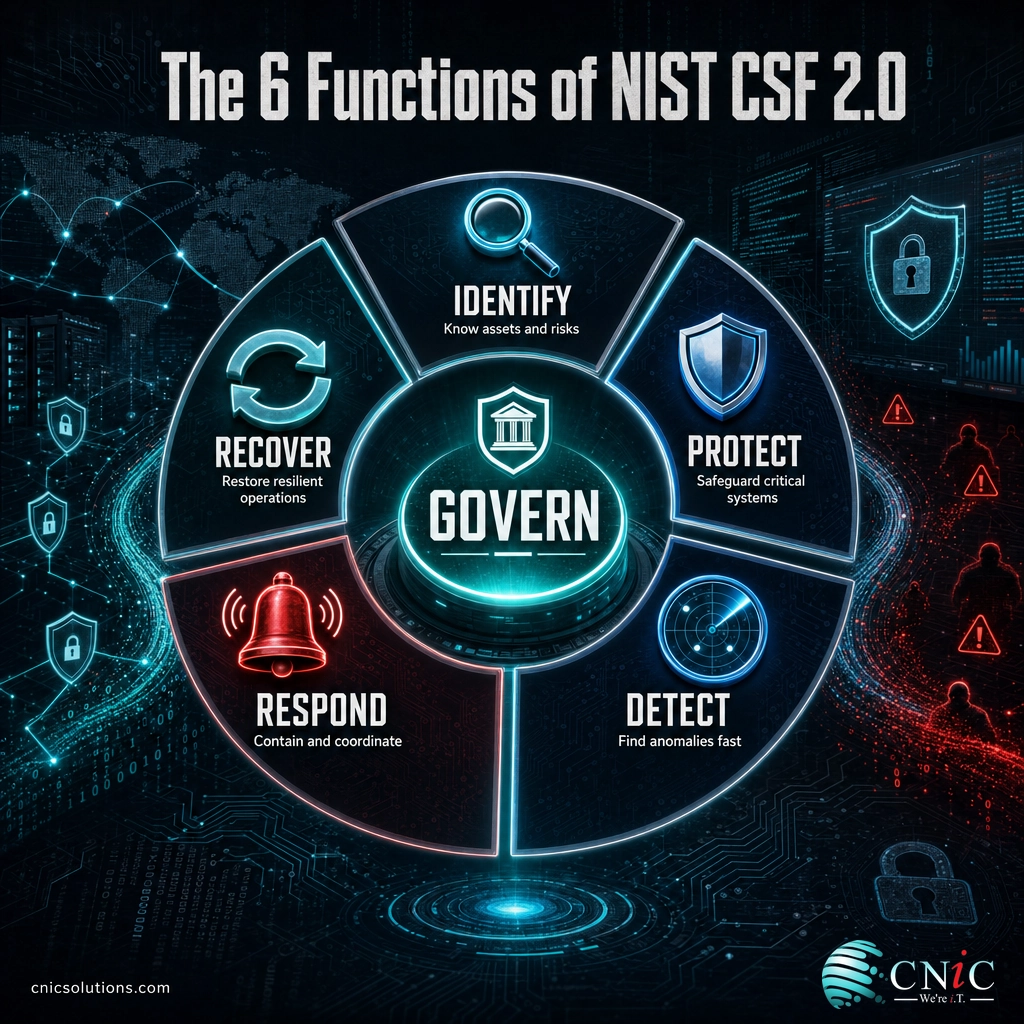
The most widely used starting point is the NIST Cybersecurity Framework. Its 2.0 release, published in February 2024, is the first major update since the framework debuted in 2014, and it organizes cybersecurity into six core functions. Think of them as the plain-English questions every security program has to answer:
- Govern. Who is accountable, what is our risk tolerance, and how do we make security decisions? This function is new in 2.0 and sits above the other five.
- Identify. What data, devices, and systems do we have, and where are the risks?
- Protect. What safeguards keep those assets secure, from access controls to training?
- Detect. How would we know an attack is happening?
- Respond. What is our plan when something goes wrong?
- Recover. How do we restore operations and learn from the incident?
Under those six functions, CSF 2.0 breaks the work into 106 outcomes (called subcategories) across 22 categories. You do not have to hit all of them on day one. The framework is designed to be scaled to your size, industry, and risk, which is exactly why organizations of every kind adopt it. A useful way to picture the mechanics is a single diagram, with Govern in the middle holding the other functions together.
Source: NIST Cybersecurity Framework 2.0
NIST vs. ISO 27001: Clearing Up the Confusion
The single most common point of confusion is the difference between NIST and ISO 27001. Both are respected ways to manage information security, and plenty of mature organizations use both. The practical differences decide which one fits your situation.
| Consideration | NIST (CSF / 800-53 / 800-171) | ISO 27001 |
|---|---|---|
| Published by | U.S. government (NIST), free to use | International Organization for Standardization, paid standard |
| Primary audience | U.S. federal agencies, contractors, and businesses adopting a benchmark | Global organizations wanting an internationally recognized certificate |
| Certification | No NIST certificate (CMMC is the closest formal attestation) | Formal, auditable certification exists |
| Cost to access | Free to download and use | Standard must be purchased |
| Best fit | Federal work, U.S. supply chains, and rapid risk-based improvement | Companies needing a formal badge for international customers |
In short: NIST is the more flexible, freely available benchmark and is effectively required if you touch federal data. ISO 27001 offers a formal certificate that some international clients specifically ask for. They map closely to each other, so building on NIST first rarely goes to waste.
Why NIST Compliance Matters for Businesses
Even when no regulation forces your hand, NIST alignment is a business decision as much as a technical one. It gives you a defensible, documented answer to the two questions every stakeholder is now asking: how do you manage cyber risk, and can you prove it? That answer increasingly decides whether you win a contract, qualify for insurance, and survive a breach without a catastrophic bill.
Breach costs vary widely by industry, and the sectors CNiC Solutions serves most, such as healthcare and financial services, sit at the top of the list. The chart below shows the 2025 averages.
Average Data Breach Cost by Industry, 2025 (Global)
Source: IBM Cost of a Data Breach 2025.
A NIST-aligned program does not just reduce the odds of a breach. It shortens the time to detect and contain one, which is the single biggest lever on the final cost. For a fuller picture of how these numbers have trended, see our breakdown of the latest data breach cost research.
Myth: “NIST compliance is only for government agencies.” This is the most persistent misconception, and it is wrong. The Cybersecurity Framework was deliberately written for organizations of any size and sector. Private businesses now adopt NIST because customers, cyber insurers, and auditors treat it as the default measure of a serious security program, not because a federal law demands it.
Source: IBM Cost of a Data Breach 2025 | CMMC Program Final Rule
Get a Free Security Assessment
The Core NIST Frameworks Explained
“NIST compliance” is really a family of publications. Knowing which one applies saves you from chasing requirements that were never meant for your organization. Here are the four you are most likely to encounter.
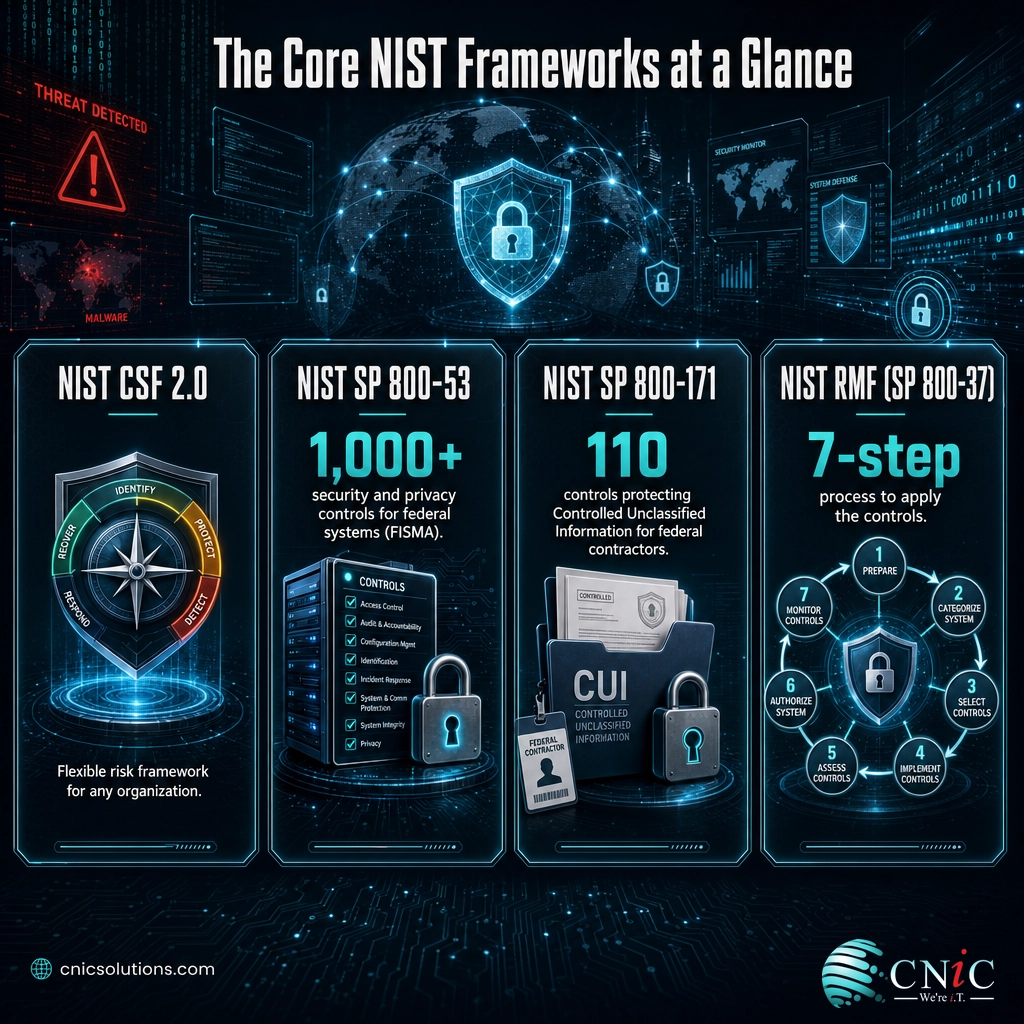
NIST Cybersecurity Framework (CSF) 2.0
The flexible, risk-based framework for any organization. It is voluntary, free, and industry-neutral, which makes it the natural starting point for a private business that wants structure without a federal mandate. Its six functions (Govern, Identify, Protect, Detect, Respond, Recover) give leadership a shared language for security decisions.
NIST SP 800-53
The comprehensive control catalog for federal information systems, with more than 1,000 security and privacy controls across 20 families. It is the backbone of federal compliance under FISMA. Most private businesses will never implement all of 800-53, but many of its controls flow downstream into the requirements they do face.
NIST SP 800-171
The set that most often affects private companies. It protects Controlled Unclassified Information (CUI) on nonfederal systems, meaning contractor and subcontractor networks. Revision 2, the version currently enforced under the federal DFARS 252.204-7012 clause, defines 110 security requirements across 14 families. Revision 3 reorganizes these into 97 controls across 17 families, but a 2024 DoD class deviation kept active contracts tied to Revision 2 for now.
NIST Risk Management Framework (RMF, SP 800-37)
Less a control list than a process. The RMF lays out seven steps, Prepare, Categorize, Select, Implement, Assess, Authorize, and Monitor, for applying NIST controls in a disciplined, repeatable way. If you want the full comparison against other governance models, our guide to IT risk management frameworks, including NIST RMF, ISO 31000, and FAIR, breaks down when to use each. Many teams also pair NIST with the prioritized action list in our overview of the CIS Critical Security Controls.
Source: NIST SP 800-171 | NIST SP 800-53 Rev. 5

Who Needs NIST Compliance?
Whether NIST is a legal obligation or a smart-but-optional benchmark depends entirely on who you work with and what data you handle. Most organizations fall into one of two groups.
Organizations for which NIST is mandatory
- Federal agencies. Required to follow NIST SP 800-53 under FISMA.
- Defense contractors and subcontractors. Any business handling Controlled Unclassified Information must meet NIST SP 800-171, now enforced through the CMMC program. CMMC Level 2 maps directly to the 110 controls in 800-171 Revision 2.
- Federal civilian contractors and grantees whose contracts reference NIST requirements.
Organizations for which NIST is strongly recommended
- Regulated industries. Healthcare (alongside HIPAA), financial services, and legal firms use NIST to structure the safeguards their own regulations demand.
- Anyone in a supply chain. If you sell to enterprises, government contractors, or regulated firms, expect NIST-based questions in their vendor reviews.
- Businesses buying cyber insurance. Insurers increasingly price policies around the controls NIST describes.
- Any organization that wants a credible security baseline. The framework scales down to a small office just as well as it scales up.
If your business sits in more than one of these buckets, that is not a contradiction. It usually means NIST is the common language that lets one security program satisfy several requirements at once.
How to Get Started With NIST Compliance
You do not begin by implementing hundreds of controls. You begin by figuring out which framework applies and how far your current program already goes. A workable path looks like this:
- Pick the right framework. CSF 2.0 for a general baseline, 800-171 if you handle CUI, 800-53 for federal systems.
- Run a gap assessment. Compare your existing controls against the framework to see where you stand today.
- Prioritize by risk. Close the highest-risk gaps first rather than working alphabetically through a checklist.
- Document everything. Policies, procedures, and evidence are the difference between “we do that” and “we can prove it.”
- Monitor continuously. Because compliance is ongoing, build in regular reassessment rather than a once-a-year scramble.
This is where many small and midsize businesses get stuck, not because the guidance is unclear, but because interpreting it and mapping it to real systems is a specialized job. A Virtual CIO who owns your compliance roadmap can translate a NIST framework into a prioritized plan, and day-to-day managed IT support keeps the controls maintained instead of drifting. The Recover function in particular leans on tested backup and disaster recovery you can count on when it matters. It is also worth pairing your framework work with a written incident response plan, which is what the Respond function asks for.
Talk to CNiC About Your NIST Roadmap
Common Questions About NIST Compliance
Is NIST compliance mandatory?
What is the difference between NIST CSF, 800-171, and 800-53?
How many controls are in NIST 800-171?
Is there a NIST compliance certification?
How long does NIST compliance take?
Related Terms
- CUI (Controlled Unclassified Information): Sensitive federal information that is not classified but still requires protection under NIST SP 800-171.
- CMMC: The Cybersecurity Maturity Model Certification program, which verifies that defense contractors have implemented NIST 800-171 controls. See our risk management framework guide.
- FISMA: The federal law that requires U.S. agencies to secure their systems using NIST SP 800-53.
- DFARS 252.204-7012: The defense acquisition clause that obligates contractors to safeguard CUI per NIST 800-171.
- ISO 27001: An international, certifiable information security standard that maps closely to NIST frameworks.
- Security control: A specific safeguard (such as multi-factor authentication) that a framework requires you to implement and document.
- CIS Controls: A prioritized list of defensive actions that pairs well with NIST. Read our CIS Critical Security Controls guide.
About This Guide
Sources and Methodology
This explainer is built entirely on primary sources: framework documentation published directly by NIST, federal rulemaking, and independently researched breach-cost data. Figures were current as of publication and reflect the most recent editions of each standard.
- NIST Cybersecurity Framework 2.0, structure and six functions, from NIST’s official Cybersecurity Framework resource.
- Control counts for NIST SP 800-171 and NIST SP 800-53 Revision 5, from NIST’s Computer Security Resource Center.
- CMMC scope and requirements from the CMMC Program Final Rule in the Federal Register.
- Data breach cost figures from the IBM Cost of a Data Breach Report 2025.
CNiC Solutions is a Houston-based managed IT and cybersecurity provider. This article is educational and not legal or compliance certification advice; confirm your specific obligations with your contracting officer or compliance counsel.



related posts
What Is Network Penetration Testing? Types and Process
October 25, 2026Network penetration testing is a controlled, authorized simulation of a real cyberattack on your network, run…
What Is MFA? How Multi-Factor Authentication Protects Your Accounts
October 24, 2026Multi-factor authentication (MFA) is a security method that requires two or more separate proofs of identity…
What Is Mobile Device Management (MDM)? A Guide for Businesses
October 24, 2026Mobile Device Management (MDM) is software that lets an organization remotely enroll, configure, secure, and monitor…
What Is Log Analysis? How It Works and Why It Matters
October 23, 2026Log analysis is the practice of reviewing and interpreting the log files that computers, applications, and…