

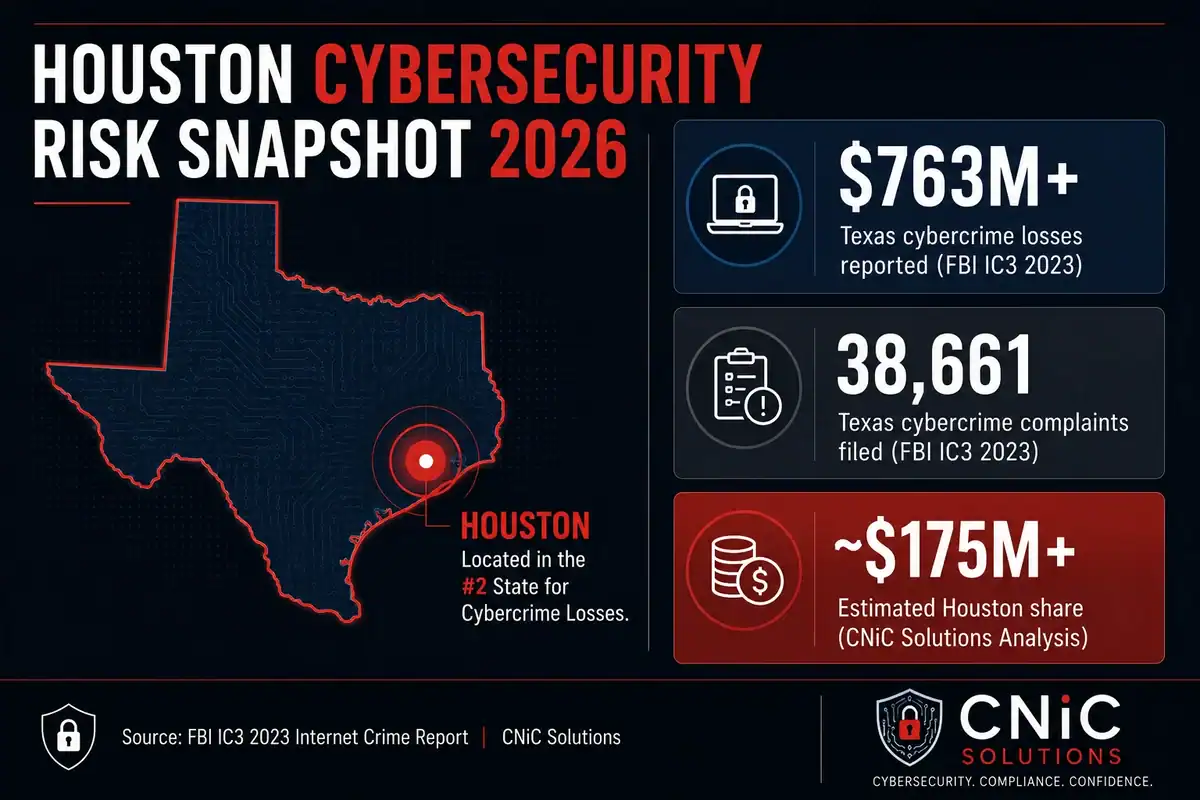
Houston is the fourth-largest city in the United States and one of the most targeted metro areas for cybercrime in the country. Texas ranked #2 nationally for total cybercrime victim losses in the FBI IC3’s most recent Internet Crime Report — with over $763 million in reported losses and 38,661 complaints filed in a single year. For Houston’s 150,000+ small and midsize businesses, the exposure is direct: the city’s concentration of healthcare systems, energy companies, law firms, financial services firms, and manufacturers puts it squarely in the crosshairs of ransomware operators, business email compromise gangs, and data thieves who target high-value industries regardless of company size. This article compiles the definitive Houston cybersecurity statistics for 2026 from Tier 1 primary sources — FBI IC3, IBM, Sophos, Verizon DBIR, ISC2, HHS OCR, Ponemon Institute, CISA, and Proofpoint — covering local threat data, breach costs, ransomware impact, phishing trends, industry-specific risk, the workforce gap, and SMB preparedness. For a national view of the same threat landscape, see our cybersecurity statistics 2026 roundup.
Key Takeaways: Houston Cybersecurity Statistics 2026
- Texas ranked #2 nationally for cybercrime losses — $763M+ in reported victim losses and 38,661 complaints filed in 2023 alone (FBI IC3 2023 Internet Crime Report).
- The average U.S. data breach now costs $9.36 million — the highest of any country globally, with healthcare breaches averaging $9.77M per incident (IBM 2024).
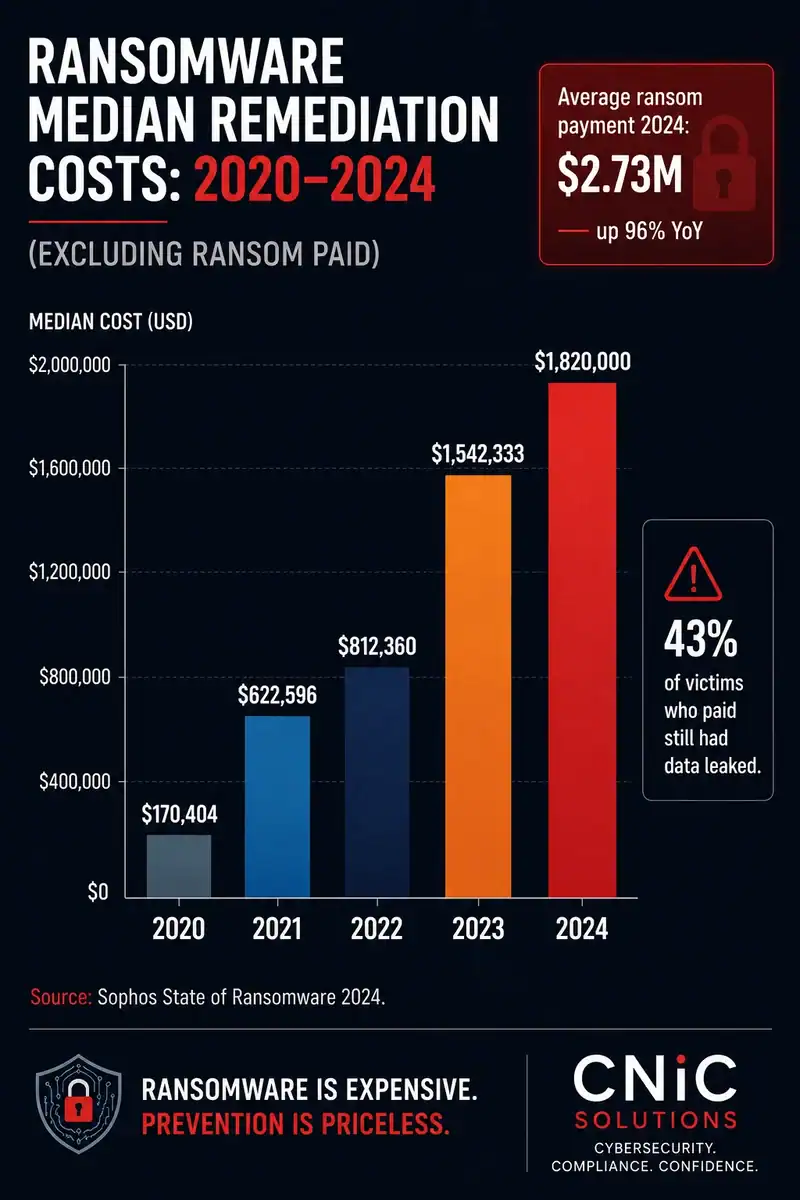
- Ransomware remediation costs reached $1.82 million in 2024 — excluding the ransom itself — up from $170,404 in 2020, a tenfold increase in four years (Sophos 2024).
- 36% of all data breaches begin with phishing, and Business Email Compromise cost U.S. victims $2.9 billion in reported losses in 2023 (Verizon DBIR 2024; FBI IC3 2023).
- Houston’s highest-risk industries — healthcare, financial services, legal, energy, and manufacturing — all carry average breach costs well above the global average.
- 3.5 million cybersecurity positions remain unfilled globally, making in-house security staffing unworkable for most Houston SMBs (ISC2 2023).
- 60% of small businesses close permanently within six months of a major cyber attack — yet only 45% of SMBs have a documented incident response plan (Verizon DBIR; Ponemon 2023).
Texas Cybercrime Losses: Where Houston Fits in the National Picture
To understand Houston’s cybersecurity risk, you have to start with Texas. The state is a consistent top-three target nationally for cybercrime — driven by its massive economy, the concentration of energy, healthcare, and financial firms, and a large base of small and midsize businesses that often lack dedicated IT security staff.
The FBI Internet Crime Complaint Center (IC3) tracks reported cybercrime complaints and losses by state. Texas’s figures are consistently among the worst in the country — and Houston, as the state’s economic engine, carries a disproportionate share of that exposure.
Top 5 States for Total Cybercrime Victim Losses — FBI IC3 2023
Houston’s position as Texas’s largest city and home to more than 24 Fortune 500 companies makes it an especially high-value target. The city’s energy sector concentration, large healthcare systems, and dense professional services market — legal, financial, accounting, insurance — are all priority industries for ransomware operators and data thieves.
FBI IC3 data captures reported losses only. Cybersecurity researchers consistently estimate that fewer than 15% of cybercrime incidents are ever reported to law enforcement, meaning the true scale of Houston-area cybercrime losses is likely several multiples of the figures above.
Houston represents approximately 23% of the Texas population (2.3M of 30M residents) and a disproportionately large share of Texas GDP due to its corporate and energy sector concentration. Applying a conservative population-proportional estimate to Texas’s $763M in reported cybercrime losses suggests Houston-area businesses and individuals account for approximately $175M+ in reported cybercrime losses annually — before accounting for the city’s outsized corporate density, which would push the true proportion higher.
CNiC-derived calculation: 23% population proportion × $763M Texas reported losses = ~$175M estimated Houston share. Sources: FBI IC3 2023 Internet Crime Report; U.S. Census Bureau Texas/Houston population data. Calculation and interpretation original to CNiC Solutions.
Source: FBI Internet Crime Complaint Center (IC3) — 2023 Internet Crime Report
Assess Your Houston Business’s Cyber Risk — Talk to CNiC Solutions →
Data Breach Costs: What a Houston Business Actually Pays
When a data breach happens, the bill is rarely what business owners expect. Direct costs — forensics, notification, legal fees, regulatory penalties — are only part of the picture. Lost business, reputational damage, and operational downtime often dwarf the immediate response costs. IBM’s annual Cost of a Data Breach Report is the most comprehensive study of breach costs globally, tracking 604 organizations across 17 industries and 16 countries. For context on how these figures fit into the broader national data breach landscape, see our data breach statistics 2026 breakdown.
Average Data Breach Cost by Industry — Houston’s Highest-Risk Sectors (IBM 2024)
For small and midsize businesses — the majority of the Houston business base — the Ponemon Institute’s research on SMB breach costs provides context that IBM’s enterprise-focused methodology sometimes underrepresents. Ponemon data indicates SMB breach costs ranging from $120,000 to $1.24 million per incident depending on scope, industry, and response readiness. At either end of that range, the cost exceeds what most unprepared SMBs can absorb without material operational impact.
Verizon’s 2024 Data Breach Investigations Report found that 46% of all reported breaches involved small businesses. Threat actors don’t filter by company size — they filter by vulnerability. Unpatched systems, weak passwords, and absent MFA are open invitations regardless of headcount. Houston SMBs are not too small to be targeted. They are often too exposed to withstand an attack.
Source: IBM Cost of a Data Breach Report 2024 | Verizon 2024 Data Breach Investigations Report (DBIR)
Protect Houston Business Data — CNiC Backup & Recovery Services →
Ransomware in Texas: Frequency, Costs & Recovery Reality
Ransomware is the dominant cyber threat to Houston businesses in 2026. It targets every industry and every business size, and the recovery costs have reached levels that permanently close organizations that survive the initial attack. Texas sees consistent ransomware activity from both financially motivated criminal groups and state-linked actors targeting critical infrastructure. For a complete national picture of ransom payment trends and victim data, see our ransomware statistics 2026.
Texas’s energy infrastructure, municipal government systems, and school districts have all been documented ransomware victims in publicly reported incidents. Private businesses — which rarely make news when attacked — face the same tactics without the public incident response resources that large institutions can access.
The ransom payment is rarely the end of the cost. Sophos data shows organizations spend more on recovery, system restoration, lost productivity, and reputational damage than on the ransom itself. For businesses without tested backup and recovery systems, the recovery bill compounds with every day of downtime. Sophos research indicates 35% of ransomware victims required more than a month to fully recover — a period during which most Houston businesses cannot operate normally, serve clients, or generate revenue.
CISA has specifically identified the oil and gas sector, utilities, and energy infrastructure among the most aggressively targeted sectors by ransomware groups and nation-state actors. Houston, home to more than 4,600 energy-related companies, carries elevated exposure. The Colonial Pipeline ransomware attack — which shut down fuel supply to the U.S. East Coast — originated from a single compromised password on a legacy VPN account with no MFA protection. Houston-based energy firms operate against this same attack surface daily.
Source: Sophos State of Ransomware 2024 | CISA Energy Sector Critical Infrastructure Security
Build Ransomware Resilience — CNiC Data Backup & Recovery for Houston →
Phishing Attacks: The Entry Point for Most Houston Breaches
The majority of successful cyberattacks on Houston businesses don’t begin with sophisticated technical exploits. They begin with a single employee clicking a malicious link or entering credentials into a spoofed login page. Phishing is the most common attack vector globally — and it works because it targets human judgment, not technical defenses. For complete phishing volume, cost, and AI-assisted attack data, see our phishing statistics 2026.
Business Email Compromise (BEC) is a particularly damaging phishing variant for Houston businesses. BEC attacks impersonate executives, vendors, or financial institutions to trick employees into authorizing fraudulent wire transfers or disclosing credentials. The FBI IC3’s 2023 Internet Crime Report identified BEC as the costliest cybercrime category in the U.S. — responsible for over $2.9 billion in adjusted losses, more than ransomware, more than data theft, more than any other attack type.
For Houston businesses with active vendor relationships, client invoicing, and financial transactions — common across the city’s construction, legal, real estate, and professional services sectors — BEC is not a theoretical threat. It is a daily operational risk that has cost Houston-area businesses millions in documented, publicly reported incidents.
IBM’s Cost of a Data Breach Report 2024 found that breaches caused by phishing took an average of 261 days to identify and contain — significantly longer than breaches detected by automated security tools. Every day of undetected access increases the volume of data exfiltrated and the cost of remediation. Employee security awareness training, email filtering, and MFA enforcement are not optional — they are the difference between a detected incident and a $9.36M breach bill.
Security awareness training programs demonstrate measurable impact. Proofpoint research indicates that organizations running regular phishing simulation training reduce employee click rates on simulated phishing emails by up to 86% over 12 months — making it one of the highest-ROI security investments available to Houston SMBs.
Source: Verizon 2024 Data Breach Investigations Report | FBI IC3 2023 Internet Crime Report | Proofpoint State of the Phish 2024
Protect Your Team From Phishing — CNiC Cybersecurity Services →
Houston’s Highest-Risk Industries: Breach Costs by Sector
Cybersecurity risk is not evenly distributed across industries. In Houston, four sectors carry dramatically elevated exposure — and all four are core pillars of the city’s economy. Understanding industry-specific risk is essential for any Houston business owner making security investment decisions.
Healthcare
Houston is home to the Texas Medical Center — the largest medical complex in the world, employing over 106,000 people across 61 institutions. Beyond the TMC, hundreds of independent medical practices, dental offices, specialty clinics, and regional healthcare networks operate across the metro. Healthcare is the most targeted sector in the U.S. for data breaches, driven by the high resale value of protected health information (PHI) on dark web markets and the pressure on providers to restore operations quickly — a dynamic ransomware operators deliberately exploit.
Legal Services
Houston law firms hold some of the most sensitive client data in any business category — litigation strategy, M&A details, financial records, and personal information for thousands of clients. The American Bar Association’s TechReport 2023 found 29% of law firms reported a security breach at some point, with firms of 10–49 attorneys being the most common victim size. Houston’s legal community — concentrated in downtown and the Energy Corridor — is a documented priority target for both data theft and ransomware operators who calculate that client confidentiality pressure increases willingness to pay.
Financial Services
Financial services organizations face an average breach cost of $6.08 million — second only to healthcare globally. Houston’s banking, wealth management, accounting, and insurance sectors all operate under regulatory frameworks (GLBA, SOX, state insurance regulations) that impose mandatory breach notification and remediation requirements, adding compliance cost layers on top of direct incident costs. A single breach can trigger simultaneous notification obligations to multiple regulators across different jurisdictions.
Energy
CISA has specifically identified oil and gas, utilities, and energy infrastructure among the most aggressively targeted sectors by criminal ransomware groups and nation-state actors. Houston’s concentration of energy companies — from supermajors to independent operators and oilfield services firms — creates a target-rich environment with deeply interconnected vendor and supply chain relationships that attackers exploit through third-party access vectors.
Source: IBM Cost of a Data Breach Report 2024 | HHS Office for Civil Rights Breach Portal | ABA TechReport 2023
Industry-Specific IT Security for Houston Businesses — See CNiC’s Solutions →
The Cybersecurity Workforce Gap: Why Houston SMBs Can’t Hire Their Way to Security
One of the most underappreciated drivers of cybersecurity risk for Houston businesses is the global shortage of qualified cybersecurity professionals. There are more open positions than qualified people to fill them — and this gap directly determines how protected local businesses actually are.
For Houston SMBs, hiring a full-time cybersecurity professional is typically not financially viable. The salary cost alone exceeds the entire IT budget of most businesses with fewer than 50 employees — and a single hire cannot provide the breadth of expertise modern cyber defense requires. Effective security needs monitoring, incident response, compliance expertise, vulnerability management, patch management, and security awareness training — disciplines that span multiple specializations no single hire covers.
A minimally viable in-house cybersecurity function for a 25-person Houston business would require, at minimum: one security analyst ($85,000–$110,000/yr), endpoint security software ($30–$60/endpoint/yr × 25 endpoints = $750–$1,500/yr), SIEM tooling ($15,000–$40,000/yr), and annual penetration testing ($5,000–$15,000). Total estimated annual cost before benefits, training, and turnover: $140,000–$200,000+. A managed IT and cybersecurity partnership typically delivers equivalent or superior protection across all of these categories at a fraction of that figure.
CNiC-derived calculation based on BLS salary data, vendor pricing benchmarks, and Ponemon Institute SMB security cost research. Calculation and interpretation original to CNiC Solutions.
Source: ISC2 Cybersecurity Workforce Study 2023 | BLS Information Security Analysts Occupational Outlook
Enterprise-Level Cybersecurity for Houston SMBs — Managed IT by CNiC →
Cyber Incident Preparedness: The Houston SMB Readiness Gap
Knowing the threat landscape matters. What matters more is whether Houston businesses are actually prepared to respond when an attack occurs. The data on SMB preparedness is consistently sobering — and the gap between awareness and action is where the real damage happens. For a deeper look at how these figures compare nationally, see our small business cyber attack stats breakdown.
The preparedness gap is not primarily a budget problem. Many of the highest-impact cybersecurity controls are low-cost or no-cost. CISA’s Known Exploited Vulnerabilities catalog, MFA enforcement, regular patch management, and employee phishing awareness training are all accessible to any Houston business regardless of size. The gap is execution — and in most cases, that gap exists because no internal person is accountable for maintaining these controls consistently.
IBM data shows that organizations using AI and automation in their security operations identify breaches 108 days faster than those without — a difference that directly translates into lower breach costs and less data exfiltrated. For Houston businesses currently operating without a security plan, the most important first step is a professional cybersecurity risk assessment that identifies the specific gaps in their environment, not the average business environment.
Cyber insurance premiums have increased sharply in recent years, and insurers are increasingly denying claims from businesses that cannot demonstrate baseline security controls were in place at the time of an incident. A policy that requires documented MFA, patch management, and tested backups — and then denies claims when those controls were absent — is not a safety net for an unprepared business. It is a reward for businesses that have already done the security work.
Source: Ponemon Institute SMB Cybersecurity Report 2023 | IBM Cost of a Data Breach Report 2024 | CISA Known Exploited Vulnerabilities Catalog
Request a Cybersecurity Risk Assessment — CNiC Solutions, Houston TX →
Houston Cybersecurity Statistics 2026: Complete Reference Table
| Statistic | Figure | Source | Year |
|---|---|---|---|
| Texas rank nationally for cybercrime victim losses | #2 | FBI IC3 Internet Crime Report | 2023 |
| Total Texas cybercrime victim losses (reported) | $763M+ | FBI IC3 Internet Crime Report | 2023 |
| Texas cybercrime complaints filed | 38,661 | FBI IC3 Internet Crime Report | 2023 |
| Estimated Houston share of Texas losses (CNiC Analysis) | ~$175M+ | CNiC Solutions / FBI IC3 / U.S. Census | 2023 |
| Average U.S. data breach cost | $9.36M | IBM Cost of a Data Breach Report | 2024 |
| Global average data breach cost | $4.88M | IBM Cost of a Data Breach Report | 2024 |
| Average healthcare data breach cost | $9.77M | IBM Cost of a Data Breach Report | 2024 |
| Average financial services data breach cost | $6.08M | IBM Cost of a Data Breach Report | 2024 |
| Average energy sector data breach cost | $4.18M | IBM Cost of a Data Breach Report | 2024 |
| Average professional services breach cost | $4.54M | IBM Cost of a Data Breach Report | 2024 |
| Average manufacturing breach cost | $3.89M | IBM Cost of a Data Breach Report | 2024 |
| Healthcare data breaches reported to HHS OCR | 725 breaches | HHS Office for Civil Rights | 2023 |
| Individuals affected by healthcare breaches | 133M+ | HHS Office for Civil Rights | 2023 |
| Organizations hit by ransomware | 66% | Sophos State of Ransomware | 2024 |
| Median ransomware remediation cost (excluding ransom) | $1.82M | Sophos State of Ransomware | 2024 |
| Average ransom payment | $2.73M (+96% YoY) | Sophos State of Ransomware | 2024 |
| Ransomware victims who paid and still had data leaked | 43% | Sophos State of Ransomware | 2024 |
| Ransomware victims requiring 1+ month to recover | 35% | Sophos State of Ransomware | 2024 |
| Share of breaches starting with phishing | 36% | Verizon DBIR | 2024 |
| Malware delivered via email | 94% | Verizon DBIR | 2024 |
| BEC losses reported to FBI IC3 | $2.9B | FBI IC3 Internet Crime Report | 2023 |
| Phishing breach identification and containment time | 261 days avg | IBM Cost of a Data Breach Report | 2024 |
| Phishing click rate reduction with regular training | Up to 86% | Proofpoint State of the Phish | 2024 |
| SMBs involved in all reported data breaches | 46% | Verizon DBIR | 2024 |
| Global cybersecurity workforce shortage | 3.5M unfilled roles | ISC2 Cybersecurity Workforce Study | 2023 |
| U.S. cybersecurity workforce gap | 663,000 roles | ISC2 Cybersecurity Workforce Study | 2023 |
| SMBs with a documented incident response plan | 45% | Ponemon Institute SMB Cybersecurity Report | 2023 |
| SMBs with no cybersecurity measures in place | 51% | CNBC/SurveyMonkey Small Business Survey | 2023 |
| Small businesses closing within 6 months of major attack | 60% | Verizon DBIR supporting research | 2024 |
| Average days to identify and contain a breach | 277 days | IBM Cost of a Data Breach Report | 2024 |
| Faster breach detection with AI/automation | 108 days faster | IBM Cost of a Data Breach Report | 2024 |
Frequently Asked Questions: Houston Cybersecurity
Methodology & Sources
All statistics in this article are sourced directly from Tier 1 primary sources: original research reports, U.S. government agencies, and organizations that collect raw security incident or market data. No blog-to-blog citations were used. No statistics were invented or extrapolated without clear disclosure. CNiC Solutions-derived calculations are clearly labeled with the formula and source data used in every instance.
Primary Sources Referenced:
- FBI Internet Crime Complaint Center (IC3) — 2023 Internet Crime Report — Texas victim loss rankings, complaint volumes, and BEC loss data. ic3.gov
- IBM Cost of a Data Breach Report 2024 — U.S. and industry-specific breach cost data, detection and containment timelines, phishing dwell time. ibm.com
- Sophos State of Ransomware 2024 — Ransomware frequency, remediation costs, ransom payment data, and recovery timelines. sophos.com
- Verizon 2024 Data Breach Investigations Report (DBIR) — Phishing as attack vector, SMB breach prevalence, malware delivery data. verizon.com
- ISC2 Cybersecurity Workforce Study 2023 — Global and U.S. cybersecurity workforce gap data. isc2.org
- HHS Office for Civil Rights — Healthcare Breach Portal (2023) — Healthcare breach frequency and individual exposure data. hhs.gov
- Ponemon Institute SMB Cybersecurity Report 2023 — SMB incident response plan adoption and breach cost ranges. ponemon.org
- CISA — Critical Infrastructure Security Guidance — Energy sector threat assessments and Known Exploited Vulnerabilities Catalog. cisa.gov
- Proofpoint State of the Phish 2024 — Phishing training effectiveness and click rate reduction data. proofpoint.com
- American Bar Association TechReport 2023 — Law firm breach prevalence data by firm size. americanbar.org
- CNBC/SurveyMonkey Small Business Survey 2023 — SMB cybersecurity posture data.
- BLS Occupational Outlook — Information Security Analysts — Cybersecurity analyst salary benchmarks. bls.gov
This article was researched and published by CNiC Solutions, a Houston-based managed IT and cybersecurity provider serving small and midsize businesses across Texas. Content is updated as new primary source data becomes available. Last updated: May 2026.



related posts
What Is Calendar Phishing and How to Prevent It
October 13, 2026Calendar phishing is a scam that hides a malicious link inside a calendar invitation instead of…
What Is BYOD? Bring Your Own Device Explained for Businesses
October 13, 2026BYOD (Bring Your Own Device) is a policy that lets employees use their own personal devices,…
What Is an IP Address? A Plain-English Guide for Business
October 12, 2026An IP address (Internet Protocol address) is a unique number assigned to every device on a…
What Is an Evil Twin Attack? How Fake Wi-Fi Hotspots Steal Your…
October 12, 2026An evil twin attack is a fake Wi-Fi hotspot that copies the name of a network…