

IoT monitoring is the continuous process of collecting and analyzing data from connected devices to keep them both secure and online. It gives a business real-time visibility into device health, connectivity, and behavior, so an outage can be fixed fast and a compromised device can be caught before it becomes a breach.
Connected devices have a way of multiplying quietly. Cameras, sensors, smart thermostats, badge readers, printers, and machines all join the network, and most businesses lose track of how many they actually have. Each one is two things at once: a tool that has to stay working, and a potential door an attacker can walk through. IoT monitoring is how you keep both in check, ensuring devices stay online and stay secure. This guide explains what IoT monitoring is, why connected devices are uniquely risky, how IoT monitoring differs from standard network monitoring, and the core best practices for doing it well.
Key Takeaways
- IoT monitoring has two jobs: keeping devices online (uptime and health) and keeping them secure (threat detection).
- Connected devices are soft targets. Default passwords, weak authentication, and patchy firmware updates make them easy entry points.
- They behave differently from servers. Intermittent connectivity and limited hardware mean IoT needs purpose-built monitoring, not standard server tools.
- Visibility comes first. You cannot secure or monitor a device you do not know exists, so discovery and inventory are step one.
- Segmentation and continuous monitoring are the backbone of keeping a growing fleet of devices both safe and reliable.
What’s in This Guide
What IoT Monitoring Actually Does
IoT monitoring has two distinct but connected jobs, and a good approach covers both.
Keeping devices online
This is the operational side: making sure devices are actually doing their job. Monitoring tracks whether each device is connected, responsive, and behaving normally, watching for devices that drop offline, report abnormal sensor readings, stall on a firmware update, or exceed expected thresholds. When a connected camera goes dark or a sensor stops reporting, monitoring is what tells you, ideally before anyone else notices.
Keeping devices secure
This is the security side: treating every connected device as part of your attack surface. Monitoring watches device behavior and network traffic for the signs of compromise, a device suddenly communicating with an unfamiliar destination, transferring unusual volumes of data, or acting outside its normal pattern. Because many IoT devices cannot run traditional security software themselves, watching their behavior on the network is often the most effective way to catch a problem.
The two jobs reinforce each other. A device that suddenly goes offline might be a hardware fault, or it might be the first sign of an attack. Monitoring both reliability and security from one view is what lets a business tell the difference and respond correctly.
Why Connected Devices Are Uniquely Risky
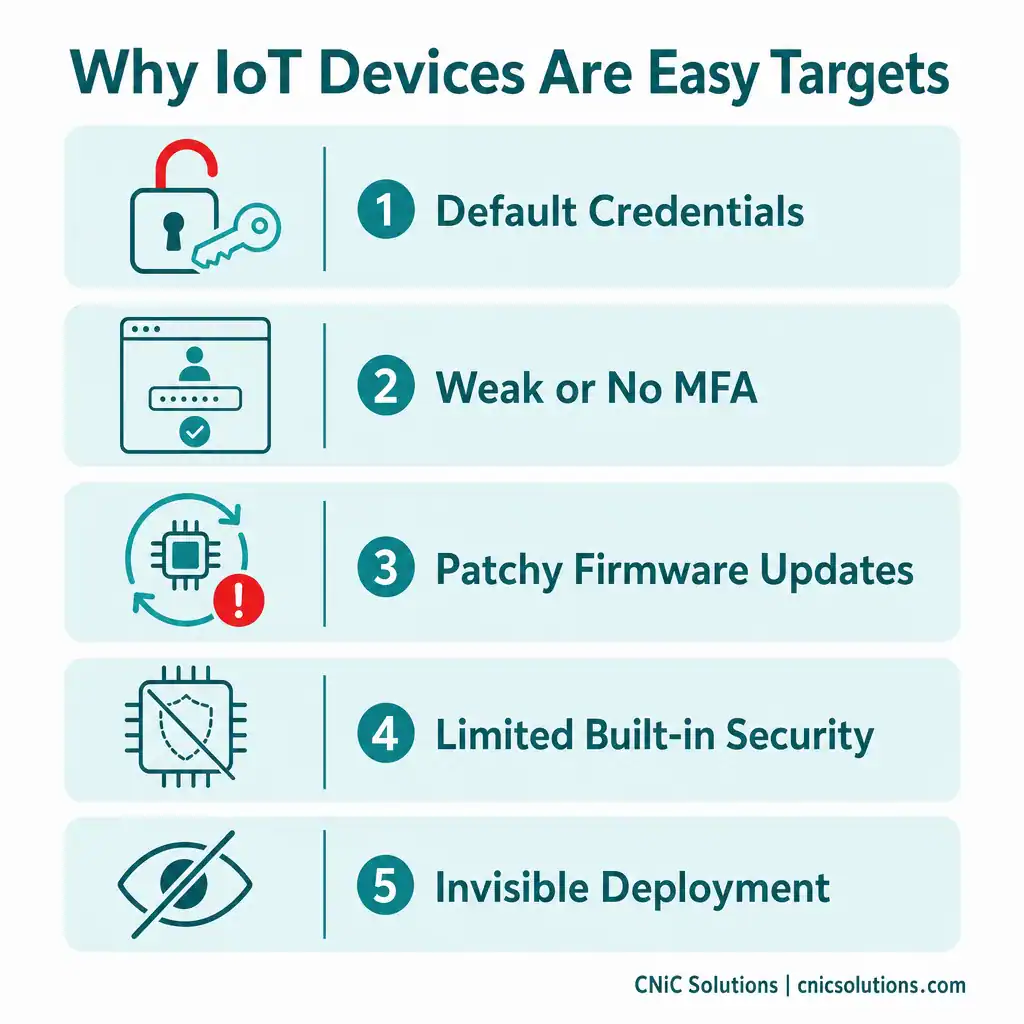
IoT devices are valuable, but they are also one of the weakest links in a typical network, and attackers know it. Several factors make them soft targets:
- Default credentials: Many devices ship with default usernames and passwords that are never changed, which attackers can simply look up and use.
- Weak authentication: A large share of devices do not support multi-factor authentication, making them far easier to compromise than a typical user account.
- Inconsistent firmware updates: Manufacturers patch on their own schedules, if at all, leaving known vulnerabilities open for long stretches.
- Limited built-in security: Many devices lack the computing power to run traditional security software, so they cannot defend themselves.
- Invisible deployment: Devices often get connected without IT’s knowledge, creating blind spots no one is watching.
The consequence is significant: a single compromised device can become an attacker’s foothold into the entire network, or get conscripted into a botnet used to attack others. This is why the Federal Trade Commission, in its guidance on keeping connected devices secure, specifically advises businesses to segment their networks and actively monitor what is trying to get in and out. The number of connected devices in the average business keeps climbing, and every unmonitored one widens the gap attackers can exploit.
The Hidden Risk: The Device You Forgot About
The most dangerous IoT device on your network is the one nobody is watching. A camera installed two years ago, a sensor added by another department, a smart device plugged in “just for now”, any of these can sit unpatched and unmonitored for months, quietly offering an attacker a way in. The danger is rarely the device you are tracking; it is the one you forgot you had. That is why discovery and continuous monitoring are not optional.
Source: FTC: Careful Connections, Keeping the Internet of Things Secure
Why IoT Monitoring Is Different
It is tempting to assume the monitoring tools you already use for servers and networks will cover IoT devices too. They usually do not, because IoT devices fail differently.
A server sits in a controlled environment with consistent power, connectivity, and resources. An IoT device might be a sensor on a remote piece of equipment, connecting over an unreliable wireless link, running on minimal hardware, and dropping offline intermittently as a normal part of life. Treat that device like a server and you will either drown in false alarms or miss the signals that actually matter.
IoT monitoring is purpose-built for that reality. It expects intermittent connectivity, accounts for diverse and resource-constrained hardware, and learns what “normal” looks like for each device so it can flag genuine trouble, a true outage or a security anomaly, without crying wolf. This is closely related to the broader discipline of infrastructure monitoring, but tuned for the messier, more distributed world of connected devices.
Core IoT Monitoring Best Practices
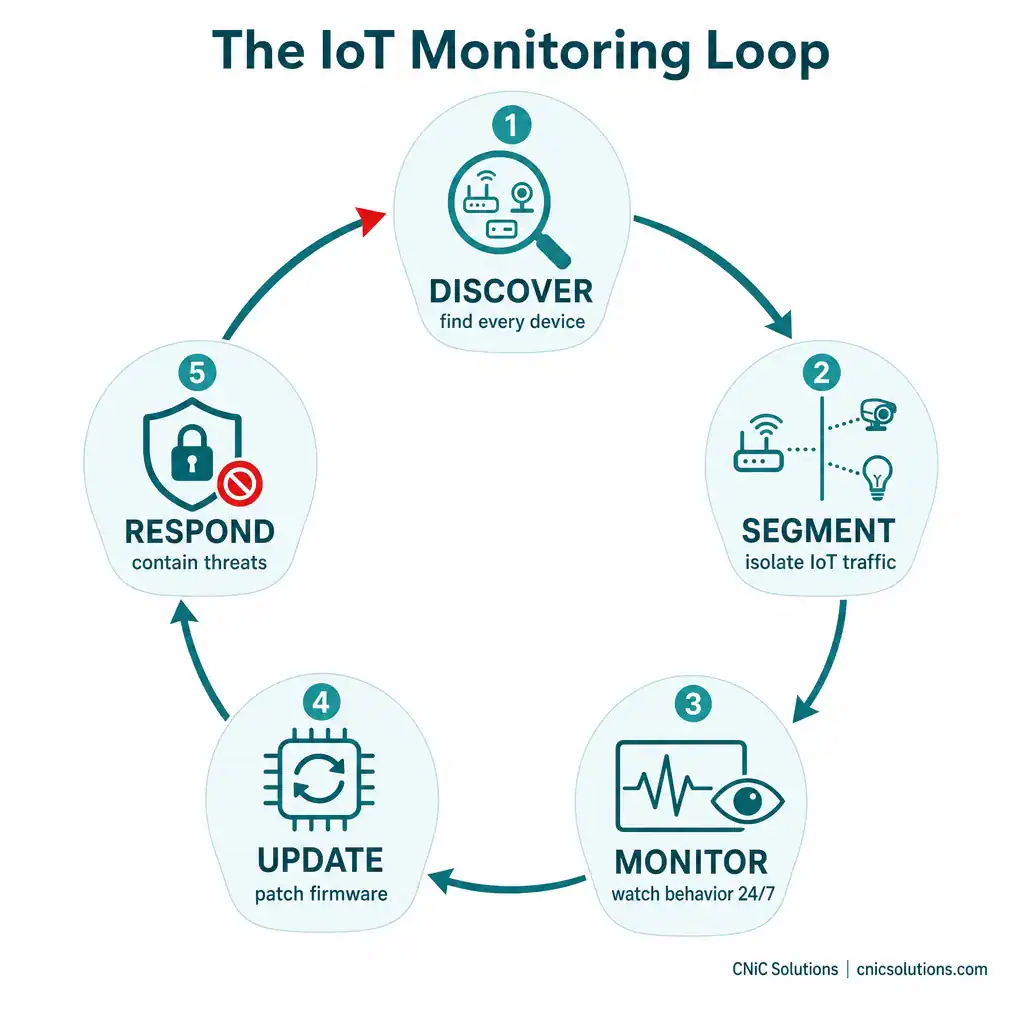
Across security authorities and industry guidance, the same core practices come up again and again. Together they form a practical playbook for keeping a fleet of connected devices secure and online.
1. Discover and inventory every device
You cannot secure or monitor what you cannot see. The foundation is automated discovery: a complete, continuously updated inventory of every connected device, including its type, manufacturer, firmware version, and network location. This eliminates the blind spots where unmanaged devices hide.
2. Segment IoT devices onto their own network
IoT devices should not share a network with sensitive business systems. Placing them on a separate network or VLAN limits the blast radius if one is compromised and stops an attacker from moving laterally into critical systems. This is one of the single highest-value steps you can take.
3. Monitor behavior continuously
Because IoT devices cannot always protect themselves, watching their behavior is the key defense. Behavioral monitoring establishes a baseline of normal activity for each device and flags deviations, an unexpected connection, a spike in data transfer, that may signal compromise. This catches threats that simple signature-based tools miss.
4. Keep firmware updated
Outdated firmware is one of the most common ways IoT devices get exploited. Tracking firmware versions across the fleet and applying updates promptly closes known vulnerabilities. Automating this across many device types is far more practical than chasing updates manually.
5. Enforce strong access controls
Change default credentials on every device at deployment, and use strong authentication and least-privilege access wherever the device supports it. Encrypt data in transit so information moving between devices and the cloud cannot be easily intercepted.
6. Integrate detection with response
Monitoring only helps if it leads to action. The strongest setups connect monitoring to an automated or rapid response, for example quarantining a compromised device at the network switch, so a detected threat is contained before it spreads.
What This Means for Your Business
Here is the practical problem: IoT monitoring done right requires discovering every device, segmenting networks, baselining normal behavior, keeping firmware current across many vendors, and watching it all continuously. For a business without a dedicated security team, that is a lot to maintain, and the consequences of a gap are real. Connected devices are easy to add and easy to forget, which is exactly what makes them dangerous when left unwatched.
This is where a managed approach earns its place. CNiC Solutions combines cybersecurity services with proactive managed IT to discover the devices on your network, segment them properly, monitor them around the clock for both outages and threats, and keep them patched, so your connected devices stay online and stay secure without your team having to track every one. If your business is adding connected devices faster than it can watch them, that visibility is exactly the gap we close.
Get your connected devices monitored and secured
If your connected devices are industrial, sensors and machines on a plant floor rather than office equipment, see our guide to the Industrial Internet of Things (IIoT), where the monitoring stakes are even higher.

Related Terms
- IoT (Internet of Things): The network of connected physical devices that collect and exchange data.
- Device discovery: Automatically identifying every device connected to a network.
- Network segmentation: Separating IoT devices onto their own network to contain potential breaches.
- Behavioral monitoring: Detecting threats by spotting deviations from a device’s normal activity.
- Firmware: The software embedded in a device; outdated firmware is a common vulnerability.
- Botnet: A network of compromised devices used together to launch attacks.
- Telemetry: The automated machine data that monitoring collects and analyzes.
- Lateral movement: An attacker spreading from one compromised device to other systems on a network.
Frequently Asked Questions
What is IoT monitoring?
Why are IoT devices a security risk?
How is IoT monitoring different from regular network monitoring?
What is the first step in securing IoT devices?
Should IoT devices be on a separate network?
Sources
The IoT monitoring practices described, automated device discovery and inventory, network segmentation, continuous behavioral monitoring, firmware patching, strong access controls, and integrating detection with response, reflect standard, widely documented guidance across security authorities and industry sources. The guidance to segment networks and actively monitor connected-device traffic aligns with the Federal Trade Commission’s published guidance on IoT security. Specific device-count and incident-cost figures circulating online vary widely between sources and are not cited here; the trend toward a rapidly growing number of connected devices is well established.
Primary source: FTC: Careful Connections.



related posts
What Is NIST Compliance? Frameworks, Requirements, and Who Needs It
October 25, 2026NIST compliance means aligning your organization's security program with the cybersecurity standards published by the National…
What Is Network Penetration Testing? Types and Process
October 25, 2026Network penetration testing is a controlled, authorized simulation of a real cyberattack on your network, run…
What Is Mobile Device Management (MDM)? A Guide for Businesses
October 24, 2026Mobile Device Management (MDM) is software that lets an organization remotely enroll, configure, secure, and monitor…
What Is MFA? How Multi-Factor Authentication Protects Your Accounts
October 24, 2026Multi-factor authentication (MFA) is a security method that requires two or more separate proofs of identity…