

Break-fix IT is a reactive support model where a business pays an IT provider only when something breaks, billed by the hour or by the incident. There is no ongoing contract, monitoring, or preventive maintenance between calls. It contrasts with managed services, where a flat monthly fee covers continuous monitoring and maintenance designed to prevent problems before they cause downtime.
For years, the break-fix model was simply how IT support worked: something broke, you called someone, they fixed it, you paid the bill. It still has a place, but as businesses have come to depend on always-on systems, the “wait until it breaks” approach has grown risky and, for many, quietly expensive. Understanding what break-fix IT is, and how it stacks up against managed services, is the first step in deciding which model your business should actually be paying for.
Key Takeaways
- Break-fix is reactive. You pay per hour or per incident only when something fails, with no coverage in between.
- Managed services are proactive. A flat monthly fee covers monitoring and maintenance built to prevent failures in the first place.
- The real difference is who owns the risk. In break-fix, downtime is your problem; in managed services, the provider’s fee is on the line for keeping you running.
- Break-fix still fits a narrow profile: very small, low-risk operations that can genuinely absorb a day offline. The deciding factor is downtime tolerance, not company size.
- The market has shifted hard toward managed services, driven by the rising cost of downtime, cybersecurity demands, and compliance requirements that reactive support cannot satisfy.
What’s in This Guide
- How Break-Fix IT Works
- Break-Fix vs Managed Services
- At a Glance: The Two Models
- Head to Head: Cost, Downtime, Security, and Strategy
- Full Comparison Table
- Why the Choice Matters for Your Business
- Who Should Still Choose Break-Fix
- Who Should Choose Managed Services
- The Verdict
- Related Terms
- Frequently Asked Questions
How Break-Fix IT Works
Break-fix is the most intuitive support model because it mirrors how we handle most repairs in everyday life. Think of it like calling a plumber: you do not pay a plumber a monthly retainer to watch your pipes. You call when something leaks, they come out, fix it, and bill you for the time and parts. Break-fix IT works the same way.
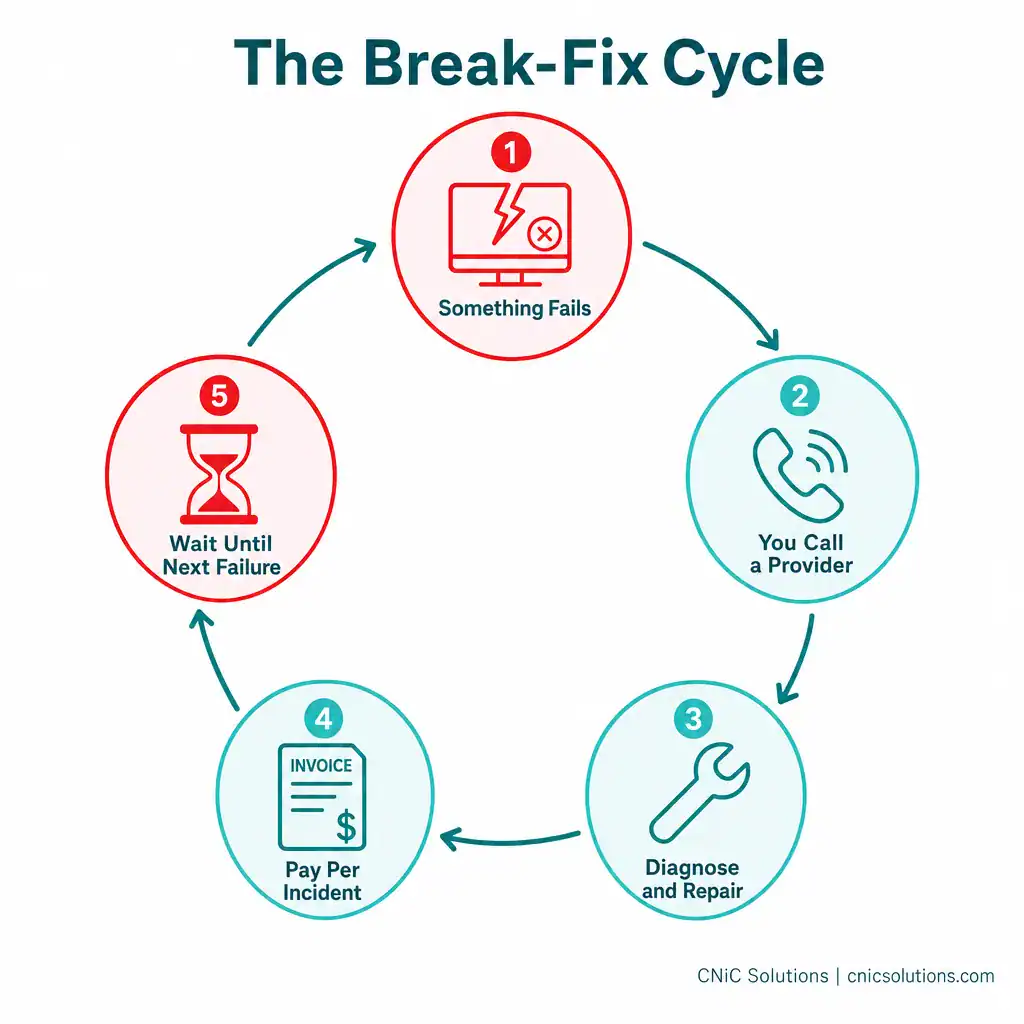
In practice, the cycle looks like this:
- Something fails. A server goes down, a laptop will not boot, a network drops, or a workstation catches malware.
- You call a provider. You reach out to an IT technician or firm, who schedules the work based on their availability.
- They diagnose and repair. The provider fixes the immediate problem on site or remotely.
- You pay per hour or per incident. Billing is tied to the labor and parts for that specific job, with no recurring fee.
- The relationship pauses until the next thing breaks.
The defining trait is that nothing happens between calls. There is no continuous monitoring, no scheduled patching, no security oversight. The model only activates after a problem has already disrupted your operations. That reactive nature is both its appeal (you pay only when you need help) and its central weakness (you are always paying after the damage is done).
Source: CompTIA: Buying Guide for Managed Services
Break-Fix vs Managed Services
The term break-fix is most often searched alongside its opposite: managed services. The two represent fundamentally different philosophies of IT support, and the contrast is the clearest way to understand either one.
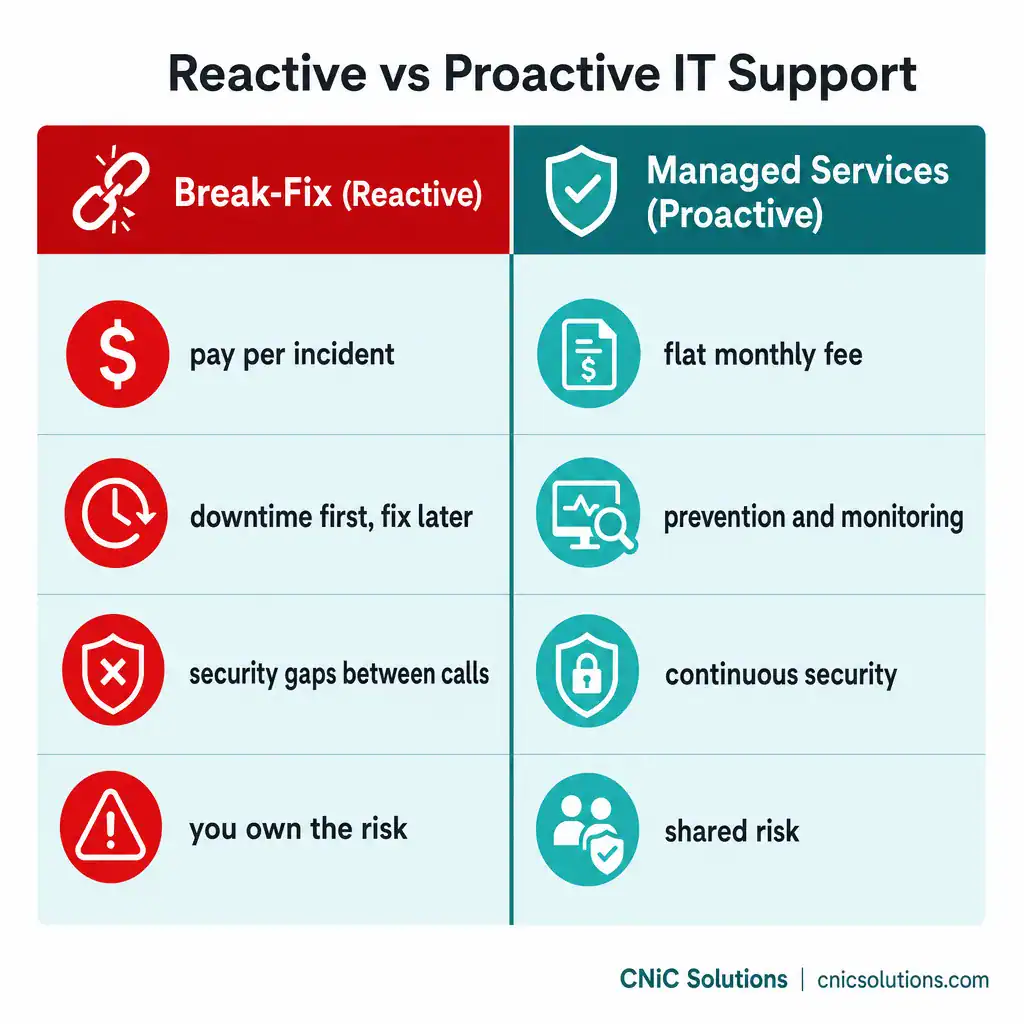
Where break-fix is reactive, managed services are proactive. A Managed Service Provider (MSP) takes ongoing ownership of your IT environment for a flat monthly fee, using remote monitoring and management tools to watch systems around the clock, patch software, maintain security, and resolve many issues before anyone in your office notices a problem. Instead of selling you repairs, the provider is selling you uptime.
That difference rewires the incentives. Under break-fix, a provider earns more when more things break, so there is no financial reason to prevent problems. Under managed services, every emergency eats into the provider’s fixed monthly margin, so preventing failures is in their direct interest. As industry analysts frame it, the most important distinction is not the price tag but who carries the risk of an outage.
At a Glance: The Two Models
| Break-Fix IT | Managed Services |
|---|---|
| Reactive: support only after something fails | Proactive: continuous monitoring and prevention |
| Billed per hour or per incident | Flat, predictable monthly fee |
| No long-term contract or SLA | Contract with guaranteed response times (SLA) |
| No monitoring or maintenance between calls | Patching, security, and maintenance built in |
| You carry all downtime and security risk | Provider shares the risk of downtime |
Head to Head: Cost, Downtime, Security, and Strategy
Cost and Budgeting
Break-fix wins on upfront simplicity. There is no monthly commitment, and a business with very few problems pays very little. The catch is unpredictability: one quiet month can be followed by a month with a major server failure and an emergency invoice. Reactive labor is also typically billed at premium hourly rates, since the work is urgent and unplanned.
Managed services convert that volatile spending into a fixed operational expense you can budget around. According to CompTIA’s research on managed services, among companies that engaged an MSP, half reduced annual IT costs by up to 24 percent, a third saved between 25 and 49 percent, and 13 percent saved more than 50 percent. The monthly invoice is higher than a quiet break-fix month, but the total cost of ownership over time is usually lower once downtime and emergency rates are counted.
Winner: Managed Services for predictability and long-term cost. Break-fix only wins on cost for the rare, very-low-incident environment.
Downtime and Reliability
This is where the models diverge most sharply. Break-fix support, by definition, begins only after systems have already gone down, so downtime is built into the model. Managed services aim to prevent the outage entirely through monitoring and maintenance.
The stakes are significant. In an ITIC survey on the cost of downtime, 98 percent of organizations said a single hour of downtime would cost them more than $100,000, and 81 percent put the figure above $300,000 per hour. When even one serious outage can cost six figures, a model that guarantees you will experience outages before help arrives carries a steep hidden price.
Winner: Managed Services. Prevention beats repair when downtime is this expensive.
Security and Compliance
Reactive support leaves gaps between calls: unpatched systems, outdated protections, and unmonitored access that attackers actively look for. Managed services close those gaps with continuous patching, monitoring, and documented security controls. For regulated businesses, this is decisive. Frameworks like HIPAA, PCI-DSS, and SOC 2 expect demonstrable, ongoing security and audit-ready records that a purely reactive model cannot produce.
Winner: Managed Services, especially for any business with compliance obligations or sensitive data.
Strategy and Growth
Break-fix delivers technical fixes, not guidance. No one is planning your technology roadmap or aligning IT with where the business is headed. Managed services typically include strategic planning, and many add a Virtual CIO element to help budget and plan technology for growth, turning IT from a cost center into a planned asset.
Winner: Managed Services for any business that wants IT to support growth rather than just survive failures.
Full Comparison Table
| Factor | Break-Fix IT | Managed Services | Better For Most Businesses |
|---|---|---|---|
| Support approach | Reactive, after failure | Proactive, prevents failure | Managed Services |
| Billing model | Per hour / per incident | Flat monthly fee | Managed Services |
| Cost predictability | Unpredictable, can spike | Predictable, budgetable | Managed Services |
| Upfront cost | Lower (no monthly fee) | Higher (recurring fee) | Break-Fix |
| Downtime exposure | High, built into model | Low, actively minimized | Managed Services |
| Security posture | Gaps between calls | Continuous protection | Managed Services |
| Compliance support | No audit-ready records | Documented and ongoing | Managed Services |
| Strategic planning | None | Included (often vCIO) | Managed Services |
| Response time | Based on availability | Guaranteed by SLA | Managed Services |
| Who owns the risk | You do | Shared with provider | Managed Services |
Why the Choice Matters for Your Business
The shift away from break-fix is not a trend manufactured by IT providers; it reflects how dependent businesses have become on technology that simply has to work. When a system being down for an afternoon means missed orders, idle staff, and frustrated customers, “wait until it breaks” stops being a savings strategy and becomes a liability.
The honest way to read the comparison is this: break-fix is not a worse version of managed services, it is a different tool for a different risk profile. The problem is that most modern businesses have quietly outgrown that profile without noticing. They are still buying support as though an outage costs them an afternoon, when it actually costs them revenue, customers, and compliance standing.
That is why the decision deserves a deliberate look rather than defaulting to whatever model you started with. The right question is not “which is cheaper this month,” but “how much does an hour of downtime actually cost us, and who should be carrying that risk.”
Who Should Still Choose Break-Fix
Break-fix remains a legitimate, rational choice for a specific and narrow profile. It can be the right call if your business genuinely fits most of these:
- Very few devices and users, with a simple setup and little that can break.
- No critical or customer-facing systems that must stay online to make money.
- Genuine downtime tolerance, meaning you could lose a full business day with no real revenue or reputation hit.
- No compliance obligations and no contracts or insurers requiring documented security controls.
- Cloud-based, locally backed-up work with no on-premise servers to monitor.
A two-person studio with a couple of laptops, cloud email, and locally saved work fits this picture. The math holds only when an outage costs you time, not income.
Who Should Choose Managed Services
Managed services become the clear choice the moment downtime starts costing real money, customers, or compliance standing, and that threshold arrives earlier than most operations leaders expect. Managed services are the right fit if:
- A few hours of downtime means lost orders, idle staff, or missed deadlines.
- You handle sensitive data or operate in a regulated industry like healthcare, legal, or finance.
- A contract, regulator, or cyber-insurance policy requires documented patching and monitoring.
- You want predictable IT budgeting instead of unpredictable emergency invoices.
- You want IT to support growth, with someone actively planning your technology roadmap.
If a four-hour outage would mean missed orders, idle staff, or broken service commitments, you are already paying for downtime. You are just paying it unpredictably, and after the fact.
The Verdict
Break-fix IT is the correct model for a narrow set of very small, low-risk businesses that can genuinely absorb being offline. For everyone else, the apparent savings are an illusion that a single bad week erases. As systems run constantly and threats never stop, the reactive model shifts more risk onto you than most businesses can afford to carry.
Managed services flip that equation by putting prevention first and sharing the risk of downtime. For most growing businesses, especially those that rely on technology every day, that predictability and protection is worth far more than the lower upfront cost of paying only when something breaks.
If you are not sure which model your business has outgrown, the clearest next step is to add up what IT actually cost you over the last twelve months, including downtime and lost productivity, and compare it honestly against a flat monthly plan. The result surprises most owners.
Move from reactive repairs to proactive managed IT

Related Terms
- Managed IT Services: The proactive model where an MSP manages your IT for a flat monthly fee.
- Managed Service Provider (MSP): The company that delivers managed services, taking ownership of your IT environment.
- Virtual CIO (vCIO): A strategic technology advisor service that handles IT planning and budgeting without a full-time executive hire.
- Service Level Agreement (SLA): A contract that guarantees specific response and resolution times for support.
- Remote Monitoring and Management (RMM): The tools MSPs use to watch and maintain client systems around the clock.
- Co-Managed IT: A hybrid where an internal team shares IT responsibilities with an external provider.
Frequently Asked Questions
What is break-fix IT?
What is the difference between break-fix and managed services?
Is break-fix IT cheaper than managed services?
When does break-fix IT still make sense?
Why are businesses moving from break-fix to managed services?
Sources
This explainer draws on CompTIA’s research on managed services adoption and cost savings, and ITIC’s survey data on the hourly cost of downtime, for the quantitative claims. The model definitions and decision criteria reflect the established, widely documented distinction between reactive (break-fix) and proactive (managed) IT support.
Primary and authoritative sources: CompTIA Buying Guide for Managed Services, CompTIA Trends in Managed Services research, and ITIC Hourly Cost of Downtime survey data.



related posts
RTO vs. RPO: Understanding the Two Key Disaster Recovery Metrics
September 24, 2026Short answer: RTO (Recovery Time Objective) is how long you can be down, measured forward from…
Security Awareness Training for Employees: A Complete Guide
September 24, 2026Security awareness training for employees is a continuous program that teaches your staff to recognize and…
Remote Work IT Setup: A Complete Guide for Small Businesses
September 23, 2026Setting up IT for a remote or hybrid team is no longer a temporary arrangement, it…
Patch Management Best Practices for Businesses: 10 Steps That Actually Reduce Risk
September 23, 2026Patch management is the disciplined process of finding, testing, and deploying software updates so known vulnerabilities…