
The Industrial Internet of Things (IIoT) is the use of connected sensors and intelligent devices on industrial equipment (machines, vehicles, and infrastructure) to collect, transmit, and analyze data. It brings the data and connectivity of the internet to factories, utilities, and logistics, letting businesses monitor operations, predict failures, and improve efficiency.
You have probably heard of the Internet of Things through smart thermostats and connected doorbells. The Industrial Internet of Things is its serious, high-stakes cousin: the same idea of connected devices, applied to the machines that run factories, power grids, and supply chains. The difference matters. When a smart speaker glitches, it is an annoyance; when an IIoT system fails, a production line can stop. This guide explains what IIoT is, how it differs from consumer IoT, the convergence of IT and operational technology that makes it work, its core architecture, and the real business outcomes it delivers.
Key Takeaways
- IIoT is IoT for industry. It connects industrial machines and infrastructure, not consumer gadgets.
- The stakes are higher. Consumer IoT is about convenience; IIoT is about efficiency and safety, where failure can be costly or dangerous.
- It bridges IT and OT. IIoT connects the digital world of data and analytics with the physical world of machines and control systems.
- Predictive maintenance is the headline benefit. Connected equipment can signal trouble before it fails, preventing unplanned downtime.
- You can start without replacing everything. Retrofitting adds sensors and gateways to legacy machines, so adoption can be gradual.
What’s in This Guide
IIoT vs Consumer IoT
IIoT is a subset of the broader Internet of Things, but the industrial context changes almost everything about how it is built and why it matters. The cleanest way to see the difference: consumer IoT is about the user, while industrial IoT is about the asset.
| Factor | Consumer IoT | Industrial IoT (IIoT) |
|---|---|---|
| Focus | Personal convenience | Efficiency, safety, output |
| Typical devices | Thermostats, wearables, smart speakers | Factory sensors, machines, vehicles, grids |
| Stakes of failure | An inconvenience | Halted production, safety risk |
| Scale | A few devices | Hundreds to thousands of devices |
| Reliability demand | Moderate | Mission-critical, long lifespan |
| Data purpose | “Did I leave the garage open?” | “Will this machine fail next week?” |
That last row captures the real point. Consumer IoT data is mostly about convenience; IIoT data drives decisions with significant operational and financial consequences. This is why IIoT systems demand far higher reliability, security, and redundancy than the connected devices in your home.
Source: TechTarget: What Is IIoT?
IT/OT Convergence: The Heart of IIoT
To understand what makes IIoT genuinely new, you have to understand the two worlds it joins together.
- Operational Technology (OT) is the physical side: the robots, CNC machines, pumps, sensors, and control systems on the factory floor. OT prioritizes availability and safety, and its equipment often runs for decades in harsh conditions.
- Information Technology (IT) is the digital side: networks, cloud computing, and data analytics. IT prioritizes data integrity and security, and it evolves quickly through software.
For most of history, these two worlds were completely separate. The machines on the floor did not talk to the business systems in the office. IIoT is the bridge between them. By connecting OT equipment to IT systems, raw physical activity (a motor’s vibration, a tank’s pressure, a line’s throughput) becomes digital data that can be analyzed, visualized, and acted on. This merging is often called IT/OT convergence, and it is the foundation of what is widely known as Industry 4.0, the fourth industrial revolution.
Why this is hard, and important: IT and OT have different priorities, lifecycles, and security models. Connecting a decades-old machine to a modern cloud platform is not plug-and-play. Done well, IT/OT convergence unlocks enormous value; done carelessly, it can expose critical equipment to cyber threats. That tension is exactly why IIoT projects benefit from experienced technology guidance.
Source: Cisco: What Is Industrial IoT?
How IIoT Works: The Architecture
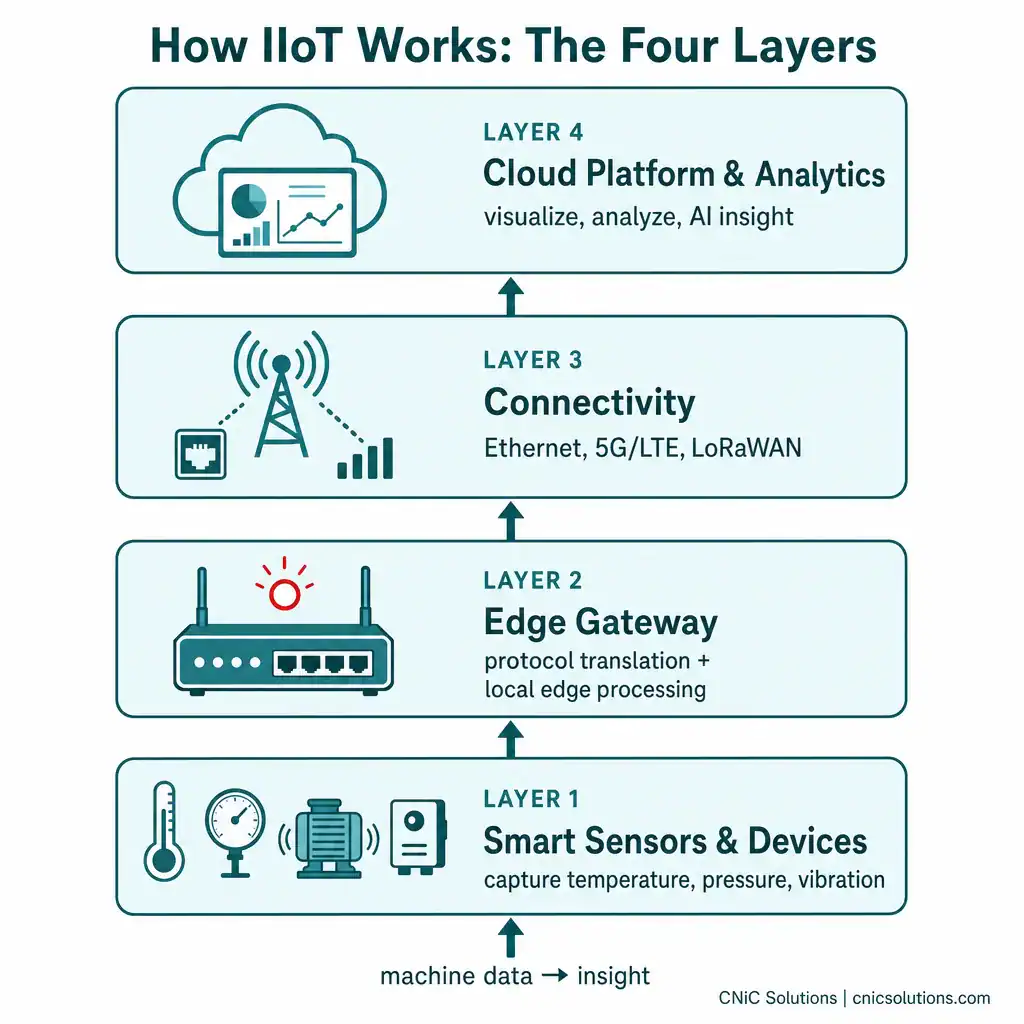
A typical IIoT system is built in functional layers, each handing data up to the next:
- Smart sensors and devices: Installed on or inside equipment, these gather raw data such as temperature, pressure, and vibration. Modern industrial sensors often do basic processing on the spot to reduce noise.
- Edge gateways: The critical link between machines and the cloud. A gateway translates between industrial protocols and the internet, and it can analyze data locally (edge computing) to react instantly, for example triggering an emergency stop the moment a pressure threshold is crossed, without waiting for a round trip to the cloud.
- Connectivity: The data needs a reliable path. Depending on the asset, this might be wired Ethernet on a factory floor or wireless options such as 5G, LTE, or low-power networks like LoRaWAN for distributed assets.
- Cloud platform and analytics: Where the data is aggregated, visualized, and analyzed (increasingly with AI and machine learning) to produce the insights that drive decisions.
The machine data flowing through this architecture is, in essence, industrial-scale telemetry. If you want the deeper picture of how that raw machine data becomes insight, see our guide on what telemetry is and how machine data drives modern IT.
Real Business Applications
IIoT is not abstract. It delivers concrete, measurable outcomes across industries:
- Predictive maintenance: The headline use case. Sensors detect when a machine is heading toward failure (an overheating motor, abnormal vibration) and trigger maintenance before it breaks down, preventing costly unplanned downtime.
- Asset and inventory tracking: Connected tags and sensors track the location, status, and condition of equipment and goods across a supply chain in real time, with alerts if something is damaged or at risk.
- Quality control: Continuous monitoring of production lines catches defects and deviations as they happen, reducing waste and rework.
- Energy and resource optimization: Real-time data on consumption lets businesses balance and reduce energy use, especially valuable in energy-intensive industries.
- Safety monitoring: Sensors detect unsafe conditions or equipment malfunctions and trigger immediate alerts or automatic shutdowns to prevent accidents.
These applications are especially relevant to the industries that anchor the Texas and Gulf Coast economy, energy, manufacturing, and logistics, where uptime and safety carry real weight.
Source: Cisco: What Is Industrial IoT?
Challenges and Security
IIoT’s benefits come with real adoption hurdles that are worth understanding before you start:
- Security is the biggest concern. Every connected device is a potential entry point, and in an industrial setting, a compromised system can mean far more than stolen data. Because IIoT joins OT to IT, a vulnerability can give attackers a path to critical physical equipment. Strong security, including network segmentation, encryption, and authentication, is non-negotiable.
- Legacy equipment integration. Much industrial equipment predates the internet. Connecting it requires retrofitting with sensors and gateways and translating older data formats, which most businesses adopt gradually rather than all at once.
- Data volume and management. Thousands of devices generate an enormous stream of data. Collecting it is only step one; turning it into useful insight requires the right platforms and expertise.
- Ongoing device management. Deploying devices is the beginning, not the end. They must be kept tracked, updated, and secure over their full lifespan.
The Security Reality of IIoT
Connecting industrial equipment to the internet means industrial equipment can now be attacked over the internet. Unlike a consumer gadget, a compromised IIoT system can disrupt physical operations or create safety hazards. Any IIoT initiative must treat cybersecurity as a core requirement from day one, not an afterthought bolted on later.
What This Means for Your Business
For most businesses, IIoT is not a single product you buy; it is a strategy you build, connecting devices, networks, security, and analytics into a system that turns physical operations into actionable data. The promise (less downtime, better efficiency, safer operations) is real, but so is the complexity of bridging old equipment, new connectivity, and serious security requirements.
That is precisely where an experienced technology partner matters. CNiC Solutions helps Texas businesses plan and integrate Industrial IoT, automation, and operational technology as part of a broader IT strategy, so connectivity, infrastructure, and security are designed together rather than bolted on piece by piece. The goal is to capture the efficiency gains without opening new risks.
Plan your IIoT and OT strategy with a Virtual CIO
Because IIoT widens your attack surface, it should always be paired with strong protection. See how CNiC approaches cybersecurity services for connected environments.
Related Terms
- IoT (Internet of Things): The broader network of connected physical devices; IIoT is its industrial subset.
- Operational Technology (OT): The physical machines and control systems that run industrial operations.
- IT/OT convergence: The merging of digital IT systems with physical OT equipment, enabled by IIoT.
- Industry 4.0: The fourth industrial revolution, the smart, connected factory that IIoT makes possible.
- Edge computing: Processing data near where it is generated (on a gateway) rather than sending it all to the cloud first.
- Predictive maintenance: Using equipment data to forecast and prevent failures before they happen.
- Digital twin: A virtual model of a physical system, fed by IIoT data, used to simulate and optimize operations.
- Retrofitting: Adding sensors and gateways to legacy machines to make them IIoT-capable without replacement.
Frequently Asked Questions
What is the Industrial Internet of Things (IIoT) in simple terms?
What is the difference between IoT and IIoT?
What is IT/OT convergence?
What are the main business benefits of IIoT?
Can older industrial equipment be connected to IIoT?
Sources
The definition of IIoT, the distinction between industrial and consumer IoT, the concept of IT/OT convergence, the layered architecture (sensors, edge gateways, connectivity, and cloud analytics), and the core applications and challenges described reflect standard, widely documented characterizations across authoritative industry and technical sources. The term “Industrial Internet” originated with General Electric in 2012, and the Industrial Internet Consortium (now the Industry IoT Consortium) was formed in 2014 by companies including AT&T, Cisco, GE, IBM, and Intel.
Primary sources: TechTarget and Cisco.



related posts
What Is NIST Compliance? Frameworks, Requirements, and Who Needs It
October 25, 2026NIST compliance means aligning your organization's security program with the cybersecurity standards published by the National…
What Is Network Penetration Testing? Types and Process
October 25, 2026Network penetration testing is a controlled, authorized simulation of a real cyberattack on your network, run…
What Is Mobile Device Management (MDM)? A Guide for Businesses
October 24, 2026Mobile Device Management (MDM) is software that lets an organization remotely enroll, configure, secure, and monitor…
What Is MFA? How Multi-Factor Authentication Protects Your Accounts
October 24, 2026Multi-factor authentication (MFA) is a security method that requires two or more separate proofs of identity…