

A cybersecurity risk assessment is a systematic process for identifying the digital assets a business relies on, the threats and vulnerabilities that could compromise them, and the likely impact if they did. It turns a vague “are we secure?” into a prioritized, documented list of the risks that matter most and what to do about each one.
Most business owners know cybersecurity matters. What they usually cannot answer is a harder question: where, exactly, is the business most exposed, and which gap would hurt the most if an attacker found it first? A cybersecurity risk assessment answers that question with evidence instead of guesswork. It is the difference between spending on security you hope is enough and spending on the specific protections your business actually needs. This guide explains what a risk assessment is, how the process works step by step, how it differs from an audit or a vulnerability scan, why the stakes have never been higher, and how to get started.
Key Takeaways
- It is a prioritization tool, not a scan. A risk assessment ranks your exposures by likelihood and impact so you fix what matters most first.
- The output is a plan. You end with a documented risk register and a set of recommended controls, not just a list of technical findings.
- It is different from an audit. An assessment asks “what could go wrong?”; an audit checks “did we follow the rules?” You need both, but they answer different questions.
- The cost of skipping it is real. The average U.S. data breach reached $10.22 million in 2025, and 88% of small-business breaches involved ransomware.
- It is ongoing. A one-time assessment goes stale fast. The value comes from repeating it as your systems, threats, and regulations change.
What’s in This Guide
What a Cybersecurity Risk Assessment Is
Strip away the jargon and a cybersecurity risk assessment is a structured way of answering three questions: What do we have that is worth protecting? What could go wrong with it? And how bad would it be if it did? Every serious security framework, from the U.S. government down to the smallest managed IT engagement, is built on that same core logic.
The formal definition comes from the National Institute of Standards and Technology, whose NIST Special Publication 800-30 guide for conducting risk assessments describes it as the process of identifying, estimating, and prioritizing risk to an organization’s operations, assets, and people. That grounding matters: a good assessment is not one person’s opinion about what feels risky. It is a repeatable method that produces the same kind of answer no matter who runs it.
Two ideas separate a risk assessment from a simple security check. The first is prioritization. A network scan can hand you a list of two hundred technical findings and no sense of which three could actually close the business. A risk assessment ranks exposures by how likely they are and how much damage they would cause, so limited time and budget go where they count. The second is context. The same vulnerability is a minor nuisance on a test server and a catastrophe on the machine holding your customer database. Risk assessment weighs findings against the value of what they touch.
How a Cybersecurity Risk Assessment Works
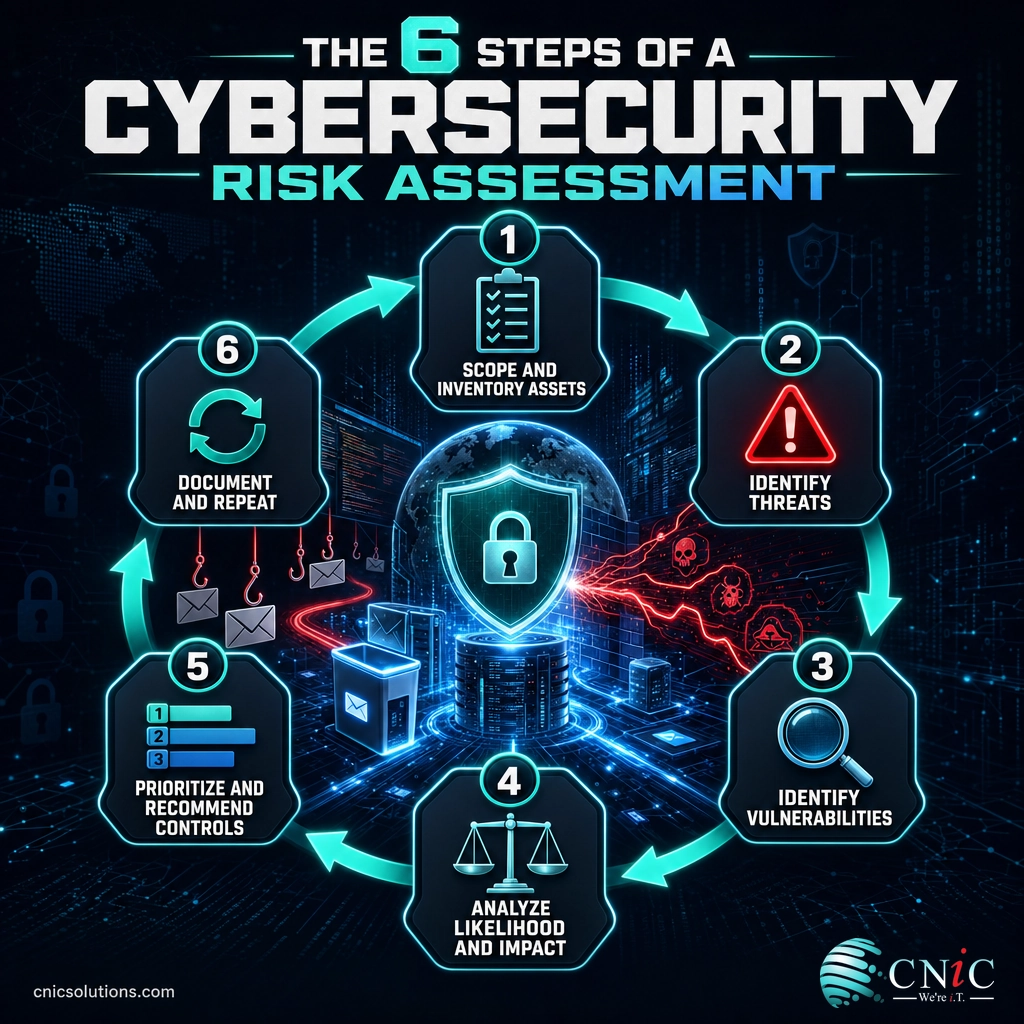
Frameworks vary in their vocabulary, but the underlying process is consistent. A thorough assessment moves through these steps in order:
- Scope and inventory your assets. You cannot protect what you have not counted. This step catalogs the hardware, software, cloud services, data stores, and network infrastructure the business depends on, and flags which of them hold sensitive or regulated information.
- Identify the threats. For each asset, what could realistically harm it? Threats range from external actors (ransomware operators, phishing campaigns, credential thieves) to insiders and simple accidents like a lost laptop or a misconfigured backup.
- Identify the vulnerabilities. A threat only matters where there is a weakness to exploit. This step surfaces the gaps: unpatched software, weak or reused passwords, missing multi-factor authentication, over-broad access permissions, unencrypted data, or untested backups.
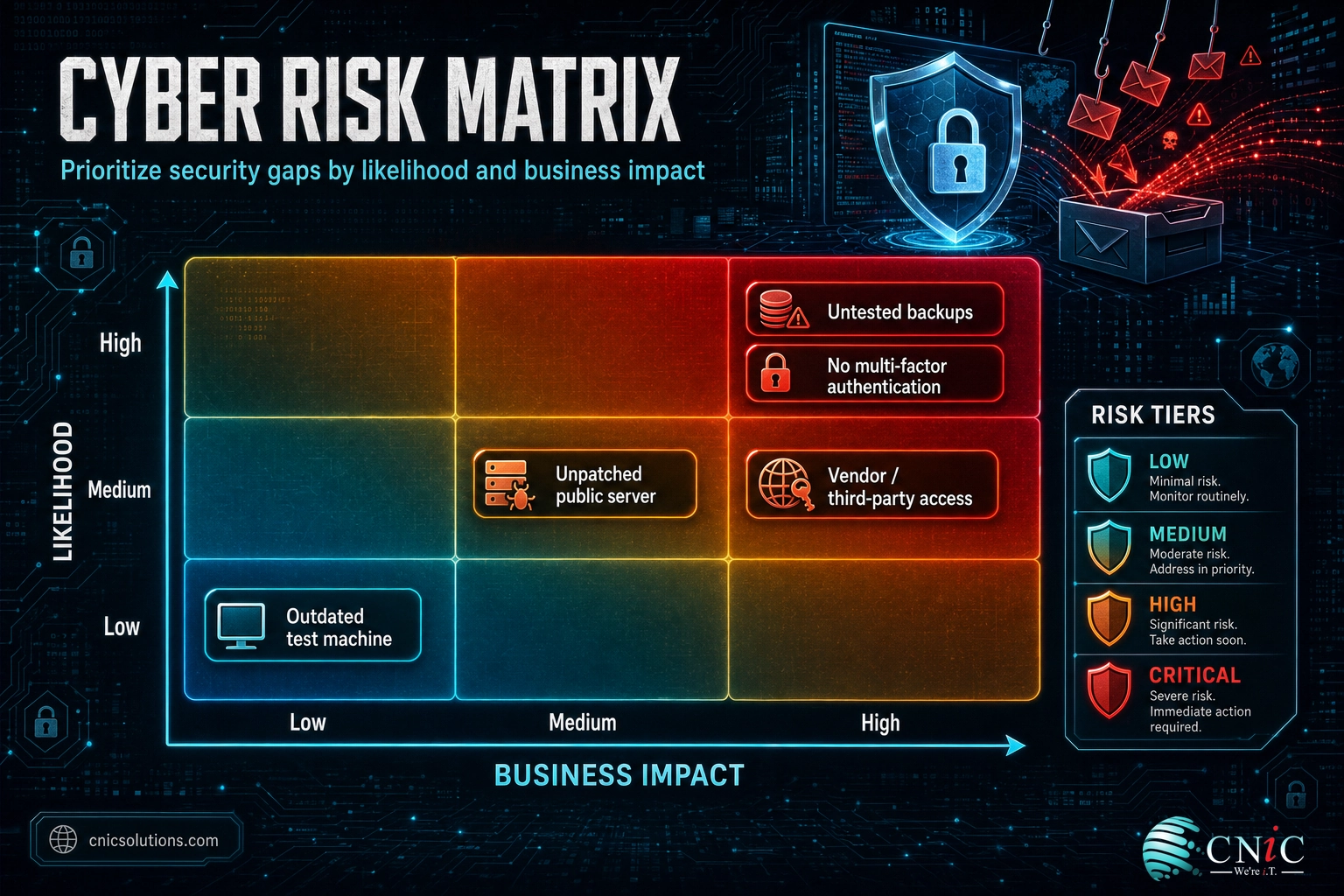
- Analyze likelihood and impact. For each threat-vulnerability pairing, how probable is it, and what would it cost the business (in dollars, downtime, legal exposure, and reputation) if it happened? Combining the two produces a risk rating, usually plotted on a likelihood-versus-impact matrix.
- Prioritize and recommend controls. The risks are ranked, and each one is matched to a response: reduce it with a control, transfer it (for example, with cyber insurance), accept it if it is genuinely minor, or avoid it by retiring the exposed system. The high-likelihood, high-impact risks lead the list.
- Document and repeat. Findings are recorded in a risk register that becomes the reference for every future decision, then the whole cycle is revisited on a schedule and after any major change.
Notice that only two of the six steps touch technical scanning. The rest are analysis and judgment: deciding what matters, in what order, and why. That is exactly why a risk assessment produces a plan a business owner can act on, not just a report only an engineer can read.
Myth: “We’re too small to be a target, and a risk assessment is a one-time job.” Both halves are wrong. Attackers deliberately favor smaller businesses because they expect thinner defenses, and 88% of SMB breaches in 2025 involved ransomware. And risk is not static: a single new cloud app, a new hire with admin access, or a new compliance requirement can reshape your exposure overnight. An assessment you ran once and filed away is a snapshot of a threat landscape that has already moved on.
Risk Assessment vs. Audit vs. Vulnerability Scan vs. Pen Test
These four terms get used interchangeably, and they should not be. Each answers a different question, and knowing which one you actually need saves money and confusion. The table below lays them side by side.
| Activity | Question it answers | Scope | Typical output |
|---|---|---|---|
| Risk assessment | What could go wrong, how likely is it, and how bad would it be? | The whole business, weighted by asset value | Prioritized risk register and a plan |
| Security audit | Do we comply with a specific standard or policy? | A defined framework or regulation | Pass/fail conformance findings |
| Vulnerability scan | What known technical weaknesses exist right now? | Systems and networks in range of the scanner | A list of detected vulnerabilities |
| Penetration test | Can an attacker actually break in, and how far? | A specific target, tested by ethical hackers | Proof of exploitable paths |
The relationship is layered. A vulnerability scan and a penetration test are inputs: they feed technical facts into the assessment. A security audit measures you against an external rulebook. The risk assessment sits above all of them, taking the raw findings and turning them into a ranked set of business decisions. If a vulnerability scan tells you a door is unlocked, the risk assessment tells you whether that door leads to a supply closet or the vault. For the deeper distinction between assessing and auditing your controls, our IT compliance checklist for small business walks through the documentation and proof auditors actually look for.
Why a Risk Assessment Matters for Your Business
The case for assessing risk deliberately rather than reacting to incidents comes down to what a breach now costs and how often smaller organizations are hit. The numbers are stark.
The gap between what a breach costs an American business and the global figure is wide, and it is widening. A risk assessment is how you find out which side of the average you are on before an incident decides it for you.
Average Data Breach Cost, 2025: United States vs. Global
Source: IBM Cost of a Data Breach Report 2025. The U.S. average reached an all-time high while the global average declined.
Beyond the raw cost, three business drivers make an assessment worth the effort. First, compliance: frameworks like HIPAA, PCI DSS, and the standards behind most cyber-insurance applications require a documented risk assessment, so producing one is often not optional. Second, spending discipline: an assessment stops you from over-investing in a fashionable tool while a basic gap, such as missing multi-factor authentication, sits open. Third, resilience: knowing your top risks in advance means an incident becomes a plan you execute rather than a crisis you improvise, which is where partnering these findings with a tested data backup and recovery program pays for itself.
Sources: IBM Cost of a Data Breach Report 2025 | Verizon 2025 Data Breach Investigations Report

Types of Cybersecurity Risk Assessments
“Risk assessment” is a category, not a single fixed deliverable. Which kind you need depends on your goal, and the main distinctions are worth knowing before you commission one.
Qualitative vs. quantitative. A qualitative assessment rates risks in relative terms (low, medium, high, critical) and is fast, intuitive, and ideal for most small and midsize businesses. A quantitative assessment attaches real dollar figures to each risk, modeling the expected annual loss. It is more rigorous and more work, and it tends to appear in larger or heavily regulated organizations. Many assessments blend the two, using qualitative ratings for speed and quantitative figures for the handful of risks big enough to justify the math.
By scope. Assessments also differ in how wide they cast. An organization-wide assessment looks across the entire business. An asset- or system-specific assessment zooms in on one critical system, such as the platform holding patient or payment data. A third-party or vendor assessment evaluates the risk your suppliers and software partners introduce, which, given that third parties now feature in 30% of breaches, is no longer a niche concern.
Compliance-driven vs. risk-driven. Some assessments exist to satisfy a specific regulation and are shaped by that framework’s checklist. Others are driven purely by the business’s own risk appetite. The strongest programs run the risk-driven assessment first and let it inform how they meet the compliance requirement, rather than treating the checklist as the ceiling. Strategic oversight of this balance is one of the roles a Virtual CIO is built to fill.
How to Get Started
A first cybersecurity risk assessment does not have to be daunting. The practical path for most businesses looks like this:
- Start with a high-level assessment. Before commissioning a formal, framework-driven engagement, a broad review will surface the obvious, high-impact gaps quickly. This is where the biggest early wins usually hide.
- Prioritize the quick wins. Enable multi-factor authentication, patch what is exposed, tighten access permissions, and confirm your backups actually restore. These address the vulnerabilities behind the majority of real-world breaches.
- Formalize on a schedule. Move to a documented, repeatable assessment tied to a recognized framework such as the NIST Cybersecurity Framework, and rerun it annually and after every major change.
- Bring in a partner for the parts you cannot staff. Most small and midsize businesses do not have a dedicated security team, and an experienced managed IT and security partner brings both the tooling and the cross-industry judgment an assessment depends on.
This is exactly where working with a managed provider earns its keep. A good partner does not just hand you a report; they help you act on it, folding the findings into ongoing protection. That is how CNiC Solutions approaches it. Our cybersecurity services begin with understanding where your business is exposed, then build the layered protection, monitoring, and response around the risks that matter most, delivered alongside the day-to-day managed IT services that keep those protections current. If you are still building the fundamentals, our guide to the cybersecurity basics every business owner should know is a good companion read.
Get a free security assessment for your business

Frequently Asked Questions
What is a cybersecurity risk assessment?
How often should a business do a cybersecurity risk assessment?
What is the difference between a risk assessment and a security audit?
How much does a cybersecurity risk assessment cost?
Do small businesses really need a cybersecurity risk assessment?
Related Terms
- Attack surface: the total set of points where an attacker could try to enter your systems. A risk assessment maps it.
- Vulnerability: a weakness (unpatched software, a weak password) that a threat can exploit. Managing these is why controls like data encryption exist.
- Threat: anything that could cause harm, from ransomware to an accidental deletion.
- Risk register: the living document that records each identified risk, its rating, and its treatment.
- Penetration test: an authorized simulated attack that proves whether a vulnerability is truly exploitable.
- Security audit: a check of your controls against a defined standard or regulation.
- Cyber insurance: a way to transfer residual risk, and a policy that increasingly requires a documented assessment to qualify.
- Data breach cost: the total financial impact of an incident, detailed in our roundup of the latest data breach cost statistics.
About This Guide and Its Sources
This explainer describes the widely recognized structure of a cybersecurity risk assessment as defined by the U.S. National Institute of Standards and Technology (NIST Special Publication 800-30 and the NIST Cybersecurity Framework). All statistics are drawn from named primary sources: breach-cost figures are from the IBM Cost of a Data Breach Report 2025, and ransomware, small-business, and third-party breach figures are from the Verizon 2025 Data Breach Investigations Report. Cost figures for assessments themselves vary widely by scope and organization size and are described qualitatively rather than with a single estimate.



related posts
OKRs vs. KPIs: What’s the Difference?
September 22, 2026An OKR (Objective and Key Results) is a goal-setting framework that pairs an ambitious objective with…
Password Statistics for 2026: Reuse, Cracks, and the Passkey Shift
September 22, 2026Weak and stolen passwords are still the number one way attackers get in. In 2025, stolen…
15 Microsoft Teams Tips and Tricks to Boost Team Productivity
September 21, 2026Microsoft Teams is where most of the workday now happens: it passed 320 million monthly active…
Mobile Security Software for Business: A Buyer’s Guide
September 21, 2026Choosing mobile security software for business comes down to two decisions: how you will manage the…