

A virtual CISO (vCISO) is an outsourced cybersecurity executive who provides the strategic security leadership of a full-time Chief Information Security Officer, but on a part-time, fractional, or contractual basis. A vCISO owns your security strategy, manages risk and compliance, and guides high-stakes decisions, without the cost of a full-time executive hire.
Cybersecurity has stopped being something a business can handle on the side. Regulators, insurers, and enterprise clients now expect a real security program with someone accountable for it, yet a full-time Chief Information Security Officer is a six-figure executive hire most small and midsize businesses cannot justify. That gap is exactly what a virtual CISO fills. This guide explains what a vCISO is, how the role differs from a vCIO and an MSSP, what a vCISO actually does day to day, what it costs your business to go without security leadership, and the clearest signs you are ready for one.
Key Takeaways
- A vCISO is fractional security leadership. You get CISO-level strategy, risk management, and compliance guidance without a CISO-level salary.
- It is leadership, not tooling. A vCISO decides your security strategy and priorities; an MSSP and your IT team carry them out.
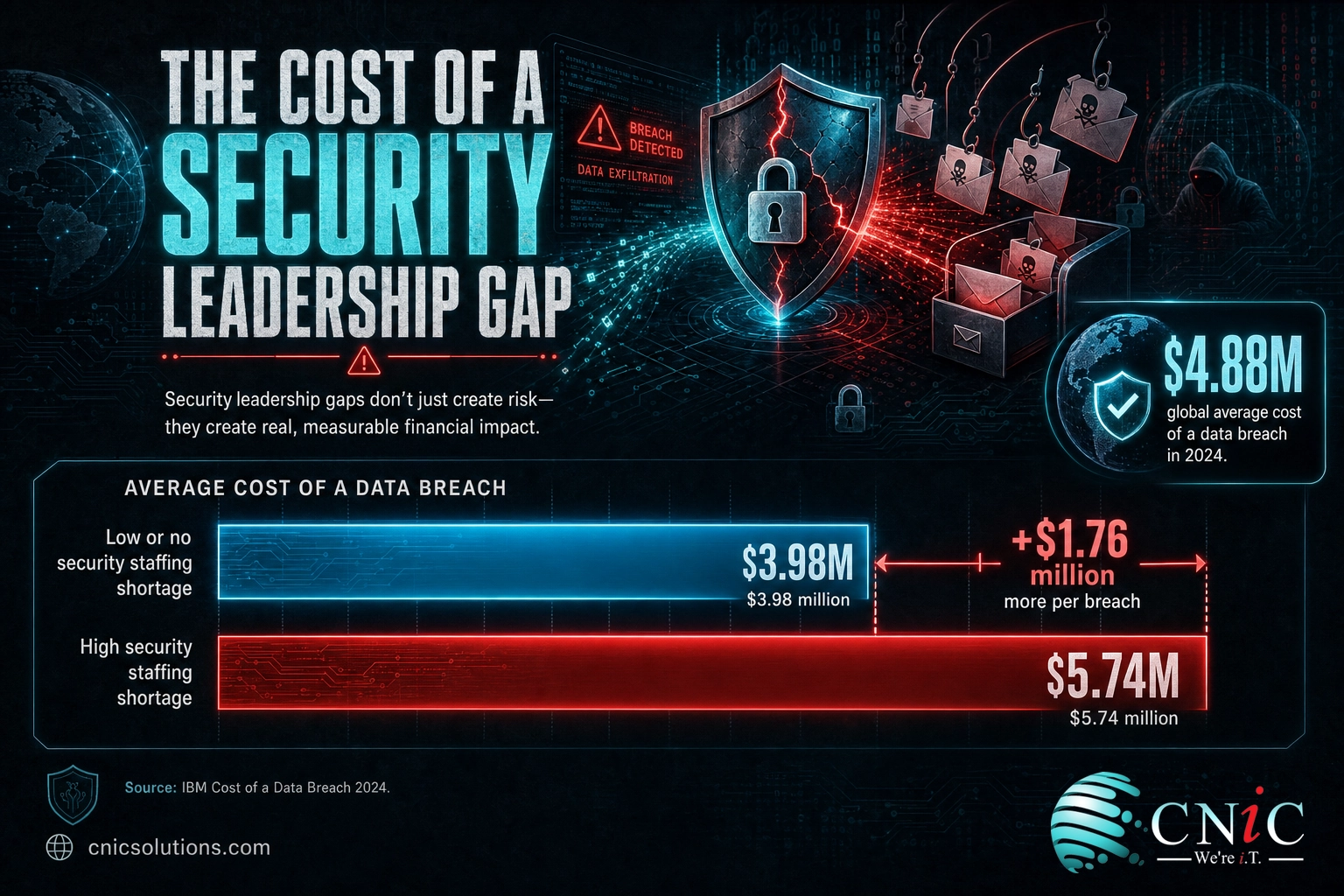
- The staffing gap is expensive. Organizations with a high-level security staffing shortage paid an average of $1.76 million more per data breach, according to IBM.
- It is not the same as a vCIO. A vCIO leads overall technology; a vCISO leads security specifically. Growing businesses often need both.
- Compliance and insurance are common triggers. HIPAA, CMMC, and cyber insurance questionnaires increasingly assume someone owns security. A vCISO is often that someone.
What’s in This Guide
What a Virtual CISO Is
The simplest way to understand a vCISO is by analogy. Many businesses use a fractional CFO, an outsourced financial executive, instead of hiring a full-time one. A virtual CISO is the same idea applied to security: an outsourced security executive who works with you part-time or on a fractional basis rather than sitting in your office full-time. You get the same seniority and strategic judgment; you pay only for the leadership you actually need.
A Chief Information Security Officer is, in the words of NIST’s definition of the Chief Information Security Officer role, the official responsible for an organization’s information security program. A vCISO carries that same accountability on a flexible basis. Their job is not to install antivirus, patch a server, or answer a help desk ticket. Their job is to answer the questions that keep a business owner up at night: Where are we exposed? What could actually hurt us? Are we meeting our compliance obligations? And what should we do first with a limited budget? They sit at the intersection of security risk and business strategy, which is exactly the seat most growing companies cannot afford to staff full-time.
vCISO vs vCIO vs MSSP: Clearing Up the Confusion
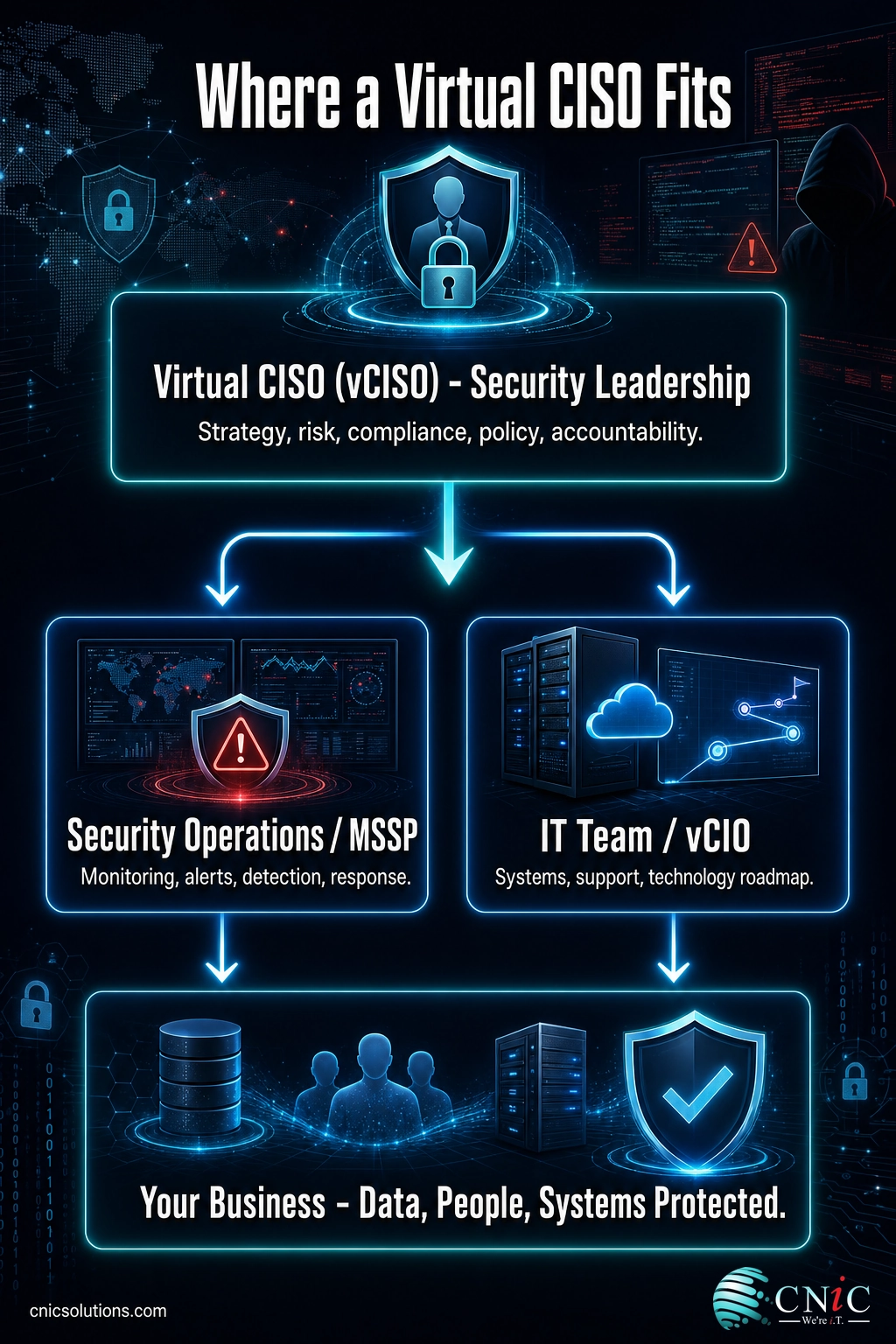
These three terms get used interchangeably, but they solve different problems, and buying the wrong one leaves a real gap. A virtual CIO (vCIO) leads your overall technology direction. An MSSP runs your security tools and monitoring. A vCISO provides the security leadership that decides what all of it should be doing. The table below shows how they compare.
| Factor | Virtual CISO (vCISO) | Virtual CIO (vCIO) | MSSP |
|---|---|---|---|
| Primary focus | Security strategy, risk, and compliance | Overall IT strategy and roadmap | Security operations, tools, and monitoring |
| Question it answers | “Are we secure and compliant, and where are our risks?” | “Where should our technology go next?” | “Are our security tools running and watched?” |
| Level | Executive, strategic (security) | Executive, strategic (all IT) | Operational, technical |
| Engagement | Fractional, ongoing advisor | Fractional, ongoing advisor | Managed service, tooling plus monitoring |
| Best for | SMBs needing security leadership and compliance without a full-time CISO | SMBs needing IT direction without a full-time CIO | Businesses needing monitoring and response capacity |
The relationship matters more than the labels. A vCISO sets the security direction and priorities; an MSSP and your internal or managed IT team carry that direction out. Think of the vCISO as the architect and the MSSP as the construction crew: you want both, and you especially do not want a crew building without a plan. A vCIO and a vCISO can also work side by side, or be delivered by the same partner, with the vCIO steering technology broadly and the vCISO owning the security half of that picture in depth.
What a Virtual CISO Actually Does
A vCISO’s value shows up in a set of concrete responsibilities. The exact mix depends on your industry and risk, but these are the core functions across the board:
- Security strategy and roadmap: The headline deliverable. A vCISO builds a prioritized, multi-year security plan tied to your actual risks and budget, so security spending is deliberate instead of reactive.
- Risk assessments: They identify where you are exposed, rank those risks by likelihood and business impact, and turn them into a plan you can act on rather than a list of alarms.
- Compliance leadership: They guide you through frameworks and regulations such as HIPAA, PCI DSS, SOC 2, and CMMC, translating requirements into a program auditors and clients will accept.
- Policies and governance: They write and maintain the security policies, access rules, and standards that most small businesses do not have in place at all.
- Incident response planning: They make sure you have a tested plan for what happens when something goes wrong, before the day it does.
- Security vendor oversight: They evaluate and manage security tools and providers, including your MSSP, so the pieces fit together and you are not paying for overlap.
- Reporting to leadership: They translate technical risk into plain business language for owners and boards, and answer the security questions on insurance and client questionnaires.
Notice the through-line: every one of these is about judgment, priorities, and accountability, not maintenance. That is what separates security leadership from security operations, and it is the piece most SMBs are missing.
Why a vCISO Matters for Small and Midsize Businesses
The case for a vCISO is not abstract. The cost of running without security leadership is measurable, and it has been climbing. According to IBM’s Cost of a Data Breach 2024 report, the global average cost of a data breach reached a record high, and organizations that were short on security talent paid a steep premium when one hit.
The more telling number for a business weighing security leadership is what a shortage of it costs. IBM found that organizations facing a high level of security staffing shortage paid an average of $5.74 million per breach, compared with $3.98 million for those with low or no staffing gap.
And this gap is not shrinking. IBM reported that more than half of breached organizations were facing a severe or high-level security staffing shortage, a problem that grew sharply year over year.
A vCISO is the most direct answer to that shortage for a business that cannot hire a full-time executive. You are not just buying a title. You are buying the strategy, prioritization, and accountability that make the difference between a program that reduces risk and a pile of tools no one is steering. On top of that, the practical triggers keep multiplying: cyber insurance applications now ask detailed questions that assume a security owner exists, and enterprise clients increasingly require vendors to prove a security program before they will sign.
Myth: our IT company already handles security, so we do not need a CISO. IT management and security leadership are different jobs. Your IT provider keeps systems running and can deploy security tools, but that is operations, not governance. A vCISO decides what your security strategy should be, whether it meets your compliance obligations, and where your real risks are, then holds the operational work accountable to that plan. Assuming “IT has it covered” is exactly how gaps go unnoticed until a breach or a failed audit exposes them.
Source: IBM Cost of a Data Breach 2024
Signs Your Business Needs a vCISO
Most businesses do not set out to “hire a virtual CISO.” They reach a point where security questions start outrunning their answers. These are the common signals:
- You handle regulated or sensitive data (health records, payment data, client financials) and are not certain you are meeting your obligations.
- A cyber insurance renewal or client security questionnaire is asking questions no one on your team can confidently answer.
- You are pursuing contracts (government, defense, healthcare, enterprise) that require proof of a security program or a specific certification.
- You are making security decisions yourself without a security expert in the room, and hoping they are the right ones.
- You have bought security tools but have no strategy tying them together and no one accountable for the outcome.
- You have had a scare (a phishing incident, a near-miss, a vendor breach) and realized no one owns “are we secure?”
If several of those sound familiar, it is usually the point where fractional security leadership pays for itself, by preventing the far more expensive mistakes that come from steering a security program with no one at the wheel. A good first step is a cybersecurity risk assessment, which is often the first thing a vCISO runs to establish where you stand.
How to Get Started With a Virtual CISO
A vCISO works best when it is connected to the rest of your IT, not bolted on in isolation. When the same partner both manages your day-to-day technology and provides the security leadership above it, strategy and execution stay aligned: the vCISO sets the direction, and the IT and security operations teams carry it out against that plan. That is very different from a standalone advisor who writes a report and disappears.
This is how CNiC Solutions delivers it. Our managed cybersecurity services pair strategic security leadership with the hands-on protection that carries the plan out, and for businesses that need broader technology direction as well, our Virtual CIO services for Texas businesses add executive-level guidance across your whole IT program. Whether you need security leadership specifically or full technology strategy, you get the direction and the execution from one aligned partner rather than a stack of disconnected vendors. A typical engagement starts with a risk assessment and a prioritized roadmap, then settles into a steady cadence of guidance, reporting, and course correction as your business and its threats evolve.
Get a Free Security Assessment From CNiC
Common Questions About Virtual CISOs
What is a virtual CISO (vCISO)?
What is the difference between a vCISO and a vCIO?
What does a virtual CISO actually do?
Is a vCISO the same as an MSSP?
Does a small business really need a virtual CISO?
Related Terms
- Virtual CIO (vCIO): a fractional technology executive who leads overall IT strategy, the broader counterpart to a vCISO’s security focus.
- MSSP: a managed security service provider that delivers the operational side of security, tooling, monitoring, and response, under the strategy a vCISO sets.
- Cybersecurity risk assessment: the structured review of where your business is exposed, usually the first thing a vCISO runs.
- IT compliance: meeting the regulatory and framework requirements that apply to your data and industry. Read the complete IT compliance guide for SMBs.
- MDR (managed detection and response): an operational security service that continuously detects and responds to threats, often overseen at the strategy level by a vCISO.
- CMMC compliance: the Cybersecurity Maturity Model Certification required of many defense and manufacturing contractors, a frequent reason businesses bring in a vCISO.
- Fractional CISO: another name for the vCISO model, emphasizing that you buy a fraction of a security executive’s time.
- Security roadmap: the prioritized, multi-year plan a vCISO builds to sequence security investments against real risk and budget.
See How Managed IT and Security Work Together
About This Guide
Breach cost and security staffing figures are drawn from IBM’s Cost of a Data Breach 2024 report, an annual study conducted by the Ponemon Institute and published by IBM. The definition of a Chief Information Security Officer follows NIST’s published glossary. The vCISO role, its distinction from a vCIO and an MSSP, and its core responsibilities (security strategy, risk assessment, compliance leadership, policy and governance, incident response planning, and security vendor oversight) reflect widely consistent characterizations across the managed IT and cybersecurity industry. Specific salary figures for a full-time CISO vary widely by company size, region, and source and are not cited here; the relevant point is that a full-time CISO is a significant executive-level expense most small and midsize businesses cannot justify. Figures are cited to their original sources and used to illustrate the cost of a security-leadership gap, not as guaranteed outcomes for any specific business.
Sources: IBM Cost of a Data Breach 2024 | NIST Glossary, Chief Information Security Officer



related posts
What Is a DDoS Attack? How DDoS Attacks Work and How to…
October 4, 2026A DDoS attack (distributed denial-of-service attack) is an attempt to take a website, application, or network…
What Is a Data Center? Types, Components, and How They Work
October 4, 2026A data center is a physical facility that houses the servers, storage, and networking equipment a…
What Is a Brute Force Attack? How It Works and How to…
October 3, 2026A brute force attack is a trial-and-error method for cracking a password, PIN, or encryption key…
What Is a Checksum? How It Verifies Data Integrity
October 3, 2026A checksum is a small value calculated from a block of digital data, used to detect…