

IT compliance for a small business is the work of meeting the legal, industry, and contractual rules that govern how you protect data and run your technology, and being able to prove it. It is not a single certificate you earn once. It is an ongoing state you maintain across several frameworks at the same time, from HIPAA and PCI-DSS to SOC 2 and state privacy laws, depending on the data you hold and the customers you serve. This guide explains what IT compliance actually means for a company your size, which rules apply to you, what non-compliance really costs, and the practical, step-by-step path to becoming and staying audit-ready without a large internal IT team.
Key Takeaways
- Compliance is proof, not just protection. Owning security tools is not the same as being compliant. Auditors, regulators, and insurers want documented evidence that controls are enforced consistently.
- Most small businesses face more than one framework. A single company can be subject to HIPAA, PCI-DSS, SOC 2, a state privacy law, and cyber-insurance requirements simultaneously.
- The financial stakes are real. The U.S. average cost of a data breach hit an all-time high of $10.22 million in 2025 (IBM), and non-compliance measurably increases that cost.
- Small businesses are primary targets. 88 percent of breaches involving SMBs contained ransomware, compared with 39 percent for large organizations (Verizon 2025 DBIR).
- Fines are only part of the risk. Non-compliance can also void cyber-insurance claims, cancel client contracts, and damage reputation.
- Documentation is the deliverable. In a review, what you cannot prove effectively did not happen. Logs, policies, and records turn intent into evidence.
- It is ongoing, not annual. The businesses that pass treat compliance as a continuous operational habit, supported by monitoring and clear ownership.
What’s in This Guide
- What IT Compliance Really Means for a Small Business
- Why IT Compliance Matters: The Real Cost of Getting It Wrong
- The Compliance Frameworks and Regulations SMBs Face
- Penalties and Consequences of Non-Compliance
- The Building Blocks of a Compliant IT Environment
- How to Achieve IT Compliance: A Step-by-Step Path
- IT Compliance and Cyber Insurance
- Compliance by Industry: What Applies to You
- Building an Ongoing Compliance Program
- Common IT Compliance Mistakes SMBs Make
- What to Do Next: Implementation Roadmap
- IT Compliance Frameworks and Controls at a Glance
- Related Resources
- Frequently Asked Questions
1What IT Compliance Really Means for a Small Business
IT compliance is the practice of aligning your technology, data handling, and security operations with the rules that apply to your business, then documenting that alignment so it can be verified. Those rules come from several places at once: federal and state law, industry standards such as PCI-DSS, formal frameworks such as SOC 2 and the NIST Cybersecurity Framework, and increasingly the contracts your clients ask you to sign and the applications your cyber insurer asks you to complete.
For a large enterprise, compliance is a department. For a small business, it is usually a set of responsibilities layered on top of people who already have full-time jobs. That difference matters, because it shapes where small businesses succeed and where they fall down. The failure point is rarely a lack of awareness that rules exist. It is the gap between having a control and being able to prove that control is configured correctly, enforced everywhere, and maintained over time.
It helps to separate three ideas that often get blurred together. Security is protecting your systems and data from threats. Compliance is demonstrating, against a defined standard, that appropriate protections are in place. Governance is the ongoing decision-making and oversight that keeps both aligned with the business as it changes. A company can be reasonably secure yet fail an audit because it cannot produce evidence, and a company can technically satisfy a checklist while leaving meaningful risk unaddressed. Mature programs treat security, compliance, and governance as partners rather than substitutes.
The one-sentence definition worth remembering: being in compliance means you have identified every rule that applies, implemented the controls those rules require, and can produce evidence on demand that the controls are working. Everything else in this guide is detail on how to reach and hold that state. For the specific regulations and how they interlock, our companion overview on the IT compliance and regulatory landscape goes deeper on each framework.
One more distinction is worth setting early, because it drives everything that follows. Compliance is not a project with an end date. Systems change, staff turn over, regulations update, and new clients bring new obligations. A business that reaches compliance and then stops maintaining it drifts out of compliance quietly, usually discovering the gap at the worst possible moment: during an audit, an insurance renewal, or the investigation that follows a breach.
Source: NIST Cybersecurity Framework | CISA resources for small and medium businesses
2Why IT Compliance Matters: The Real Cost of Getting It Wrong
It is tempting for a small business to treat compliance as paperwork for larger companies. The data argues otherwise. The financial and operational stakes of getting IT compliance wrong have risen sharply, and they land hardest on organizations with the fewest resources to absorb them.
Start with the headline number. In its 2025 Cost of a Data Breach Report, IBM found the global average cost of a breach fell to $4.44 million, the first decline in five years, driven largely by faster detection. In the United States, the trend ran the opposite direction: the average cost jumped to an all-time high of $10.22 million, pushed up by higher regulatory fines and escalation costs. For an American small business, the relevant benchmark is the higher one, and the gap between the two is itself instructive.
That 88 percent figure, from the Verizon 2025 Data Breach Investigations Report, is the clearest evidence that small businesses are not too small to target. They are preferred targets. Attackers gravitate toward organizations with weaker incident response, slower patch cycles, and under-resourced security, all conditions more common in smaller companies. Across all breaches, ransomware now features in 44 percent of incidents, up from 32 percent the prior year, and the median ransom payment reached $115,000, a sum that can be existential for a small firm.
Ransomware’s share of breaches, by organization size (Verizon 2025 DBIR)
Source: Verizon 2025 Data Breach Investigations Report
Compliance matters here because it is not separate from this risk picture, it is the discipline that reduces it. The controls that frameworks require, enforced MFA, encryption, tested backups, prompt patching, and logging, are the same controls that prevent, contain, and limit the cost of the breaches above. IBM’s own data has consistently shown that organizations with stronger security governance detect and contain breaches faster and pay less when one occurs. Non-compliance does not just risk a fine. It removes the very safeguards that keep an incident from becoming a closure.
CNiC Solutions Analysis: Comparing IBM’s two 2025 figures, the U.S. average breach cost of $10.22 million is roughly 2.3 times the global average of $4.44 million. Much of that premium is driven by U.S. regulatory penalties and notification obligations, which are precisely the costs a documented compliance program is designed to reduce. Calculation and interpretation original to CNiC Solutions, based on IBM Cost of a Data Breach Report 2025.
There is also a hard commercial reality beyond breaches and fines. Compliance is now a condition of doing business. Enterprise clients pass their security obligations down to vendors through contracts and questionnaires, cyber insurers require evidence of specific controls before they will bind coverage, and a failed audit can cost a contract that took years to win. For a deeper look at the numbers behind regulatory enforcement, see our roundup of cybersecurity compliance penalty data, and for the full breakdown of breach economics, our analysis of the true cost of a data breach.
Reduce your breach and compliance risk with expert cybersecurity
Source: IBM Cost of a Data Breach Report 2025 | Verizon 2025 Data Breach Investigations Report
3The Compliance Frameworks and Regulations SMBs Face
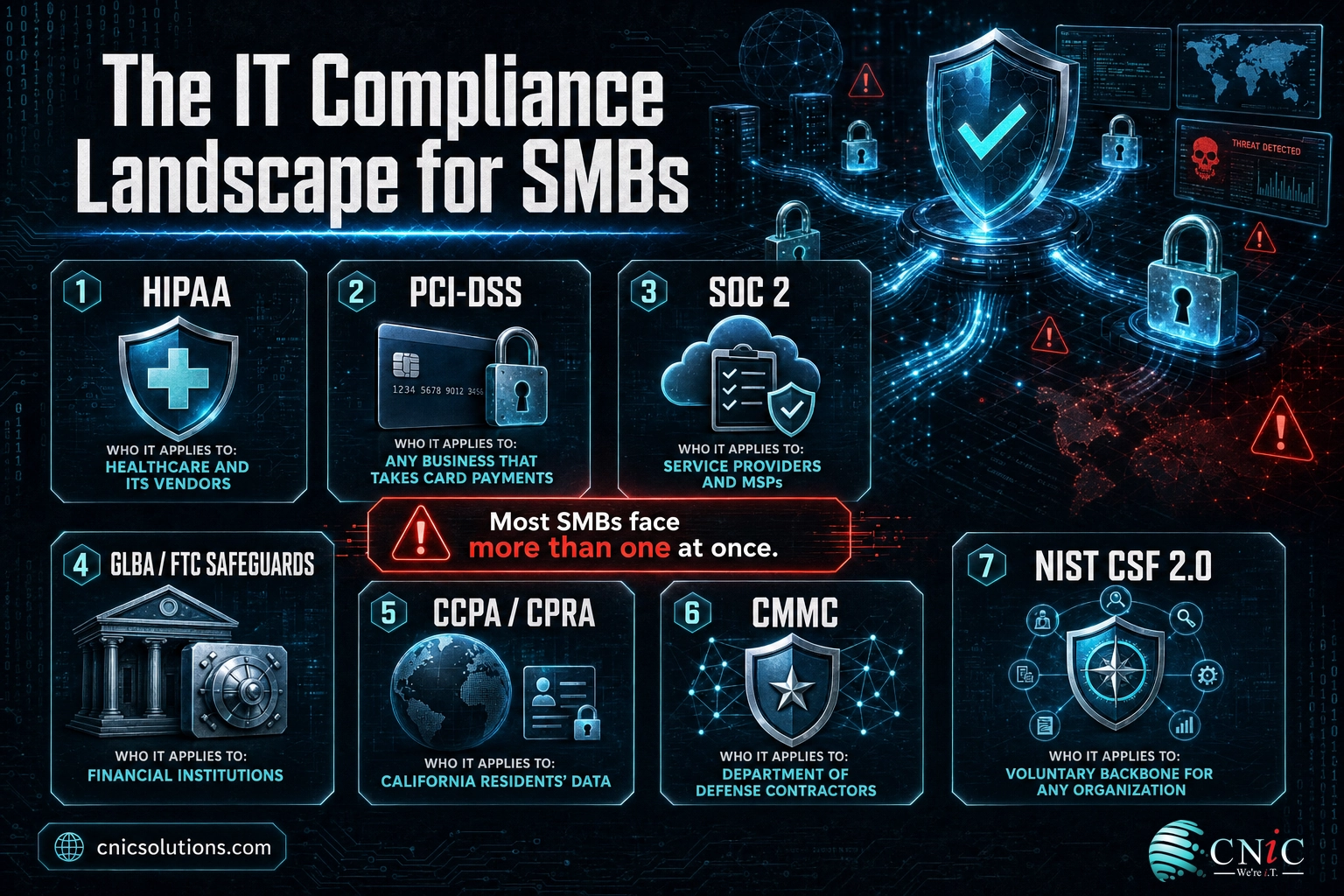
The single most confusing thing about IT compliance for a small business is that there is no one rulebook. Instead there is a patchwork of laws, standards, and frameworks, and which ones apply to you depends on your industry, the data you handle, where your customers live, and who you sell to. Below are the ones a small or midsize business is most likely to encounter. Most companies are subject to several at once.
HIPAA (healthcare and its vendors)
The Health Insurance Portability and Accountability Act governs how protected health information is handled by healthcare providers, health plans, and, critically, their business associates. If your business touches health data on behalf of a covered entity, whether you are a billing service, an IT provider, or a SaaS platform, HIPAA obligations flow down to you through a business associate agreement. Many small businesses are surprised to learn they are subject to HIPAA not because they are in healthcare, but because they serve a client who is. Our explainer on the business associate agreement and what signing one commits you to covers this in detail.
PCI-DSS (any business that accepts card payments)
The Payment Card Industry Data Security Standard applies to every business that stores, processes, or transmits payment card data, from a restaurant to an e-commerce shop to a professional practice that takes cards over the phone. Unlike a law, PCI-DSS is a contractual standard enforced by the card brands and your acquiring bank. The scope and effort scale with your transaction volume, but even the smallest merchant has obligations, typically satisfied through a self-assessment questionnaire and quarterly scanning.
SOC 2 (service providers and technology vendors)
SOC 2 is not a law but an attestation report, produced by an independent auditor, that a service organization’s controls meet defined trust criteria such as security and availability. For technology companies, managed service providers, and SaaS vendors, a SOC 2 report has become the price of admission to sell to larger customers. If your enterprise prospects keep asking for your SOC 2, that demand is a compliance obligation in all but name. The related but distinct SOC 1 report covers financial-reporting controls, and our guide to the difference between SOC 1 and SOC 2 explains which one your clients actually want.
GLBA and the FTC Safeguards Rule (financial institutions, broadly defined)
The Gramm-Leach-Bliley Act, enforced through the FTC Safeguards Rule, requires financial institutions to protect customer information with a written information security program. The definition of “financial institution” is broader than most owners expect, reaching mortgage brokers, auto dealers, tax preparers, and other businesses “significantly engaged” in financial activities. The Safeguards Rule’s expanded requirements, in force since 2023, spell out specific controls including access management, encryption, and multi-factor authentication.
State privacy laws (CCPA/CPRA and the growing patchwork)
California’s Consumer Privacy Act, strengthened by the CPRA, gives residents rights over their personal data and imposes obligations on businesses that meet certain thresholds. A wave of similar laws has followed in other states, each with its own scope and definitions. If you handle personal data from consumers in multiple states, you are likely navigating several privacy regimes at once, and the compliance question shifts from “does a privacy law apply” to “how many, and how do they differ.”
CMMC (Department of Defense contractors)
The Cybersecurity Maturity Model Certification is the Department of Defense’s framework for protecting federal contract information and controlled unclassified information across the defense supply chain. If your business is a contractor or subcontractor to the DoD, CMMC certification at the appropriate level is becoming a prerequisite to bid and win work. Our guide to CMMC compliance for contractors and manufacturers walks through the levels and the path to certification.
NIST Cybersecurity Framework (the voluntary backbone)
The NIST Cybersecurity Framework is not a regulation but a voluntary structure that many businesses adopt as the backbone of their program, and that regulators and insurers increasingly recognize. Version 2.0, released in February 2024, is explicitly written for organizations of every size and adds a “Govern” function to its existing Identify, Protect, Detect, Respond, and Recover functions, emphasizing that compliance and security are leadership responsibilities, not just IT tasks. Building your program around the NIST CSF gives you a common language that maps cleanly to most of the frameworks above.
| Framework | Who It Applies To | What It Governs | Type |
|---|---|---|---|
| HIPAA | Healthcare providers, plans, and their business associates | Protected health information | Federal law |
| PCI-DSS | Any business that handles payment cards | Cardholder data | Industry standard |
| SOC 2 | Service providers, MSPs, SaaS vendors | Trust criteria (security, availability, and more) | Attestation report |
| GLBA / FTC Safeguards | Financial institutions (broadly defined) | Customer financial information | Federal law / rule |
| CCPA / CPRA | Businesses handling California residents’ data (by threshold) | Consumer personal data and privacy rights | State law |
| CMMC | Department of Defense contractors and subcontractors | Federal contract and controlled unclassified information | Federal program |
| NIST CSF 2.0 | Any organization (voluntary) | Overall cybersecurity risk management | Voluntary framework |
Get help mapping the right frameworks to your business
Source: HHS HIPAA for Professionals | FTC Safeguards Rule guidance | DoD CMMC program
4Penalties and Consequences of Non-Compliance
The penalties for non-compliance fall into two categories, and the fines everyone worries about are only the first. Direct regulatory penalties are real and, in some frameworks, severe. But the indirect consequences, denied insurance claims, lost contracts, and the amplified cost of a breach, often hurt a small business more than the fine itself.
On the regulatory side, the numbers are sobering. HIPAA penalties are structured in four tiers based on culpability, and the amounts are adjusted for inflation each year. For 2025, the inflation-adjusted annual cap reached $2,190,294 for all violations of an identical provision. Under the European Union’s GDPR, which reaches any business handling EU residents’ data, fines can climb to 20 million euros or 4 percent of global annual turnover, whichever is higher.
Card payments carry their own regime. PCI-DSS non-compliance fees are levied not by a government but by acquiring banks and payment processors, and they commonly range from $5,000 to $100,000 per month depending on the severity and duration of the violation, often escalating the longer a merchant remains out of compliance. State privacy laws add another layer: under the CCPA, as adjusted for inflation in 2025, penalties run to $2,663 for each unintentional violation and $7,988 for each intentional violation or violation involving a consumer under 16, assessed per affected consumer, which multiplies quickly across a customer database.
| Framework | Maximum or Typical Penalty | Assessed By |
|---|---|---|
| HIPAA | Up to $2,190,294 per identical provision per year (2025, tiered) | HHS Office for Civil Rights |
| GDPR | Up to 20 million euros or 4% of global annual turnover | EU data protection authorities |
| PCI-DSS | Commonly $5,000 to $100,000 per month | Acquiring banks and card brands |
| CCPA / CPRA | $2,663 unintentional / $7,988 intentional, per violation (2025) | California Privacy Protection Agency / AG |
| Contract and insurance | Lost contracts, voided claims (varies) | Clients and cyber insurers |
Myth: “We are too small for regulators to notice.”
Enforcement is not reserved for large companies, and penalties are assessed per violation, which often means per record or per affected individual. A small business with a modest customer database can accumulate a penalty that dwarfs the cost of the controls that would have prevented it. Just as important, regulators and insurers weigh whether you made a reasonable, documented effort. A business that can show a good-faith compliance program is treated very differently from one that cannot.
The indirect costs deserve equal attention. A failed audit or a discovered gap can trigger the loss of a major client whose contract required specific safeguards. A cyber-insurance claim can be reduced or denied if the insurer finds that a control you attested to was not actually in place. And as the breach economics in the previous section show, non-compliance removes the safeguards that keep an incident small, so the same gap that draws a fine also raises the total cost of recovery. Understanding this full picture is the reason it pays to treat compliance as risk management rather than paperwork.
Source: HHS HIPAA Enforcement | California Privacy Protection Agency | PCI Security Standards Council
5The Building Blocks of a Compliant IT Environment
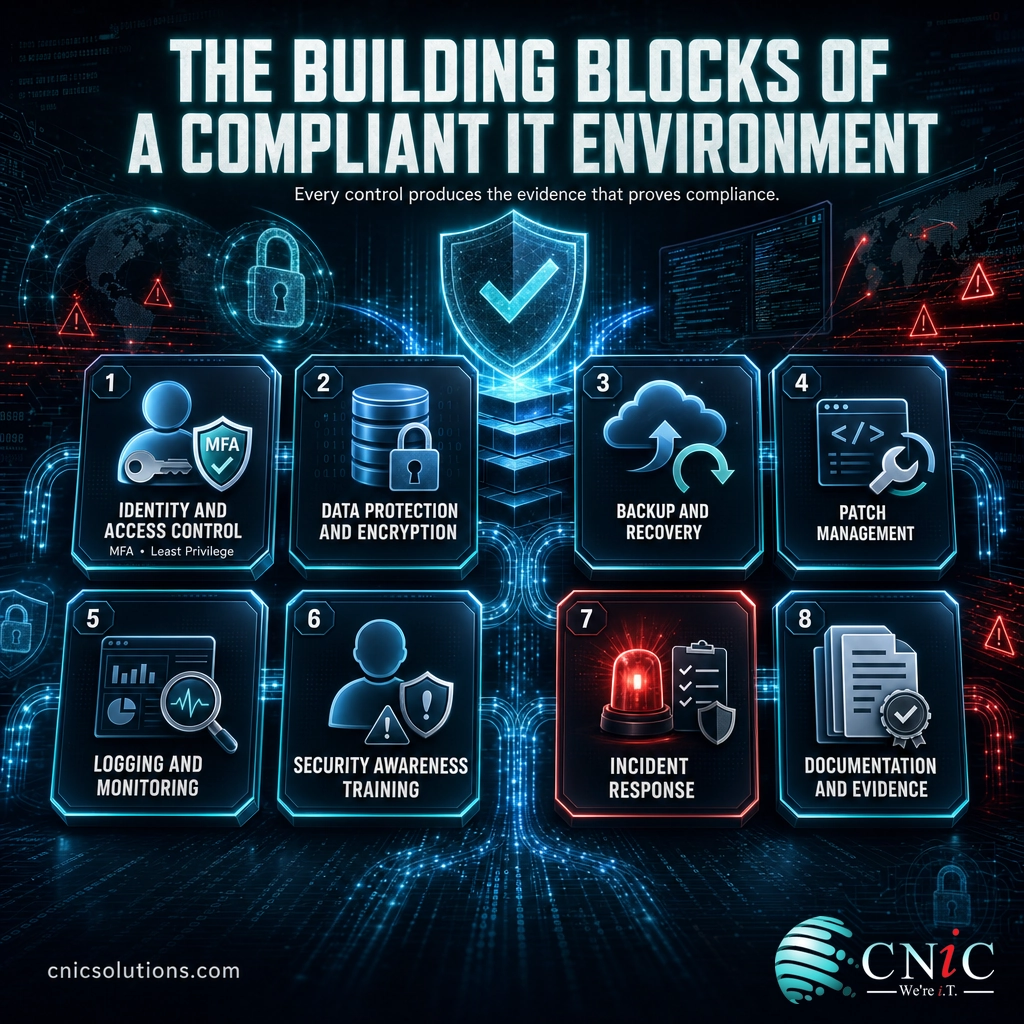
Different frameworks use different language, but they ask for a remarkably consistent set of controls underneath. If you build these building blocks well, you satisfy the core of nearly every framework at once and dramatically reduce your breach risk in the process. Think of this section as the technical foundation that the rest of compliance documents and proves.
Identity and access control
Who can access what is the foundation of every framework, and it is where most audits look first. Enforce multi-factor authentication on every account that supports it, especially email, remote access, and administrative logins. Apply least-privilege access so each person has only what their role requires, use unique accounts so activity is always traceable to an individual, and review access regularly, removing it promptly when someone changes roles or leaves.
Data protection and encryption
Protecting sensitive data both at rest and in transit is a core expectation everywhere. Encrypt data on servers, laptops, and mobile devices so a lost device does not become a breach, use TLS and VPNs for data in motion, and classify your data so the most sensitive information gets the strongest protection. If the distinction between encryption at rest and in transit is unclear, our explainer on how data encryption works for business breaks it down.
Backup and recovery
Backups are both a compliance requirement and your last line of defense against ransomware, but only if they actually restore. Back up critical data automatically on a schedule, keep backups encrypted and ideally immutable so ransomware cannot alter them, and, most important, test restores regularly. An untested backup is a hope, not a safeguard, and reviewers increasingly ask for proof of a successful restore.
Patching, monitoring, and logging
Unpatched vulnerabilities are a leading breach cause and a frequent audit finding, so patch systems on a defined schedule rather than when someone remembers. Enable and retain logs of sign-ins, access changes, and administrative activity, because logs are the evidence reviewers ask for first, and monitor for suspicious activity continuously so problems are caught rather than discovered after the damage.
People, policies, and training
Most breaches involve human error, so frameworks require that your people and the policies that guide them are part of the program. Maintain written security policies, train employees on security awareness regularly with records of completion, and build security into onboarding and offboarding so access is granted and revoked consistently.
Incident response and documentation
Frameworks assume incidents will happen and judge you on your readiness. Maintain a written, tested incident response plan, know your breach-notification timelines, and keep records of what happened and how you responded. Underpinning all of it is documentation: policies, logs, access reviews, patch histories, restore tests, and training records are what convert “we do that” into “we can prove that.”
The through-line: every control above produces evidence, and that evidence is the compliance deliverable. The businesses that struggle are usually not missing tools, they are missing the record that proves the tools are working. Our practical, category-by-category IT compliance checklist for small business turns these building blocks into assignable tasks with owners and review frequencies.
Put compliant, tested backups in place
Source: CISA Secure Our World guidance | NIST Cybersecurity Framework 2.0
6How to Achieve IT Compliance: A Step-by-Step Path
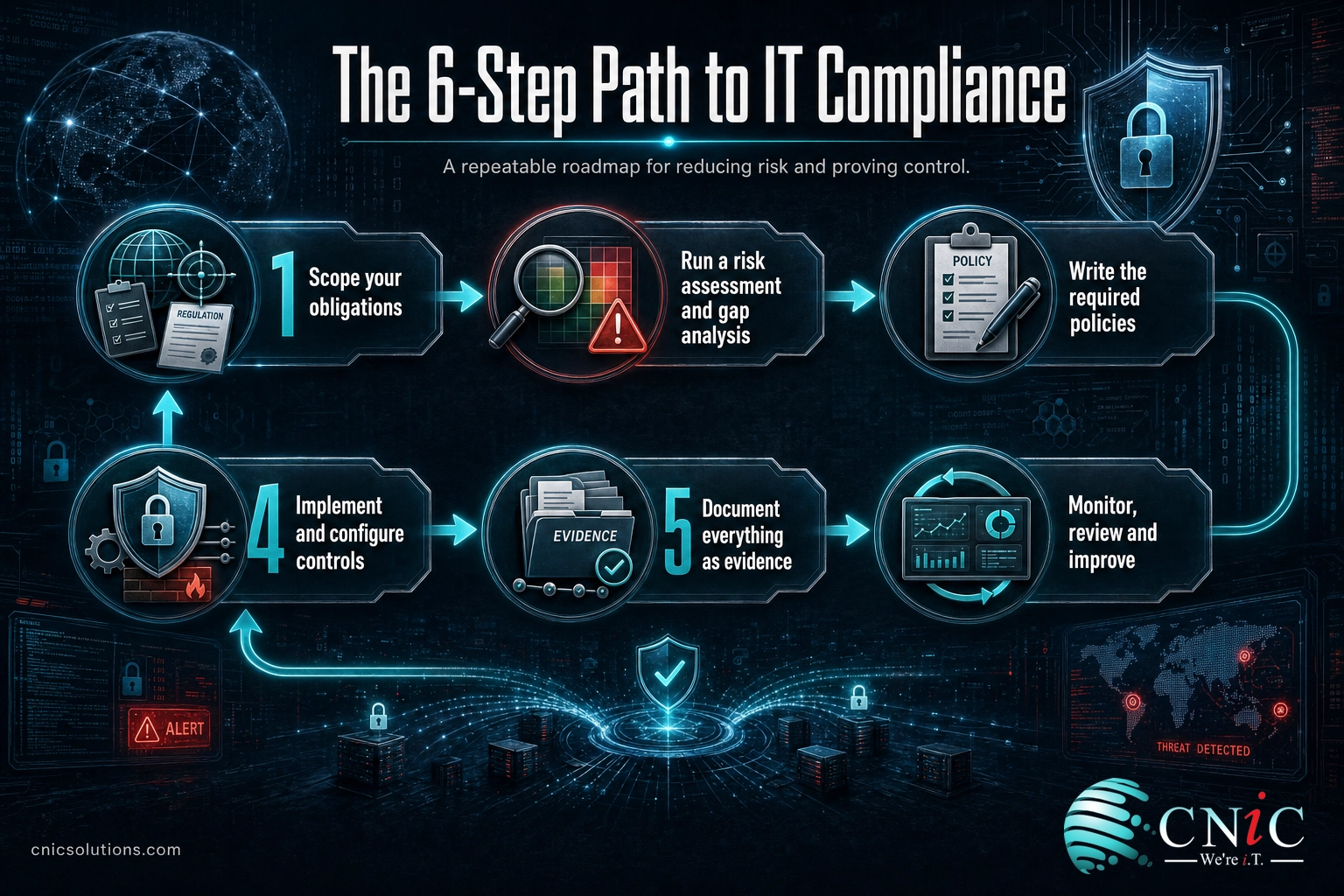
Compliance can feel overwhelming when viewed as a whole, so the practical answer is to work it as a sequence. The path below takes a small business from “we are not sure where we stand” to a maintained, audit-ready program. Each step builds on the one before it, and the order matters: you cannot fix gaps you have not found, and you cannot find gaps without first knowing which rules apply.
Step 1: Scope your obligations
Identify every framework, law, and contractual requirement that applies to your business based on your industry, the data you hold, your customers’ locations, and the agreements you have signed. This is the foundation, and getting it wrong wastes effort in every step that follows. Inventory your sensitive data and where it lives before you go further.
Step 2: Run a risk assessment and gap analysis
With your obligations mapped, assess your current controls against what those frameworks require. A structured risk assessment identifies where you are exposed and prioritizes remediation by likelihood and impact. This is the single most valuable step for a small business, because it turns a vague sense of risk into a ranked, actionable list. Our guide to the cybersecurity risk assessment and why you need one explains how to run it.
Step 3: Write the policies your frameworks require
Policies are where many small businesses stall, because writing them feels bureaucratic. But policies are the documented rules auditors expect, covering acceptable use, access control, data handling, retention, and incident response. Sound governance of your data underpins all of it, which is why establishing a basic data governance approach and a clear data retention policy early pays off across every framework.
Step 4: Implement and configure controls
Close the gaps your assessment found by deploying and correctly configuring the building blocks from the previous section: MFA, encryption, tested backups, patching, logging, endpoint protection, and training. Configuration matters as much as deployment, because a control that exists but is not enforced everywhere is a control that fails an audit.
Step 5: Document everything as evidence
As you implement, capture the evidence: MFA enforcement reports, access-review records, patch histories, backup-restore results, policy sign-offs, and training completion. Centralize it so it can be produced quickly during an audit, insurance renewal, or client questionnaire. This is the step that separates businesses that pass from businesses that scramble.
Step 6: Monitor, review, and improve
Finally, treat compliance as an ongoing operating rhythm. Monitor controls continuously, review your posture on a schedule, and reassess whenever a major change, a new system, a new client, a regulatory update, alters your obligations. Compliance held is compliance maintained, not compliance achieved once and filed away.
| Step | What You Produce | Typical Cadence |
|---|---|---|
| 1. Scope obligations | Framework map and data inventory | Annually and on major change |
| 2. Risk and gap assessment | Ranked remediation plan | At least annually |
| 3. Write policies | Documented, dated policies | Review annually |
| 4. Implement controls | Configured, enforced safeguards | Ongoing |
| 5. Document evidence | Logs, records, and reports | Continuous |
| 6. Monitor and review | Audit-ready posture | Continuous + scheduled review |
Have your compliance program built and maintained for you
Source: NIST Cybersecurity Framework 2.0 | CISA small business cybersecurity
7IT Compliance and Cyber Insurance
Cyber insurance has quietly become one of the strongest drivers of IT compliance for small businesses, because insurers now underwrite based on the exact controls that compliance frameworks require. The application is no longer a formality. It is a detailed, evidence-based questionnaire, and the answers determine whether you can get coverage, what you pay, and whether a future claim will be honored.
The pattern insurers care about most is multi-factor authentication, and the gap in the market is wide. According to a Cyber Readiness Institute survey, 65 percent of small and midsize businesses globally do not use MFA, a control that sits near the top of every insurer’s requirements and every compliance framework’s expectations. That gap is why MFA is now one of the first things an application asks about and one of the most common reasons applications are declined.
The relationship runs both ways, and understanding it turns insurance from a cost into a forcing function. Insurers require controls; those same controls are what your compliance frameworks demand; and the documentation you build for compliance is exactly the evidence an insurer wants at application and, crucially, at claim time. Where businesses get burned is misrepresentation: attesting on an application that a control is in place when it is not, or was not enforced everywhere. When a claim follows, the insurer investigates, and a control that was on paper but not in practice can reduce or void the payout.
The practical takeaway: do not treat the insurance application as a form to get past. Treat it as a compliance audit that happens to come from your insurer. Answer it honestly, close the gaps it exposes, and keep the evidence. The work you do to make the application true is the same work that makes you compliant and, more importantly, actually harder to breach.
Source: Cyber Readiness Institute | CISA multi-factor authentication guidance
8Compliance by Industry: What Applies to You
Because obligations depend on what you do, it helps to see compliance through the lens of your industry. The mappings below are a starting point, not a substitute for a proper scoping exercise, but they show how quickly a single business can accumulate multiple frameworks. Most companies will recognize themselves in more than one row.
Healthcare organizations and their vendors live under HIPAA, and if they take card payments, PCI-DSS as well. A small medical practice that emails patient records, stores them in the cloud, and processes copays is already juggling protected health information rules, a business associate relationship with its cloud provider, and cardholder data obligations at the same time. Financial services firms, from accountants to insurance agencies to lenders, fall under the GLBA Safeguards Rule and frequently PCI-DSS, and they hold exactly the kind of data that draws both regulators and attackers.
Professional services firms such as law offices handle privileged and confidential client information governed by both regulation and professional-conduct obligations, and they are increasingly asked to demonstrate SOC 2-style controls by corporate clients. Manufacturers and construction firms that work on government or defense contracts step into the world of CMMC, while any business selling to enterprise customers, in any industry, will eventually face security questionnaires that function as de facto compliance requirements.
| Industry | Frameworks Most Likely to Apply | Common Trigger |
|---|---|---|
| Healthcare | HIPAA, PCI-DSS | Patient data, copays, cloud vendors |
| Financial services | GLBA / FTC Safeguards, PCI-DSS | Customer financial data, payments |
| Legal and professional services | State privacy law, SOC 2 (client-driven) | Confidential client data, enterprise clients |
| Retail and e-commerce | PCI-DSS, state privacy law | Card payments, consumer data |
| Manufacturing and construction | CMMC (if defense work), NIST CSF | Government and defense contracts |
| Technology and SaaS | SOC 2, state privacy law | Handling client data at scale |
| Any business with EU customers | GDPR | Processing EU residents’ personal data |
CNiC Solutions works across these regulated verticals, and the pattern is consistent: the businesses that struggle are not the ones with the most obligations, they are the ones that never scoped their obligations clearly in the first place. If you are unsure which row you belong in, that uncertainty is itself the signal to start with a scoping and risk assessment. Explore how compliance plays out in specific sectors on our healthcare IT, financial services IT, and law firm IT pages.
Source: HHS HIPAA for Professionals | FTC Safeguards Rule
9Building an Ongoing Compliance Program
Reaching compliance is a milestone. Keeping it is the actual job, and it is where small businesses most often run out of capacity. An ongoing program does not require an enterprise budget, but it does require three things: clear ownership, a regular rhythm, and someone with the expertise to interpret changing requirements. This is where governance moves from a concept to a practice.
Ownership is the first and most neglected pillar. Every control needs a named owner who is responsible for keeping it enforced and documented, and the program as a whole needs an owner who sees the full picture. Without that, controls decay quietly: an MFA exception granted “temporarily” that never gets revoked, a backup job that started failing months ago, a departed employee whose access was never removed. These are the exact gaps audits and breaches expose.
The second pillar is rhythm. Compliance work should be scheduled like payroll, not handled in a panic before each audit or renewal. Access reviews on a quarterly cadence, patch cycles monthly or faster, restore tests on a regular basis, policy reviews annually, and a full posture reassessment each year and after major changes. A calendar of recurring compliance tasks turns an overwhelming project into a manageable routine.
The third pillar is expertise, and it is where many small businesses reach the limits of doing it alone. Interpreting which frameworks apply, keeping up with regulatory changes, running assessments, and maintaining evidence is specialized work. This is the role a virtual CISO or Virtual CIO fills, providing senior security and compliance leadership without a full-time executive salary. For the day-to-day operational side, monitoring, patching, logging, and evidence, many businesses partner with a managed security services provider so the continuous work gets done consistently.
Resilience belongs in the program too. Compliance frameworks increasingly expect that you can not only prevent incidents but recover from them, which ties directly to your business continuity plan and your disaster recovery plan. A business impact analysis feeds both, telling you which systems must recover fastest and why, which is exactly the prioritization an ongoing compliance program needs.
Myth: “We passed our audit, so we are compliant.”
An audit is a snapshot, not a status. The day after you pass, systems change, staff turn over, and requirements evolve. Businesses that treat a passed audit as a finish line drift out of compliance within months and often do not notice until the next review or the next incident. Compliance is a state you maintain, not a trophy you win.
Source: NIST Cybersecurity Framework 2.0 (Govern function) | CISA small and medium business resources
10Common IT Compliance Mistakes SMBs Make
After enough reviews, the failure patterns become predictable. The encouraging news is that they are also avoidable, and knowing them in advance lets you sidestep the traps that catch most small businesses. These are the mistakes that turn up again and again.
Confusing tools with compliance. Buying MFA, antivirus, and a backup service and assuming the box is checked. Ownership matters more than acquisition: a control that is not enforced everywhere, configured correctly, and documented is not a control an auditor will credit.
Treating compliance as a one-time project. Standing up controls for an audit, passing, and then letting them decay. Compliance without a maintenance rhythm has a short shelf life.
Never scoping obligations. Working hard on the wrong things because no one mapped which frameworks actually apply. Effort spent on controls you do not need, while a required one goes missing, is worse than no effort at all.
Underestimating documentation. Doing the right things but keeping no evidence. In a review, what you cannot prove effectively did not happen, and screenshots are not the same as logs and records.
Ignoring the human layer. Investing in technology while skipping security awareness training, when most breaches still involve human error. Policies and training are compliance requirements, not optional extras.
Assuming backups work. Trusting that backups will restore without ever testing them, until ransomware or an auditor proves otherwise. A documented, successful restore test is the only real proof.
Misrepresenting controls on insurance applications. Answering “yes” to a control question that is only partly true, then discovering at claim time that the gap voids coverage. Honesty on the application is cheaper than a denied claim.
The common thread: nearly every mistake above is a gap between appearance and evidence. Businesses that close that gap, by assigning owners, keeping records, and maintaining a rhythm, pass reviews with modest tools, while businesses that leave it open fail with expensive ones. If several of these sound familiar, that recognition is the starting point, not a verdict.
11What to Do Next: Implementation Roadmap
If you are ready to move from understanding to action, use the roadmap below to sequence the work. It is ordered so that each action makes the next one easier, and it pairs every action with the priority, a realistic timeline, and the type of help that fits. Start at the top, and do not let the length of the list stop you from beginning today.
| Action | Priority | Timeline | Relevant Service |
|---|---|---|---|
| Turn on MFA everywhere it is not yet enforced | Critical | This week | Cybersecurity |
| Review and clean up access; revoke former staff | Critical | This week | Managed IT |
| Confirm backups run and test a restore | Critical | This week | Backup and recovery |
| Map which frameworks and contracts apply to you | Critical | Weeks 1 to 2 | Virtual CIO |
| Run a cybersecurity risk assessment and gap analysis | High | Weeks 2 to 4 | Cybersecurity |
| Write core policies and a data retention policy | High | Weeks 3 to 6 | Virtual CIO |
| Close prioritized control gaps from the assessment | High | Weeks 4 to 12 | Managed IT |
| Stand up logging, monitoring, and patch management | High | Weeks 4 to 12 | Managed IT |
| Deliver security awareness training with records | Medium | Ongoing | Cybersecurity |
| Centralize documentation and evidence | High | Ongoing | Virtual CIO |
| Build and test an incident response plan | Medium | Weeks 6 to 12 | Managed IT |
| Set a recurring review and reassessment cadence | High | Ongoing | Virtual CIO |
The first three items require no budget approval and meaningfully improve both your security and your audit readiness today. The rest are best sequenced with expert help, particularly the scoping and assessment steps that determine where your limited time is best spent. Whether you build this in-house or bring in a partner, the important thing is to start with the critical items and keep moving.
IT Compliance Frameworks and Controls at a Glance
Use this master reference to see the whole landscape in one place: the frameworks that may apply to you, and the core controls that satisfy most of them. It combines the regulatory picture and the technical foundation into a single scannable table you can return to as your obligations change.
| Item | Type | What It Covers | Priority / Note |
|---|---|---|---|
| HIPAA | Framework | Protected health information | If you touch health data |
| PCI-DSS | Framework | Payment card data | If you take cards |
| SOC 2 | Framework | Service-provider trust criteria | Often client-driven |
| GLBA / FTC Safeguards | Framework | Customer financial information | Financial institutions |
| CCPA / CPRA | Framework | Consumer privacy rights | California residents’ data |
| GDPR | Framework | EU personal data | If you serve EU customers |
| CMMC | Framework | Defense contract information | DoD supply chain |
| NIST CSF 2.0 | Framework | Overall risk management | Recommended backbone |
| Multi-factor authentication | Control | Account access protection | Critical |
| Least-privilege access | Control | Limiting who can reach what | Critical |
| Access reviews and offboarding | Control | Removing stale access | Critical |
| Encryption at rest | Control | Data on devices and servers | High |
| Encryption in transit | Control | Data in motion (TLS, VPN) | High |
| Automated, tested backups | Control | Recovery and ransomware defense | Critical |
| Patch management | Control | Closing known vulnerabilities | Critical |
| Endpoint protection | Control | Devices and laptops | High |
| Logging and monitoring | Control | Detection and evidence | High |
| Security awareness training | Control | The human layer | High |
| Written security policies | Control | Documented rules | High |
| Incident response plan | Control | Readiness to respond | Medium |
| Documentation and evidence | Control | Proof of everything above | High |
| Ongoing review cadence | Program | Maintaining compliance over time | High |
Related Resources
This guide is the hub of CNiC Solutions’ compliance and IT governance library, and the sections above link out to every companion piece in context. When you are ready to go deeper on a specific piece, the most useful next steps are the actionable IT Compliance Checklist for Small Business (linked in the Building Blocks section), the framework-by-framework Navigating IT Compliance and Regulations overview (linked in Section 1), and the individual framework explainers for HIPAA business associate agreements, CMMC, and SOC 1 vs SOC 2 (all linked in the Frameworks section). For the numbers behind enforcement, the Cybersecurity Compliance Statistics and cost of a data breach analyses are linked in Section 2.
Authoritative external resources for primary-source detail: the NIST Cybersecurity Framework, the HHS Office for Civil Rights HIPAA portal, the PCI Security Standards Council, the FTC Safeguards Rule guidance, and CISA’s small and medium business resources.
Frequently Asked Questions
What is IT compliance?
What does it mean to be in compliance?
Does a small business really need to worry about IT compliance?
Which compliance frameworks apply to my business?
How much do IT compliance violations cost?
How do I make my small business IT compliant?
Is IT compliance the same as cybersecurity?
Does cyber insurance require IT compliance?
How often should a small business review its IT compliance?
Methodology and Sources
This guide synthesizes primary-source data and official framework documentation to describe how IT compliance applies to small and midsize businesses. Statistics are drawn from named Tier 1 sources and cited inline: breach economics from the IBM Cost of a Data Breach Report 2025, ransomware and breach-pattern data from the Verizon 2025 Data Breach Investigations Report, HIPAA penalty figures from the U.S. Department of Health and Human Services, CCPA penalty amounts from the California Privacy Protection Agency, and MFA adoption data from the Cyber Readiness Institute. Framework descriptions reference the official bodies that maintain them, including NIST, HHS OCR, the FTC, the PCI Security Standards Council, and the U.S. Department of Defense. The CNiC Solutions Analysis note derives its ratio directly from the two IBM figures cited. This guide is educational and does not constitute legal advice; confirm your specific obligations with qualified counsel or a compliance professional.
Last Updated: August 2026.



related posts
OKRs vs. KPIs: What’s the Difference?
September 22, 2026An OKR (Objective and Key Results) is a goal-setting framework that pairs an ambitious objective with…
Password Statistics for 2026: Reuse, Cracks, and the Passkey Shift
September 22, 2026Weak and stolen passwords are still the number one way attackers get in. In 2025, stolen…
15 Microsoft Teams Tips and Tricks to Boost Team Productivity
September 21, 2026Microsoft Teams is where most of the workday now happens: it passed 320 million monthly active…
Mobile Security Software for Business: A Buyer’s Guide
September 21, 2026Choosing mobile security software for business comes down to two decisions: how you will manage the…