

Cybersecurity is the practice of protecting computers, networks, data, and accounts from digital attacks and unauthorized access. It works to keep information confidential, accurate, and available, so a business can operate without disruption, theft, or loss caused by cyber threats.
Cybersecurity has quietly become one of the biggest operational risks a business carries, and most owners never see it until something breaks. Your company runs on email, cloud apps, customer records, payment data, and remote access, and every one of those is a target. The question is no longer whether attackers will try, but whether your defenses hold when they do. This guide explains what cybersecurity actually is, how it works, the threats it stops, and what it costs when it is missing, in plain terms a decision-maker can act on without a technical background.
- Cybersecurity protects three things: the confidentiality, integrity, and availability of your information. Those three goals, known as the CIA triad, are the foundation everything else is built on.
- The threat is expensive and growing. The FBI’s Internet Crime Complaint Center logged $16.6 billion in reported losses in 2024 alone, up sharply from prior years.
- Most attacks target people, not machines. Verizon found the human element was involved in 68% of breaches, which is why training and email defenses matter as much as firewalls.
- One breach can be a business-ending event. The global average cost of a data breach reached $4.88 million, and small businesses often lack the reserves to absorb a hit like that.
- Cybersecurity is a program, not a product. It combines technology, written policies, and trained people, usually coordinated by an internal or outsourced IT and security team.
What’s in This Guide
What Is Cybersecurity?
Cybersecurity is the discipline of protecting systems, networks, and data from digital attack. The U.S. government’s authoritative definition, maintained through the National Institute of Standards and Technology, describes it as preventing damage to and protecting computers and electronic communications systems so that their availability, integrity, authentication, confidentiality, and nonrepudiation are preserved. In practice, that means keeping the wrong people out of your technology, keeping your data accurate and private, and keeping your systems running when someone tries to disrupt them. You can read NIST’s official definition of the term for the full standards language.
A useful way to picture it is physical security for a building, moved online. A business protects its offices with locks, alarms, cameras, ID badges, and a receptionist who checks who comes in. Cybersecurity is the same idea applied to your digital premises. Firewalls and access controls are the locks and badges. Monitoring tools are the cameras and alarms. Security policies are the rules about who is allowed where. The building never becomes “secure” as a finished state, and neither does a network. It is an ongoing practice of keeping defenses current as the threats change.
Cybersecurity is also broader than any single tool. Antivirus software is part of it, but so are your password rules, your backup process, the training your staff receives, and the plan you follow when something goes wrong. The federal cybersecurity agency frames it as a shared, everyday responsibility rather than a one-time purchase, which is the message behind CISA’s Secure Our World guidance. For a business, the practical takeaway is that cybersecurity is a program you run, not a box you check.
Source: NIST Computer Security Resource Center, cybersecurity definition | CISA, Secure Our World
How Cybersecurity Works: The CIA Triad
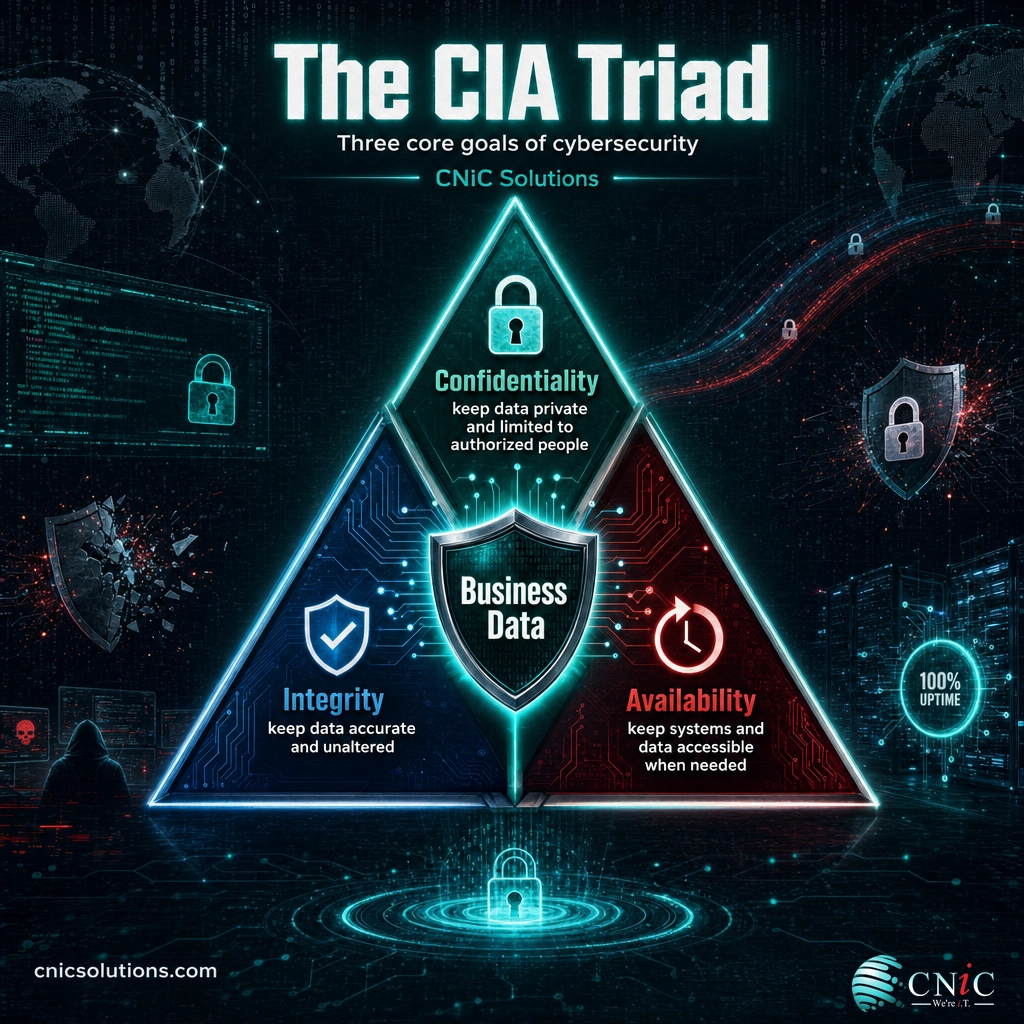
Underneath the tools and jargon, cybersecurity is organized around three goals. Security professionals call them the CIA triad, and every control you will ever buy or configure exists to serve at least one of them. Understanding these three ideas is the fastest way for a non-technical owner to grasp what security is really protecting.
- Confidentiality. Keeping information private and limited to the people authorized to see it. Passwords, encryption, and access permissions all serve confidentiality. When customer records or financial data leak, this is the goal that failed.
- Integrity. Keeping data accurate and unaltered. You need confidence that a wire-transfer instruction, a medical record, or a contract has not been secretly changed. Integrity controls detect and prevent tampering.
- Availability. Keeping systems and data accessible when you need them. A ransomware attack that locks your files, or an outage that takes your store offline, is an attack on availability. Backups and resilient systems protect it.
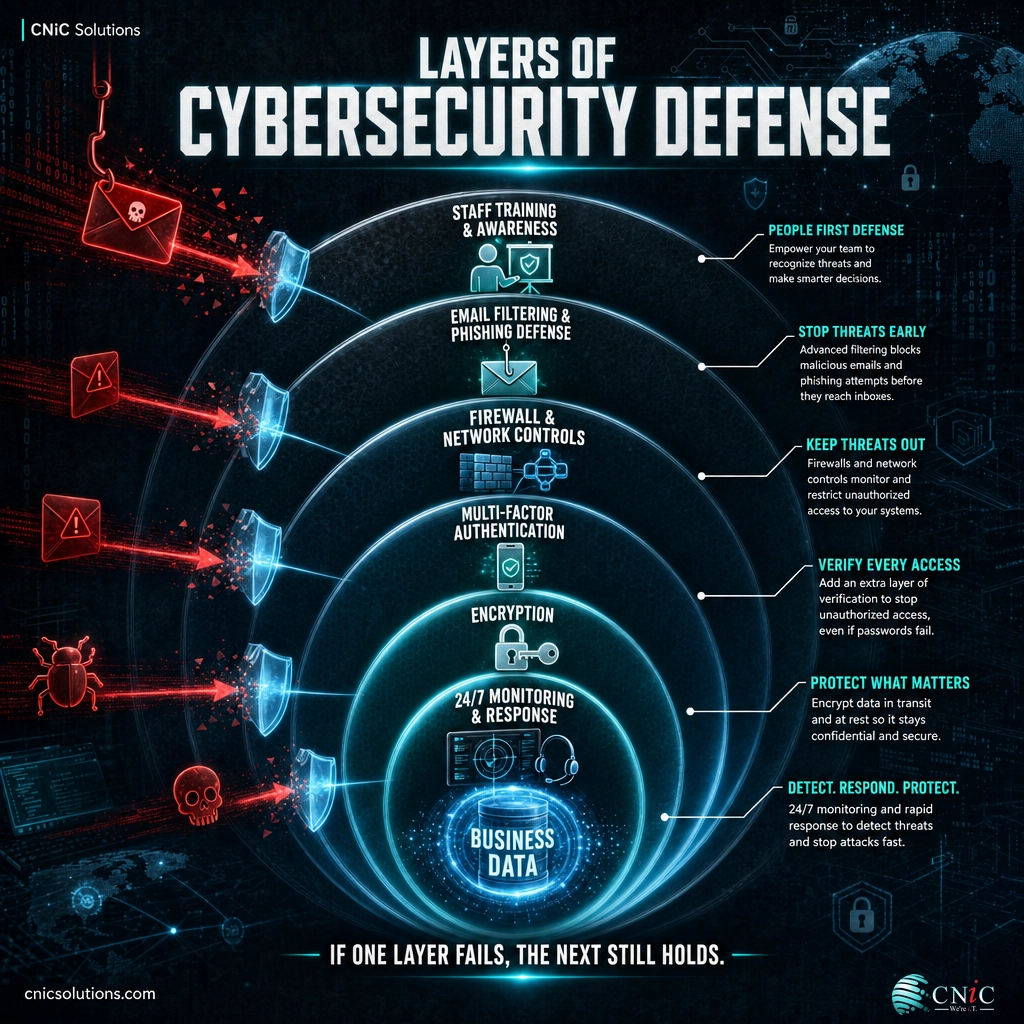
Real protection layers controls across all three goals, an approach called defense in depth. No single control is perfect, so security teams stack several so that when one fails, another still stands. A phishing email might slip past your spam filter (one layer), but multi-factor authentication stops the stolen password from working (a second layer), and monitoring flags the unusual login attempt (a third). The strength of a security program comes from the layers working together, not from any one product. That layered thinking is also the reason ongoing managed detection and response matters: someone has to watch the alarms after the locks are installed.
Source: NIST Computer Security Resource Center | CISA cybersecurity best practices
Cybersecurity vs. IT Security
People use “cybersecurity,” “IT security,” and “information security” as if they mean the same thing, and the overlap is real, but the distinction matters when you are deciding what to protect. IT security is the widest term: protecting all of your technology, including physical servers, devices, and even offline systems. Cybersecurity is the slice of that focused specifically on threats arriving through networks and the internet. Information security, meanwhile, is about protecting data in any form, digital or paper. The table below clears up the most common confusion.
| Attribute | Cybersecurity | IT Security |
|---|---|---|
| Main focus | Attacks that come through networks and the internet | All technology assets, online and offline |
| Protects against | Hackers, malware, phishing, ransomware, data theft | The above, plus physical hardware failure, theft, and misuse |
| Typical scope | Firewalls, endpoints, cloud, email, identity | Everything in cybersecurity plus servers, devices, and facilities |
| Relationship | A specialized part of IT security | The broader umbrella that contains cybersecurity |
Think of it as the difference between “vehicle safety” and “crash protection.” Crash protection (cybersecurity) is a critical, specialized part of the wider goal of vehicle safety (IT security), which also covers maintenance, tires, and visibility. For most small and midsize businesses the practical point is simple: you need both, and a good IT partner treats them as one continuous responsibility rather than separate projects. The terms matter less than making sure nothing falls through the gap between them.
Source: CISA cybersecurity best practices | NIST Computer Security Resource Center
Why Cybersecurity Matters for Your Business
Cybersecurity can feel abstract until it is translated into money, downtime, and legal exposure. Three sets of numbers make the case concrete, and all of them are getting worse, not better, as more of business moves online.
First, the direct cost of an incident is severe. When a breach happens, the bill is not just the ransom or the stolen funds. It includes investigation, recovery, lost business, legal fees, and regulatory penalties. Researchers who track this across thousands of organizations put the global average in the millions.
Second, the volume of attacks keeps climbing. The FBI’s Internet Crime Complaint Center collects reports of cybercrime from the public and businesses, and the annual totals show a steep upward trend, reaching a record in 2024.
Reported Losses to the FBI IC3, 2020 to 2024
Annual reported cybercrime losses have nearly quadrupled in five years. Source: FBI IC3 Internet Crime Reports, 2020 to 2024.
Third, and most important for how you spend your security budget, the majority of breaches begin with a person, not a machine. Attackers overwhelmingly find it easier to trick an employee than to defeat a firewall, which is why security awareness and email defenses deliver some of the best returns of any control.
Myth: “We’re too small to be a target.” This is the most dangerous assumption a small business can make. Attackers automate their attacks, scanning the internet for any vulnerable system regardless of company size, and they know smaller firms often have weaker defenses and thinner IT support. A small business is not flying under the radar. It is frequently the easier target precisely because it assumes no one is looking. The obligation to protect customer, payment, and health data does not scale down with headcount.
Explore Managed Cybersecurity Services
See Backup and Recovery Options
Source: IBM Cost of a Data Breach Report | FBI IC3 2024 Internet Crime Report | Verizon Data Breach Investigations Report
The Main Types of Cyber Threats
You do not need to memorize an attacker’s playbook, but knowing the main categories helps you recognize risk and ask better questions of your IT team. Most attacks against businesses fall into a handful of families, and they frequently combine, for example a phishing email that delivers ransomware.
Phishing and Social Engineering
The most common entry point. Attackers pose as a trusted person or company to trick someone into revealing a password, approving a payment, or opening a malicious file. Because it targets human trust rather than software, it bypasses many technical defenses. Learning to spot the warning signs of a phishing email is one of the highest-value skills your staff can build, and it is the front line against the broader tactic of social engineering.
Malware and Ransomware
Malware is malicious software that infects a system to steal data, spy, or cause damage. Ransomware is the variety that has hurt businesses most: it encrypts your files and demands payment to unlock them, halting operations until you recover or pay. Reliable, tested backups are the single best defense, because they let you restore rather than negotiate.
Stolen and Weak Credentials
Passwords that are reused, guessed, or stolen give attackers a legitimate-looking way in. This is why multi-factor authentication, which requires a second proof of identity beyond the password, is now considered a baseline control rather than an upgrade. A stolen password alone should never be enough to open your systems.
Insider Risk and Human Error
Not every incident is malicious. A misdirected email, a misconfigured cloud folder, or a lost laptop can expose data just as effectively as an attacker. This category is why access controls, encryption, and clear policies matter, and why the human element shows up in so many breaches.
Because these threats evolve constantly, the goal is not to eliminate risk entirely, which is impossible, but to reduce it to a level the business can accept and to detect problems fast when they occur. A formal cybersecurity risk assessment is how most organizations figure out which of these threats poses the greatest danger to them specifically.
Source: CISA cybersecurity best practices | Verizon Data Breach Investigations Report
How to Get Started With Cybersecurity
You do not secure a business overnight, and you do not need an enterprise budget to be meaningfully safer than you are today. The highest-impact controls are well understood, and a small business can put a solid foundation in place by working through five steps in order.
- Know what you have. List your critical data, systems, and accounts, and identify where the sensitive information lives. You cannot protect what you have not inventoried, and this step usually surfaces forgotten accounts and unmanaged devices.
- Turn on multi-factor authentication everywhere. Especially for email, banking, and remote access. It is one of the cheapest, most effective controls available and stops the majority of password-based attacks cold.
- Patch and update on a schedule. Attackers exploit known flaws that vendors have already fixed. Keeping software and devices current closes those doors before they are used against you.
- Back up your data and test the restore. A backup you have never restored is a hope, not a plan. Reliable, tested backups are what turn a ransomware attack from a catastrophe into an inconvenience, which is why they anchor any real business continuity plan.
- Train your people. Because most attacks target staff, short, regular security training on phishing and safe habits often prevents more breaches than any single piece of software.
The hardest part is rarely knowing the steps. It is having the time and expertise to run them consistently while also running a business. That is why many small and midsize companies hand day-to-day security to a managed IT and security provider, and hand the strategy to an internal or outsourced leader. If you lack a senior technology voice in the room, a virtual CISO can set priorities, translate compliance obligations into practical controls, and hold the program accountable over time. The point is that these controls need an owner, whether that owner is on your payroll or on retainer.
Common Questions About Cybersecurity
What is cybersecurity in simple terms?
What is the difference between cybersecurity and IT security?
What are the main types of cyber threats?
Why is cybersecurity important for small businesses?
How do I get started with cybersecurity for my business?
Related Terms
- Phishing: a scam that impersonates a trusted sender to trick someone into giving up information or access. See the warning signs in this guide to spotting a phishing email.
- Social engineering: the broad set of tactics that manipulate people, rather than software, into breaking security. Learn how to prevent social engineering attacks.
- Ransomware: malware that encrypts your files and demands payment for their release, one of the costliest threats to business operations.
- Multi-factor authentication (MFA): a control requiring a second proof of identity beyond a password, now a baseline defense against stolen credentials.
- Encryption: scrambling data so it is unreadable without a key, protecting confidentiality even if data is stolen. See data encryption explained.
- Managed detection and response (MDR): a service that monitors your systems around the clock and responds to threats. Read what managed detection and response covers.
- MSSP: a managed security services provider that runs security tools and monitoring on your behalf. Learn what an MSSP does.
- Risk assessment: a structured review of your specific threats and weaknesses that sets security priorities. See why you need a cybersecurity risk assessment.
About This Guide
The definition of cybersecurity in this guide is grounded in the National Institute of Standards and Technology (NIST) glossary, drawn from CNSSI 4009-2015, and in guidance from the Cybersecurity and Infrastructure Security Agency (CISA). Breach cost figures are from the IBM Cost of a Data Breach Report 2024, produced with the Ponemon Institute. Cybercrime loss and complaint totals are from the FBI Internet Crime Complaint Center (IC3) annual Internet Crime Reports for 2020 through 2024. The share of breaches involving the human element is from the Verizon 2024 Data Breach Investigations Report. Figures are cited to their original sources and used to illustrate the scale of risk, not as guaranteed outcomes for any specific business.
Sources: NIST Computer Security Resource Center | CISA cybersecurity best practices | IBM Cost of a Data Breach Report 2024 | FBI IC3 2024 Internet Crime Report | Verizon 2024 Data Breach Investigations Report
Protect Your Business: Get a Free Security Consultation



related posts
What Is ZTNA (Zero Trust Network Access)?
November 3, 2026Zero Trust Network Access (ZTNA) is a security service that grants a verified user access to…
Zero Trust Statistics for 2026: Adoption, Maturity, and Breach Impact
November 3, 2026Zero trust has become the default security strategy on paper, but not yet in practice. Okta's…
What Is XDR (Extended Detection and Response) and How Does It Protect…
November 2, 2026Extended detection and response (XDR) is a security platform that collects and correlates threat data from…
What Is Zero Trust Security? A Guide for Small Businesses
November 2, 2026Zero Trust security is a cybersecurity model built on one rule: never trust, always verify. Instead…