

Homomorphic encryption is a form of encryption that lets you perform calculations directly on encrypted data without decrypting it first. The result comes back still encrypted, and only the key holder can unlock it. That means sensitive information can be processed by an outside system, such as a cloud provider, while never being exposed in readable form.
Ordinary encryption has a blind spot: to actually use data, you normally have to decrypt it first, which briefly exposes it. Homomorphic encryption closes that gap by letting a computer work on data while it stays scrambled. It is one of the most promising ideas in modern cryptography, and also one of the most misunderstood. This guide explains what it is in plain language, how it works, the different types, and whether it is something your business needs to think about right now.
Key Takeaways
- Homomorphic encryption lets computers process data that stays encrypted the entire time, so the raw information is never revealed, even during the calculation.
- It closes the “data in use” gap. Standard encryption protects data at rest and in transit, but normally must decrypt it to compute on it. Homomorphic encryption does not.
- There are three families: partially homomorphic (one type of operation), somewhat homomorphic (limited mixed operations), and fully homomorphic (any computation).
- It became real in 2009, when Craig Gentry built the first fully homomorphic scheme, solving a problem cryptographers had posed back in 1978.
- It is powerful but slow. The main trade-off is performance, so today it is used where privacy is critical, not as a replacement for everyday encryption.
What’s in This Guide
How Homomorphic Encryption Works
To understand what makes homomorphic encryption special, it helps to see the problem it solves. With the way everyday data encryption works, data is protected while it sits in storage and while it travels across a network. But the moment you want to actually do something with it, add up a column of numbers, search it, run a report, you have to decrypt it back into readable form. For that brief window, the data is exposed to whatever system is processing it.
Homomorphic encryption removes that window. It has a special mathematical property: operations you perform on the encrypted data (the ciphertext) carry through to the underlying data as if you had performed them on the original. You add two encrypted numbers, decrypt the encrypted answer, and you get the correct sum, even though the computer that did the addition never saw the real numbers.
The sealed glovebox analogy. Imagine a jeweler who needs to work on your gold but is never allowed to touch it directly. You lock the gold inside a transparent glovebox and keep the only key. The jeweler reaches in through built-in gloves, shapes the gold, and hands the box back, still locked. Only you can open it and take out the finished piece. Homomorphic encryption is that glovebox: the outside worker can shape your data without ever holding it in the open.
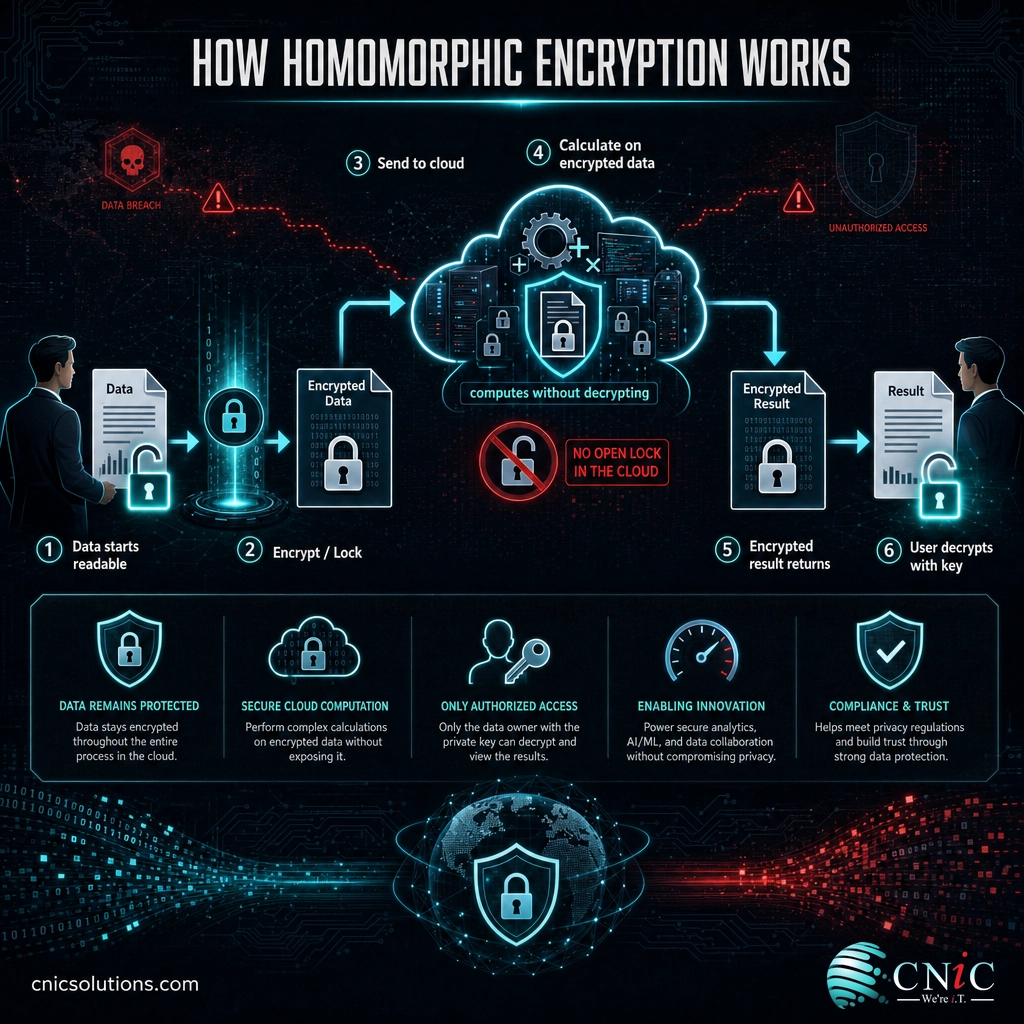
In practice, the process follows a simple flow:
- Encrypt. You scramble your data with a homomorphic scheme and keep the secret key.
- Send. You hand the encrypted data to an outside system, such as a cloud service, that you may not fully trust with the raw information.
- Compute. That system runs the required calculations directly on the encrypted data. It never decrypts anything and never sees a single real value.
- Return. It sends back an encrypted result.
- Decrypt. You use your key to unlock the result, which matches what you would have gotten by computing on the original data.
Source: NIST: Cryptography | Homomorphic Encryption Standardization: Introduction
Homomorphic vs. Standard Encryption
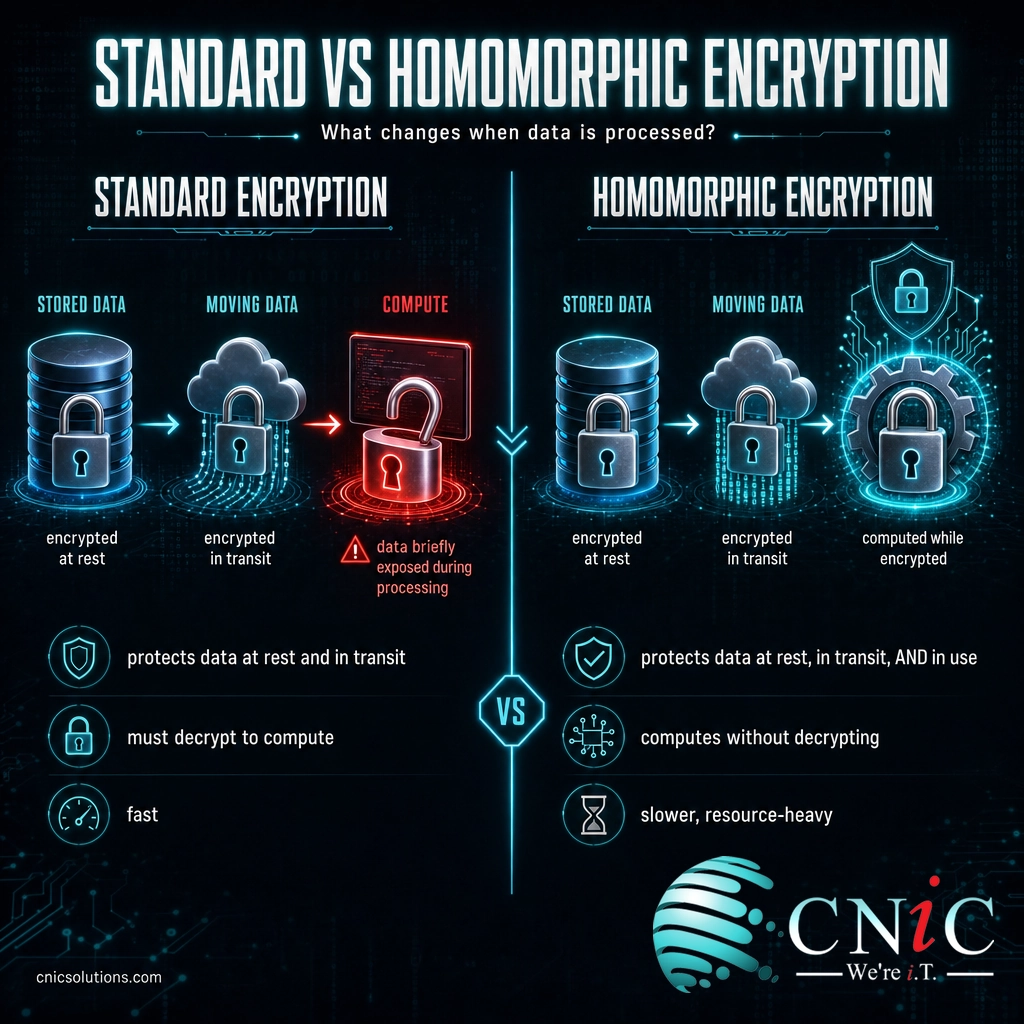
The most common point of confusion is how homomorphic encryption differs from the encryption businesses already use. They are not competitors; they solve different parts of the same problem. Standard encryption protects data in two of its three states, while it is stored and while it moves. Homomorphic encryption is built to protect the third and hardest state: data while it is being used.
| Standard Encryption | Homomorphic Encryption | |
|---|---|---|
| Protects data at rest and in transit | Yes | Yes |
| Must decrypt to compute on the data | Yes, the data is briefly exposed | No, it stays encrypted throughout |
| Data exposed to the processing system | Yes, during computation | No, never in readable form |
| Speed | Fast and efficient | Much slower and resource-heavy |
| Best used for | Everyday protection of nearly all business data | Processing highly sensitive data on untrusted systems |
Put simply: standard encryption is the lock on the door and the armored truck. Homomorphic encryption is the glovebox that lets someone work on your valuables without the door ever being unlocked. Almost every business relies heavily on the first. The second is a specialized tool for cases where even momentary exposure is unacceptable.
Source: NIST: Cryptography
The Three Types of Homomorphic Encryption
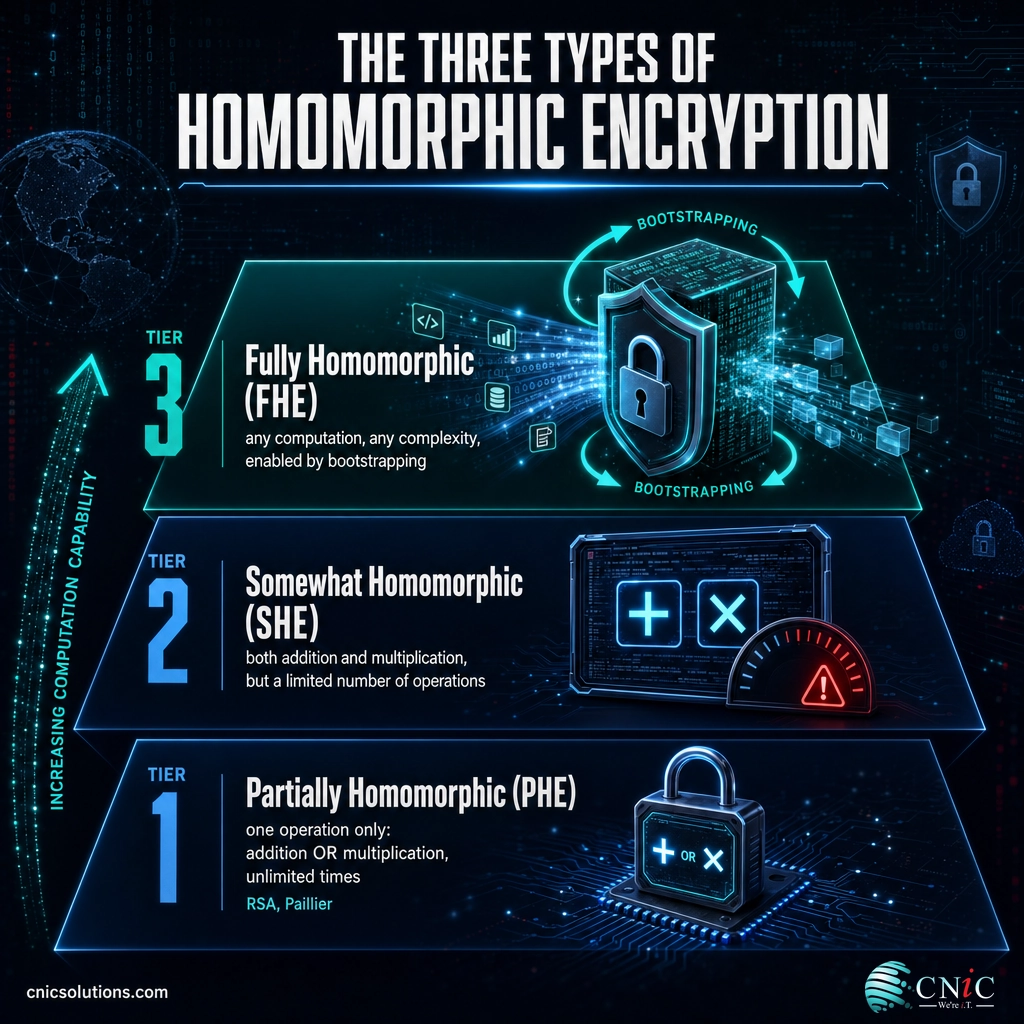
Not all homomorphic encryption can do the same amount of work. Schemes are grouped into three families based on how many and what kind of operations they can perform on encrypted data. Each step up the ladder handles more computation.
1. Partially Homomorphic Encryption (PHE)
Partially homomorphic schemes support one type of operation, unlimited times, but only that one. Some allow only addition; others allow only multiplication. This is actually older and more common than most people realize. The widely used RSA algorithm, for example, has a multiplicative homomorphic property, and the Paillier scheme is additively homomorphic. PHE is efficient and practical, but limited, because most real calculations need both addition and multiplication.
2. Somewhat Homomorphic Encryption (SHE)
Somewhat homomorphic schemes can handle both addition and multiplication, but only for a limited number of operations before the encrypted data becomes too “noisy” to decrypt correctly. Every homomorphic operation adds a small amount of mathematical noise to the ciphertext, and once it builds up past a threshold, the result can no longer be recovered. SHE was an important stepping stone toward the real goal.
3. Fully Homomorphic Encryption (FHE)
Fully homomorphic encryption is the holy grail: it can perform any computation, of any complexity, on encrypted data. The breakthrough that made it possible was a technique called bootstrapping, which effectively “refreshes” the ciphertext and clears the accumulated noise, allowing computation to continue indefinitely. FHE is the most powerful and the most demanding on computing resources. When people talk about the promise of homomorphic encryption, they usually mean FHE.
Source: Homomorphic Encryption Standardization: Introduction
Why It Matters for Businesses
Homomorphic encryption is not just an academic curiosity. It represents the solution to a problem that has held back a lot of sensitive data collaboration: how do you let someone compute on your data without trusting them with it? A few numbers put the idea in context.
The business significance is straightforward. As more data processing moves to the cloud and to outside partners, the ability to keep data encrypted even while it is being worked on removes a major source of risk. It changes the question from “do I trust this provider with my raw data?” to “can this provider compute on my locked data and hand back a locked result?” For regulated industries, that distinction can be the difference between a workflow being allowed and being off-limits.
Talk to CNiC about protecting your sensitive business data
Source: Homomorphic Encryption Standardization: Introduction

Real-World Use Cases
Because homomorphic encryption is slower than standard encryption, it is applied where the privacy payoff justifies the cost. Several use cases are already being explored or deployed.
- Privacy-preserving cloud computing. A business can upload encrypted data to a cloud provider, have the provider run analysis on it, and receive an encrypted result, all without the provider ever accessing the underlying information. This is the flagship use case.
- Healthcare research. Hospitals and researchers can run computations across encrypted patient data, enabling collaborative studies and predictions without exposing individual medical records.
- Financial services. Banks and insurers can analyze encrypted financial data for fraud detection or risk scoring while keeping the sensitive underlying records private, including when the work is outsourced.
- Encrypted machine learning. Models can be trained or run on encrypted inputs, so a company can use a third-party AI service without handing over its confidential data in the clear.
- Secure data collaboration. Multiple organizations can jointly compute on their combined data, for example to detect shared threats or benchmark performance, without any party revealing its own private inputs to the others.
The common thread is that the data owner gets a useful answer while an outside system does the heavy lifting, and the raw data never leaves its encrypted shell. That is exactly the scenario cloud and outsourcing arrangements have long struggled with.
Source: Homomorphic Encryption Standardization: Introduction
The Catch: Performance and Practical Limits
If homomorphic encryption is this powerful, why is not everything encrypted this way? The honest answer is performance. Computing on encrypted data is dramatically slower and more resource-intensive than computing on plaintext. Early implementations of fully homomorphic encryption were so slow that a single basic operation could take minutes, making real applications impractical.
The good news is that progress has been rapid. A series of newer schemes, known by names like BGV, BFV, CKKS, and TFHE, have made homomorphic encryption orders of magnitude faster than Gentry’s original design, and specialized hardware is pushing it further. CKKS, for instance, is designed for approximate arithmetic and is well suited to machine learning workloads. It is now fast enough for targeted, high-value tasks, even if it is still far from replacing everyday encryption.
Myth: “Homomorphic encryption means my data is never decrypted anywhere, so it replaces all my other security.”
Not quite, and treating it that way is risky. Homomorphic encryption protects data during computation on an outside system, but you still decrypt results on your own trusted machine, and you still need everything else: strong encryption for data at rest and in transit, disciplined key management, access controls, and monitoring. It is a specialized addition to a security strategy, not a magic replacement for one. The keys that unlock your data remain the crown jewels, exactly as they do with standard encryption.
Source: NIST: Cryptography
What This Means for Your Business
For most small and midsize businesses, the practical takeaway is reassuring: you almost certainly do not need to deploy homomorphic encryption today. It is an advanced, still-maturing technology aimed at specialized privacy problems. Chasing it before the basics are solid would be a distraction.
What actually protects your business right now is getting the fundamentals right and verified: strong standard encryption on every device and connection, encrypted backups, disciplined key management, and alignment with any compliance obligations you carry. Those are the controls that stop the breaches businesses actually suffer. Homomorphic encryption sits on the horizon as a tool for a narrower set of high-sensitivity scenarios, mostly around processing confidential data on infrastructure you do not fully control.
Where it does become relevant, the smart move is not to build it yourself but to work it into a broader security and technology plan. That is the role a managed IT and security partner plays: keeping your core protections airtight today, and advising you on when an emerging technology like this genuinely fits your needs. A Virtual CIO can map new cryptographic options to real business risk instead of hype, so you adopt them when, and only when, they earn their place.
Build encryption into a managed IT and security plan
Related Terms
- Plaintext: Readable, unencrypted data before it is scrambled.
- Ciphertext: The scrambled, unreadable output of encryption that homomorphic schemes compute on.
- Fully homomorphic encryption (FHE): The type that can run any computation on encrypted data, made possible by bootstrapping.
- Bootstrapping: The technique that refreshes a ciphertext to clear accumulated noise, allowing unlimited computation.
- Public-key encryption: A system using a public key to encrypt and a private key to decrypt, the foundation many homomorphic schemes build on.
- Confidential computing: A hardware-based approach to protecting data in use, an alternative to homomorphic encryption for the same “data in use” problem.
- Secure multi-party computation: A method letting several parties jointly compute a result without revealing their individual private inputs.
- Data in use: The state of data while it is actively being processed in memory, the hardest state to protect and the one homomorphic encryption targets.
Frequently Asked Questions
What is homomorphic encryption in simple terms?
How is homomorphic encryption different from standard encryption?
Who invented homomorphic encryption?
Is homomorphic encryption used in the real world yet?
Does my business need homomorphic encryption?
Sources
This explainer grounds its technical claims in standards-based cryptographic sources rather than vendor marketing. The definition of homomorphic encryption, the three families (partially, somewhat, and fully homomorphic), and the additive and multiplicative homomorphic properties of schemes like Paillier and RSA reflect established cryptographic concepts. The historical timeline, the 1978 origin of the idea and Craig Gentry’s 2009 first fully homomorphic scheme using bootstrapping, follows the Homomorphic Encryption Standardization community. No market statistics or performance percentages are asserted; performance is described qualitatively.
Primary and authoritative sources: NIST Cryptography, Homomorphic Encryption Standardization (Introduction).



related posts
What Is Infrastructure Security? A Guide for Businesses
October 21, 2026Infrastructure security is the practice of protecting the core technology systems a business runs on: its…
What Is Infrastructure as Code (IaC)? A Guide for Businesses
October 21, 2026Infrastructure as Code (IaC) is the practice of managing and provisioning IT infrastructure, such as servers,…
What Is GDPR? A Data Protection Compliance Guide for Businesses
October 20, 2026GDPR (the General Data Protection Regulation) is a European Union law that governs how organizations collect,…
What Is FinOps? A Guide to Managing and Optimizing Cloud Costs
October 19, 2026FinOps is an operational framework and cultural practice for managing and optimizing cloud costs by bringing…