

FinOps is an operational framework and cultural practice for managing and optimizing cloud costs by bringing finance, engineering, and business teams together to make spending decisions based on shared data. The name blends “Finance” and “DevOps,” and the goal is not just to spend less. It is to get the most business value out of every cloud dollar. That distinction matters more each year: Gartner forecasts worldwide public cloud spending will reach 723.4 billion dollars in 2025, and roughly a quarter of it is wasted.
Before You Begin
You do not need a dedicated team or new software to start practicing FinOps. You need a few things in place:
- Access to your cloud billing data. The native tools (AWS Cost Explorer, Microsoft Cost Management, Google Cloud Billing) are enough to begin.
- A tagging or labeling plan so spend can be tied to a team, project, or customer.
- Buy-in from three groups: finance, engineering, and a business owner who cares about the outcome.
- Estimated time: basic visibility in days, first savings in weeks, cultural maturity over months.
- Skill level: mixed. Finance stakeholders and technical stakeholders both take part, which is the point.
Key Takeaways
- FinOps is a discipline, not a tool. It combines financial management with cloud engineering so teams can understand and control what they spend.
- The goal is value, not just savings. The FinOps Foundation states plainly that the point is to maximize business value, not to cut the bill.
- The waste is real and large. The 2025 Flexera State of the Cloud Report estimates 27 percent of cloud spend is wasted, and 84 percent of organizations struggle to manage cloud spend.
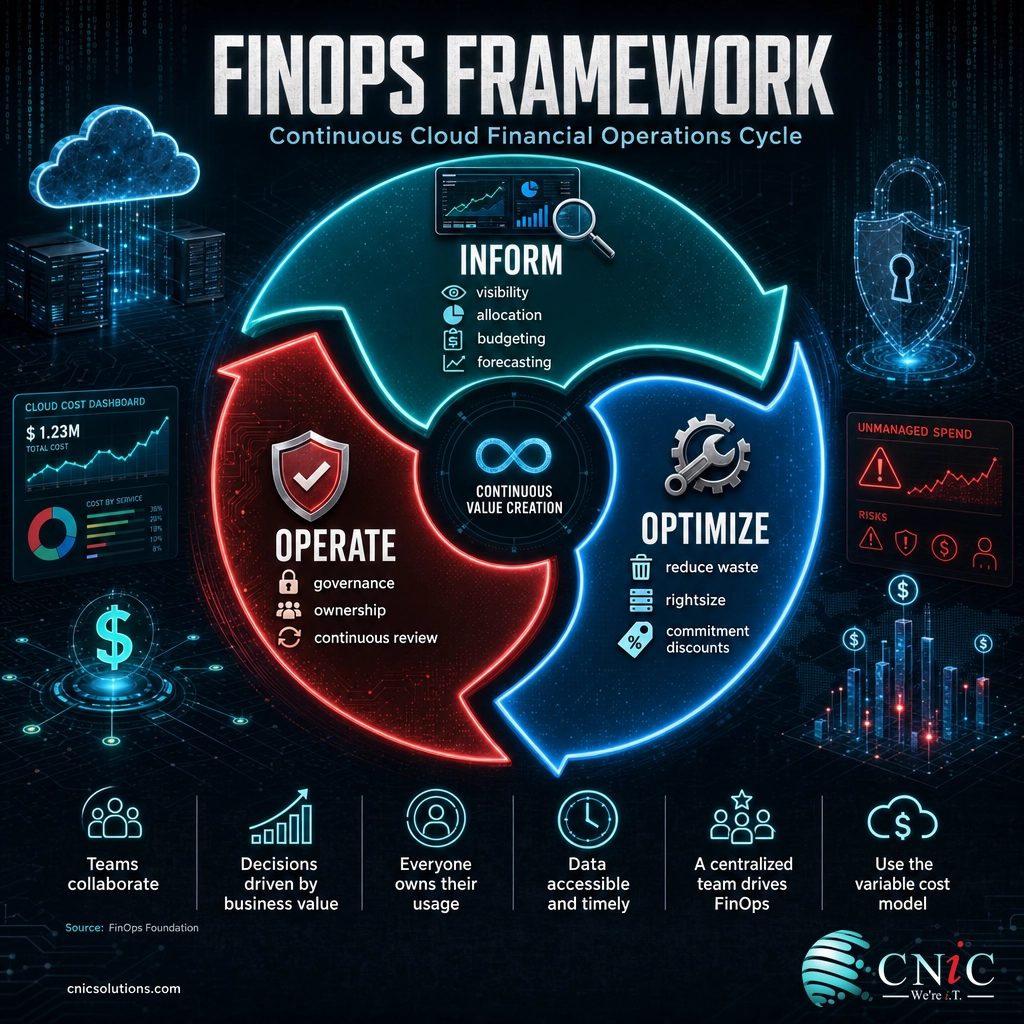
- The framework has three repeating phases: Inform (get visibility), Optimize (cut waste and improve efficiency), and Operate (make it continuous).
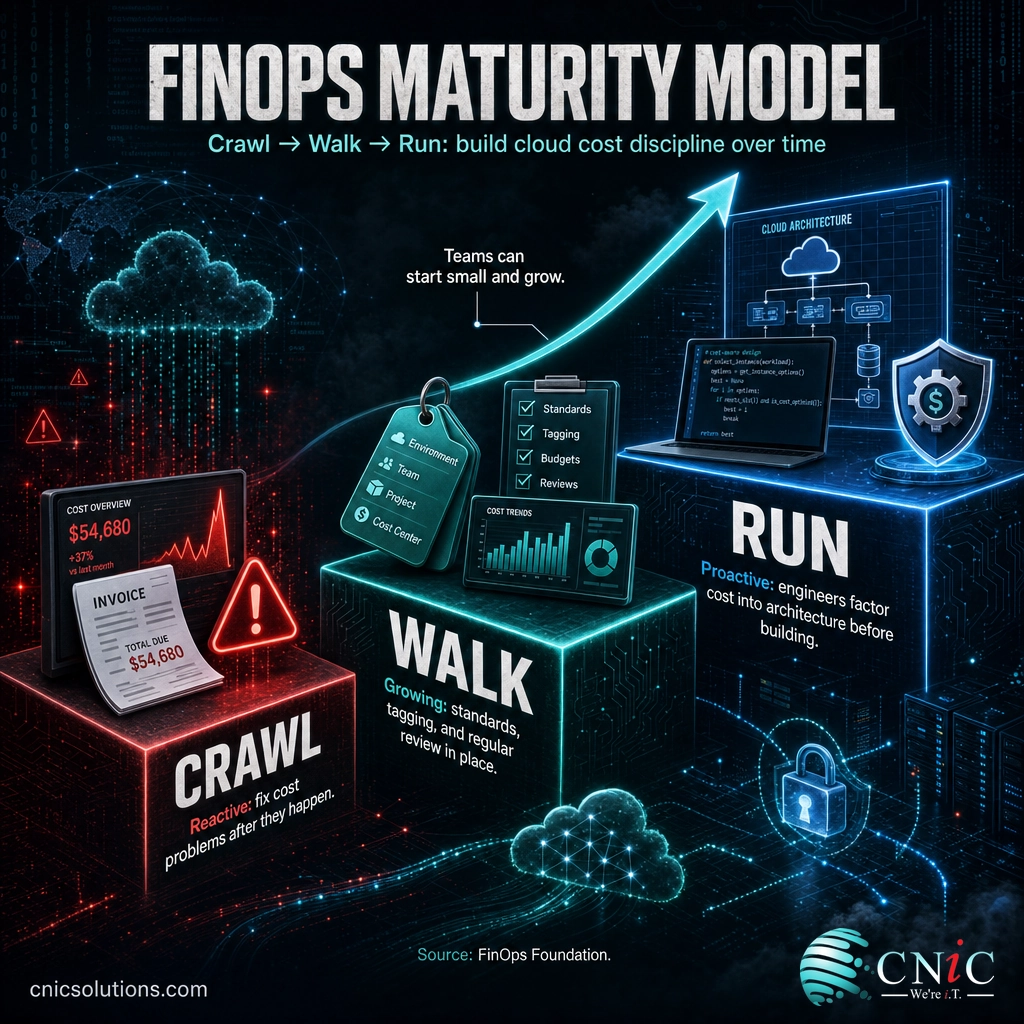
- Start small. The “Crawl, Walk, Run” model means you can begin with one team and a single cost report and grow from there.
What’s in This Guide
What Is FinOps?
The FinOps Foundation, the non-profit that maintains the standard, defines it this way: “FinOps is an operational framework and cultural practice which maximizes the business value of cloud, enables timely data-driven decision making and creates financial accountability through collaboration between engineering, finance and business teams.”
Read that once more and notice what it does not say. It does not say “software that finds savings.” It does not say “a report finance runs at the end of the month.” FinOps is a way of working. The word itself, a blend of Finance and DevOps, is the clue: it takes the collaborative, fast-feedback habits that DevOps brought to software delivery and applies them to money.
Here is why that shift is needed. In the old data-center world, someone in finance approved a server purchase months in advance, and the cost was fixed for years. In the cloud, an engineer can spin up a database at 2 p.m. that adds thousands of dollars to next month’s invoice, and no one in finance sees it until the bill arrives. The people making spending decisions (engineers) are not the people who own the budget (finance). FinOps closes that gap by giving both sides the same real-time data and a shared set of rules for acting on it.
It is worth being clear about the goal, because this is where most teams get FinOps wrong. Microsoft, which joined the FinOps Foundation in 2023, puts it directly in its own documentation: “The goal of FinOps isn’t to save money, but to maximize revenue or business value through the cloud.” Cutting cost is often the outcome, but the real work is making sure every dollar of cloud spend earns its place.
Source: FinOps Foundation | Microsoft Learn, What is FinOps
Why FinOps Matters Now
Cloud spending has grown into one of the largest line items on the modern IT budget, and it keeps climbing. Gartner forecasts that worldwide end-user spending on public cloud services will total 723.4 billion dollars in 2025, up from 595.7 billion in 2024, a 21.5 percent jump in a single year. As more of your operation runs in the cloud, the bill stops being a rounding error and starts being a number leadership asks about.
Forecast 2025 Public Cloud End-User Spending by Segment (Gartner)
The problem is that a large share of that spend does nothing. The 2025 Flexera State of the Cloud Report, one of the most widely cited annual surveys in the industry, estimates that 27 percent of cloud spend is wasted on idle, oversized, or forgotten resources. The same report found that 84 percent of organizations struggle to manage cloud spend, making it one of the top challenges cloud teams name year after year.
That waste is the opportunity. For most businesses, there is real money on the table before a single new efficiency project is started, and FinOps is the discipline that goes and gets it. If you want the specific tactics that turn visibility into savings, our companion guide to proven cloud cost optimization strategies covers the levers in detail.
Myth: FinOps is just a fancy word for cutting the cloud bill
This is the most common misunderstanding, and it leads teams to do FinOps badly. If your only measure of success is a smaller invoice, you will eventually cut something that mattered: a backup, a redundant server, a capacity buffer that kept a customer-facing app fast. The FinOps Foundation is deliberate on this point. Optimizing for cost without optimizing for value is not FinOps. The right decision is sometimes to spend more, because the extra spend captures disproportionate value. FinOps gives you the data to tell the difference. It does not tell you to spend less by default.
Source: Gartner public cloud spending forecast | Flexera 2025 State of the Cloud Report
Explore CNiC Solutions cloud services
The FinOps Framework: Principles and Phases
FinOps is not a loose idea. The FinOps Foundation maintains a formal framework built on a set of principles, a repeating lifecycle, and a maturity model. You do not have to adopt all of it at once, but understanding the structure keeps a program from drifting.
The six FinOps principles
These principles, refreshed by the Foundation in 2025 for the first time since 2019, describe how a healthy FinOps culture behaves:
- Teams need to collaborate. Finance, engineering, and business talk to each other continuously, not once a quarter.
- Decisions are driven by the business value of cloud. Value, not raw cost, is the deciding factor.
- Everyone takes ownership of their cloud usage. The engineer who provisions a resource owns its cost.
- FinOps data should be accessible and timely. Cost data is only useful if people see it while they can still act on it.
- A centralized team drives FinOps. A small group sets standards, handles rate negotiations, and keeps the practice consistent.
- Take advantage of the variable cost model of the cloud. The ability to scale up and down is an asset to plan for, not a hazard to fear.
The three phases: Inform, Optimize, Operate
The framework’s engine is a lifecycle of three phases that repeat. It is not a straight line. Different teams and workloads can sit in different phases at the same time.
- Inform. The foundation. You get visibility into what you are spending and why, then allocate, benchmark, budget, and forecast. You cannot manage what you cannot see.
- Optimize. With the picture clear, you reduce waste and improve efficiency: rightsizing, shutting down idle resources, and locking in commitment-based discounts.
- Operate. You make it continuous. Governance, policy, ownership, and a regular cadence of review turn a one-time cleanup into a lasting practice.
The maturity model: Crawl, Walk, Run
The Foundation describes progress through a “Crawl, Walk, Run” model so that starting is never overwhelming. In the Crawl stage a team is reactive, fixing cost problems after they appear. By the Run stage, engineers factor cost into architecture decisions before they build. The message is to start small and grow in scope as the value justifies it. A first cost report on one team is a legitimate beginning.
Source: FinOps Foundation Framework

How to Start a FinOps Practice: 5 Steps
The framework becomes real in five practical steps. They map onto the Inform, Optimize, and Operate phases, and you can run them at any scale, from one engineer with a spreadsheet to a full team.
Step 1: Establish cloud cost visibility (Inform)
What to do: Turn on your cloud provider’s native cost tools and apply a consistent tagging or labeling scheme so every resource carries a team, project, or product tag. Then use cost-allocation rules to divide shared costs. The aim is that every dollar on the invoice can be traced to something.
Why it matters: Visibility is the base every other step depends on. You cannot cut what you cannot see.
What success looks like: You can answer “which team spent what, on which service, this month” without guessing.
Step 2: Set budgets and forecasts (Inform)
What to do: Use the allocated data to set budgets per team or product, benchmark against previous months, and forecast where spend is heading. Configure alerts so a budget threshold triggers a notification, not a surprise on the invoice.
Why it matters: Forecasting turns cost from a backward-looking report into a planning tool leadership can trust.
What success looks like: A cost spike is flagged in near real time and traced to its source within a day.
Step 3: Eliminate waste and rightsize (Optimize)
What to do: Hunt down the two biggest sources of waste: idle resources that are running but unused, and oversized resources provisioned larger than the workload needs. Shut down or resize them, and schedule non-production environments to stop overnight and on weekends.
Why it matters: With more than a quarter of cloud spend commonly wasted, this is usually where the first meaningful savings appear.
What success looks like: The invoice drops without any application slowing down or breaking.
Step 4: Apply commitment-based discounts (Optimize)
What to do: Once your baseline usage is predictable, cover it with the provider’s committed-use options. Amazon Web Services reports that Savings Plans and Reserved Instances can lower prices by up to 72 percent compared with On-Demand rates when you commit to steady usage.
Why it matters: This lowers the rate you pay for capacity you were going to use anyway, which is close to free money once your baseline is clear.
What success looks like: A healthy share of your steady-state workload runs on committed pricing, not full On-Demand rates.
Common mistake: buying commitments before you have visibility
Steps run in order for a reason. Locking in a one-year or three-year commitment before you understand your baseline is how teams end up paying for reserved capacity they no longer use. Finish Steps 1 through 3 first. Commit to the usage that remains after you have cut the waste, not before.
Step 5: Operationalize FinOps (Operate)
What to do: Assign clear ownership, put cost data into the dashboards engineers already use, set governance policies (tagging rules, approval thresholds, standard instance types), and hold a recurring review. This is what turns a project into a practice.
Why it matters: One-time cleanups quietly erode. Teams that treat cost as an ongoing responsibility keep the savings; teams that do a cleanup and move on watch the waste creep back.
What success looks like: Cost is a normal input to engineering decisions, and no one is surprised by the monthly bill.
Source: FinOps Foundation Framework | AWS Savings Plans
When to Call in a FinOps Partner
If you reach the point where your cloud bill is large enough to matter but no single person owns it, that is the signal to bring in help. The 2025 State of FinOps Report from the FinOps Foundation found that workload optimization and waste reduction is now the top priority for practitioners, and that 63 percent of organizations are already tracking AI-related spend, up from 31 percent the year before. Cloud cost management is getting more complex, not less, and small and midsize businesses rarely have a spare specialist to run it.
This is where a managed IT partner earns its keep. A provider that already operates your cloud environment can run the FinOps lifecycle for you: setting up visibility, cutting the waste, negotiating and managing commitments, and holding the ongoing review so savings do not slip. It is the same argument as a virtual CIO. You get the discipline of a senior cost owner without hiring one full time.
See how virtual CIO services put a cost owner on your team
Source: FinOps Foundation, State of FinOps 2025
Troubleshooting Common FinOps Problems
Most FinOps programs stall in one of a handful of predictable places. Here is how to diagnose and fix the common ones.
| Problem | Likely cause | Fix |
|---|---|---|
| Costs are still unclear after setup | Resources are untagged, so spend cannot be allocated | Enforce a tagging policy and use allocation rules for shared costs |
| Savings erode a few months after a cleanup | Optimization was a one-time effort with no owner | Move optimization into the Operate phase with a recurring review |
| Engineers ignore the cost data | Data is late or lives in a tool they never open | Surface cost in the dashboards engineers already use, in near real time |
| Forecasts keep missing | Usage is variable and no commitments are in place | Add forecasting plus commitment coverage for the predictable baseline |
| Finance and engineering disagree on priorities | No shared metric for what “good” spending looks like | Agree on unit economics, cost per customer or per feature, as the shared measure |
Maintain and Monitor: Making FinOps Stick
FinOps is never finished, and that is by design. The Operate phase loops back to Inform: you check the current state, find new improvements, act on them, then look again to see what changed. The businesses that hold onto their savings are the ones that build this loop into normal operations instead of treating cost as an annual fire drill.
Practically, maintaining FinOps means a short, regular review of spend against forecast, a standing owner for anomalies, tagging hygiene that does not decay, and a habit of revisiting commitments as usage shifts. For a small or midsize business, that ongoing monitoring is often the piece that falls off the plate first, because the person who set it up has a day job. Folding cost monitoring into your broader IT infrastructure management keeps it from being forgotten, so the discipline survives past the initial push.
Keep FinOps running with managed infrastructure
Frequently Asked Questions
What does FinOps stand for?
Is FinOps only about cutting cloud costs?
Who is responsible for FinOps in an organization?
How is FinOps different from cloud cost management?
Do small and midsize businesses need FinOps?
Sources
- FinOps Foundation, What is FinOps and FinOps Framework (definition, principles, phases, maturity model)
- Microsoft Learn, What is FinOps (cloud financial management overview)
- Gartner, Forecasts Worldwide Public Cloud End-User Spending to Total 723 Billion Dollars in 2025 (Nov. 19, 2024)
- Flexera, 2025 State of the Cloud Report (cloud waste and spend-management challenge figures)
- FinOps Foundation, State of FinOps 2025 Report (practitioner priorities and AI spend tracking)
- Amazon Web Services, Savings Plans (commitment-based discount range)



related posts
What Is Endpoint Security? How It Protects Your Business Devices
October 19, 2026Endpoint security is the practice of protecting the devices that connect to your network, such as…
What Is DNS? How the Internet’s Address Book Works
October 18, 2026DNS (Domain Name System) is the internet's address book. It translates the human-friendly domain names you…
What Is Encryption in Cybersecurity?
October 18, 2026Encryption in cybersecurity is the process of scrambling readable data into an unreadable code that only…
What Is Data Loss Prevention (DLP) and Why Does Your Business Need…
October 17, 2026Data loss prevention (DLP) is a set of tools and policies that detect and stop sensitive…