

Infrastructure security is the practice of protecting the core technology systems a business runs on: its networks, servers, devices, data, and the facilities and cloud platforms that host them. It uses layered defenses to keep these foundational assets available, trustworthy, and resistant to both physical and cyber threats.
Every application you use, every file you store, and every transaction you process sits on top of an underlying stack of technology: routers and switches, servers, employee devices, data stores, and the physical or cloud environments that hold them. Infrastructure security is what protects that foundation. When it fails, nothing above it is safe, and the business itself can grind to a halt. This guide explains what infrastructure security actually is, the layers and domains it covers, how it differs from cybersecurity, and the practical steps a business can take to strengthen it.
Key Takeaways
- Infrastructure security protects the foundation everything else runs on: networks, servers, devices, data, facilities, and cloud platforms.
- It is layered by design. No single control secures infrastructure. Real protection comes from defense in depth across physical, network, endpoint, application, data, and identity layers.
- It is a part of cybersecurity, not a synonym for it. Infrastructure security is the foundational layer inside the broader cybersecurity discipline.
- The stakes are business-critical. IBM put the global average cost of a data breach at $4.88 million in 2024, and one compromised device or server can expose an entire environment.
- Coverage and upkeep matter most. The weak point is rarely one missing tool; it is unpatched systems, weak access control, or gaps no one is monitoring.
What’s in This Guide
- How Infrastructure Security Works
- The Core Domains of Infrastructure Security
- Infrastructure Security vs. Cybersecurity
- Why Infrastructure Security Matters for Your Business
- How to Get Started With Infrastructure Security
- Why Infrastructure Security Is a Managed Discipline
- Related Terms
- Frequently Asked Questions
How Infrastructure Security Works
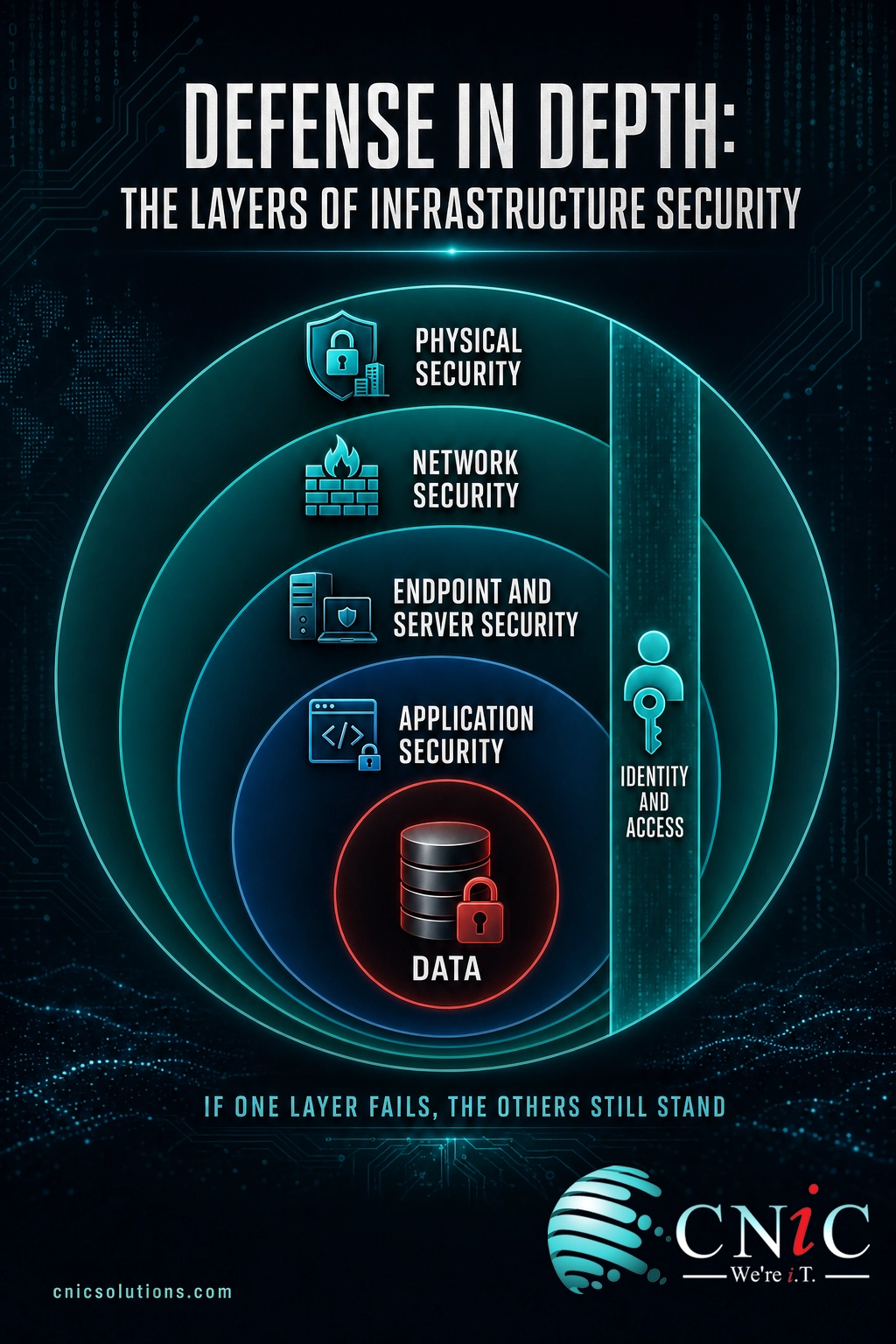
Infrastructure security works on a principle security professionals call defense in depth: instead of relying on one strong barrier, you stack multiple independent layers of protection so that if one fails, others still stand. The goal is not a single impenetrable wall but a series of controls that each slow an attacker down and increase the odds of catching them.
A useful analogy is how you protect a physical building. You do not rely only on the front door lock. You have a fence and gate at the perimeter, locked doors on individual rooms, a safe for the most valuable items, cameras and alarms watching for intruders, and keys issued only to the people who genuinely need them. Infrastructure security applies the same logic to your technology: perimeter defenses, internal segmentation, protected endpoints, encrypted data, continuous monitoring, and tightly controlled access.
In practice, that means a threat has to get past several layers to do real damage. A firewall filters traffic at the edge. Network segmentation prevents an intruder who gets in from moving freely. Endpoint protection guards individual devices. Access controls limit what any one account can reach. Monitoring watches for anything unusual. Each layer covers the gaps the others leave, and the combination is what makes the foundation genuinely resilient.
Source: CISA: Critical Infrastructure Security and Resilience
The Core Domains of Infrastructure Security
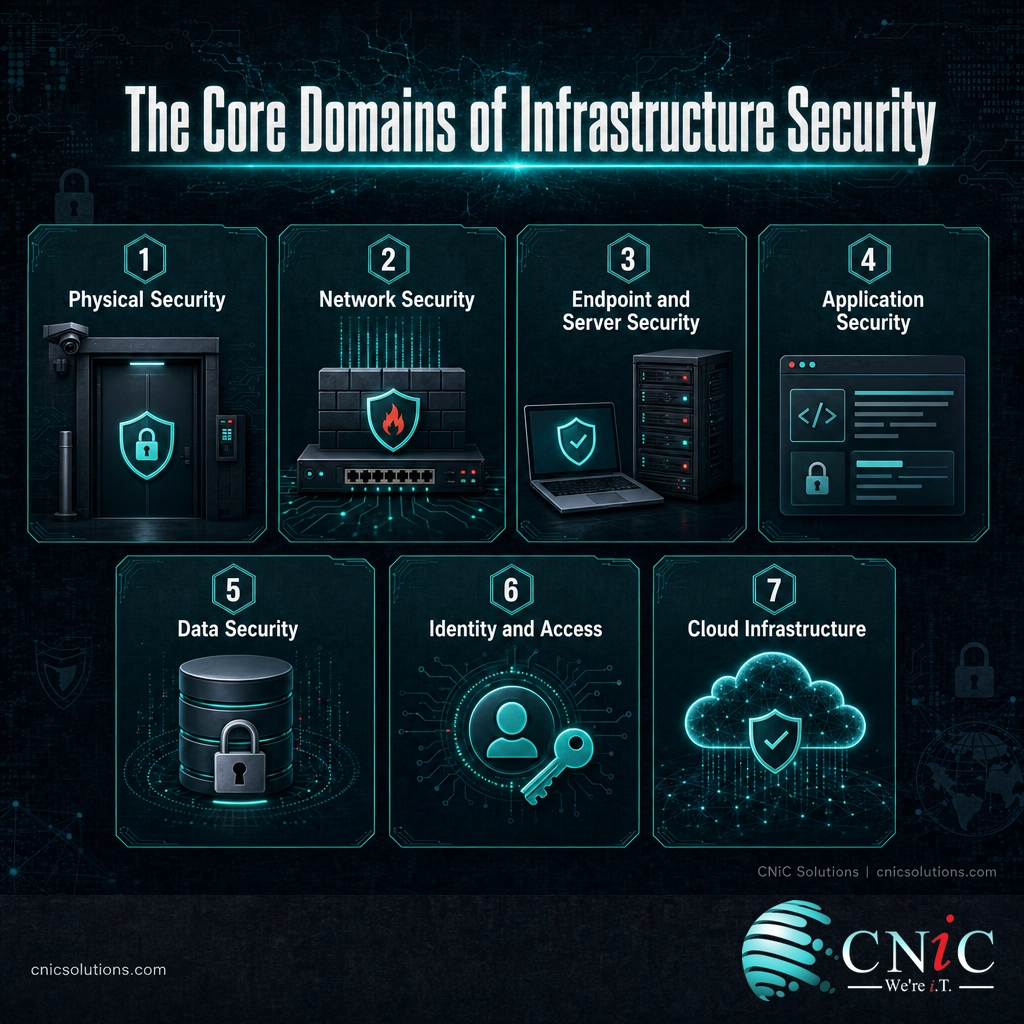
Infrastructure security is best understood as a set of connected domains, each protecting a different part of your technology foundation. A complete program addresses all of them, because a weakness in any one can undermine the rest.
Physical Security
The often-overlooked starting point. Servers, network equipment, and storage live somewhere physical, whether that is a server closet, an office, or a data center. Physical security covers locked facilities, access badges, surveillance, and environmental controls that keep hardware safe from theft, tampering, and disasters like fire or flooding.
Network Security
The controls that protect data as it moves and that govern what can connect to your systems. This includes firewalls, network segmentation, intrusion detection, secure Wi-Fi, and VPNs for remote access. It is the domain most people picture first when they think about security, and it remains central.
Endpoint and Server Security
Every laptop, desktop, phone, and server is a potential entry point. This domain covers keeping operating systems and software patched, running modern endpoint protection, hardening configurations, and removing unnecessary services that widen the attack surface.
Application Security
The software running on your infrastructure, from off-the-shelf tools to custom systems, must be secured and kept current. Unpatched applications are one of the most common ways attackers gain a foothold, which makes disciplined update and configuration management essential.
Data Security
Protecting the information itself through encryption, backups, and access restrictions, so that even if a system is compromised, the data on it is not readable or lost. Reliable, tested backups are what turn a potential catastrophe into a recoverable event.
Identity and Access Management
Controlling who can access what, and proving they are who they claim to be. This spans strong authentication, multi-factor authentication (MFA), and the principle of least privilege, giving each account only the access it genuinely needs. Compromised credentials are a leading cause of breaches, which makes this domain disproportionately important.
Cloud Infrastructure Security
As businesses move servers, applications, and storage to cloud platforms, security has to follow. Cloud infrastructure security covers correctly configuring cloud services, managing cloud identities and permissions, and understanding the shared-responsibility model, where the provider secures the platform but you remain responsible for how you use it.
Source: NIST: Cybersecurity Framework

Infrastructure Security vs. Cybersecurity
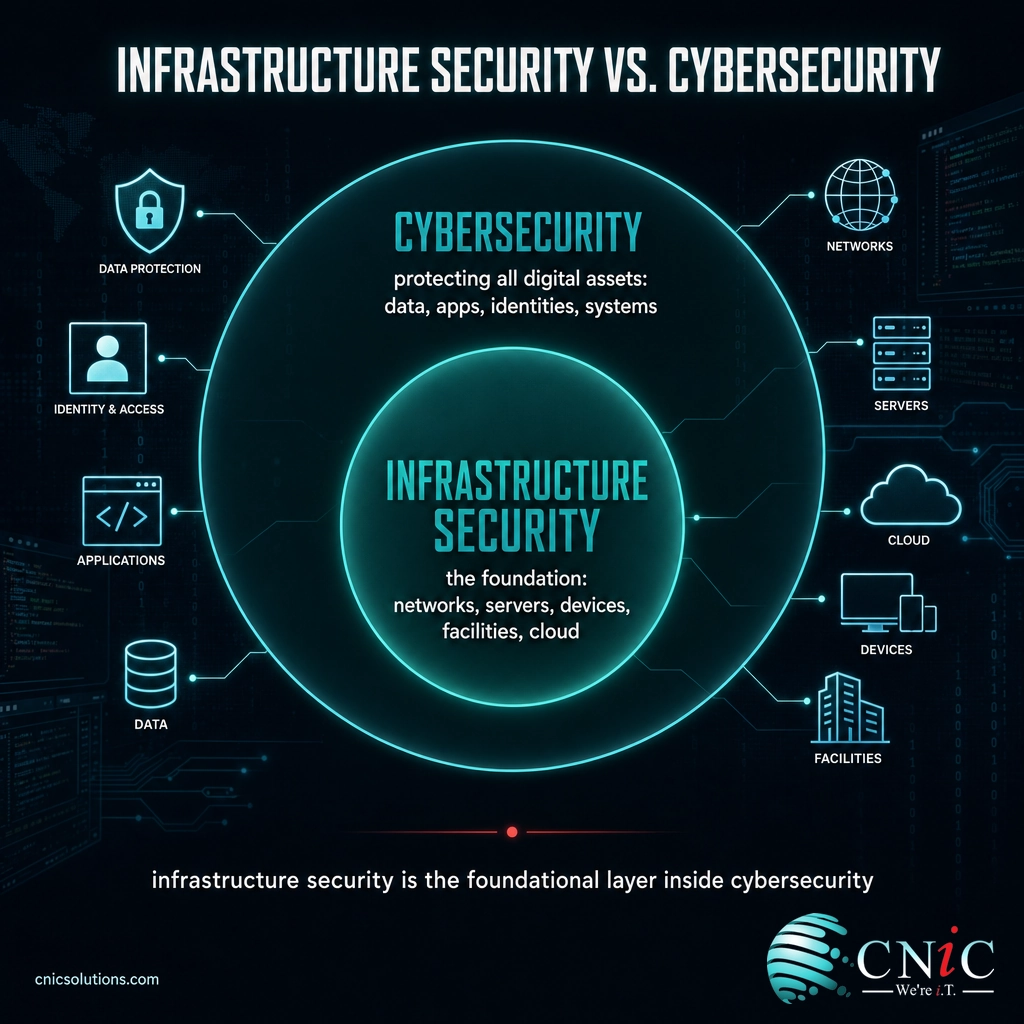
These two terms are used almost interchangeably, and the confusion is understandable, but the distinction is worth getting right. Cybersecurity is the broad discipline of protecting all of an organization’s digital assets, data, applications, identities, and systems, from threats. Infrastructure security is the foundational layer within that discipline: the protection of the underlying technology, networks, servers, devices, and facilities, that everything else runs on.
Put another way, infrastructure security is a critical part of cybersecurity, not a competitor to it. You cannot have effective cybersecurity if the infrastructure beneath it is exposed, and securing infrastructure without a wider security strategy leaves other assets unprotected. The two work together.
| Aspect | Infrastructure Security | Cybersecurity |
|---|---|---|
| Primary focus | The foundational systems: networks, servers, devices, facilities, cloud platforms | All digital assets: data, applications, identities, and the systems that use them |
| Scope | A specialized layer within cybersecurity | The overarching discipline that contains it |
| Core question | Is the foundation everything runs on protected and available? | Are we protected against digital threats across the whole organization? |
| Example controls | Firewalls, network segmentation, server hardening, physical access, backups | All of the left column, plus data governance, security awareness, incident response, and threat intelligence |
Myth: “We have a firewall and antivirus, so our infrastructure is secure.”
This is the single most common and most dangerous misconception. A firewall and antivirus are two controls in one or two domains. They do nothing for an unpatched server, a misconfigured cloud bucket, a stolen password with admin rights, an untested backup, or an unlocked server closet. Infrastructure security is layered by definition, and a program that stops at the perimeter leaves most of the foundation exposed. Real security comes from covering every domain and keeping each one current.
Source: CISA: Cybersecurity Best Practices
Why Infrastructure Security Matters for Your Business
Infrastructure is the layer where a security failure does the most damage, because everything else depends on it. When infrastructure is compromised, the consequences are rarely contained to one file or one user; they ripple across operations, finances, and reputation.
The financial exposure is real and rising. IBM’s research put the global average cost of a data breach at $4.88 million in 2024, a 10 percent increase over the prior year and the highest figure the report had recorded. For a small or midsize business, even a fraction of that can be existential, and much of that cost traces back to compromised infrastructure: servers, credentials, and networks.
The way attackers get in reinforces why layered infrastructure security matters. Verizon’s 2024 Data Breach Investigations Report found that 68 percent of breaches involved a human element, such as a mistake or a person being tricked, which is precisely why controls like least-privilege access, network segmentation, and monitoring are so important. They limit the damage when a single account or device is inevitably compromised.
The same report found that breaches beginning with the exploitation of a vulnerability grew roughly 180 percent year over year, nearly tripling. That surge lands squarely on infrastructure: it is unpatched servers, exposed services, and misconfigured systems that attackers exploit. Disciplined patching and configuration management, core infrastructure-security practices, are a direct defense against that trend.
Source: IBM: Cost of a Data Breach Report | Verizon: Data Breach Investigations Report
How to Get Started With Infrastructure Security
You do not need to solve every domain at once. A practical program is built in a sensible order, and most businesses can make meaningful progress by working through these steps.
- Inventory your assets. You cannot protect what you do not know you have. Start with a clear list of your servers, network devices, endpoints, applications, cloud services, and where sensitive data lives.
- Assess and prioritize risk. Identify which systems are most critical and most exposed, and where the biggest gaps are. An IT infrastructure audit is a structured way to do this.
- Harden the foundation. Patch systems, segment your network, enforce multi-factor authentication and least-privilege access, and lock down configurations across devices and cloud services.
- Protect your data. Encrypt sensitive information and put reliable, tested backups in place so you can recover quickly from an incident or ransomware.
- Monitor continuously. Security is not a one-time project. Ongoing monitoring, logging, and alerting are what catch problems while they are still small.
For the actionable, control-by-control version of these steps, see our companion guide to IT infrastructure security best practices, which walks through each safeguard in detail.
Get your infrastructure secured and managed
Why Infrastructure Security Is a Managed Discipline
The hardest part of infrastructure security is rarely turning on a single control. It is keeping every layer covered, current, and verified across an entire environment, month after month, as systems change and new threats emerge. A single unpatched server, one over-privileged account, or a backup no one has tested can undo an otherwise solid posture.
That is why many businesses treat infrastructure security as a managed discipline rather than a set of tools they install once. A managed cybersecurity partner deploys the controls across every domain, keeps them maintained, monitors continuously, and can prove the whole program holds up under a compliance audit. For businesses that want security aligned to a broader strategy rather than handled piecemeal, a Virtual CIO builds infrastructure security into overall technology planning.
The point is not that you cannot do this yourself. It is that infrastructure security rewards consistency and coverage, exactly the things that slip when it is one more responsibility on an already-full plate. Whether managed in-house or with a partner, the winning approach is the same: cover every domain, keep each one current, and verify rather than assume.
Talk to a managed cybersecurity team
Source: CISA: Cyber Essentials
Related Terms
- Network infrastructure: The hardware and software (routers, switches, cabling, firewalls) that connect an organization’s devices, users, and applications.
- IT infrastructure management: The operational discipline of keeping technology systems available, reliable, and performing well.
- Defense in depth: A strategy of layering multiple independent security controls so that no single failure exposes the whole system.
- Network segmentation: Dividing a network into isolated zones so an intruder in one area cannot move freely across the environment.
- Least privilege: Granting each user or account only the minimum access needed to do its job, limiting the blast radius of a compromise.
- Endpoint: Any device (laptop, phone, server) that connects to a network and can serve as an entry point for an attacker.
- Attack surface: The total set of points where an attacker could try to enter or extract data; reducing it is a core security goal.
Frequently Asked Questions
What is infrastructure security in simple terms?
What is the difference between infrastructure security and cybersecurity?
What are the main types of infrastructure security?
Why is infrastructure security important for small businesses?
How do I improve my business’s infrastructure security?
Sources
This guide grounds its definitions and best-practice framing in primary government and industry sources. The defense-in-depth model, critical-infrastructure framing, and best-practice guidance follow CISA (the U.S. Cybersecurity and Infrastructure Security Agency) and the NIST Cybersecurity Framework. The breach-cost figure is from IBM’s Cost of a Data Breach Report (2024). The human-element and vulnerability-exploitation figures are from Verizon’s 2024 Data Breach Investigations Report. Definitions of the security domains reflect established, standards-based concepts.
Primary and authoritative sources: CISA Critical Infrastructure Security and Resilience, NIST Cybersecurity Framework, IBM Cost of a Data Breach Report, Verizon Data Breach Investigations Report.



related posts
What Is Infrastructure as Code (IaC)? A Guide for Businesses
October 21, 2026Infrastructure as Code (IaC) is the practice of managing and provisioning IT infrastructure, such as servers,…
What Is GDPR? A Data Protection Compliance Guide for Businesses
October 20, 2026GDPR (the General Data Protection Regulation) is a European Union law that governs how organizations collect,…
What Is Homomorphic Encryption? A Simple Explanation
October 20, 2026Homomorphic encryption is a form of encryption that lets you perform calculations directly on encrypted data…
What Is FinOps? A Guide to Managing and Optimizing Cloud Costs
October 19, 2026FinOps is an operational framework and cultural practice for managing and optimizing cloud costs by bringing…