

Infrastructure as Code (IaC) is the practice of managing and provisioning IT infrastructure, such as servers, networks, and cloud resources, through machine-readable code files instead of manual setup. The code acts as a blueprint that builds the same environment every time, making infrastructure faster to deploy, easier to change, and far less error-prone.
For most of computing history, setting up infrastructure meant a person logging into a console and configuring each server, firewall, and storage volume by hand. That approach is slow, hard to repeat, and one typo away from an outage. Infrastructure as Code replaces the manual clicking with a written definition of exactly what your infrastructure should look like, so a tool can build it automatically and identically, whether you need one environment or fifty.
- IaC in one line: your servers, networks, and cloud resources are defined in code files, then built automatically from those files.
- Not the same as automation: automation is the goal; IaC is the specific, version-controlled method that gets you there.
- The business payoff: identical environments on demand, changes tracked in version control, and recovery measured in minutes rather than days.
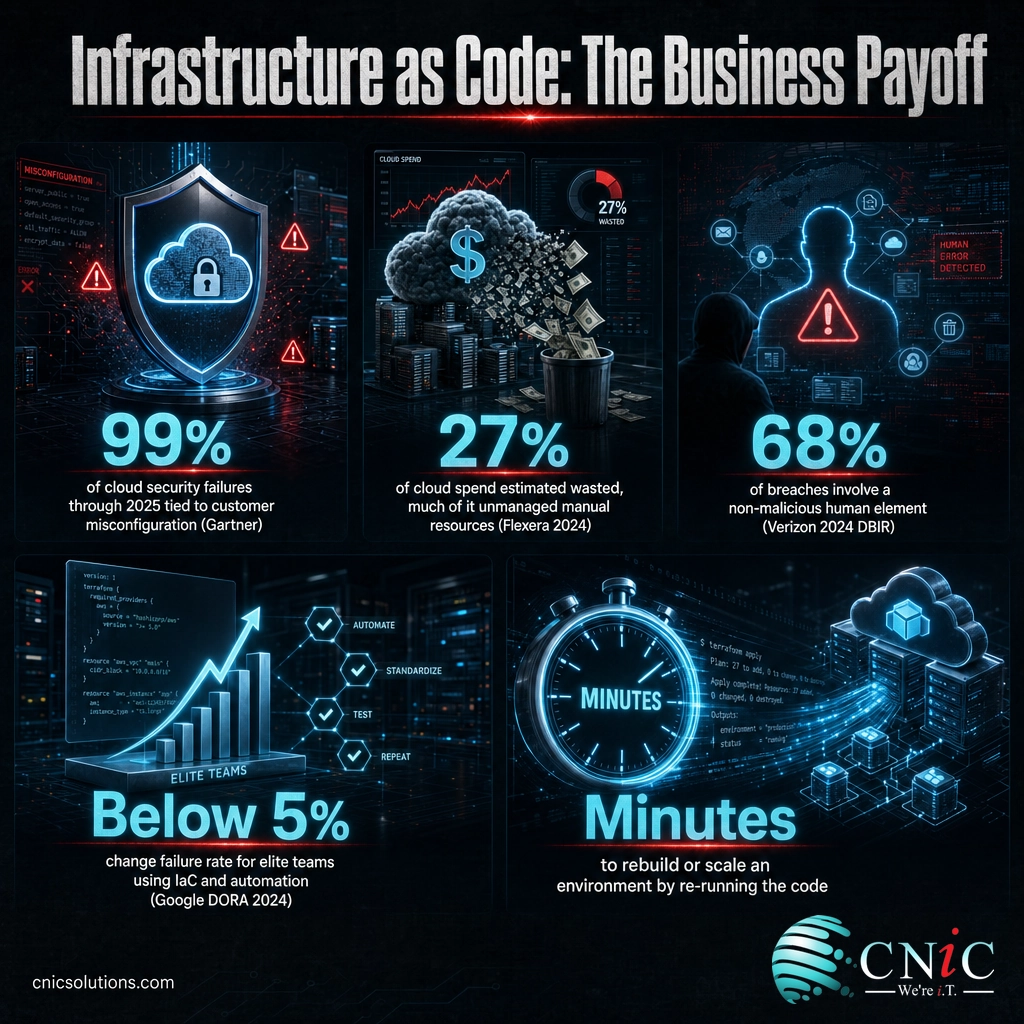
- Fewer costly mistakes: Gartner attributes 99% of cloud security failures through 2025 to customer misconfiguration, exactly the human error IaC is built to prevent.
- You do not need a big team: small and midsize businesses gain the most, and a managed IT partner can run IaC for you.
What’s in This Guide
- How Infrastructure as Code Works
- Infrastructure as Code vs. Manual Configuration
- Declarative vs. Imperative: The Two Approaches
- Why Infrastructure as Code Matters for Your Business
- Common Infrastructure as Code Tools
- How to Get Started with Infrastructure as Code
- Common Questions About Infrastructure as Code
- Related Terms
How Infrastructure as Code Works
Think of Infrastructure as Code the way an architect thinks of a blueprint. A builder does not measure and guess each time a house goes up. They follow a precise plan, and any builder using that same plan produces the same house. IaC gives your infrastructure that blueprint: a text file that spells out every server, network setting, and cloud resource you want, so any tool reading it produces the same result.
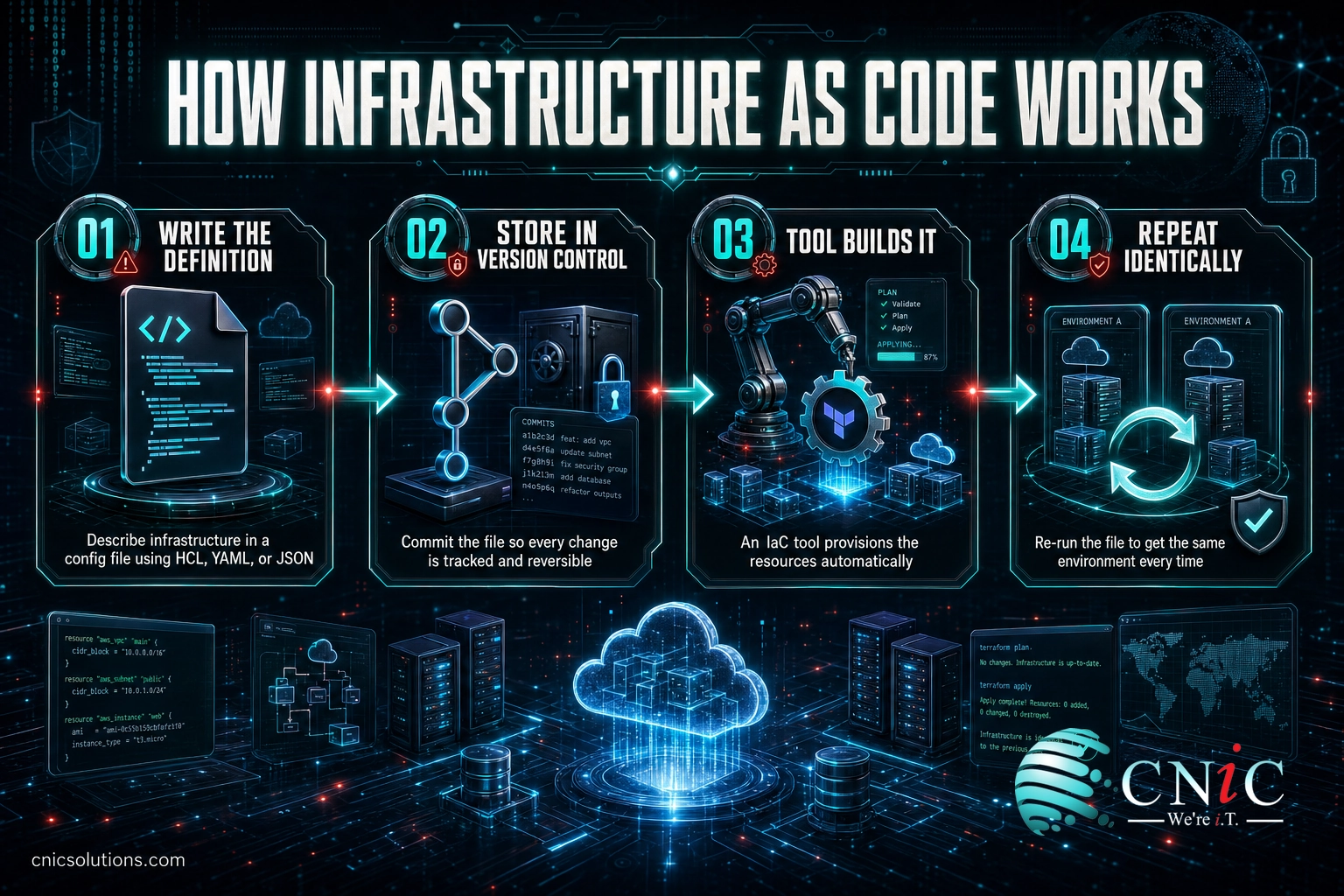
In practice, the process follows four repeatable steps:
- Write the definition. An engineer describes the desired infrastructure in a configuration file using a language such as HCL, YAML, or JSON. The file lists what should exist, for example two web servers, a database, and a firewall rule, rather than the click-by-click steps to create them.
- Store it in version control. The file is committed to a version control system like Git. Now every change is tracked, reviewable, and reversible, the same way software teams manage application code.
- Let the tool build it. An IaC tool reads the file and provisions the resources automatically against your cloud or on-premise platform. No console clicking, no missed steps.
- Repeat with confidence. Need an identical test environment, a second region, or a full rebuild after an incident? Run the same file again and get an identical result every time.
Because the definition lives in a file rather than in one person’s memory, your infrastructure becomes documented, shareable, and auditable by default. This is the same discipline that underpins broader infrastructure automation for IT teams, applied specifically to how the environment itself is defined and built.
Source: AWS: What is Infrastructure as Code | Microsoft Learn IaC overview
Infrastructure as Code vs. Manual Configuration
The clearest way to understand IaC is to compare it with the manual, or “click-ops,” approach it replaces. Both can produce a working server. Only one produces a working server you can rebuild on demand, hand to a teammate, and audit later.
| Consideration | Manual Configuration | Infrastructure as Code |
|---|---|---|
| Speed to deploy | Hours or days of hands-on setup | Minutes, run automatically from a file |
| Consistency | Drifts over time as people make one-off changes | Identical every time the file runs |
| Documentation | Lives in one person’s head or a stale wiki | The code is the documentation |
| Change tracking | Hard to know who changed what, when | Every change recorded in version control |
| Disaster recovery | Rebuild by hand under pressure | Re-run the file to restore the environment |
| Error risk | High: one typo or skipped step causes outages | Low: tested code applied the same way each time |
Myth: “IaC is only for big tech companies and DevOps engineers.” This is the most common misconception, and it keeps smaller businesses stuck with fragile manual setups. IaC is a discipline, not a headcount. A five-person office running a handful of cloud servers gains the same repeatability and recovery speed a large enterprise does, and a managed IT provider can own the entire practice so no in-house engineer is required. The businesses that benefit most from consistency are often the ones with the least room to absorb an outage.
One point of confusion is worth clearing up directly: IaC, infrastructure automation, and configuration management are related but not identical. Infrastructure automation is the broad objective of removing manual effort. Configuration management focuses on maintaining the settings on servers that already exist. Infrastructure as Code is specifically about defining and provisioning the infrastructure itself from code. For the wider picture of how these pieces fit together, see our guide to what IT infrastructure management involves.
Source: Red Hat: What is Infrastructure as Code | HashiCorp: What is Infrastructure as Code
Declarative vs. Imperative: The Two Approaches
IaC tools generally follow one of two styles, and knowing the difference helps when you evaluate options.
Declarative (the “what”)
You describe the end state you want, and the tool figures out how to get there. If you declare “three web servers,” the tool checks what exists and creates only what is missing to match. Terraform, AWS CloudFormation, and Azure Bicep are declarative. This approach is popular for infrastructure because the file always reflects the intended final state, making it easy to read and safe to re-run.
Imperative (the “how”)
You specify the exact sequence of commands to reach the desired state, step by step. This gives fine-grained control but requires you to account for the current state yourself. Some tools, including Ansible, can operate in a largely imperative or procedural style, which suits configuration tasks and orchestration well.
Which should a business choose? Most organizations start with a declarative tool for provisioning core infrastructure because it is forgiving and self-documenting, then add configuration tooling where step-by-step control is genuinely needed. The right mix depends on your platforms and goals, which is where a Virtual CIO advisory earns its keep by matching the toolset to the business, not the other way around.

Why Infrastructure as Code Matters for Your Business
The value of IaC is not abstract. It maps directly to the three risks that cost businesses money: downtime, wasted spend, and preventable security failures.
It prevents the misconfigurations behind most cloud breaches
The single biggest cloud security risk is not a hacker outsmarting your provider, it is a resource left misconfigured by mistake. Gartner has projected that through 2025, 99% of cloud security failures will be the customer’s fault, most often due to misconfiguration. Because IaC applies reviewed, tested definitions the same way every time, it removes the ad-hoc human changes that create those gaps.
It curbs the wasted spend that quietly grows in the cloud
Manual, one-off cloud setups accumulate forgotten resources and oversized instances. Flexera’s 2024 State of the Cloud report estimates that 27% of cloud spend is wasted. IaC makes resources explicit, consistent, and easy to tear down, so you provision what you actually need and decommission cleanly.
It reduces the human error behind most incidents
People are fallible, especially under pressure. Verizon’s 2024 Data Breach Investigations Report found that 68% of breaches involved a non-malicious human element, such as an error or someone falling for social engineering. Codifying infrastructure into reviewed files removes a large share of the manual, error-prone steps that lead to exposure.
It measurably improves stability
Teams that adopt cloud-native practices like IaC and automation are more reliable, not just faster. Google’s 2024 DORA research reports that elite-performing teams now hold a change failure rate below 5%, down from below 15% four years earlier, a stability gain driven by exactly this kind of disciplined, automated delivery.
Change Failure Rate: Elite-Performing Teams
Source: Google DORA Accelerate State of DevOps Report 2024. Lower is better.
These gains compound with sound scalable infrastructure planning: when the environment is defined in code, growing from one region to three is a change to a file, not a months-long project.
Explore CNiC Infrastructure Management
Source: Gartner on cloud security responsibility | Flexera 2024 State of the Cloud | Verizon Data Breach Investigations Report | Google DORA 2024 report
Common Infrastructure as Code Tools
You do not need to master these tools yourself, but knowing the landscape helps you ask the right questions of any IT partner. Each links to its official source.
- Terraform (HashiCorp): The most widely used IaC tool. It is declarative and cloud-agnostic, meaning one workflow can manage AWS, Azure, Google Cloud, and more, which avoids locking you into a single vendor.
- AWS CloudFormation: Amazon’s native IaC service for provisioning AWS resources. A natural fit for businesses committed to the AWS ecosystem.
- Azure Bicep: Microsoft’s declarative language for deploying Azure resources with cleaner syntax than raw templates.
- Pulumi: Lets teams define infrastructure using familiar programming languages such as Python, TypeScript, and Go rather than a dedicated configuration language.
- Red Hat Ansible: Strong for configuration management and orchestration, often paired with a provisioning tool to handle server setup after infrastructure exists.
The right choice depends on your cloud platforms, team skills, and growth plans. For businesses without a dedicated platform team, the practical answer is usually to let a managed IT team select, implement, and maintain the toolset.
Source: Microsoft Learn: What is Infrastructure as Code | AWS: What is IaC
How to Get Started with Infrastructure as Code
Adopting IaC is a shift in habit more than a giant project. A sensible rollout looks like this:
- Inventory what you have. Document your current servers, networks, and cloud resources. You cannot codify what you have not mapped. An infrastructure audit is the natural starting point.
- Pick one small, low-risk environment. Start with a test or staging environment rather than production. Codify it, run it, and confirm the tool reproduces it exactly.
- Put everything in version control. Store definitions in Git from day one so every change is reviewed and reversible.
- Standardize and expand. Once the pattern proves out, extend it to production and additional environments, building a library of reusable definitions.
- Govern it. Establish who reviews changes, how they are approved, and how security is checked, so IaC strengthens control rather than bypassing it.
The realistic path for most businesses: partner rather than hire. Building in-house IaC expertise is expensive and slow. A managed provider brings proven patterns, handles the tooling, and folds IaC into your broader infrastructure strategy from the start. That is precisely the model CNiC uses to keep client environments consistent, recoverable, and secure.
Talk to CNiC About Cloud Solutions
Common Questions About Infrastructure as Code
What is Infrastructure as Code in simple terms?
Is Infrastructure as Code the same as automation?
What are the main benefits of Infrastructure as Code?
What tools are used for Infrastructure as Code?
Do small businesses need Infrastructure as Code?
Related Terms
- Infrastructure automation: The broad practice of removing manual effort from infrastructure operations; IaC is one method within it.
- IT infrastructure management: The processes and tools used to monitor, maintain, and optimize the technology systems a business runs on.
- Cloud computing: Delivering computing resources over the internet, the environment IaC most often provisions.
- Infrastructure lifecycle management: Managing infrastructure from planning and provisioning through retirement.
- Cloud vs. on-premise: The choice between hosting infrastructure in the cloud or in your own facility, both of which IaC can define.
- Version control: A system such as Git that tracks every change to files, giving IaC its audit trail and rollback ability.
- Provisioning: The act of creating and configuring infrastructure resources, which IaC automates from a definition file.
Sources & Methodology
This guide draws on primary vendor documentation and industry research current as of 2026. Definitions are grounded in the official IaC references published by AWS, Microsoft, Red Hat, and HashiCorp. Statistics are drawn from Tier 1 sources and cited inline at each claim.
- AWS: What is Infrastructure as Code (IaC)
- Microsoft Learn: What is Infrastructure as Code
- Red Hat: What is Infrastructure as Code (IaC)
- Gartner: Is the Cloud Secure? (99% customer-fault projection)
- Flexera 2024 State of the Cloud Report (27% wasted cloud spend)
- Verizon 2024 Data Breach Investigations Report (68% human element)
- Google DORA Accelerate State of DevOps Report 2024



related posts
What Is Infrastructure Security? A Guide for Businesses
October 21, 2026Infrastructure security is the practice of protecting the core technology systems a business runs on: its…
What Is GDPR? A Data Protection Compliance Guide for Businesses
October 20, 2026GDPR (the General Data Protection Regulation) is a European Union law that governs how organizations collect,…
What Is Homomorphic Encryption? A Simple Explanation
October 20, 2026Homomorphic encryption is a form of encryption that lets you perform calculations directly on encrypted data…
What Is FinOps? A Guide to Managing and Optimizing Cloud Costs
October 19, 2026FinOps is an operational framework and cultural practice for managing and optimizing cloud costs by bringing…