

Agentic AI security is the practice of protecting autonomous AI agents, the tools they control, and the data they touch from misuse, manipulation, and attack. Because an agent can act on its own rather than just answer questions, it introduces new risks such as prompt injection, tool misuse, and machine identity sprawl that traditional security was never built to catch.
The AI most businesses first met was a chatbot: you asked, it answered, nothing happened until you acted. Agentic AI is different. It is given a goal and the keys to get there, so it can send the email, update the record, or move the file on its own. That autonomy is genuinely useful, and it is also a new attack surface. When software can take action without a person clicking the button, a single manipulated instruction can turn a helpful agent into a fast, tireless insider threat. This guide explains what agentic AI security is, where the real risks live, and the practical controls that keep an autonomous agent working for you instead of against you.
- An agent acts, a chatbot answers. The defining feature of agentic AI, autonomy, is exactly what creates the security problem: mistakes and manipulations become actions, not just wrong answers.
- Prompt injection is the signature attack. Hiding malicious instructions in text an agent reads is ranked the number one risk to LLM applications in the OWASP Top 10 for LLM Applications (2025).
- Excessive agency is the risk you control. Giving an agent more access or autonomy than the job requires is a named OWASP top-ten risk, and it is the one most within your power to fix.
- Adoption is running ahead of governance. Stanford’s 2025 AI Index found 78% of organizations used AI in 2024, up from 55% a year earlier, while security controls for autonomous agents are still catching up.
- The fix is old discipline applied to new software. Least privilege, human-in-the-loop approval, full logging, and a recognized governance framework turn agentic AI from a liability into a managed tool.
What’s in This Guide
How Agentic AI Works
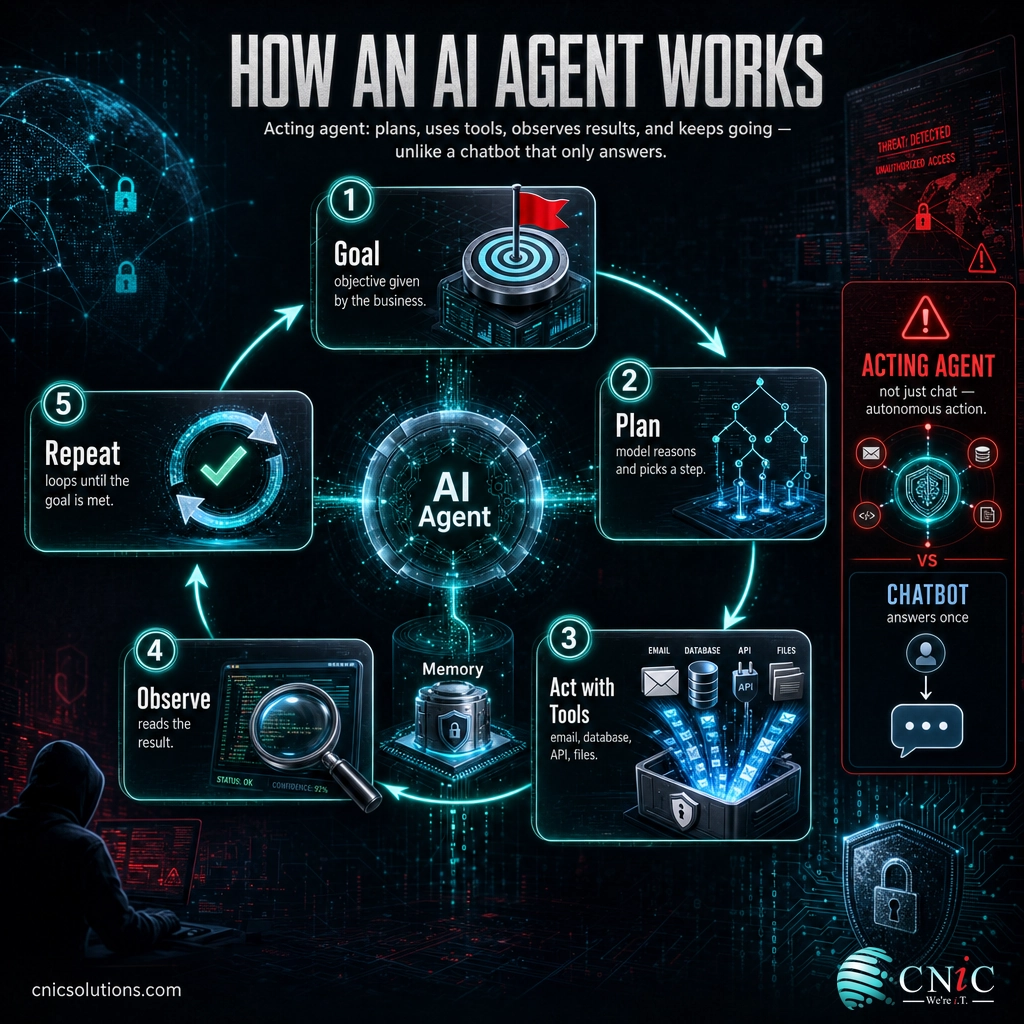
Agentic AI is software built around a large language model that is allowed to pursue a goal by taking a series of actions, not just producing text. Instead of returning an answer and stopping, an agent breaks a goal into steps, decides what to do next, uses tools to do it, checks the result, and repeats until the job is done. The plain-English version is a loop:
- Goal. You give the agent an objective, for example “reconcile these invoices” or “triage new support tickets.”
- Plan. The model reasons about how to reach the goal and picks the first step.
- Act with tools. The agent calls a tool, such as a database query, an email send, an API, or a file operation, to actually do something in the real world.
- Observe. It reads what happened and updates its plan.
- Repeat. It loops through act and observe, often with a memory of earlier steps, until the goal is met.
Think of the difference between a reference librarian and a new employee. A librarian tells you where the file is (that is generative AI answering a question). A new employee is handed a login, a goal, and a company credit card, then sent off to get the task done on their own (that is agentic AI). The employee is far more useful, and far more capable of causing damage if they are tricked, careless, or given more access than the role requires.
The two capabilities that make an agent powerful, tools and autonomy, are also the two that create the security problem. A chatbot that gives a bad answer wastes a minute. An agent with tool access that follows a bad instruction can email a customer list to a stranger before anyone notices.
Source: NIST AI Risk Management Framework | OWASP Top 10 for LLM Applications
Agentic AI vs Generative AI
The most common point of confusion is treating agentic AI and generative AI as the same thing with a new name. They are not. Generative AI produces content: text, images, summaries, code. Agentic AI uses that same underlying intelligence to act: to make decisions and carry them out across your systems. Every agentic AI contains a generative model, but not every generative tool is an agent. The table below shows why the distinction matters for security.
| Attribute | Generative AI (chatbot) | Agentic AI (agent) |
|---|---|---|
| What it does | Produces an answer or content when asked | Pursues a goal by taking a series of actions |
| Human role | Human reads and decides what to do next | Agent decides and acts, often with limited oversight |
| System access | Usually none, it only returns text | Tools, APIs, files, email, databases, accounts |
| Worst-case mistake | A wrong or misleading answer | A wrong or malicious action in a live system |
| Security question | Is the output accurate and appropriate? | What can this thing do, and who verified it? |
The right-hand column is the whole reason agentic AI security exists as its own discipline. With a chatbot, the security question is about the quality of an answer. With an agent, the question becomes “what is this software authorized to do in my environment, and what stops it from doing the wrong thing?” That shifts the problem from content safety to access control, identity, and monitoring, the same concerns you already have for a human employee or a service account.
Myth: securing agentic AI is just filtering bad prompts. Input filtering helps, but it is a fraction of the job. An agent’s real risk lives in what it can do after it accepts an instruction: which systems it can reach, which actions it can take, and whether a human ever reviews the high-stakes ones. Treating agentic AI security as a chatbot content filter leaves the actual attack surface, tools and permissions, wide open.
Source: OWASP Agentic Security Initiative, Agentic AI Threats and Mitigations
The New Security Risks of Agentic AI
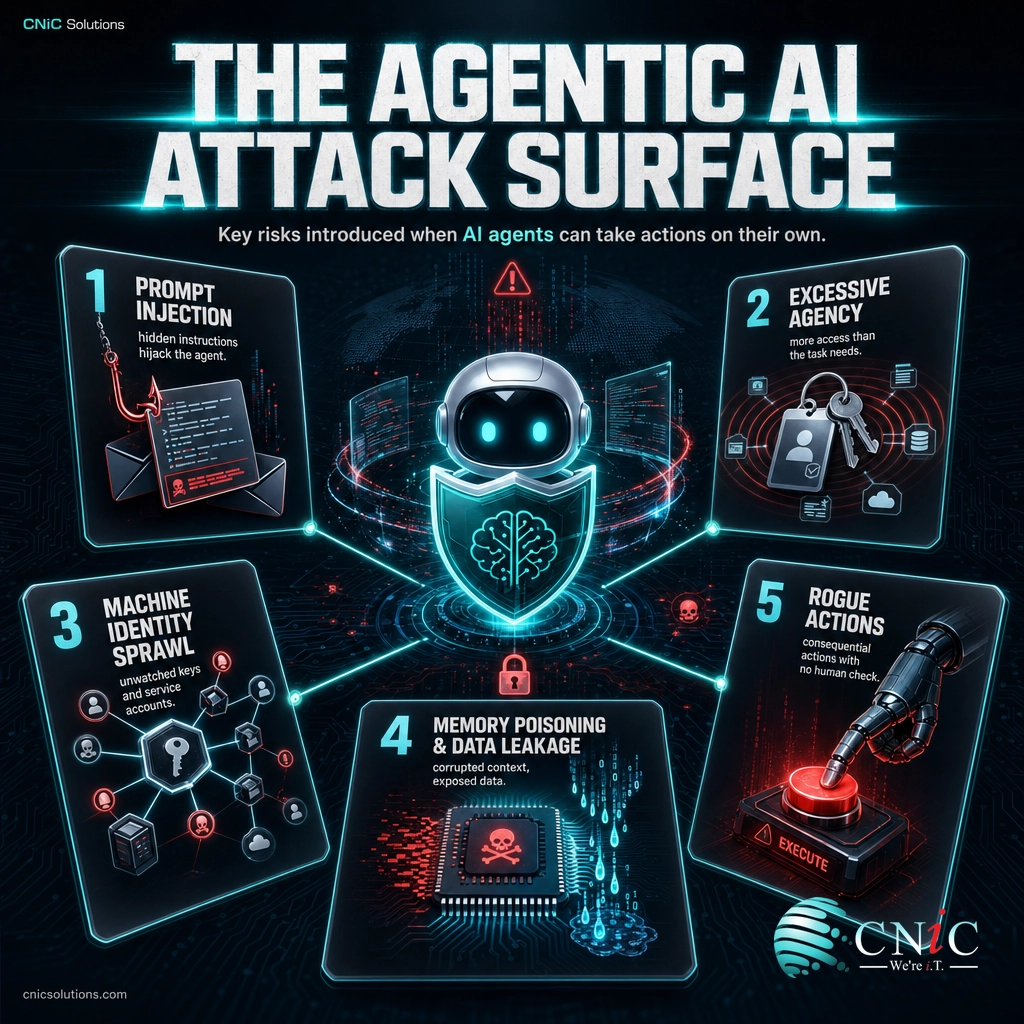
The risks below are not hypothetical edge cases. They are the categories security researchers have organized into formal references, including the OWASP Top 10 for LLM Applications and the OWASP Agentic Security Initiative’s threat guidance. Here are the ones a business owner should understand.
1Prompt Injection
Prompt injection is the signature vulnerability of anything built on a language model. The attacker hides instructions inside text the AI will read, and the model, which cannot reliably tell “content to process” apart from “commands to follow,” obeys them. It comes in two forms. Direct injection is a user typing a manipulative instruction. Indirect injection is more dangerous for agents: the malicious instruction is planted in a document, a web page, an email, or a support ticket that the agent later reads while doing its job. An agent asked to “summarize this webpage” can be hijacked by hidden text on that page telling it to forward internal data instead.
Prompt injection is also recognized in the U.S. government’s adversarial machine learning taxonomy, which catalogs direct and indirect prompt injection among the attack techniques defenders need to plan for. Because an agent acts on what it reads, injection is not just a way to get a bad answer, it is a way to trigger a bad action.
2Excessive Agency and Tool Misuse
Excessive agency is what happens when an agent is given more capability, permission, or autonomy than its task actually requires. It is its own entry in the OWASP Top 10 for LLM Applications, and it is the risk most within your control. If an agent that only needs to read a calendar is also able to delete files, send payments, or change user permissions, then any successful manipulation, or even an honest model mistake, can reach far beyond the intended job. Tool misuse is the same idea from the attacker’s side: turning the agent’s own legitimate tools against the business.
3Machine Identity Sprawl
Every agent, and often every tool it uses, needs an identity and credentials to log in to your systems. These non-human identities, API keys, tokens, and service accounts, tend to multiply quickly and get watched far less closely than employee logins. An over-permissioned, long-lived credential attached to an autonomous agent is a quiet, high-value target: it does not sleep, it does not get suspicious, and it may hold standing access to production systems. Managing these machine identities with the same rigor as human accounts is a core part of agentic AI security.
4Memory Poisoning and Data Leakage
Many agents keep a memory of past steps and conversations to stay effective. That memory is also something an attacker can corrupt. Memory poisoning slips false information or hidden instructions into what the agent “remembers,” so it acts on tainted context later. Data leakage is the flip side: an agent with broad access can be coaxed into revealing sensitive information, or can include it in an output that goes somewhere it should not. For a business in a regulated field like healthcare, finance, or legal, an agent that quietly exposes protected records is both a security incident and a compliance problem.
5Rogue Actions and Weak Human Oversight
The failure that ties the others together is an agent taking a consequential action with no human check. Autonomy is the feature, but full autonomy over irreversible actions, sending money, deleting data, changing access, publishing content, is where a single bad decision becomes a real loss. The defense is not to abandon autonomy, but to decide in advance which actions an agent can take alone and which require a person to approve.
Source: OWASP Top 10 for LLM Applications | NIST AI 100-2e2025, Adversarial Machine Learning taxonomy

Why Agentic AI Security Matters for Your Business
Two things are true at once: AI adoption is accelerating, and the controls for autonomous agents are still maturing. That gap is exactly where risk concentrates.
For a small or midsize business, the exposure rarely comes from building a custom agent from scratch. It arrives quietly, bundled into software you already pay for: a help desk tool that can now “resolve tickets automatically,” an accounting platform that can “act on invoices,” a marketing suite that can “run campaigns on its own.” Each of those is an agent with access to your data and the ability to act on it. Turning the feature on is a business decision with a security consequence, and often no one owns that decision.
The stakes scale with what the agent can reach. An agent limited to drafting text is low risk. An agent wired into your email, your customer database, your bank feed, or your cloud console can cause damage at machine speed if it is manipulated. This is the same logic behind a cybersecurity risk assessment: you cannot protect what you have not inventoried, and most businesses have not yet inventoried where autonomous AI already touches their systems.
There is also a hard compliance edge. If an agent handles records covered by HIPAA, PCI-DSS, or SOC 2 obligations, then its access, its logging, and its decision to act are all in scope. “The AI did it” is not a defense a regulator accepts. Treating agentic AI as a governed system, with an owner, a policy, and an audit trail, is what keeps an efficiency gain from becoming a reportable breach.
Get a Free Security Assessment
How to Get Started Securing Agentic AI
You do not need a research lab to secure agentic AI. The controls are disciplined versions of security practices you already know, applied to a new kind of user, one that happens to be software. Start here.
- Inventory where agents already act. List every tool that can take an action on its own, and what each one can reach. Most businesses find more than they expected once they look.
- Apply least privilege. Give each agent the minimum access its task requires, and nothing more. This is the single most effective defense against excessive agency, and it limits the blast radius of any successful prompt injection.
- Keep a human in the loop for high-impact actions. Decide in advance which actions an agent may take alone (draft a reply) and which need a person to approve (send a payment, delete data, change permissions).
- Log everything the agent does. Full, reviewable records of every action are how you detect misuse, investigate an incident, and prove compliance. An agent you cannot audit is one you cannot trust.
- Manage machine identities like human ones. Rotate credentials, scope them tightly, and monitor the non-human accounts your agents use with the same attention you give employee logins.
- Govern it under a recognized framework. The NIST AI Risk Management Framework gives you a voluntary, business-friendly structure for mapping, measuring, and managing AI risk, including for autonomous systems.
For most small and midsize businesses, the practical answer is not hiring a dedicated AI security team. It is folding agentic AI into the security governance you already have, or should have. That is where an outside advisor earns its keep: a virtual CISO or virtual CIO can set the policy, define which actions need human approval, and put the logging and identity controls in place, so you can adopt AI’s efficiency without inheriting its risk blindly.
Talk to a Virtual CIO About AI Governance
Common Questions About Agentic AI Security
What is agentic AI security?
How is agentic AI different from a chatbot?
What is prompt injection?
What is the biggest risk of agentic AI for businesses?
How do you secure an AI agent?
Related Terms
- Prompt injection: the top-ranked LLM attack, where hidden instructions in text hijack an AI’s behavior.
- Excessive agency: giving an AI agent more permissions, functionality, or autonomy than its task requires, a named OWASP top-ten risk.
- Generative AI: AI that produces content such as text or images when prompted, the underlying model an agent uses to reason.
- Bots: automated software that performs tasks online. Learn the difference between good bots, bad bots, and how to defend against them.
- Machine identity: the credentials and accounts that non-human software, including AI agents, use to access systems.
- Human-in-the-loop: a control that requires a person to review or approve an agent’s high-impact actions before they happen.
- Cybersecurity risk assessment: the process of inventorying and rating your risks, including where autonomous AI touches your systems. See what a risk assessment covers and why you need one.
- Virtual CISO (vCISO): an outsourced security leader who can own AI governance and policy. Learn whether your business needs a vCISO.
About This Guide
Risk categories in this article are drawn from published security references rather than opinion. Prompt injection and excessive agency are documented in the OWASP Top 10 for LLM Applications (2025), maintained by the OWASP GenAI Security Project, and agentic-specific threats are covered by the OWASP Agentic Security Initiative’s “Agentic AI Threats and Mitigations.” Prompt injection is also cataloged in NIST’s Adversarial Machine Learning taxonomy (NIST AI 100-2e2025). The governance approach references the NIST AI Risk Management Framework (NIST AI 100-1). The AI adoption figure is from Stanford HAI’s 2025 AI Index Report. Figures are cited to their original sources and used to illustrate the nature of the risks, not as guaranteed outcomes for any specific business.
Sources: OWASP Top 10 for LLM Applications | OWASP Agentic AI Threats and Mitigations | NIST AI 100-2e2025, Adversarial Machine Learning | NIST AI Risk Management Framework | Stanford HAI, 2025 AI Index Report
Get a Free Consultation on Securing Your AI



related posts
What Is a Hypervisor? Types and How They Work
October 7, 2026A hypervisor is software that lets a single physical computer run many separate virtual machines at…
What Is a Load Balancer? How It Keeps Applications Fast and Reliable
October 7, 2026A load balancer is a device or piece of software that sits in front of your…
What Is a Human Firewall? Turning Employees Into Your Best Defense
October 6, 2026A human firewall is the group of employees who, through security awareness and good habits, act…
What Is a Firmware Update and Why It Matters for Security
October 6, 2026A firmware update is a manufacturer-issued revision to the low-level software built into a device, such…