

A human firewall is the group of employees who, through security awareness and good habits, act as an organization’s first line of defense against cyberattacks. Instead of relying on technology alone, it turns every person who spots a phishing email, verifies an unusual request, or reports something suspicious into active protection for the business.
You can spend heavily on firewalls, email filtering, and endpoint protection and still get breached by a single employee clicking one convincing email. That is not a technology failure. It is the reason the idea of a “human firewall” exists. Modern attackers have learned that the easiest way past strong defenses is not to break the technology, it is to trick a person. This guide explains what a human firewall actually is, how it works alongside your technical defenses, why the data makes it one of the highest-return investments in security, and the practical steps to build one in a small or midsize business.
Key Takeaways
- A human firewall is your people acting as security defenders, not a product you buy.
- Attackers target humans on purpose. Roughly 60% of breaches involve a human element (Verizon 2025 DBIR).
- It complements technology, it does not replace it. Technical controls and trained people cover each other’s blind spots.
- It is built through ongoing training, phishing simulations, easy reporting, and culture, not a single annual video.
- A no-blame reporting culture is the difference between a mistake that is caught in minutes and one that becomes a breach.
What’s in This Guide
What a Human Firewall Is
A human firewall is a way of describing the people in an organization who are trained and motivated to defend it against cyber threats. The term borrows from the technical firewall, the system that inspects network traffic and blocks what does not belong. A human firewall does the same job for the threats that arrive through people: the phishing email, the fake invoice, the urgent text from the “CEO,” the phone call from someone pretending to be IT support.
The concept exists because a large share of attacks are aimed squarely at human judgment rather than technical weaknesses. The U.S. Cybersecurity and Infrastructure Security Agency (CISA) identifies phishing and other social-engineering techniques as one of the most common ways attackers gain their first foothold in a network. Those attacks are engineered to look legitimate and to create pressure, so no filter catches every one. The last line of defense is a person deciding whether to click, approve, or report. A human firewall is what makes that decision reliably go the right way.
It is worth being precise about what a human firewall is not. It is not a piece of software, and it is not a replacement for security tools. It is a capability you build in your workforce, so that alertness, healthy skepticism, and quick reporting become the normal way people handle anything that looks off.
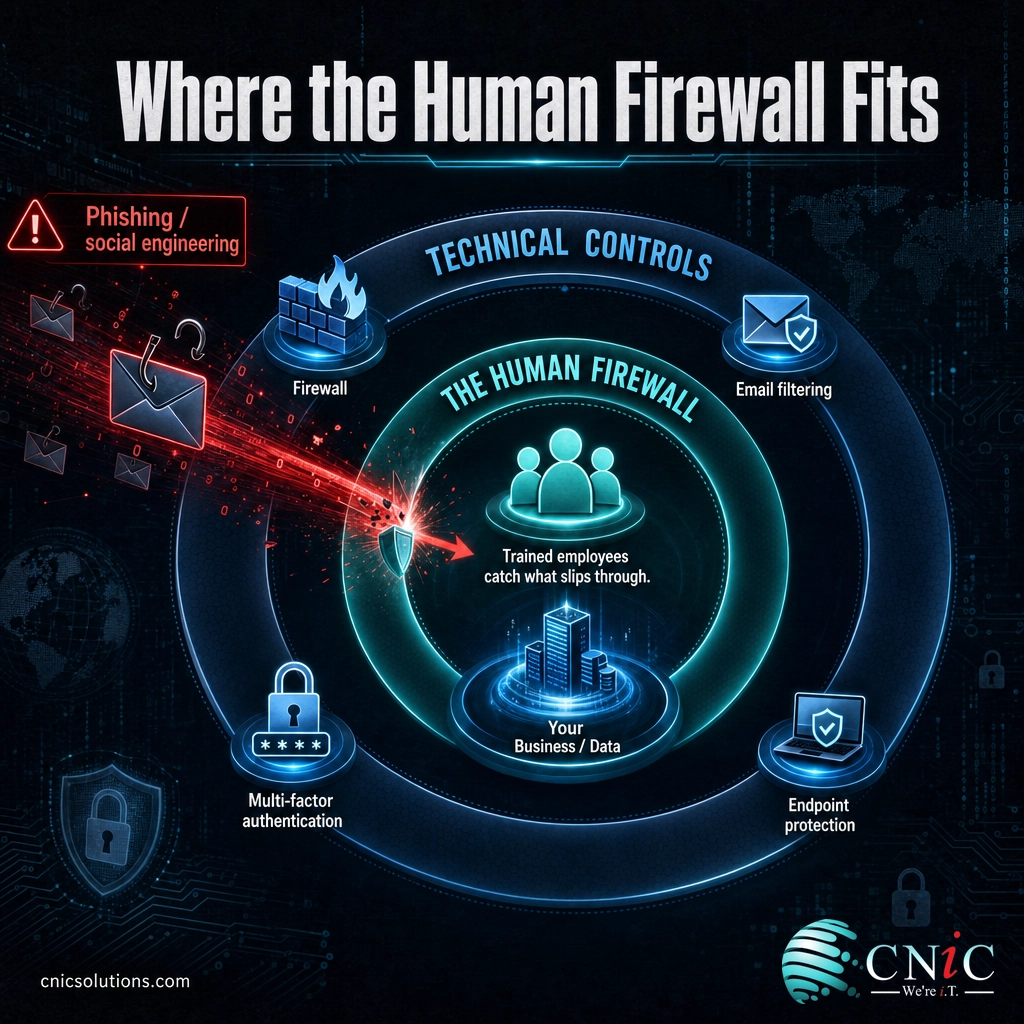
How a Human Firewall Works
Think of your defenses as layers. Technical controls (firewalls, spam filtering, multi-factor authentication, endpoint protection) form the outer layers and stop the large volume of automated, obvious attacks. But some threats are built specifically to pass through those layers by targeting a person. That is where the human layer does its work.
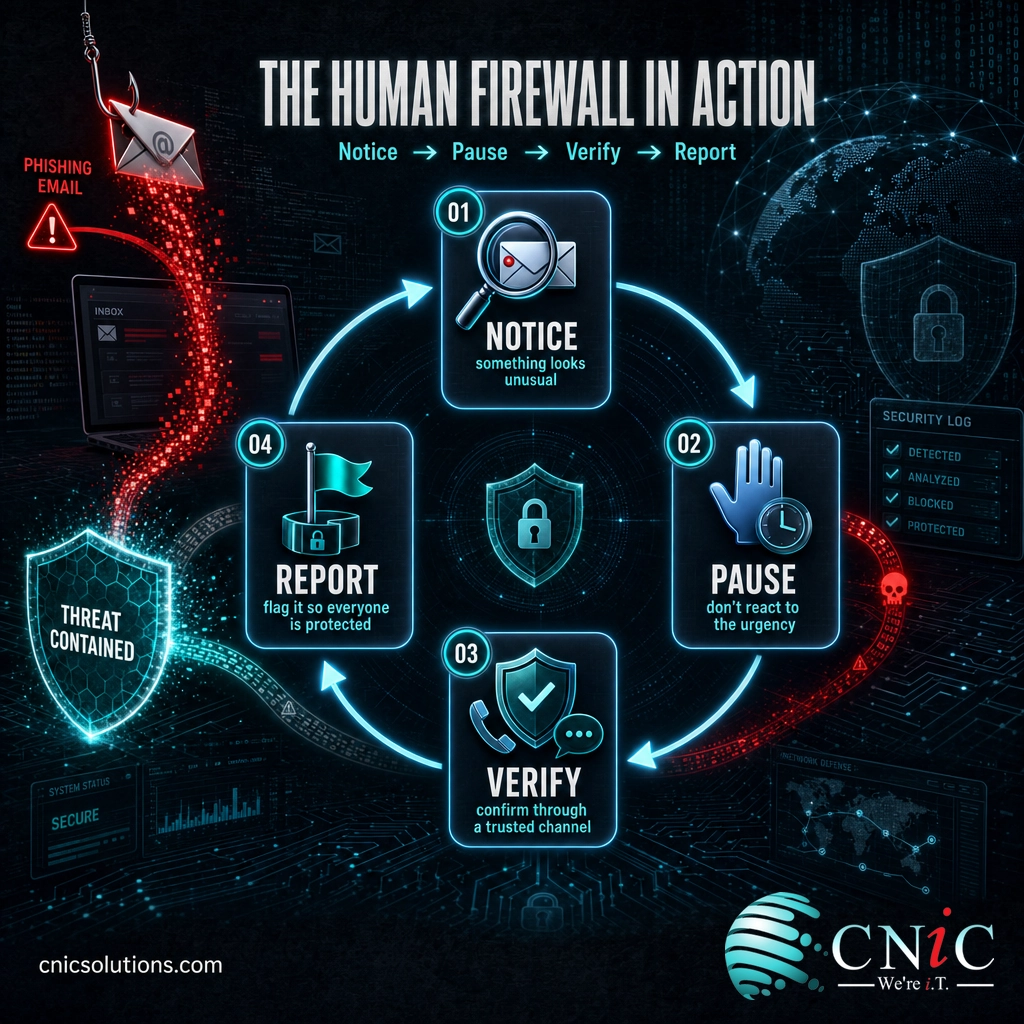
In practice, a functioning human firewall runs through a simple loop every time something suspicious arrives:
- Notice: the employee recognizes that an email, message, or request looks unusual, whether it is an unexpected attachment, a login page that feels wrong, or a payment request that skips normal steps.
- Pause: instead of reacting to the urgency the attacker manufactured, the person slows down and questions it.
- Verify: they confirm the request through a known, separate channel, such as calling the vendor on a trusted number rather than replying to the email.
- Report: they flag it to IT or their provider, so the same attack aimed at ten other colleagues gets blocked before someone falls for it.
That last step is what turns individual awareness into an actual firewall. One person reporting a phishing attempt protects everyone else who received it. This is why security teams treat a rising report rate as a sign of health, not annoyance: the goal is not zero suspicious emails, it is that suspicious emails get caught and surfaced fast.
Human Firewall vs. Technical Firewall
The two are often confused because they share a name, but they defend against different things and are strongest together. A technical firewall enforces rules on network traffic. A human firewall applies judgment to the manipulation attempts that are designed to look like legitimate human requests.
| Technical Firewall | Human Firewall | |
|---|---|---|
| What it is | Hardware or software | Trained, aware people |
| What it inspects | Network traffic and connections | Emails, calls, requests, and behavior |
| What it stops | Unauthorized access by rule | Phishing and social engineering that fool a person |
| How it decides | Fixed rules and signatures | Context and judgment |
| Main weakness | Cannot judge a convincing human request | Fatigue, pressure, lack of training |
Neither is optional. A technical firewall will never talk an employee out of wiring money to a fraudster, and no amount of employee awareness will inspect a million packets a second. The point of the human firewall is to close the specific gap that technology cannot: the threat that only works if a person cooperates with it.
Why the Human Firewall Matters
The case for investing in your people is not sentimental, it is statistical. Attackers concentrate on humans because it works, and the numbers from primary industry research are hard to ignore.
Human involvement is not a rounding error in breach data, it is the single largest theme. And attackers move fast once a person engages. In its 2024 report, Verizon measured how quickly people fall for phishing once they open a malicious email.
That speed is exactly why prevention has to live in the person, not just in tools that clean up afterward. There is also a targeting insight that reshapes how you should train. Not everyone carries equal risk.
For a small or midsize business, the practical reading of this data is encouraging: the biggest source of risk is also the most improvable. You cannot patch human nature, but you can train judgment, build habits, and make reporting easy, and the research consistently shows that reduces the events most likely to become a breach.
Source: Verizon Data Breach Investigations Report | CISA guidance on recognizing and reporting phishing

What Makes Someone Part of the Human Firewall
A human firewall is not a job title. It is a set of behaviors that, once they become routine, dramatically shrink the number of attacks that succeed. The employees who form a strong human firewall tend to do these things by default:
- Recognize phishing and social engineering: they know the warning signs of a fraudulent message and treat unexpected links, attachments, and urgent demands with suspicion. Building this instinct is the core of learning how to recognize the warning signs of a phishing email.
- Verify before they act: they confirm money movements, credential requests, and sensitive-data requests through a second, trusted channel rather than trusting the message in front of them.
- Practice good credential hygiene: they use strong, unique passwords and multi-factor authentication, so a single stolen password does not open the door.
- Guard information: they are careful about what they share by email or phone, because attackers assemble small details into convincing pretexts.
- Report quickly, without fear: they flag anything suspicious immediately, and if they do slip and click, they say so right away, because early reporting is what limits the damage.
None of these require technical expertise. They require awareness and the confidence to act on it, which is precisely what training and culture create.
How to Build a Strong Human Firewall
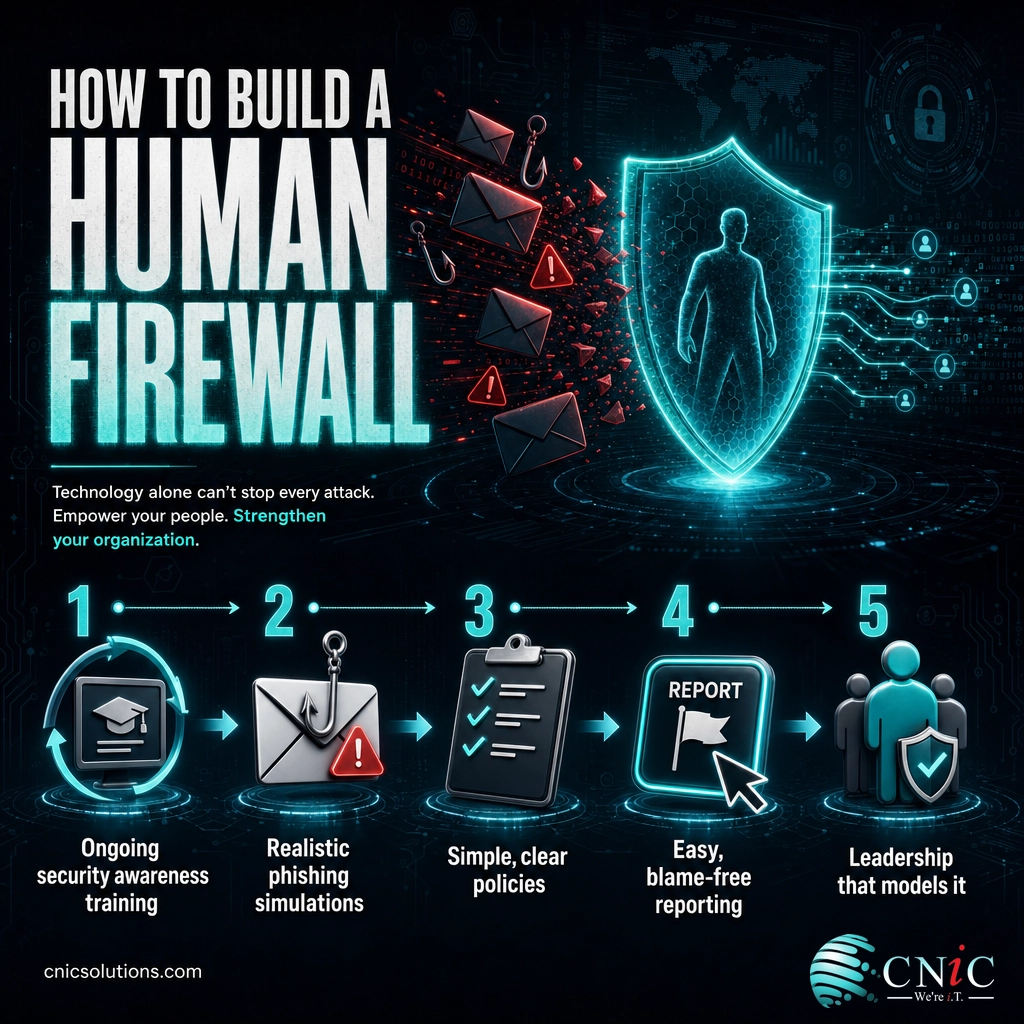
Building a human firewall is a program, not an event. The organizations that do it well treat it the way they treat any operational capability: continuous, measured, and led from the top. A practical build looks like this:
- Ongoing security awareness training: replace the annual compliance video with short, frequent, role-relevant lessons. A structured security awareness training program keeps threats top of mind and adapts as attacker tactics change. This aligns with federal guidance: NIST’s official framework for building a cybersecurity learning program treats awareness as a continuous function, not a one-time task.
- Realistic phishing simulations: send safe, simulated phishing to measure who clicks and who reports, then coach in the moment. Track the report rate as your key metric, not just the click rate.
- Simple, clear policies: people follow rules they understand. Keep guidance on passwords, verification, and reporting short and specific.
- An easy, blame-free reporting path: a one-click report button and a culture that thanks people for flagging beats a policy no one uses out of fear. Human error is common precisely because attacks are convincing, and a look at the data on human error in cybersecurity shows why punishing mistakes only drives them underground.
- Leadership that models it: when executives complete the training and follow the verification steps, everyone else does too.
Myth: “We have firewalls and antivirus, so our people don’t need training.” This is the most expensive assumption in security. Technical controls stop automated and obvious attacks, but phishing and social engineering are engineered specifically to slip past them and reach a person. If the human layer is untrained, attackers simply aim there, which is why breaches keep happening at companies with strong technology. Tools and training are not alternatives, they are two halves of one defense.
Most small and midsize businesses do not have the internal time to run this well on top of everything else, which is where a managed security partner helps. CNiC Solutions builds the human layer alongside the technical one, combining employee awareness training and phishing simulations with the monitoring, email security, and access controls that back it up. For businesses that want security folded into a broader, fully managed technology strategy, our managed IT services keep the tools, the training, and the response coordinated under one accountable team.
Strengthen your human firewall with CNiC cybersecurity services
Related Terms
- Phishing: fraudulent messages that impersonate a trusted sender to trick people into clicking, downloading, or sharing credentials. It is the most common threat a human firewall is trained to catch.
- Social engineering: the broader practice of manipulating people (by email, phone, or in person) into breaking security, of which phishing is the most common form.
- Spear phishing: a targeted phishing attack tailored to a specific person or company using researched details. Real examples appear in our guide to recognizing real phishing emails.
- Security awareness training: the ongoing program that teaches employees to recognize and respond to threats, the main way a human firewall is built.
- Multi-factor authentication (MFA): requiring a second proof of identity beyond a password, so a stolen password alone cannot grant access.
- Pretexting: inventing a believable scenario (a fake vendor, a fake executive) to make a request seem legitimate and lower a target’s guard.
- Incident response: the plan for containing and recovering from an attack when one gets through. See how to build a cybersecurity incident response plan step by step.
Frequently Asked Questions
What is a human firewall?
What is the difference between a human firewall and a technical firewall?
Why is the human firewall important?
How do you build a human firewall?
Can technology replace the human firewall?
About This Guide and Sources
The definition and framework in this guide reflect the standard, widely consistent characterization of a “human firewall” across the cybersecurity field: employees, supported by awareness and training, acting as a defensive layer against phishing and social engineering. Statistics are drawn from primary industry research: the human-element share of breaches (roughly 60%) and the finding that 8% of employees accounted for 80% of incidents come from Verizon’s 2025 Data Breach Investigations Report; the median time to fall for phishing (about 21 seconds to click, 28 seconds to enter data) comes from Verizon’s 2024 report. Phishing and social engineering are identified as leading initial-access methods in guidance from the U.S. Cybersecurity and Infrastructure Security Agency (CISA). The recommendation to treat awareness as a continuous program follows NIST Special Publication 800-50r1. No statistics in this article are estimated or invented; each is attributable to the primary source named.


related posts
What Is a Firmware Update and Why It Matters for Security
October 6, 2026A firmware update is a manufacturer-issued revision to the low-level software built into a device, such…
What Is a Distributed System? How It Works and Why It Matters
October 5, 2026A distributed system is a collection of independent computers, called nodes, that are connected over a…
What Is a Firewall? How It Protects Your Business Network
October 5, 2026A firewall is a network security device or software that monitors incoming and outgoing traffic and…
What Is a Data Center? Types, Components, and How They Work
October 4, 2026A data center is a physical facility that houses the servers, storage, and networking equipment a…