

Cyber insurance is a business insurance policy that pays for the financial fallout of a cyberattack or data breach. It reimburses first-party costs such as incident response, data recovery, business interruption, and ransom payments, and covers third-party liability when customers or regulators hold your business responsible for exposed data.
A single cyber incident can cost a small business more than a year of profit, yet most owners cannot say what their policy would actually pay for. The global average cost of a data breach reached $4.44 million in 2025, and ransomware now appears in 88% of small-business breaches. Cyber insurance exists to absorb that shock, but only for the specific costs your policy names. This guide breaks down exactly what cyber insurance covers, what it excludes, and how to read a policy before you need it.
- Two halves of every policy: first-party coverage pays your own recovery costs; third-party coverage pays claims other people bring against you.
- Ransomware is usually covered, but only if you meet the insurer’s security requirements, and some policies sub-limit or exclude ransom payments.
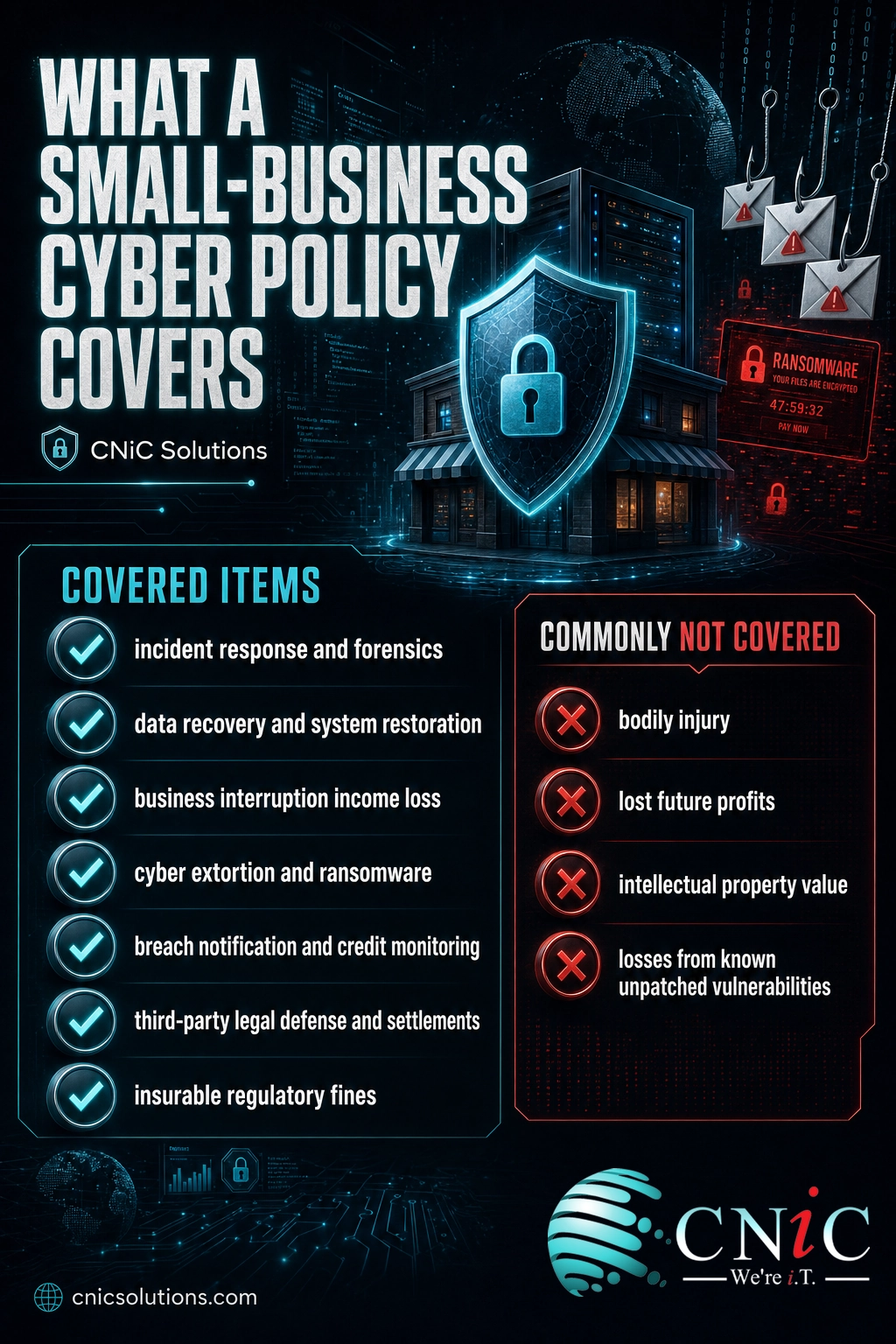
- Exclusions matter as much as coverage. Bodily injury, lost future profits, intellectual property value, and losses from ignored vulnerabilities are commonly not covered.
- Cost context: the average ransomware insurance claim was $269,000 in 2025, and ransomware recovery averaged $1.53 million even before any ransom.
- Controls decide eligibility. Multi-factor authentication, tested backups, and endpoint detection are now baseline requirements to qualify for coverage.
What’s in This Guide
How Cyber Insurance Works: First-Party vs. Third-Party
Cyber insurance, sometimes called cyber liability insurance, is a specialized policy that covers losses from technology incidents that a general liability policy leaves out: data breaches, ransomware, network outages, funds transfer fraud, and the lawsuits and regulatory actions that follow. Think of it the way you already think of property and liability insurance. Property insurance pays to rebuild your own building after a fire; liability insurance pays when someone else is harmed. Cyber insurance splits along the same line, into first-party and third-party coverage.
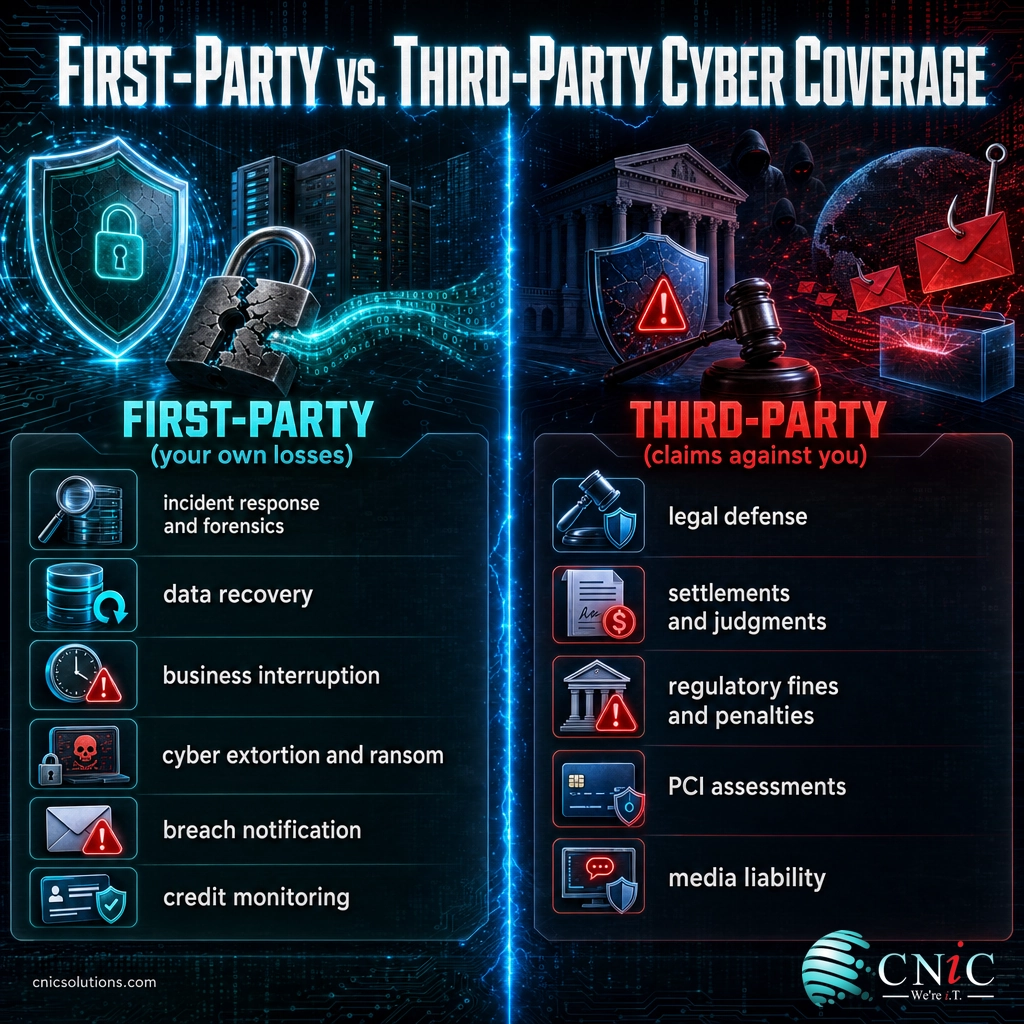
First-party coverage pays for direct losses to your own business. When your systems are encrypted, your data is stolen, or your operations stop, first-party coverage funds the response and the recovery. Third-party coverage pays when other people are harmed because you were breached, and they come after you: customers whose records leaked, business partners whose data you held, or regulators enforcing a privacy law. Most small-business policies bundle both, but the dollar limits assigned to each can differ sharply, which is why reading the sub-limits matters more than reading the headline coverage amount.
| Coverage side | Who the loss falls on | What it typically pays for |
|---|---|---|
| First-party | Your own business | Incident response, forensic investigation, data restoration, business interruption, cyber extortion and ransom, breach notification, credit monitoring, PR and crisis management |
| Third-party | Customers, partners, regulators | Legal defense, settlements and judgments, regulatory fines and penalties where insurable, PCI assessments and fines, media liability |
The distinction is not academic. A retailer that loses point-of-sale data faces first-party costs to rebuild systems and third-party costs when card networks impose PCI penalties. A medical practice faces first-party recovery costs and third-party HIPAA exposure. Knowing which bucket a cost lands in tells you which limit protects you.
Source: FTC Cyber Insurance guidance for small business
What Cyber Insurance Covers
Inside those two halves, a modern policy covers a specific list of costs. The exact wording varies by carrier, but the categories below appear in nearly every small-business cyber policy. When a carrier quotes you, match each line to a real cost you would otherwise pay out of pocket.
Incident response and forensics
The first hours of a breach decide the final bill. Coverage funds a breach coach, a forensic investigation to determine what was accessed, and the legal counsel that directs the response under privilege. This is the coverage you use on day one, and it is often the difference between a contained incident and a runaway one.
Data recovery and business interruption
When systems are down, you lose both data and revenue. First-party coverage pays to restore data and reconstruct systems, and business interruption coverage reimburses the income you lose while operations are halted. Ransomware recovery alone averaged $1.53 million in 2025, excluding any ransom, which is why the business interruption limit is one of the most important numbers in the policy. Strong data backup and recovery practices both lower this cost and improve your eligibility for coverage.
Cyber extortion and ransomware
Cyber extortion coverage can reimburse a ransom payment, the cost of a professional negotiation firm, and the expense of restoring encrypted systems. Coverage is real but conditional. Insurers increasingly require security controls before they will underwrite ransomware, and some policies sub-limit ransom payments or exclude them where a payment would violate sanctions. You can see how carriers price this risk in the latest ransomware payout data.
Breach notification and credit monitoring
Nearly every state requires you to notify affected individuals after a breach, and many businesses offer credit monitoring to reduce liability. Coverage pays the per-record cost of notification, call centers, and monitoring services, which scales quickly when thousands of records are involved.
Third-party liability and regulatory defense
When customers or partners sue, or a regulator opens an action, third-party coverage funds legal defense, settlements, and insurable fines. For regulated businesses this is critical: a healthcare practice faces HIPAA enforcement, a retailer faces PCI-DSS penalties, and a financial firm faces state and federal privacy actions. Coverage does not erase the obligation, but it funds the defense and the settlement.
Source: Sophos State of Ransomware 2025 | FTC Cyber Insurance guidance
What Cyber Insurance Does Not Cover
A policy is defined as much by its exclusions as its coverage. Assuming a cost is covered when it is not is how businesses end up underinsured at the worst moment. The following are commonly excluded from small-business cyber policies.
Read the exclusions first. Cyber insurance generally does not cover bodily injury, the loss of future or anticipated profits, or the diminished value of intellectual property. It also commonly excludes losses that trace to a known, unpatched vulnerability you failed to remediate, incidents you knew about before the policy started, betterment (upgrading systems beyond their prior state), and, in many policies, certain forms of insider fraud. If your security controls lapse below what your application promised, the carrier can deny the claim.
The unpatched-vulnerability exclusion is the one that surprises owners most. Insurance is designed to cover uncertain, accidental loss, not the predictable result of neglecting a fix you knew about. If a patch was available and you left it undeployed, the carrier may treat the resulting breach as avoidable and deny it. That is one more reason ongoing managed IT and patch management is not just good hygiene but a condition of getting paid.
Source: FTC Cyber Insurance guidance for small business
Why Small Businesses Need Cyber Insurance
Small businesses are not too small to be targets. They are the target. The 2025 Verizon Data Breach Investigations Report analyzed 12,195 confirmed breaches and found that ransomware appeared in 88% of breaches at small and midsize businesses, nearly four times the rate seen at large enterprises. Attackers automate their way to the least-defended networks, and small businesses rarely have the reserves to absorb a six-figure loss.
The gap between the average breach headline and the average claim is instructive. The multimillion-dollar breach figures are pulled up by large enterprises, while the claim figures reflect what small and midsize businesses actually file. Either way, the loss dwarfs a typical annual premium, which is the entire economic argument for coverage.
The Cost of a Cyber Incident (2025)
Sources: IBM Cost of a Data Breach 2025; Sophos State of Ransomware 2025
Myth: “60% of small businesses close within six months of a cyberattack.” You will see this figure everywhere, but it cannot be traced to any primary study, and reputable analysts have flagged it as unverifiable. Do not budget your cyber risk on a scare statistic. Budget it on verifiable numbers: the documented cost of breach response, recovery, and downtime from sources like IBM, Verizon, and Coalition. The real data is alarming enough without the folklore.
For a fuller picture of how insurers price and pay these risks, CNiC maintains a data-only companion piece, cyber insurance statistics for 2026, alongside our small business cyber attack statistics and the average cost of a data breach.
Source: Verizon 2025 Data Breach Investigations Report | IBM Cost of a Data Breach Report 2025 | Coalition 2025 Cyber Claims Report
How to Choose a Policy and Qualify for It
Buying cyber insurance is no longer a matter of filling out a one-page form. Underwriters now assess your security posture before they quote, and the same controls that win you a lower premium are the controls that keep you from being breached in the first place. Work through these steps before you sign.
1. Inventory your real exposure
List the data you hold (customer records, payment data, health data, credentials), the systems you depend on to operate, and the revenue you lose per hour of downtime. That inventory tells you which coverages and which limits actually matter, so you do not overpay for irrelevant coverage or underinsure the loss that would hurt.
2. Read the sub-limits, not just the total
A policy advertised at a $1 million limit may sub-limit ransomware to $100,000 or business interruption to a fraction of the total. The sub-limits, waiting periods, and retention (your deductible) determine what you actually collect. Compare those, not the cover-page number.
3. Meet the security requirements before you apply
Insurers now expect a baseline of controls: multi-factor authentication on email and remote access, endpoint detection and response, tested and immutable backups, timely patching, email filtering, and documented security awareness training. Businesses that can show these controls get better terms; those that cannot are quoted higher premiums or declined outright. A Virtual CIO can map your current controls against carrier questionnaires and close the gaps before renewal.
4. Align insurance with an actual security program
Insurance is the backstop, not the plan. It pays after a loss; it does not prevent one, and a policy will not pay if your controls lapsed below what you attested to. Pair coverage with a managed security program so the two reinforce each other. When you are ready to review your qualifications in detail, our upcoming guide covers the specific requirements insurers check.
Source: Coalition 2025 Cyber Claims Report | CISA ransomware guidance
Frequently Asked Questions
What does cyber insurance cover?
What is the difference between first-party and third-party cyber coverage?
Does cyber insurance cover ransomware and cyber extortion?
What does cyber insurance not cover?
What do insurers require a small business to have before they will cover it?
Related Terms
- First-party coverage: the part of a cyber policy that pays your own recovery costs after an incident. See data backup and recovery.
- Third-party liability: coverage for claims others bring against you after their data is exposed, including legal defense and settlements.
- Cyber extortion: coverage for ransom demands and the cost of responding to them; see the ransomware payout statistics.
- Business interruption: reimbursement for income lost while a cyber incident halts your operations.
- Breach notification: the legally required process of informing affected individuals, a cost most first-party coverage pays.
- Retention (deductible): the amount you pay out of pocket before coverage begins.
- Sub-limit: a cap on a specific coverage (such as ransomware) that sits below the policy’s total limit.
- Managed detection and response: a security control insurers increasingly require; part of managed cybersecurity services.
Methodology and Sources
How we sourced this guide
Every figure in this article comes from a Tier 1 primary source: the organization that produced the underlying data. Coverage and exclusion definitions follow U.S. Federal Trade Commission guidance for small business. We do not cite secondary blog summaries, vendor press releases without methodology, or unverifiable claims. Where a widely repeated figure could not be traced to a primary source, we flagged it rather than repeat it.
- IBM, Cost of a Data Breach Report 2025: global average breach cost of $4.44 million.
- Verizon, 2025 Data Breach Investigations Report: 12,195 confirmed breaches; ransomware in 88% of SMB breaches.
- Sophos, The State of Ransomware 2025: $1.53 million average recovery cost; $1.0 million median ransom paid.
- Coalition, 2025 Cyber Claims Report: $269,000 average ransomware claim.
- U.S. Federal Trade Commission, Cyber Insurance: first-party and third-party coverage definitions and exclusions.
- CISA, Ransomware guidance: recommended security controls.



related posts
What Is a NAS? Network-Attached Storage Explained for Businesses
October 8, 2026A NAS (network-attached storage) is a dedicated storage device that connects to your network and lets…
What Is a Server? Types, Roles, and How They Power Your Business
October 8, 2026A server is a powerful computer, or software running on one, that stores data and delivers…
What Is a Hypervisor? Types and How They Work
October 7, 2026A hypervisor is software that lets a single physical computer run many separate virtual machines at…
What Is a Load Balancer? How It Keeps Applications Fast and Reliable
October 7, 2026A load balancer is a device or piece of software that sits in front of your…