

Managed detection and response (MDR) is a cybersecurity service that pairs advanced detection technology with a team of human analysts who monitor your systems around the clock, hunt for threats, and actively respond to attacks on your behalf. It gives a business enterprise-grade threat detection and response without building an in-house security team.
Buying security tools is easy. Watching them 24 hours a day, telling the real attack apart from the thousand harmless alerts, and stopping an intruder at 3 a.m. on a Sunday is the hard part, and it is where most businesses fall down. Managed detection and response exists to close exactly that gap. It is not another product to install; it is an outside team and technology stack that does the detecting, investigating, and responding for you. This guide explains what MDR is, how it works step by step, how it differs from the alphabet soup of EDR, MSSP, SIEM, and SOC, why it has become a mainstream choice for growing companies, and how to tell a genuine MDR service from a rebranded alert feed.
Key Takeaways
- MDR is a service, not a product. You are buying a team plus technology that runs your threat detection and response, not a box you have to operate yourself.
- The “R” is the point. What separates MDR from older monitoring services is active response: analysts contain the threat, they do not just email you an alert.
- It is built around 24/7 human analysts. Software flags the anomaly; trained people decide whether it is real and act on it, day or night.
- It solves a staffing problem. With a global shortfall of roughly 4.8 million cybersecurity professionals, most businesses cannot hire and retain a round-the-clock security team, so they rent one.
- The stakes are concrete. The average U.S. data breach reached $10.22 million in 2025, and organizations still took an average of 241 days to identify and contain a breach.
What’s in This Guide
What Managed Detection and Response Is
At its core, managed detection and response is a way to outsource the hardest, most time-sensitive part of cybersecurity: catching an attack in progress and stopping it. A provider deploys detection technology across your endpoints, network, cloud services, and user identities, then a team of security analysts watches the resulting signals continuously. When something looks wrong, they investigate it, decide whether it is a genuine threat, and take action to shut it down, all as a managed service you pay for monthly.
The term was popularized by the analyst firm Gartner, which uses it to describe services that deliver threat monitoring, detection, and response using a combination of technology and human expertise. You can read Gartner’s own definition of managed detection and response services for the formal framing. The important shift the term captured was this: detection alone was never enough. Businesses were drowning in alerts from tools they had bought but could not fully operate, and attackers were slipping through the noise. MDR bundles the tools, the round-the-clock people, and the authority to act into one service.
Two ideas make MDR different from merely owning security software. The first is human expertise applied continuously. Detection technology produces signals; it takes a trained analyst to separate a real intrusion from routine activity, and to do it at any hour. The second is response. A genuine MDR service does not stop at telling you there is a problem. It contains the threat by isolating an infected device, killing a malicious process, or disabling a compromised account, then hands you a clear account of what happened and what to fix. That grounding in recognized security practice, the same detect-and-respond logic behind the NIST Cybersecurity Framework, is what turns a pile of tools into a defense.
How MDR Works, Step by Step
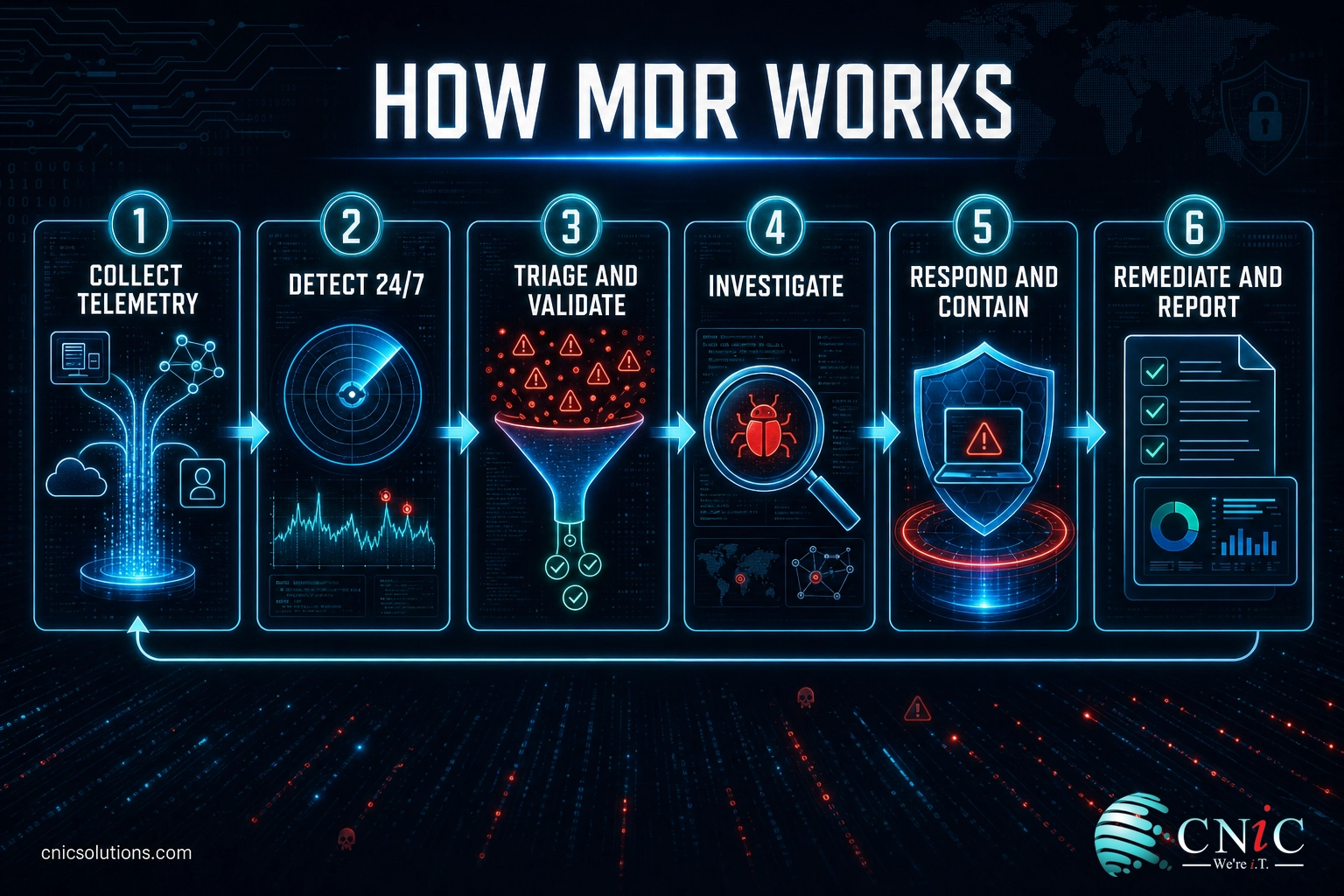
Providers differ in their technology, but the operating model is consistent. A mature MDR service moves through the same cycle, continuously, for every business it protects:
- Collect telemetry everywhere. Sensors and log feeds gather activity from endpoints (laptops, servers, phones), the network, cloud platforms, and identity systems. You cannot detect what you cannot see, so broad visibility is the foundation.
- Detect around the clock. Analytics, behavioral models, and up-to-date threat intelligence scan that telemetry 24/7, flagging anomalies such as unusual logins, suspicious file behavior, or signs of a known attack technique.
- Triage and validate. This is where MDR earns its keep. Analysts filter the flood of alerts, discard the false positives, and confirm which signals represent a real threat, so your team is never buried in noise.
- Investigate the real threats. Human threat hunters dig into confirmed incidents to understand the full picture: how the attacker got in, what they touched, and how far the compromise spread.
- Respond and contain. The provider acts to stop the attack, isolating an affected machine from the network, terminating a malicious process, or locking a compromised account, before the damage spreads. The speed here is what limits the blast radius.
- Remediate and report. Finally, the provider guides recovery and delivers a plain account of what happened, what was done, and which weaknesses to close so the same thing does not happen twice.
Notice how much of that cycle depends on judgment rather than software. Collection and detection can be automated, but triage, investigation, and the decision to isolate a critical server in the middle of a workday are human calls. That is the difference between a service that protects you and a dashboard that merely informs you.
Myth: “We already have antivirus and a firewall, so we are covered.” Preventive tools stop known, common threats, and they are essential, but they are not detection and response. They cannot tell you when a determined attacker slips past them, and they do nothing at 2 a.m. when no one is watching the console. Modern attacks are built to evade prevention and move quietly. MDR assumes something will eventually get through and is designed to catch and stop it fast, which is a fundamentally different job from keeping it out in the first place.
MDR vs. EDR vs. MSSP vs. SIEM vs. SOC
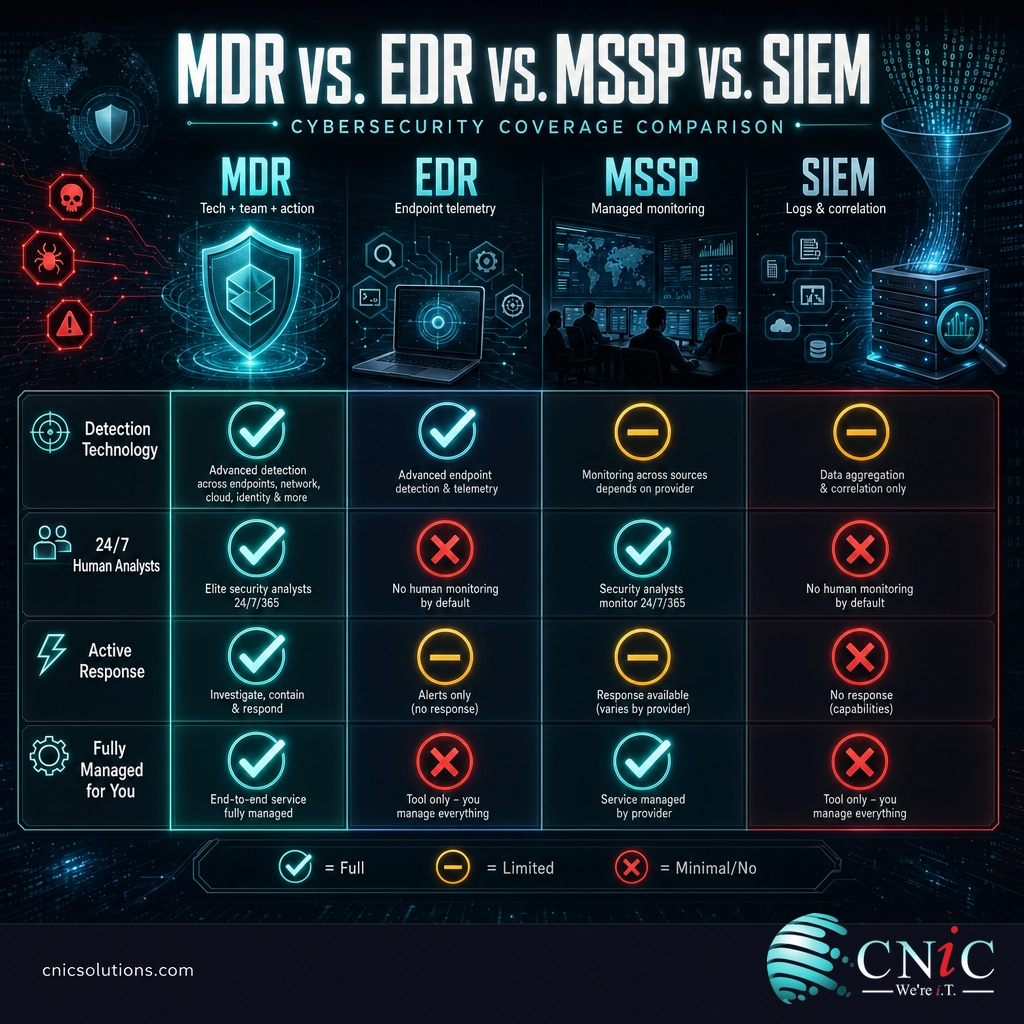
Few corners of cybersecurity are as crowded with acronyms, and they get used interchangeably when they should not be. The clearest way to understand MDR is to see exactly what it is not. The table below lines up the terms that get confused with it.
| Term | What it is | Who operates it | Does it respond for you? |
|---|---|---|---|
| MDR | A managed service: technology plus a 24/7 analyst team for detection and response | The provider | Yes, active containment is core to it |
| EDR | A tool that detects and records threats on endpoints | You (unless it is managed) | Only if someone operates it |
| MSSP | A provider that manages security tools and forwards alerts | The provider | Usually no, it alerts; you act |
| SIEM | A platform that aggregates and correlates logs and alerts | You or a provider | No, it surfaces data |
| SOC | A security operations center, the team and facility that does monitoring | You or a provider (MDR is essentially SOC-as-a-service) | Yes, if staffed to respond |
The two comparisons that trip people up most are MDR versus EDR and MDR versus MSSP. EDR (endpoint detection and response) is a technology: it lives on your devices and is one of the most powerful sensors an MDR team uses, but on its own it is a tool that needs an expert to run it. If you want the deeper picture on the tooling itself, our guide to the leading endpoint protection and EDR platforms for smaller businesses covers the options. The simplest way to hold it in your head: EDR is what you buy, MDR is who runs it, watches it, and acts on it.
The MSSP distinction is about ownership of the outcome. A classic managed security services provider keeps your tools patched and running and sends you alerts, which leaves your team to investigate and respond, often without the staff to do it. MDR takes that final, decisive step: its analysts investigate and contain the threat themselves. The gap between “you have been alerted” and “the threat has been stopped” is the whole reason MDR exists.
Why MDR Matters for Your Business
The case for MDR is not abstract. It comes down to three hard realities: breaches are expensive, they take a long time to catch, and almost no small or midsize business can staff the 24/7 detection needed to catch them faster. The figures below tell that story.
Those three numbers reinforce one another. A breach is enormously costly, it hides for the better part of a year on average, and the talent needed to find it faster is scarce and expensive. That is the squeeze MDR relieves: it delivers the continuous, expert detection and response a business needs at a price far below hiring and running its own security operations center.
The pressure is heaviest on smaller organizations, which attackers single out precisely because they expect thinner defenses. In 2025, ransomware was involved in the overwhelming majority of small-business breaches, at double the rate seen across organizations of all sizes.
Share of Breaches Involving Ransomware, 2025: Small Business vs. All Organizations
Source: Verizon 2025 Data Breach Investigations Report. Ransomware appeared in 88% of SMB breaches, twice the 44% rate across all organizations.
For a smaller business, that combination is the argument for MDR in a single line: you are more likely to be hit, less able to absorb the cost, and least equipped to catch the intrusion on your own. MDR is how you get the detection-and-response muscle of a large enterprise without the enterprise headcount, working alongside a tested data backup and recovery program so that if an attacker does strike, you can both stop the spread and restore what they touched.
Sources: IBM Cost of a Data Breach Report 2025 | Verizon 2025 Data Breach Investigations Report | ISC2 2024 Cybersecurity Workforce Study

What to Look For in an MDR Provider
Because “MDR” has become a popular label, plenty of services now use the name without delivering the substance. Some are alert-forwarding under a new coat of paint. When you evaluate a provider, a handful of questions separate genuine managed detection and response from a repackaged monitoring feed.
Do they actually respond, or only alert? This is the single most important question. Ask exactly what actions the provider will take on your behalf, and how far their authority to act goes. If the answer is “we notify you,” that is not MDR in any meaningful sense.
Is it truly 24/7 with human analysts? Threats do not keep business hours, and neither can your defense. Confirm there are real people watching outside 9-to-5, not just automated tooling that files a ticket for the morning. Ask how quickly a human engages once a genuine threat is confirmed.
How broad is their visibility? Strong MDR watches endpoints, network, cloud, and identity together, because modern attacks move across all of them. Endpoint-only coverage leaves obvious blind spots. The broader the telemetry, the harder it is for an intruder to hide.
Do they know your environment and your industry? Detection improves dramatically when the provider understands what “normal” looks like for your business and what rules you operate under. A provider fluent in the compliance demands of healthcare, legal, or financial services will tune detection to the risks that actually matter to you. That strategic fit is where broader guidance from a Virtual CIO and a clear-eyed cybersecurity risk assessment pays off, pointing MDR at your real exposures rather than generic ones.
How to Get Started With MDR
Adopting MDR is more straightforward than most business owners expect, because the heavy lifting sits with the provider. The practical path looks like this:
- Understand your exposure first. A short risk assessment shows where your business is most vulnerable, so the MDR service is pointed at your genuine weak spots rather than switched on blind.
- Confirm the response promise in writing. Before signing, get specific about what the provider will do when a threat is confirmed, how fast, and with what authority. Vague language here is the most common disappointment.
- Deploy the sensors. The provider rolls out lightweight agents and log connectors across your endpoints, network, cloud, and identity systems. This is usually quick and low-disruption.
- Let it learn, then lean on it. The service establishes a baseline of normal activity, then runs continuously. From there, detection and response become something you oversee rather than operate.
For most small and midsize businesses, MDR works best as one layer inside a managed relationship rather than a standalone purchase, because detection and response are far more effective when the same partner also keeps your systems patched, configured, and backed up. That is how CNiC Solutions approaches it: our cybersecurity services deliver the continuous monitoring, expert investigation, and rapid response of MDR, folded into the day-to-day managed IT services that keep the rest of your environment healthy. The result is not a dashboard you have to babysit; it is a team that watches, decides, and acts so your business does not have to.
Get a free security assessment for your business

Frequently Asked Questions
What is managed detection and response (MDR)?
What is the difference between MDR and EDR?
Is MDR the same as an MSSP?
How much does MDR cost?
Does a small business really need MDR?
Related Terms
- EDR (endpoint detection and response): the technology that detects and records threats on devices, and a primary sensor MDR relies on. See our roundup of EDR solutions built for smaller businesses.
- XDR (extended detection and response): detection and response stitched across endpoints, network, cloud, and identity in one platform, often the technology layer under a modern MDR service.
- SIEM (security information and event management): a platform that aggregates and correlates log data, feeding the signals analysts investigate.
- SOC (security operations center): the team and facility that runs monitoring and response; MDR is essentially a SOC delivered as a service.
- SOAR (security orchestration, automation, and response): tooling that automates repetitive response steps to help analysts act faster.
- Threat hunting: analysts proactively searching for hidden intruders rather than waiting for an alert to fire.
- Dwell time: how long an attacker stays undetected in a network. Cutting it is a core goal of MDR.
- MSSP (managed security services provider): a provider that manages security tools; strong ones layer managed firewall services and more beneath an MDR offering.
About This Guide and Its Sources
This explainer describes managed detection and response as the term is defined by the analyst firm Gartner and grounded in the detect-and-respond functions of the NIST Cybersecurity Framework. All statistics come from named primary sources: breach-cost and breach-lifecycle figures are from the IBM Cost of a Data Breach Report 2025; ransomware and small-business breach figures are from the Verizon 2025 Data Breach Investigations Report; and the cybersecurity workforce shortfall is from the ISC2 2024 Cybersecurity Workforce Study. MDR pricing varies widely by provider, scope, and organization size, and is described qualitatively rather than with a single estimate.



related posts
What Is Network Security Monitoring?
August 25, 2026Network security monitoring (NSM) is the continuous collection and analysis of network traffic and logs to…
What Is Network Segmentation? A Small Business Guide to VLANs and Isolation
August 25, 2026Network segmentation is the practice of dividing a computer network into smaller, isolated zones and controlling…
What Is Desktop as a Service (DaaS)?
August 24, 2026Desktop as a Service (DaaS) is a cloud model in which a third-party provider hosts, secures,…
What Is Conditional Access and How Does It Protect Your Accounts?
August 23, 2026Conditional Access is an identity-driven security feature, built into Microsoft Entra ID, that brings together signals…