

Managed firewall services, defined: A managed firewall service is a firewall that a third-party IT provider configures, monitors, and maintains on your behalf. You keep the protection and the policy control; the provider handles the round-the-clock monitoring, rule tuning, patching, and expert support that keep it effective over time.
Buying a firewall is easy. Keeping it correctly configured, patched, and watched every hour of every day is where most businesses fall short, and that gap is exactly where attackers get in. Managed firewall services exist to close it: instead of installing a device and hoping, you hand its operation to a team that runs it as a living, monitored control.
- A managed firewall is a firewall plus a service: configuration, 24/7 monitoring, rule management, patching, and reporting, all handled by an outside team.
- The firewall hardware is rarely the problem. Gartner projected that through 2023, 99 percent of firewall breaches would trace to misconfiguration, not device failure.
- Attackers have shifted toward internet-facing edge devices. Exploitation of edge devices and VPNs jumped from 3 percent to 22 percent of breaches in a single year (Verizon 2025 DBIR).
- Small and midsize businesses are hit hardest: 88 percent of SMB breaches involved ransomware, versus 39 percent at large enterprises (Verizon 2025 DBIR).
- A managed service turns a one-time purchase into predictable monthly protection, freeing your team from firmware updates and 2 a.m. alerts.
What’s in This Guide
- What a Managed Firewall Service Actually Is
- How Managed Firewall Services Work
- Managed Firewall vs. a Firewall You Run Yourself
- Why Managed Firewall Services Matter for Growing Businesses
- What’s Included in a Managed Firewall Service
- Types of Firewalls a Managed Service Covers
- Signs Your Business Needs a Managed Firewall
- How to Get Started with Managed Firewall Services
- Frequently Asked Questions
- Related Terms
What a Managed Firewall Service Actually Is
A firewall is the checkpoint between your internal network and the open internet. It inspects traffic coming in and going out and enforces a set of rules about what is allowed through. That part has not changed in decades. What has changed is how much ongoing work it takes to keep that checkpoint effective against modern threats.
A managed firewall service wraps expert operation around the firewall itself. The provider selects or works with your existing appliance, writes and maintains the rules, watches the traffic and alerts 24/7, applies firmware and security patches, and produces the reports auditors and leadership need. In practical terms, you get the outcome, a firewall that is actually doing its job, without staffing a network security specialist to babysit it.
The distinction matters because a firewall is not a “set it and forget it” product. Rules accumulate as your business adds applications, vendors, and remote workers. Firmware ages. New vulnerabilities are published constantly. Left alone, even a good firewall drifts out of date. The definitions and configuration guidance published in NIST’s guidelines on firewalls and firewall policy (SP 800-41) make the same point: a firewall is only as strong as the policy behind it and the discipline that keeps that policy current.
The #1 misconception: “We already have a firewall, so we’re covered.” Having a firewall and having a well-managed firewall are not the same thing. Gartner projected that through 2023, 99 percent of firewall breaches would be caused by misconfiguration rather than a flaw in the firewall itself. Overly permissive rules, forgotten exceptions, and unpatched firmware are what open the door, and those are management problems, not hardware problems.
Good firewall management is also the foundation of broader network defense fundamentals every business relies on. The firewall is the front gate, but it only works when someone is responsible for keeping it locked, tuned, and watched.
Source: NIST SP 800-41 Rev. 1 | Gartner firewall management research
How Managed Firewall Services Work
Think of it like the difference between buying a lock and hiring a security company. Anyone can install a deadbolt. A security company installs the right lock, decides who gets keys, watches the cameras overnight, changes the locks when an employee leaves, and calls you the moment something looks wrong. A managed firewall service does the same thing for the traffic entering and leaving your network.
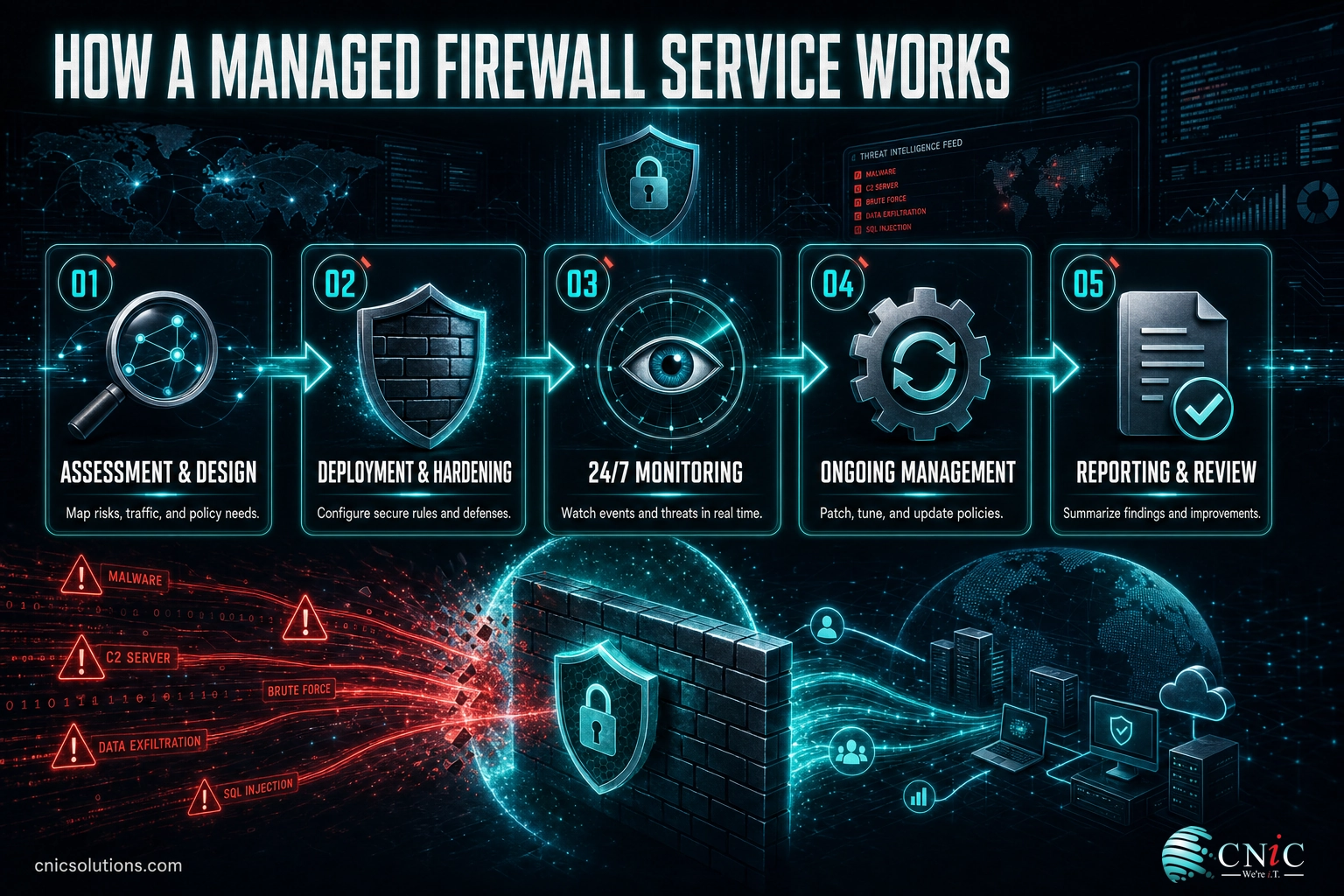
Most managed firewall engagements follow the same lifecycle:
- Assessment and design. The provider maps your network, identifies what needs to be reachable from the outside and what does not, and drafts a rule set built around least privilege rather than convenience.
- Deployment and hardening. The firewall, whether a physical appliance or a virtual one, is installed, hardened, and configured. Default passwords and unused services are removed, and segmentation is put in place so a breach in one area cannot spread freely.
- Continuous monitoring. A security operations team watches firewall logs and alerts around the clock, triaging what matters and filtering out the noise so genuine threats surface fast.
- Ongoing management. Rules are added, retired, and tuned as your business changes. Firmware and security patches are tested and applied on a schedule instead of whenever someone remembers.
- Reporting and review. You receive regular reports on blocked threats, policy changes, and compliance posture, plus periodic reviews to make sure the rule set still fits the business.
The value is in steps three through five. The initial setup is a one-time event. The monitoring, tuning, patching, and reviewing are what keep the firewall effective in month twelve, not just week one.
Managed Firewall vs. a Firewall You Run Yourself
The most common question is whether a managed service is really different from the firewall a business already owns and manages in-house. The device can be identical. The difference is who does the ongoing work, how consistently it gets done, and what happens at 2 a.m. on a Saturday when an alert fires.
| Dimension | Firewall You Manage In-House | Managed Firewall Service |
|---|---|---|
| Setup and rules | Your team configures, if they have the time and expertise | Provider designs, documents, and tunes the rule set |
| Monitoring | Business hours at best, often only when something breaks | 24/7/365 monitoring and alert triage |
| Patching and firmware | Manual and frequently delayed | Tested and applied on a defined schedule |
| Threat response | Reactive, after the impact is felt | Proactive, with rapid escalation |
| Compliance reporting | Do-it-yourself, if it happens at all | Included and audit-ready |
| Cost model | Hardware plus unpredictable staff time | Predictable monthly operating expense |
Neither approach is wrong in every case. A large organization with a staffed, 24/7 security team may keep firewall management in-house by choice. For most small and midsize businesses, though, the honest question is not “can we manage our own firewall?” but “will we actually manage it well, every day, forever?” When the honest answer is no, a managed service is the safer path.
Why Managed Firewall Services Matter for Growing Businesses
The threat landscape has moved directly toward the edge of the network, the exact place a firewall sits. Attackers increasingly go after internet-facing devices, firewalls, VPN gateways, and routers, because compromising one gives them a foothold inside the network. The shift over the past year has been dramatic.
What makes that number worse is how slowly those exposed devices get fixed. When a vulnerability is published for an edge device, the clock starts, and attackers move faster than most in-house teams can.
Smaller organizations feel this most acutely, because they are targeted with the same tooling as large enterprises but rarely have the same defenses. The data on how often small firms are attacked and breached is sobering, and firewalls sit right in that firing line.
Breaches Involving Ransomware: Small and Midsize vs. Large Enterprise
Source: Verizon 2025 Data Breach Investigations Report. Ransomware appeared in 44% of all breaches studied.
When an intrusion does succeed, the financial stakes are high across the board. The global average cost of a data breach reached 4.44 million dollars in 2025, and the fuller picture on what a breach actually costs a business shows how quickly downtime, recovery, and lost trust add up.
A managed firewall does not eliminate every risk, but it directly attacks the biggest failure points: unpatched edge devices, drifting rules, and threats that go unnoticed for days. For a business that lives or dies by uptime, that is the difference between a blocked attempt and a breach headline. This is why so many organizations fold firewall management into a broader set of managed cybersecurity services rather than trying to cover it alone.
Explore CNiC’s Managed Cybersecurity Services
Because ransomware so often follows a network intrusion, firewall management works hand in hand with resilient data backup and recovery. The firewall reduces the odds of a breach; tested backups make sure one bad day does not become a permanent one.
See Backup & Disaster Recovery
Sources: Verizon 2025 Data Breach Investigations Report | IBM Cost of a Data Breach Report 2025
What’s Included in a Managed Firewall Service
“Managed” can mean very different things from one provider to the next, so it pays to know what a complete service actually covers. A thorough managed firewall service should include all six of the following, not just monitoring.
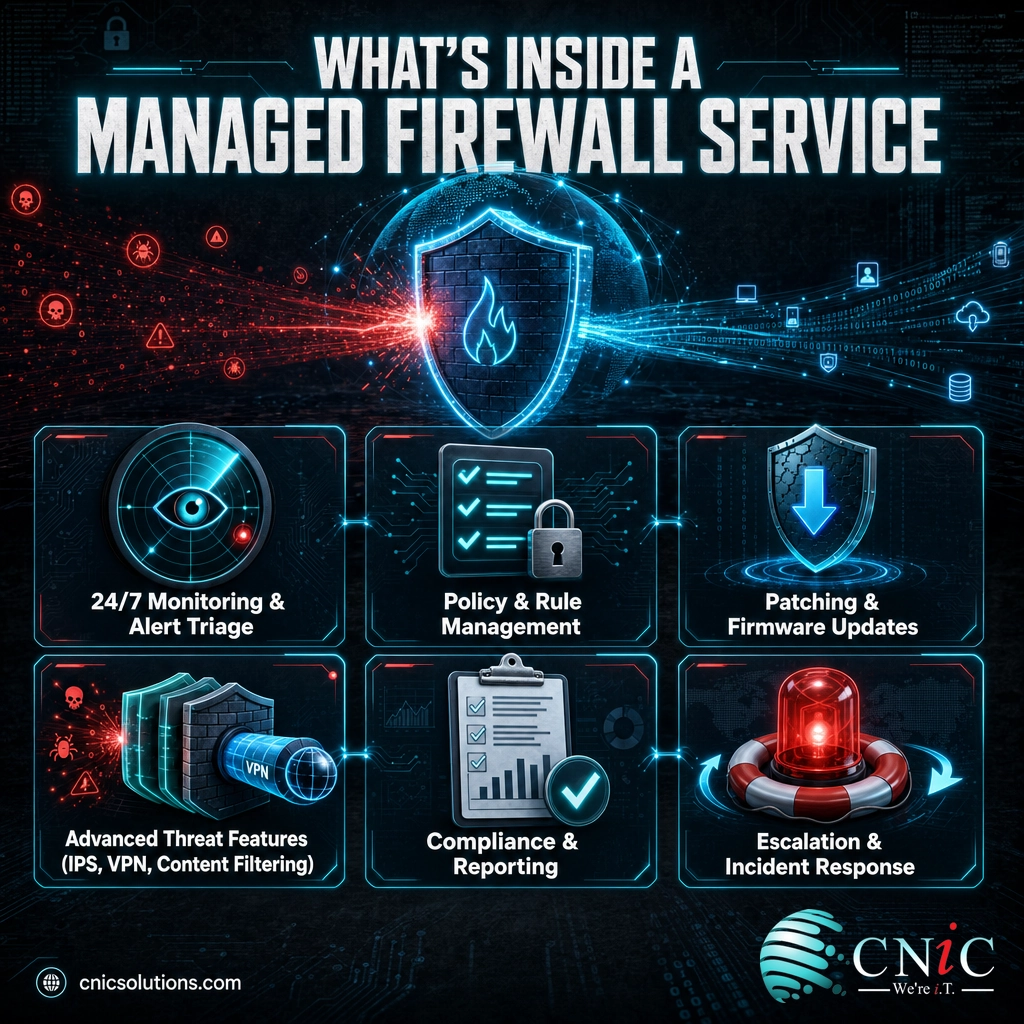
- 24/7 monitoring and alert triage. A security operations team watches firewall activity around the clock, separating real threats from routine noise so nothing critical sits in a queue overnight.
- Policy and rule management with change control. Every rule change is reviewed, documented, and reversible. This is the single biggest defense against the misconfigurations that cause most firewall breaches.
- Patching and firmware updates. Security updates are tested and applied on a schedule, closing the exposure window that unpatched edge devices leave open.
- Advanced threat features. Next-generation firewalls layer in intrusion prevention, web and content filtering, application control, and secure VPN access, all configured and kept current by the provider.
- Compliance and reporting. Regular reports document what was blocked and what changed, supporting frameworks such as HIPAA, PCI-DSS, and SOC 2 where they apply to your business.
- Escalation and incident response. When something does get through, there is a defined path to contain it fast rather than a scramble to figure out who is responsible.
Firewall management rarely stands alone. It usually sits inside a wider program of proactive infrastructure management, where servers, networks, and endpoints are all monitored and maintained as one system instead of a collection of parts.
Types of Firewalls a Managed Service Covers
Not all firewalls are the same, and a good managed service will recommend the right type for your environment rather than selling one box for every situation. The main categories, from oldest to most capable:
- Packet-filtering firewalls. The original design. They check each packet against basic rules for source, destination, and port. Fast and simple, but blind to the context of a connection.
- Stateful inspection firewalls. These track the state of active connections and make decisions based on the full context of the traffic, not just individual packets. This became the baseline standard for business networks.
- Next-generation firewalls (NGFW). The current standard for most businesses. An NGFW adds intrusion prevention, deep packet inspection, application awareness, and threat intelligence on top of stateful inspection, so it can identify and block modern, application-layer attacks.
- Unified threat management (UTM). A UTM appliance bundles several security functions, firewall, antivirus, content filtering, and VPN, into a single device. It is a popular fit for smaller offices that want broad coverage without multiple products.
- Firewall as a Service (FWaaS) and cloud firewalls. Instead of hardware on site, the firewall lives in the cloud and is consumed as a subscription. This suits distributed teams and cloud-first businesses, and it can be fully managed just like an on-premises appliance.
A managed provider assesses your traffic, locations, and compliance needs, then matches the firewall type, and often a mix, to the real environment. That decision is part of the service, not a purchase you have to get right on your own.
Signs Your Business Needs a Managed Firewall
Not every business needs to outsource firewall management, but several situations make a strong case for it. You are likely a good candidate if more than one of these is true:
- You do not have a dedicated network security specialist on staff, or the person managing the firewall does it alongside a dozen other jobs.
- No one can confidently say when the firewall’s firmware was last updated or when its rules were last reviewed.
- You are subject to HIPAA, PCI-DSS, SOC 2, or similar frameworks that expect documented, monitored controls.
- You have remote workers, multiple sites, or cloud applications that have quietly expanded what your firewall has to protect.
- Downtime is expensive, and a breach would threaten contracts, customer trust, or the business itself.
If those points land, firewall management is usually one piece of a larger conversation about outsourced IT. Many businesses reach it while evaluating fully managed IT support that covers the whole environment rather than a single device.
Learn About Managed IT Services
How to Get Started with Managed Firewall Services
Getting started is less about buying a product and more about understanding your current exposure. A sensible first step is a security assessment: a review of your existing firewall configuration, patch status, rule set, and network segmentation to see where the real gaps are. From there, a provider can recommend the right firewall type, a management plan, and a monitoring approach that fits your size and budget.
The goal is a firewall that is designed for your network, watched around the clock, kept patched, and documented for compliance, without adding headcount. For many businesses the fastest way to figure out what they actually need is a conversation with a virtual CIO who can look at the whole picture and prioritize.
Talk to a Virtual CIO About Your Security Roadmap
Frequently Asked Questions
What is a managed firewall service?
Is a managed firewall different from a regular firewall?
Do small businesses really need a managed firewall?
How much do managed firewall services cost?
What is the difference between a managed firewall and Firewall as a Service (FWaaS)?
Related Terms
- Next-Generation Firewall (NGFW): A firewall that adds intrusion prevention, application awareness, and threat intelligence on top of traditional traffic filtering. The current standard for most business networks.
- Firewall as a Service (FWaaS): A cloud-delivered firewall consumed as a subscription, with no on-site hardware. A common fit for remote and multi-site teams.
- Intrusion Prevention System (IPS): A control, often built into an NGFW, that detects and actively blocks known attack patterns in network traffic.
- Network segmentation: Dividing a network into isolated zones so a breach in one area cannot spread freely. Part of sound infrastructure security practice.
- Ransomware: Malware that encrypts data and demands payment. It now appears in the majority of small-business breaches, as the latest ransomware trend data shows.
- Managed Security Service Provider (MSSP): A company that delivers security functions, including managed firewalls, as an ongoing service rather than a one-time sale.
Sources and Methodology
All statistics in this article come from primary, Tier 1 sources and are cited inline where they appear. Figures reflect the most recent available reporting at the time of writing.
- Verizon 2025 Data Breach Investigations Report (edge device and VPN exploitation, patch timelines, ransomware share by business size).
- IBM Cost of a Data Breach Report 2025 (global average breach cost).
- NIST SP 800-41 Rev. 1, Guidelines on Firewalls and Firewall Policy (firewall definitions and policy guidance).
- Gartner research on firewall management (projection that misconfiguration, not device failure, causes the overwhelming majority of firewall breaches).



related posts
What Is a Distributed System? How It Works and Why It Matters
October 5, 2026A distributed system is a collection of independent computers, called nodes, that are connected over a…
What Is a Firewall? How It Protects Your Business Network
October 5, 2026A firewall is a network security device or software that monitors incoming and outgoing traffic and…
What Is a DDoS Attack? How DDoS Attacks Work and How to…
October 4, 2026A DDoS attack (distributed denial-of-service attack) is an attempt to take a website, application, or network…
What Is a Data Center? Types, Components, and How They Work
October 4, 2026A data center is a physical facility that houses the servers, storage, and networking equipment a…