

A distributed system is a collection of independent computers, called nodes, that are connected over a network and coordinate by passing messages so they function as a single, unified system. Spreading work and data across many machines lets the system stay fast, scale as demand grows, and keep running even when individual parts fail.
Almost every online service you used today, the store you ordered from, the app you logged into, the video you streamed, ran on a distributed system, even though nothing on your screen said so. That is the whole point: a distributed system takes dozens, hundreds, or thousands of separate computers and makes them behave like one dependable service. This guide explains what a distributed system actually is, how it works in plain English, how it differs from the centralized systems it replaced, the main types you will encounter, why it matters for a growing business, and the genuinely hard problems that come with it.
Key Takeaways
- A distributed system is many computers acting as one. Independent nodes coordinate over a network to deliver a single service.
- The payoff is scale, resilience, and speed. Work spreads across machines, so the system grows with demand and survives the failure of individual parts.
- The trade-off is complexity. Networks are unreliable, and keeping data consistent across machines is genuinely hard.
- Common shapes: client-server, three-tier, peer-to-peer, and cloud-native microservices.
- You already depend on them. Cloud computing, SaaS, and modern business applications are all distributed systems underneath.
What’s in This Guide
- What a Distributed System Is
- How a Distributed System Works
- Distributed vs Centralized Systems
- Why Distributed Systems Matter for Business
- The Main Types of Distributed Systems
- The Hard Parts: What Makes Them Difficult
- How Businesses Put Distributed Systems to Work
- Frequently Asked Questions
- Related Terms
What a Distributed System Is
A distributed system is a set of independent computers that appears to its users as a single coherent system. That definition, drawn from the standard computer-science characterization used in textbooks by Tanenbaum and van Steen and by Coulouris and colleagues, captures the two ideas that matter most. First, the machines are genuinely separate: each node has its own processor, its own memory, and often its own storage, and no node can see inside another. Second, despite that separation, the system hides the seams. You interact with one website, one application, one service, not with the fleet of servers behind it.
Because the parts are independent, a distributed system has three defining traits that a single computer does not. The nodes run concurrently, doing work at the same time rather than in a single sequence. There is no shared clock, so machines cannot assume they agree on the exact order or timing of events. And the components fail independently: one node can crash or drop off the network while the rest carry on. Everything interesting about designing a distributed system comes from managing those three realities.
How a Distributed System Works
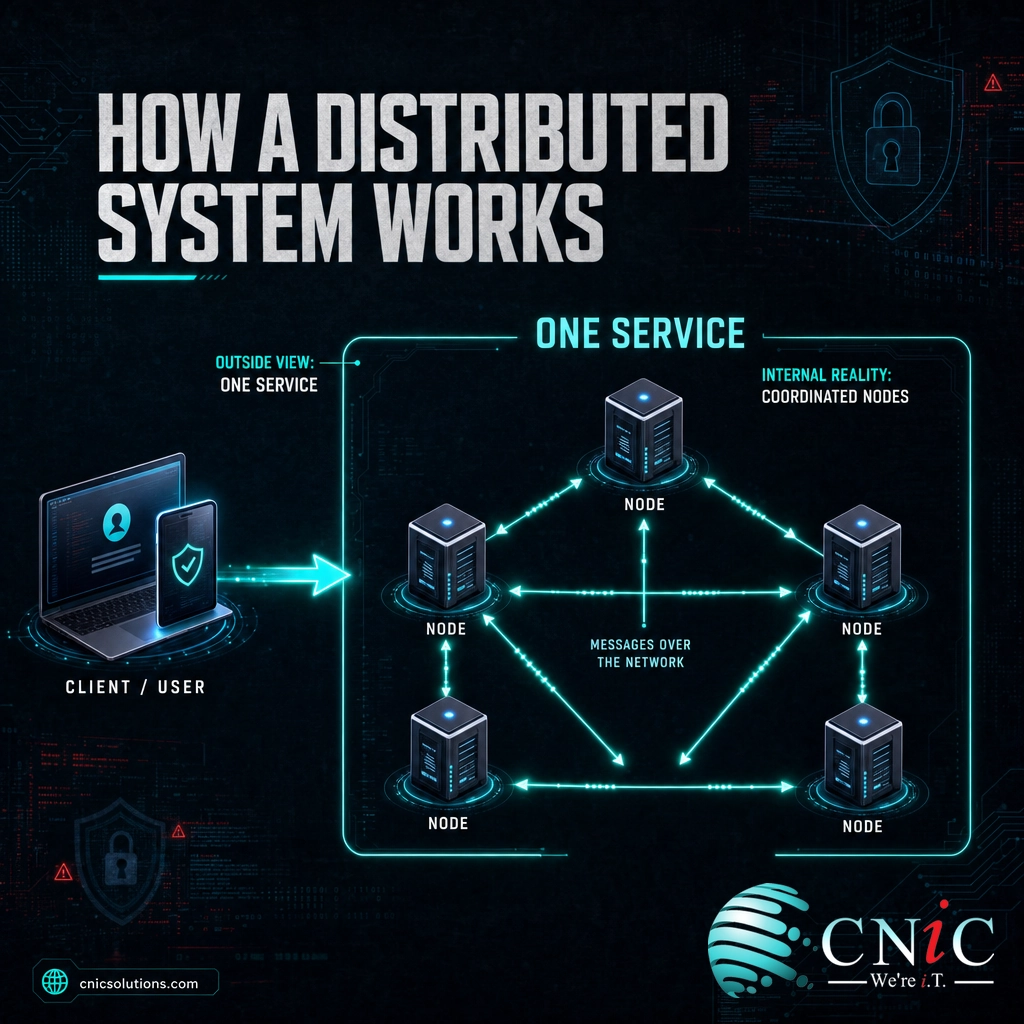
Here is a plain-English analogy. Think of a large restaurant kitchen during a dinner rush. No single chef cooks an entire order alone. One handles the grill, another plates salads, another works the sauté station, and expediters coordinate so a full table’s meal arrives together and hot. Each cook works independently and at the same time, they communicate constantly, and if one station falls behind, the others adjust so service does not stop. A distributed system works the same way, with servers in place of chefs and network messages in place of shouted instructions.
Mechanically, most distributed systems follow the same basic pattern:
- Nodes: The system runs across many separate machines (physical servers, virtual machines, or containers), each responsible for part of the work or part of the data.
- The network: Nodes communicate only by sending messages to each other over a network, since they share no common memory. This message passing is the nervous system of the whole arrangement.
- Coordination: To act as one, nodes have to agree on things, which node owns which task, what the current state of the data is, who is still alive. Reaching agreement across unreliable machines is called consensus, and it is one of the field’s central problems.
- Replication: Important data is copied across multiple nodes so that no single failure loses it and so requests can be served from whichever copy is closest or least busy.
- Transparency: All of this is hidden from the user. A load balancer or coordinating layer routes each request to an available node, so the person on the other end just sees a service that responds.
The result is a service that can absorb a machine failure without going dark and can take on more traffic by adding more nodes rather than by replacing one server with a bigger one.
Distributed vs Centralized Systems
The clearest way to understand a distributed system is to compare it with the centralized model it largely replaced. A centralized system does all of its processing and stores all of its data on a single machine (or a single tightly bound unit). It is simpler to build and reason about, because there is one place where everything happens and one version of the truth. The problem is that the single machine is also a single point of failure and a hard ceiling on growth: when it is overloaded or it goes down, the entire service is overloaded or down.
| Centralized System | Distributed System | |
|---|---|---|
| Where work happens | One machine does everything | Many machines share the work |
| If a core part fails | The whole service stops | Other nodes take over; service continues |
| How it grows | Replace the machine with a bigger one (scale up) | Add more machines to the pool (scale out) |
| Complexity | Lower, easier to reason about | Higher, network and coordination add difficulty |
| Best suited to | Smaller, predictable workloads | Large, growing, or unpredictable workloads |
Neither model is universally better. A centralized system is often the right, simpler choice for a small or steady workload. A distributed system earns its added complexity when you need to serve many users, handle unpredictable spikes, or keep running through hardware failures, exactly the demands that modern applications tend to place on the businesses that run them.
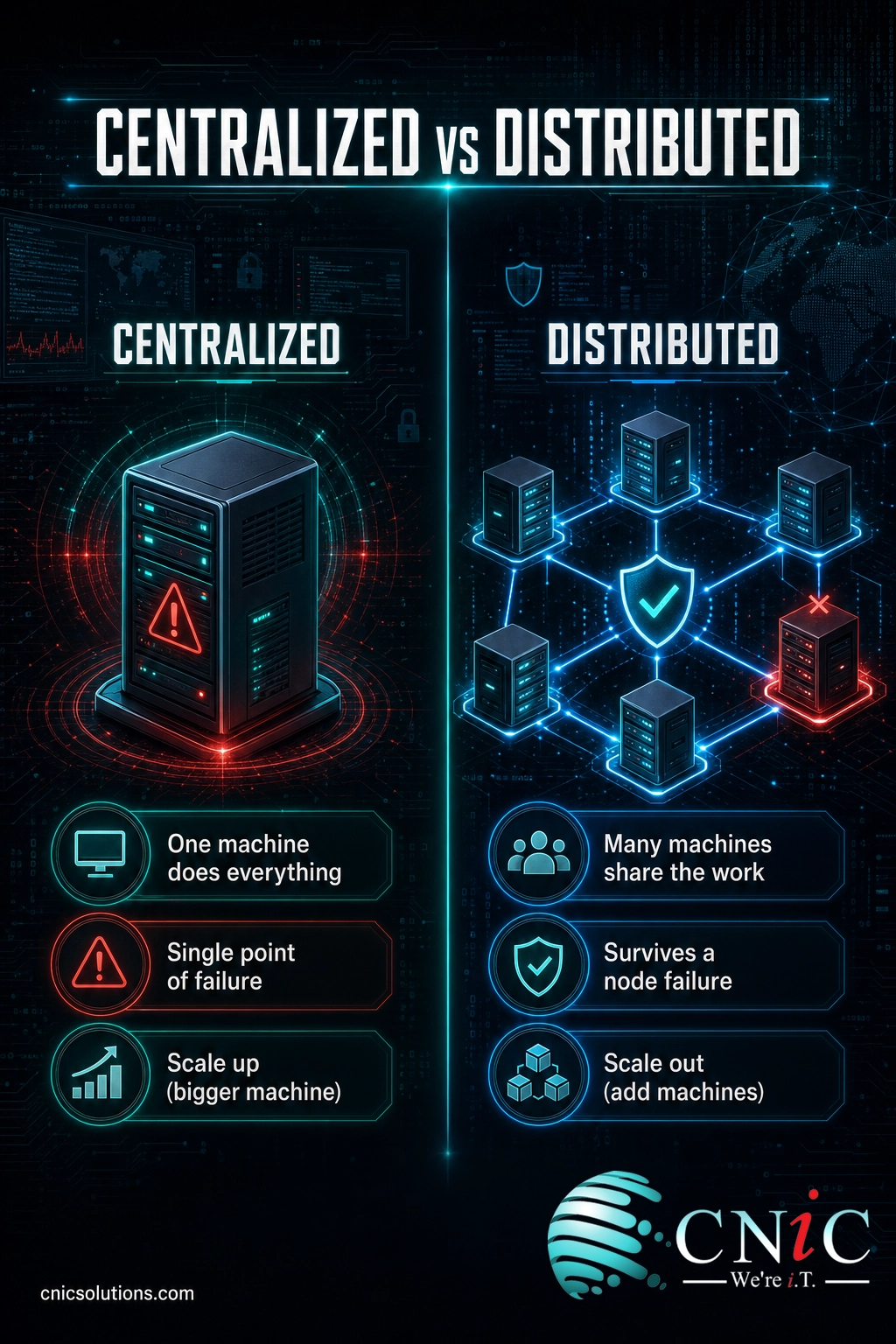
That shift, from scaling up a single box to scaling out across many, is also what makes distributed systems the foundation of nearly everything a business runs in the cloud today.

Why Distributed Systems Matter for Business
You do not have to be a software company for distributed systems to shape how your business operates. The applications most organizations depend on, email and productivity suites, accounting and payroll platforms, customer relationship management, e-commerce, backup, and video conferencing, are increasingly delivered from the cloud, and the cloud is a distributed system running at enormous scale. Spending reflects that shift.
The practical benefits that make distributed systems worth the trouble map directly onto business outcomes:
- Scalability that matches demand. When traffic surges, a distributed system adds nodes to absorb the load and releases them when the surge passes, so you are not forced to buy for your worst day and pay for it every day.
- Resilience and uptime. Because work is spread across many machines and data is replicated, the failure of a single server does not have to become an outage for your customers. That fault tolerance is the difference between a hardware hiccup and a business-stopping event.
- Performance and reach. Many machines working at once handle far more requests than one, and nodes can sit in different regions so data and processing are physically closer to the people using them.
These are the same properties that let a small business run enterprise-grade software it could never have built or hosted on its own. They are also why resilience planning, capacity, redundancy, and recovery, has moved from a niche concern to a core part of how well-run companies manage technology risk.
Source: Gartner public cloud spending forecast
The Main Types of Distributed Systems
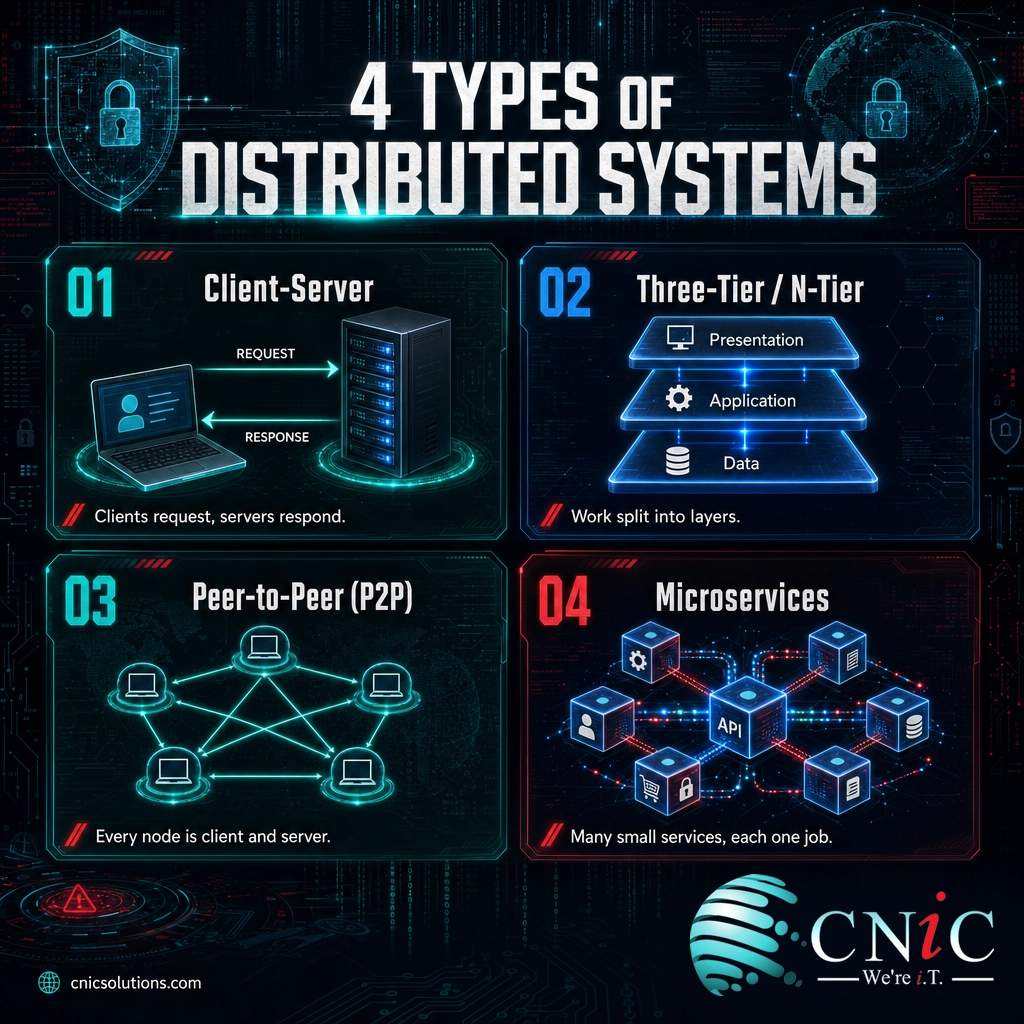
Distributed systems come in several common shapes. Most real-world platforms combine a few of these rather than following one purely.
- Client-server: The oldest and most familiar model. Clients (your browser, your phone app) send requests to servers that hold the data and do the heavy processing. A single logical “server” is often a distributed cluster of many machines behind the scenes.
- Three-tier and n-tier: The work is split into layers, typically a presentation layer (what the user sees), an application layer (the business logic), and a data layer (storage). Separating the tiers lets each one scale and be maintained independently.
- Peer-to-peer (P2P): There is no central server. Every node is both a client and a server, sharing resources directly with the others. This model underpins technologies like blockchain and many file-sharing and content-distribution networks.
- Microservices and cloud-native: A modern application is broken into many small, independent services that each do one job and talk to each other over the network. This is the dominant pattern behind large cloud platforms because each service can be scaled, updated, and recovered on its own.
The right shape depends on the workload. What they share is the core idea: independent components, coordinating over a network, presenting a single service to the outside world.
The Hard Parts: What Makes Them Difficult
Distributed systems solve real problems, but they are not free. Their power comes from spreading work across an unreliable network, and that network is the source of most of the difficulty.
The classic trap: engineers new to distributed systems tend to assume the network behaves like a local machine. It does not. The well-known “eight fallacies of distributed computing,” first articulated by Peter Deutsch and colleagues at Sun Microsystems, list the false assumptions that cause the most trouble: that the network is reliable, that latency is zero, that bandwidth is infinite, that the network is secure, that the topology never changes, that there is one administrator, that transport cost is zero, and that the network is homogeneous. Every one of those assumptions is wrong in the real world, and designing as if it were true is how distributed systems fail.
Two challenges deserve special mention because they define so much of the field:
- Keeping data consistent. When the same data lives on several nodes and can be updated in more than one place, keeping every copy in agreement is genuinely hard, especially when the network briefly splits the nodes into groups that cannot reach each other (a “partition”). Brewer’s CAP theorem captures the resulting trade-off: during a network partition, a distributed system can guarantee strong consistency or continued availability, but not both at once. Designers choose which to favor based on what the application needs.
- Observing and debugging the whole. A failure can hide in any node or in the network between them, and there is no single machine to inspect. Understanding what a distributed system is actually doing takes deliberate monitoring, logging, and tracing across every part, which is why operating one well is a discipline of its own.
None of this makes distributed systems a bad idea. It makes them a serious engineering commitment, one that rewards good design and punishes wishful thinking about the network.
How Businesses Put Distributed Systems to Work
For most organizations, the practical question is not “should we build a distributed system?” but “are we using distributed infrastructure well?” You are almost certainly relying on it already, through the cloud platforms and SaaS tools your business runs on. Getting value from it comes down to a few decisions:
- Match the model to the workload. Not everything needs to be distributed. A steady, modest workload may be simpler and cheaper on a centralized setup; a growing or spiky one benefits from the scale-out approach.
- Design for failure, not around it. Assume nodes and networks will fail, and make sure the important data is replicated and the recovery path is tested rather than assumed.
- Plan capacity and cost together. The ability to add nodes on demand is powerful, but it needs governance so scale-out serves performance without runaway spend.
- Monitor across the whole system. Visibility into every node and the links between them is what turns a distributed setup from a black box into something you can actually manage.
This is where an experienced IT partner earns its keep. CNiC Solutions helps small and midsize businesses design, run, and secure the distributed infrastructure their operations depend on through infrastructure management services that keep servers, networks, and cloud resources healthy and monitored. For businesses moving workloads into the cloud, our cloud solutions put enterprise-grade distributed platforms within reach without the in-house engineering team, and our broader managed IT services keep the whole environment running day to day. If you want a deeper primer on the platform most of this runs on, our complete guide to cloud computing for business is a natural next read, and for the resilience side, see how a tested recovery plan works in our explainer on disaster recovery as a service.
Talk to CNiC about managing your IT infrastructure
Frequently Asked Questions
What is a distributed system in simple terms?
What is an example of a distributed system?
What is the difference between a distributed system and a centralized system?
What are the main benefits of a distributed system?
Is the cloud a distributed system?
Related Terms
- Cloud computing: On-demand delivery of computing resources over the internet, built on distributed systems. See our complete guide to cloud computing for business.
- Fault tolerance: A system’s ability to keep operating correctly when one or more of its components fail, a core reason to distribute a system.
- Scalability: The capacity to handle more work by adding resources, achieved in distributed systems by scaling out across more nodes.
- Load balancing: Distributing incoming requests across multiple nodes so no single machine is overwhelmed.
- Microservices: An architecture that splits an application into many small, independently deployable services that communicate over a network.
- Data center colocation: Housing your servers in a shared, professionally managed facility. Read our explainer on how data center colocation works.
- Disaster recovery as a service (DRaaS): A cloud-delivered way to recover running systems after a failure. See what DRaaS is and how it works.
About This Guide and Sources
The definitions and framework in this guide reflect standard, widely consistent characterizations of distributed systems in computer science and industry practice. The core definition (a collection of independent computers that appears to users as a single coherent system) follows the standard textbook treatment by Andrew Tanenbaum and Maarten van Steen and by George Coulouris and colleagues. The defining traits (concurrency, no shared clock, independent failure), the message-passing and consensus model, and the common architectures (client-server, three-tier, peer-to-peer, and microservices) are standard, widely agreed characterizations, consistent with explainers from sources such as IBM. The “eight fallacies of distributed computing” are attributed to Peter Deutsch and colleagues at Sun Microsystems, and the consistency-versus-availability trade-off during a network partition is Eric Brewer’s CAP theorem, both well-established, named concepts rather than proprietary claims. The one quantitative figure cited, worldwide public cloud end-user spending, comes from Gartner’s forecast published in November 2024 (2025 forecast of $723 billion, up from $595.7 billion in 2024). It is included to illustrate the scale of distributed infrastructure in business, not as a benchmark for any specific organization.



related posts
What Is a Firewall? How It Protects Your Business Network
October 5, 2026A firewall is a network security device or software that monitors incoming and outgoing traffic and…
What Is a Data Center? Types, Components, and How They Work
October 4, 2026A data center is a physical facility that houses the servers, storage, and networking equipment a…
What Is a DDoS Attack? How DDoS Attacks Work and How to…
October 4, 2026A DDoS attack (distributed denial-of-service attack) is an attempt to take a website, application, or network…
What Is a Checksum? How It Verifies Data Integrity
October 3, 2026A checksum is a small value calculated from a block of digital data, used to detect…