

Network security is the set of technologies, policies, and controls that protect a business network and the data moving across it from unauthorized access, misuse, and attack. It is important because a single unprotected network can expose sensitive data, halt daily operations, and hand attackers the keys to the entire business.
Almost everything your business does now runs across a network: email, files, payments, phone calls, cloud apps, and the devices in every employee’s hands. That network is also the primary path attackers use to get in. Network security is what stands between routine business and a breach that stops it cold. This guide explains what network security is, why it matters so much for organizations of every size, what it protects against, and the practical layers that make it work.
Key Takeaways
- Network security protects the network and everything connected to it, including the data, devices, and applications your business depends on every day.
- It matters for five concrete reasons: protecting sensitive data, keeping operations running, preventing financial loss, preserving customer trust, and meeting compliance requirements.
- Strong network security is layered. No single tool is enough; firewalls, access control, monitoring, encryption, and segmentation work together as defense in depth.
- Every business is a target. Attackers automate their scans and do not check company size first, so small and midsize businesses are hit constantly.
- Network security is one part of cybersecurity, focused specifically on the network layer rather than every digital asset.
What’s in This Guide
What Is Network Security?
Network security is the practice of protecting a computer network, and the data traveling across it, from unauthorized access, misuse, and attack. It covers the hardware (like firewalls and routers), the software (like monitoring and filtering tools), and the policies that decide who is allowed to connect, what they can reach, and how traffic is inspected along the way.
A useful analogy is a secure office building. The network is the building, and the data inside is what everyone is there to protect. Firewalls are the locked doors and security desk that decide who gets in. Access controls are the keycards that limit which rooms each person can enter. Monitoring is the camera system watching for anything unusual. No single one of these makes the building secure on its own; together, they do. Network security works the same way, layering controls so that a failure in one is caught by another.
The goal is not to build a wall and walk away. It is to keep watch continuously, because the threats change constantly and a network is only as secure as its weakest, most out-of-date control.
Source: NIST: Cybersecurity Framework
Why Network Security Is Important
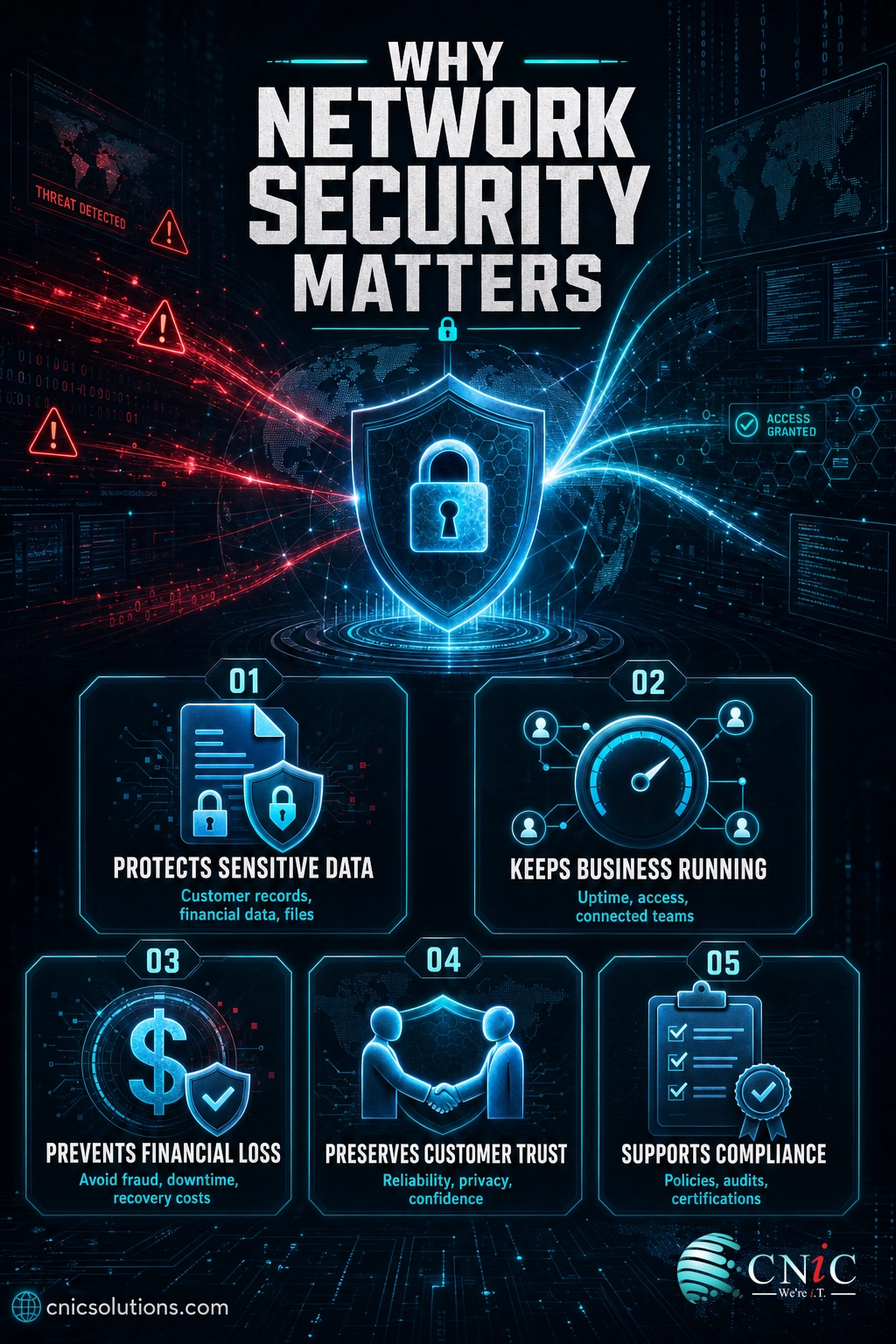
The short answer is that your network touches everything, so protecting it protects the whole business. The longer answer comes down to five concrete stakes.
- It protects sensitive data. Customer records, financial details, employee information, and confidential business files all live on or move across your network. Network security is the barrier that keeps that information from being intercepted, stolen, or leaked to anyone who should not have it.
- It keeps your business running. A network outage caused by an attack can stop everything: no email, no files, no payments, no phones. Network security prevents the disruptions and downtime that grind operations to a halt, keeping systems reliable and available when your team needs them.
- It prevents financial loss. A breach carries real costs: recovery and remediation, lost revenue during downtime, potential ransom demands, regulatory fines, and legal exposure. Investing in prevention is consistently cheaper than paying to clean up after an incident that could have been stopped.
- It preserves customer trust. Clients hand you their data on the assumption you will protect it. A publicized breach can undo years of goodwill in a single news cycle. Demonstrating strong security is increasingly a competitive advantage, especially for businesses handling financial, legal, or health information.
- It supports regulatory compliance. Frameworks such as HIPAA, PCI-DSS, and SOC 2 expect network-level safeguards as a baseline. For many organizations, network security is not optional; it is a documented requirement, and failing to meet it can mean fines, lost contracts, and legal action.
Notice that only one of these five reasons is purely technical. The rest are business outcomes: uptime, money, reputation, and legal standing. That is the real reason network security matters. It is not an IT nicety, it is a protection layer around the parts of the business that keep it alive.
Source: CISA: Cybersecurity Best Practices
Protect your business with managed cybersecurity
What Network Security Protects Against
Network security is not defending against one threat but a whole catalog of them, arriving from outside and, sometimes, from inside. These are the categories it is built to stop.
| Threat | What it does | How network security helps |
|---|---|---|
| Malware & ransomware | Malicious software that steals data or locks systems until a ransom is paid. | Firewalls, filtering, and monitoring block malicious traffic and isolate infected devices before it spreads. |
| Phishing & social engineering | Tricks a person into handing over credentials or clicking a malicious link. | Email and web filtering stop many attempts, and segmentation limits what a stolen login can reach. |
| Unauthorized access | An attacker or unapproved user gets into systems they should not. | Access control and authentication verify identity and enforce who can reach what. |
| Denial-of-service attacks | Floods a network with traffic to knock services offline. | Traffic filtering and monitoring detect and absorb abnormal spikes before they cause an outage. |
| Insider threats | A current or former employee misuses their access, deliberately or accidentally. | Least-privilege access and activity monitoring limit and flag risky behavior from inside. |
| Interception (eavesdropping) | An attacker reads data as it travels across a connection. | Encryption and VPNs make intercepted traffic unreadable. |
The pattern across every row is the same: no single control covers everything. Filtering catches malware but not a careless insider; access control stops unauthorized logins but not a traffic flood. That is exactly why network security is designed in layers, so that whatever slips past one defense is caught by the next.
Source: FBI Internet Crime Complaint Center | CISA resources for small and midsize businesses

Network Security vs. Cybersecurity
These two terms are used interchangeably, but they are not the same thing, and the difference clears up a common source of confusion.
| Network Security | Cybersecurity | |
|---|---|---|
| Scope | The network layer specifically: connections, traffic, and access between devices. | All digital assets: networks, endpoints, applications, cloud, data, and users. |
| Focus | Keeping the network and its traffic protected and available. | Protecting the organization from every category of digital threat. |
| Examples | Firewalls, VPNs, segmentation, intrusion detection. | Everything in network security, plus endpoint protection, encryption, identity management, security awareness, and more. |
The simplest way to hold it in your head: network security is a subset of cybersecurity. Cybersecurity is the whole program; network security is the part that guards the roads your data travels on. A strong network is essential, but it is one component of a complete security posture, not a substitute for one.
The Layers of Network Security
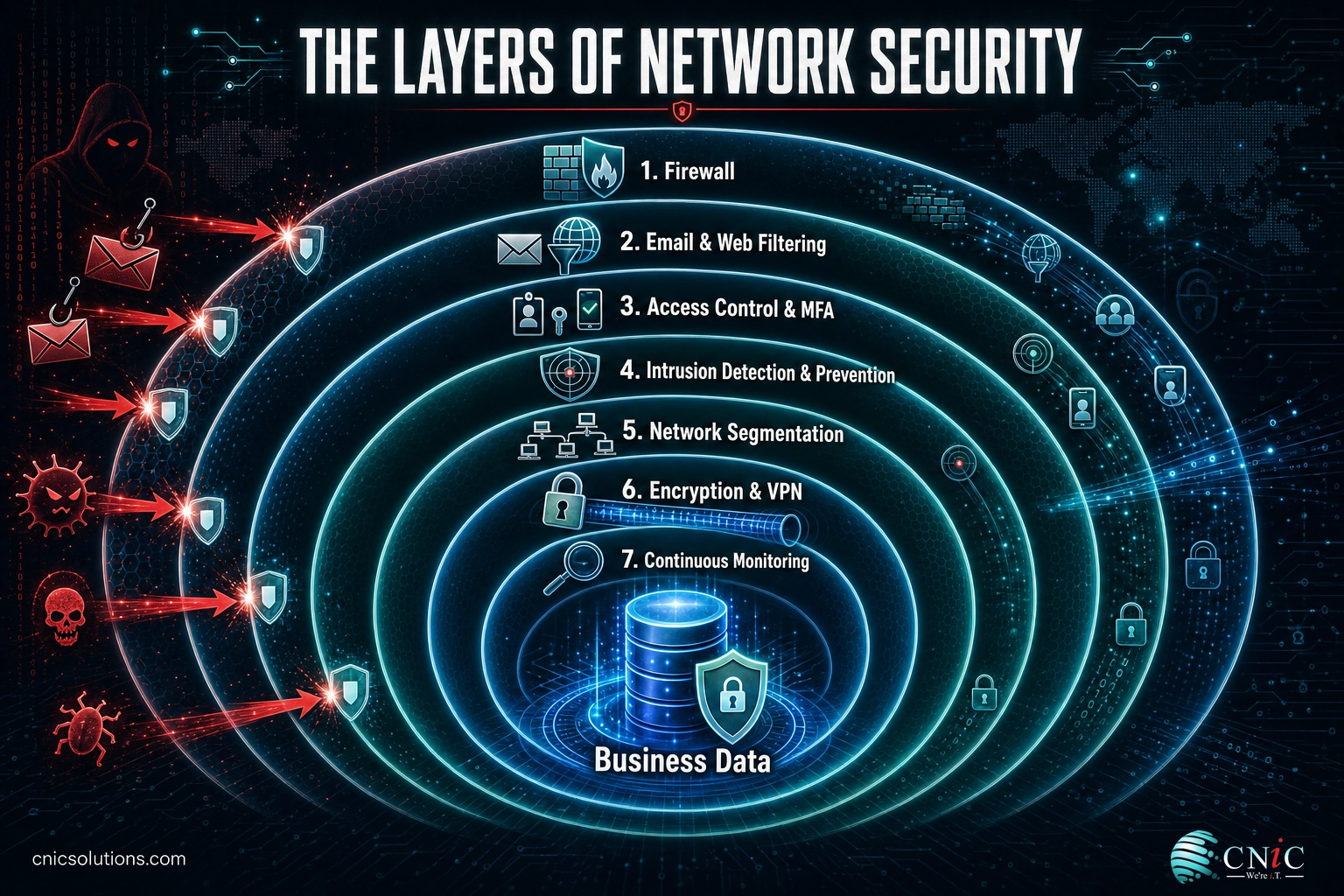
Security professionals call the layered approach “defense in depth.” The idea is that overlapping controls compensate for one another, so a single failure never becomes a full compromise. These are the core layers most businesses should have working together.
- Firewalls: the gatekeeper that inspects traffic entering and leaving the network and blocks anything that violates policy. A properly configured firewall is the foundation of network defense. Learn more in our guide to managed firewall services.
- Access control and authentication: verifying who someone is and enforcing what they are allowed to reach, so a single set of stolen credentials cannot open every door.
- Intrusion detection and prevention: systems that watch for suspicious patterns and either alert your team or actively block the activity in real time.
- Network segmentation: dividing the network into zones so that a breach in one area cannot move freely into the rest. Segmentation is one of the most effective ways to contain an attack.
- Encryption and VPNs: scrambling data as it moves across connections so that intercepted traffic is unreadable, and giving remote workers a secure tunnel into internal resources.
- Email and web filtering: blocking malicious messages and dangerous sites before they reach an employee, which stops a large share of attacks at the door.
- Continuous monitoring: ongoing visibility into network activity so anomalies are caught early, not discovered weeks later during an investigation.
The strength of this model is that it does not depend on any one layer being perfect. It depends on the layers being in place, configured correctly, kept current, and watched. That combination is what turns a collection of tools into actual protection.
Source: NIST: Cybersecurity Framework
Myth: “We’re too small to be a target.”
This is the most dangerous assumption a business can make about network security. Most attacks are not hand-picked; they are automated. Tools scan enormous ranges of the internet looking for any network with a weak or unpatched entry point, and they do not check the size of the company behind it before they strike. Smaller organizations are often hit precisely because they assume no one is looking and leave gaps a larger company would have closed. Being small is not protection. Being prepared is.
What Weak Network Security Costs a Business
It is tempting to treat network security as an expense to minimize until you weigh it against what a single serious incident actually costs. The damage rarely stops at the breach itself.
There is the direct financial hit: incident response, system recovery, and any ransom or fraud losses. There is downtime, where every hour the network is offline is an hour of lost revenue and stalled work. There are regulatory consequences for organizations bound by HIPAA, PCI-DSS, or similar frameworks, where a breach can trigger investigations and fines. And there is the slowest wound to heal: reputational damage and lost customer trust, which can drive away clients long after the technical problem is fixed.
Set against those stacked costs, prevention is the economical choice by a wide margin. The goal of network security is to make sure the incident that would trigger all of that never happens in the first place, or is contained so quickly it never becomes a crisis.
Source: FBI Internet Crime Complaint Center
How to Strengthen Your Network Security
You do not need to build a security operations center overnight. You need to make sure a short list of fundamentals is genuinely in place, configured correctly, and maintained. For most small and midsize businesses, that means:
- A properly configured firewall at the network edge, kept updated rather than set once and forgotten.
- Strong access control, including multi-factor authentication and least-privilege permissions, so no single account can reach everything.
- Encryption for data in transit, with a VPN for remote workers connecting to internal systems.
- Network segmentation to contain any intrusion and keep a single compromise from spreading.
- Timely patching and updates across network hardware and connected devices, since unpatched systems are among the most common entry points.
- Continuous monitoring so unusual activity is caught early, not weeks after the fact.
- Employee awareness, because the strongest firewall does not help if someone hands over their password to a convincing phishing email. See our guide on spotting phishing warning signs.
The hard part is rarely turning one control on. It is making sure every layer is enabled everywhere, configured correctly, kept current as threats evolve, and actively watched, rather than assumed to be working. That consistent, network-wide oversight is exactly what managed IT and cybersecurity services exist to provide: designing the layers, maintaining them, and monitoring the network so problems are caught and contained before they cost you. If you are not confident your network defenses would hold up under scrutiny, a good first step is a professional review of how your systems connect and where the gaps are, which is the foundation of solid cybersecurity risk assessment.
Build a secure, reliable business network
Get your network security managed and monitored
Related Terms
- Firewall: A gatekeeper that inspects and filters traffic entering or leaving a network. See managed firewall services.
- Encryption: Scrambling data so only someone with the right key can read it. See data encryption explained.
- Network segmentation: Dividing a network into isolated zones to contain the spread of any breach.
- Intrusion detection/prevention (IDS/IPS): Systems that watch for and block suspicious network activity.
- VPN (virtual private network): An encrypted tunnel that lets remote users connect securely to internal resources.
- Ransomware: Malware that locks systems or data until a ransom is paid, often entering through the network.
- Cybersecurity risk assessment: A structured review of where a business is exposed. See what a risk assessment covers.
Frequently Asked Questions
Why is network security important?
What is network security in simple terms?
What is the difference between network security and cybersecurity?
What are the main types of network security?
Do small businesses really need network security?
Sources
This explainer grounds its framework and best-practice claims in primary government cybersecurity guidance rather than vendor marketing. The layered “defense in depth” model and the core security functions align with the NIST Cybersecurity Framework. Best practices for protecting business networks and the specific guidance for small and midsize businesses follow CISA. Threat categories and the reality of automated, indiscriminate attacks reflect reporting from the FBI’s Internet Crime Complaint Center. No statistics have been invented; claims are definitional, standards-based, or attributed to these primary sources.
Primary and authoritative sources: NIST Cybersecurity Framework, CISA Cybersecurity Best Practices, CISA for Small and Midsize Businesses, FBI Internet Crime Complaint Center.



related posts
Remote Work IT Setup: A Complete Guide for Small Businesses
September 23, 2026Setting up IT for a remote or hybrid team is no longer a temporary arrangement, it…
Patch Management Best Practices for Businesses: 10 Steps That Actually Reduce Risk
September 23, 2026Patch management is the disciplined process of finding, testing, and deploying software updates so known vulnerabilities…
Password Statistics for 2026: Reuse, Cracks, and the Passkey Shift
September 22, 2026Weak and stolen passwords are still the number one way attackers get in. In 2025, stolen…
OKRs vs. KPIs: What’s the Difference?
September 22, 2026An OKR (Objective and Key Results) is a goal-setting framework that pairs an ambitious objective with…