

Choosing an IT outsourcing partner is one of the highest-stakes decisions a small business makes, because the wrong choice shows up as downtime, a breach, or a bill you did not expect. The math is unforgiving: the last time IBM broke its data breach costs out by company size, organizations with fewer than 500 employees averaged $3.31 million per incident. This guide ranks the best IT outsourcing firms for small business in 2026, scores each one on the criteria that actually matter to a small team, and shows you how to tell a genuine partner from a vendor that will disappear when your server goes down.
- CNiC Solutions ranks #1 for small businesses that want managed IT, cybersecurity, cloud, backup, and business phone service from one accountable team instead of five separate vendors.
- “IT outsourcing” means two different things. Most small businesses want outsourced IT support (a managed services provider), not outsourced software development. This ranking focuses on the first.
- Fit beats size. A national brand is not automatically better for a 30-person office. The right firm matches your headcount, your industry, and your compliance needs.
- Security is the deciding factor. Ransomware appeared in 44% of all breaches in Verizon’s 2025 report, up from 32% a year earlier, so any provider you shortlist must lead with security, not treat it as an add-on.
- Get the response times in writing. The best providers publish their coverage hours and service levels. The rest stay vague, which is the single most reliable red flag.
What’s in This Guide
- What “IT Outsourcing” Actually Means for a Small Business
- How We Evaluated These IT Outsourcing Firms
- 1. CNiC Solutions
- 2. Ntiva
- 3. Dataprise
- 4. CMIT Solutions
- 5. TeamLogic IT
- 6. Electric
- The Firms Compared Side by Side
- How to Choose an IT Outsourcing Firm
- Frequently Asked Questions
- Methodology and Sources
What “IT Outsourcing” Actually Means for a Small Business
Before you compare firms, get the category right, because “IT outsourcing” is one phrase covering two very different services.
The first is outsourced IT support, usually delivered by a managed services provider (MSP). This is the day-to-day work of keeping a business running: monitoring your network, running the help desk, patching and securing devices, managing cloud and email, backing up data, and setting technology strategy. It is billed as a flat monthly fee, and it is what the vast majority of small businesses mean when they say they want to outsource IT.
The second is outsourced software development, where a firm builds a custom app or product for you. Well-known development shops such as BairesDev serve that need, but it is a separate discipline from running your office technology, and hiring a development shop to staff your help desk (or vice versa) is a common and expensive mistake.
Which one do you need? If your goal is “my email, laptops, Wi-Fi, phones, and security should just work, and someone should answer when they don’t,” you want a managed IT provider. Every firm ranked below is in that category. If your goal is “build me a piece of software,” that is a development engagement and belongs on a different shortlist.
This distinction also explains why generic “top IT outsourcing” lists are so unhelpful for owners: they mix offshore development agencies in with local support providers as if they compete. They do not. The rest of this guide stays firmly in outsourced IT support, the service a growing small business actually buys, and treats managed IT and outsourcing as one connected topic.
Source: Gartner IT Spending Forecast
How We Evaluated These IT Outsourcing Firms
A ranking is only as honest as its criteria, so here is exactly how each firm was scored before any of them were placed on the list. We weighted the factors that change outcomes for a small business, not the ones that flatter a marketing page.
The six evaluation criteria (each scored out of 10):
- Small-business fit. Is the firm built for teams of roughly 10 to 250, or is a small account an afterthought behind enterprise clients?
- Service breadth. Can one contract cover managed IT, cybersecurity, cloud, backup, and voice, or will you end up managing several vendors?
- Cybersecurity depth. Is security led with a real stack and, where needed, virtual CISO guidance, or bolted on as an upsell?
- Support model. Are coverage hours, help desk response, and a named point of contact clear and committed in writing?
- Onboarding and ease. How quickly and smoothly does the firm take over, document, and stabilize an environment?
- Value for a small-business budget. Is pricing predictable and proportional to a small team, with no enterprise minimums?
Every firm on this list is a legitimate provider that wins on at least one or two of these criteria. Where a firm is a weaker match for a small business, we frame it as a fit issue, because a provider that is excellent for a 400-person manufacturer can still be the wrong call for a 25-person accounting practice. Strong cybersecurity carried the most weight, and with good reason.
Ransomware’s Share of Data Breaches (Verizon DBIR)
Ransomware was involved in 44% of breaches in Verizon’s 2025 Data Breach Investigations Report, up from 32% the prior year. Source: Verizon 2025 DBIR.
Source: Verizon Data Breach Investigations Report | IBM Cost of a Data Breach 2024
1. CNiC Solutions
Best for: Small and midsize businesses that want managed IT, cybersecurity, cloud, and business phone service from one accountable team, with a real person to call.
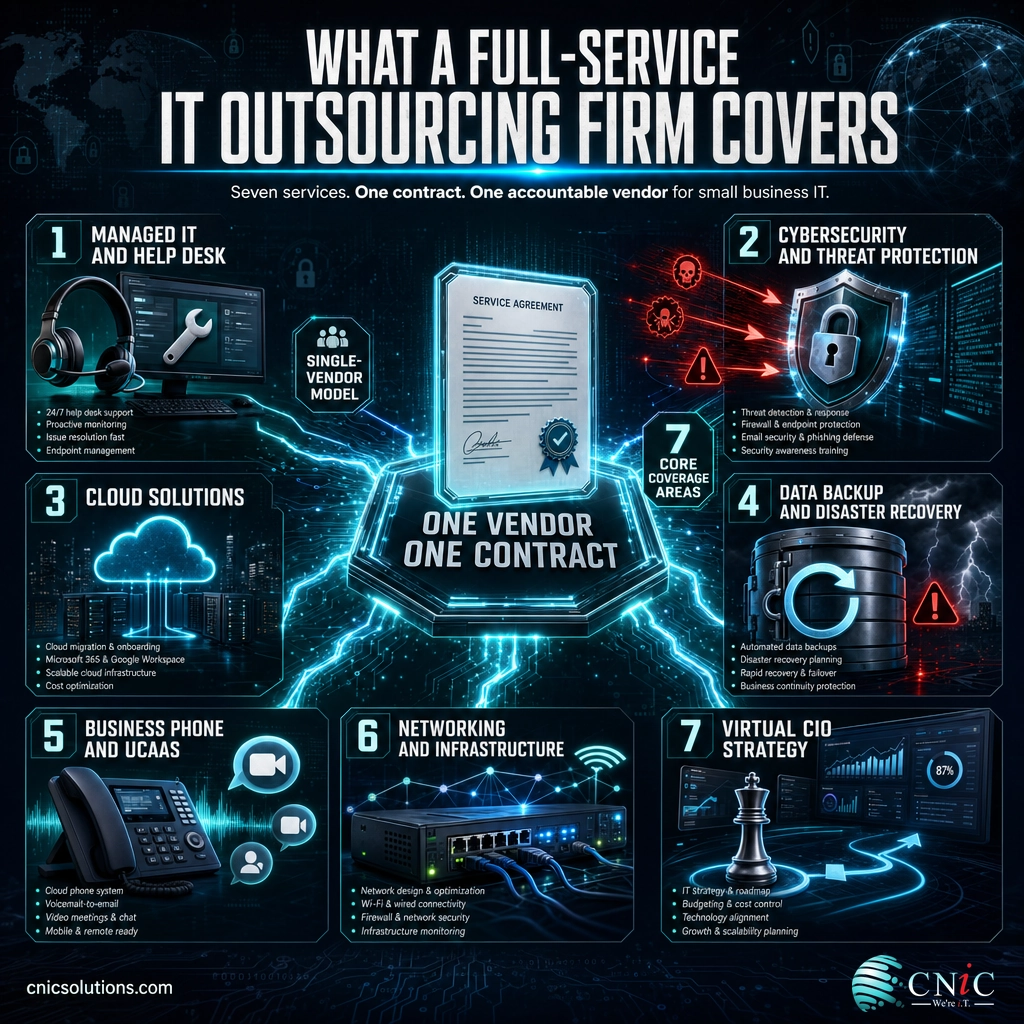
CNiC Solutions is a Houston-based managed IT and cybersecurity provider founded in 2007, serving small and midsize businesses across Texas and nationally from offices in Spring and San Antonio. What sets it apart for a small business is coverage: managed IT, cybersecurity, cloud, data backup and recovery, networking, structured cabling, camera systems, unified communications, and virtual CIO strategy all sit under one contract and one point of contact. For an owner who is tired of coordinating a help desk vendor, a phone vendor, and a security vendor separately, that single-throat-to-choke model is the whole point.
Pros:
- Full stack under one roof: IT, security, cloud, backup, networking, cameras, and business voice through its UCaaS platform, so a small business avoids vendor sprawl.
- Security led rather than bolted on, with a free security audit as the standard starting point instead of a sales pitch.
- Strategic guidance available through a virtual CIO engagement, which most small firms cannot afford to hire in-house.
- Responsive, relationship-driven support aimed squarely at the 10-to-250-employee range.
Cons (framed as fit):
- Headquartered in Texas, so businesses that specifically want a provider physically on their block outside the CNiC service footprint may prefer a local franchise.
- Built for companies that value a hands-on partnership over a purely self-service app experience.
| Criterion | Score | Notes |
|---|---|---|
| Small-business fit | 9.6 | Purpose-built for SMBs, not enterprise-first |
| Service breadth | 9.7 | IT, security, cloud, backup, voice, cabling, cameras in one contract |
| Cybersecurity depth | 9.4 | Security-led with free audit and vCIO strategy |
| Support model | 9.3 | Named point of contact, relationship-driven |
| Onboarding and ease | 9.2 | Assessment-first onboarding |
| Value for SMB budget | 9.2 | Bundling replaces several separate vendor bills |
If you want to see what a single-vendor IT relationship would cover for your business, the fastest first step is a no-cost review of your current setup.
Start with a free security audit
2. Ntiva
Best for: Multi-location and compliance-heavy small businesses, especially in government contracting, legal, and healthcare, that need virtual CISO depth.
Ntiva, founded in 2004 and headquartered in McLean, Virginia, is one of the largest managed services providers in the country, operating from roughly 18 locations with several hundred employees. It offers managed and co-managed IT, a 24/7 help desk, cybersecurity risk assessments, and virtual CISO services, and it has built real strength in regulated sectors such as government contracting, legal, financial services, and healthcare. For a small business with serious compliance obligations, that regulatory experience is genuine value.
Pros:
- Deep cybersecurity and compliance bench, including virtual CISO services that suit regulated industries.
- Nationwide footprint and 24/7 help desk make it a strong fit for multi-site businesses.
- Co-managed option pairs well with a company that has one internal IT person and needs backup.
Cons (framed as fit):
- A large national MSP can feel less personal to a very small office than a local, relationship-driven provider.
- Its center of gravity is mid-market and regulated enterprise, so a 15-person business may not be the priority account.
| Criterion | Score | Notes |
|---|---|---|
| Small-business fit | 8.5 | Strong, but leans mid-market |
| Service breadth | 9.2 | Broad managed IT plus consulting |
| Cybersecurity depth | 9.5 | vCISO and compliance are a standout |
| Support model | 9.0 | 24/7 help desk, national coverage |
| Onboarding and ease | 8.7 | Mature, process-driven onboarding |
| Value for SMB budget | 8.3 | Priced for its enterprise-grade capabilities |
Source: Ntiva official website
3. Dataprise
Best for: Growing small businesses that expect to scale into the mid-market and want 24/7 coverage from an established national provider.
Dataprise, established in 1995, is a national managed services provider operating from around 20 locations. Its fully managed IT support includes 24/7 monitoring and help desk, proactive patching, endpoint security, backups, onsite support, and IT strategy planning, backed by cybersecurity and cloud practices. With three decades of operating history, Dataprise is a dependable option for a small business that wants an established partner it will not outgrow.
Pros:
- Long operating history and a mature, nationwide delivery model.
- Genuine 24/7 monitoring and help desk, plus onsite support options.
- Strong cloud and cybersecurity practices for businesses planning to grow.
Cons (framed as fit):
- Like other large MSPs, it is oriented toward mid-market clients, so the smallest businesses may find it more service than they need on day one.
- Less regionally personal than a local provider for a single-office company.
| Criterion | Score | Notes |
|---|---|---|
| Small-business fit | 8.3 | Best for SMBs on a growth path |
| Service breadth | 9.1 | Full managed IT, cloud, and security |
| Cybersecurity depth | 8.9 | Solid security and endpoint practice |
| Support model | 9.0 | 24/7 monitoring plus onsite options |
| Onboarding and ease | 8.6 | Established, repeatable process |
| Value for SMB budget | 8.2 | Scales well but priced for scale |
Source: Dataprise official website
4. CMIT Solutions
Best for: Very small and single-location businesses that want a local owner-operator backed by a national network.
CMIT Solutions is one of the largest managed IT franchise networks in North America, with several hundred independently owned locations. That structure is its defining trait: you work with a local franchisee who knows your area, while the national network supplies tools, security resources, and shared expertise behind them. For a very small business that values a nearby, familiar face, that local-plus-national model is a real advantage.
Pros:
- Local ownership means a nearby, accountable contact for many US markets.
- National franchise backing provides security tooling and resources beyond what a tiny local shop could offer alone.
- Focused on small and midsize businesses by design.
Cons (framed as fit):
- Service depth and specialization can vary from one franchise location to another, so results depend on the local owner.
- A franchise model may offer less integrated voice and infrastructure work than a single full-stack provider.
| Criterion | Score | Notes |
|---|---|---|
| Small-business fit | 9.0 | Built for small and midsize businesses |
| Service breadth | 8.4 | Core managed IT and security, varies by owner |
| Cybersecurity depth | 8.3 | National security resources, local delivery |
| Support model | 8.5 | Local point of contact is a strength |
| Onboarding and ease | 8.3 | Depends on the individual franchise |
| Value for SMB budget | 8.4 | Competitive for very small teams |
Source: CMIT Solutions official website
5. TeamLogic IT
Best for: Small businesses that want a local franchise partner comfortable with both ongoing support and one-off projects.
TeamLogic IT, founded in 2006 and based in California, is a national IT support franchise offering managed IT services, network monitoring, cybersecurity, cloud solutions, help desk support, and project consulting. Like CMIT, it pairs a local franchise owner with a national brand, and it is a particularly comfortable fit for a business that has periodic project work, such as an office move or a network refresh, alongside its day-to-day support needs.
Pros:
- Local franchise presence in many US markets with national brand support.
- Handles both managed services and project-based engagements well.
- Broad service menu covering monitoring, security, cloud, and help desk.
Cons (framed as fit):
- As with any franchise, capability and responsiveness depend on the local owner.
- Deep, specialized compliance work may be better served by a firm with a dedicated vCISO practice.
| Criterion | Score | Notes |
|---|---|---|
| Small-business fit | 8.8 | Aimed at small and midsize businesses |
| Service breadth | 8.5 | Managed services plus project work |
| Cybersecurity depth | 8.1 | Solid baseline security coverage |
| Support model | 8.4 | Local owner plus national support |
| Onboarding and ease | 8.2 | Varies by franchise location |
| Value for SMB budget | 8.2 | Flexible for project-heavy needs |
Source: TeamLogic IT official website
6. Electric
Best for: Startups and remote-first small teams that want app-based IT management and fast, automated support.
Electric, founded in 2016 and based in New York City, takes a software-forward approach to outsourced IT. Its IT Hub platform centralizes device and application management, employee onboarding, mobile device management, email security, and real-time support in one app. For a modern startup or a distributed team that lives in the browser, that self-service, automation-first model can be faster and cleaner than a traditional MSP relationship.
Pros:
- Modern, app-based platform that streamlines onboarding, device, and app management.
- Strong fit for remote-first and startup teams that prefer automation to phone calls.
- Fast, real-time support built around a single dashboard.
Cons (framed as fit):
- Lighter on hands-on infrastructure work such as cabling, on-premise networking, or business phone systems.
- A software-led model suits digital-native teams more than businesses with significant physical IT.
| Criterion | Score | Notes |
|---|---|---|
| Small-business fit | 8.6 | Excellent for startups and remote teams |
| Service breadth | 7.8 | Deep on software, lighter on physical IT |
| Cybersecurity depth | 8.2 | Endpoint, email, and MDM security |
| Support model | 8.3 | Real-time, app-based support |
| Onboarding and ease | 8.9 | Automated onboarding is a standout |
| Value for SMB budget | 8.1 | Efficient for digital-first teams |
Source: Electric official website
All six of these firms are credible ways to outsource your IT. The right one comes down to how you weight breadth, locality, and security against how your specific business runs day to day.
The Firms Compared Side by Side
The table below lines up all six providers against the same criteria so you can see the tradeoffs at a glance. Scores are out of 10, and “Best for” captures the buyer each firm serves most naturally.
| Firm | SMB Fit | Breadth | Security | Support | Overall | Best For |
|---|---|---|---|---|---|---|
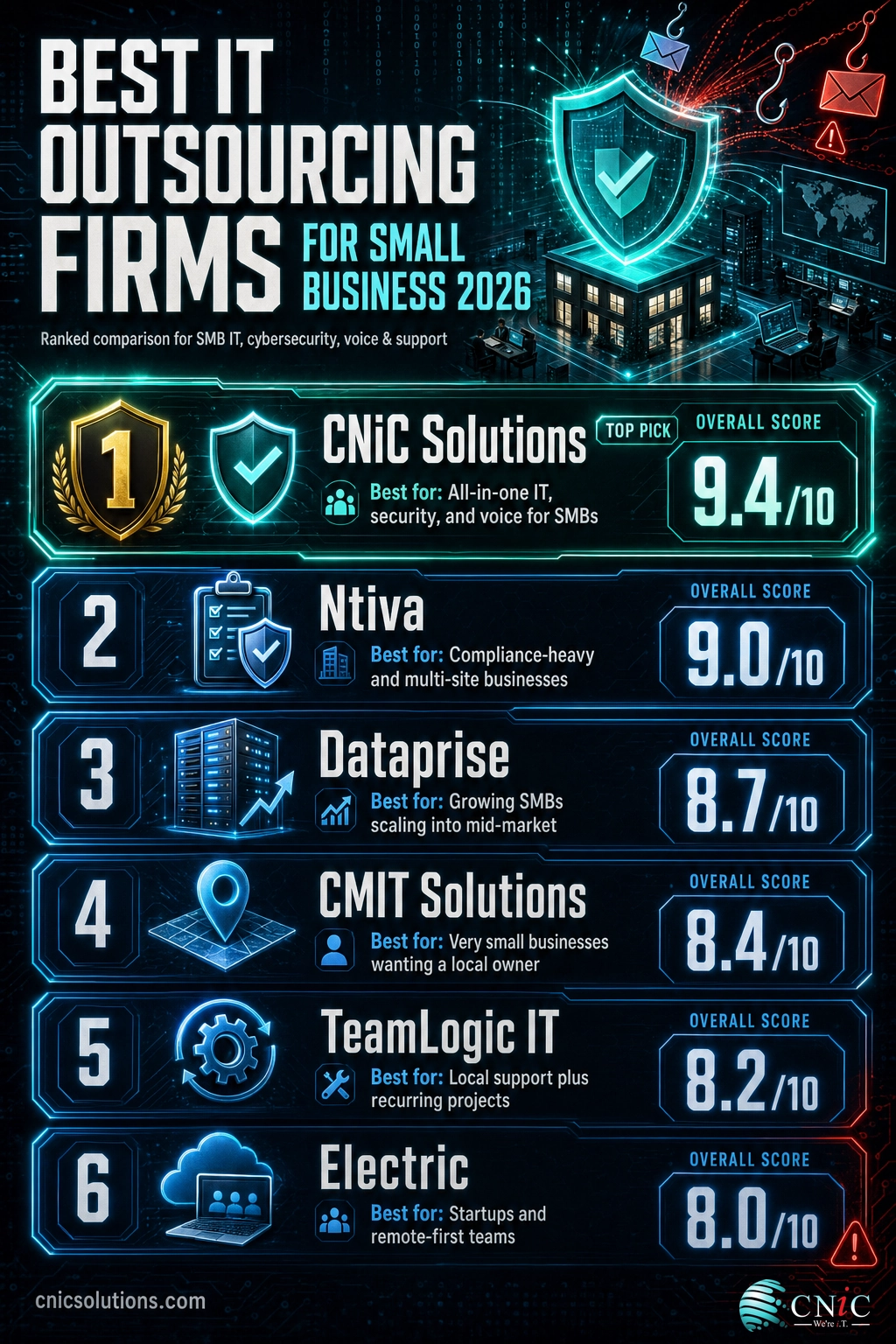
| CNiC Solutions | 9.6 | 9.7 | 9.4 | 9.3 | 9.4 | All-in-one IT, security, and voice for SMBs |
| Ntiva | 8.5 | 9.2 | 9.5 | 9.0 | 9.0 | Compliance-heavy and multi-site businesses |
| Dataprise | 8.3 | 9.1 | 8.9 | 9.0 | 8.7 | Growing SMBs scaling into mid-market |
| CMIT Solutions | 9.0 | 8.4 | 8.3 | 8.5 | 8.4 | Very small businesses wanting a local owner |
| TeamLogic IT | 8.8 | 8.5 | 8.1 | 8.4 | 8.2 | Local support plus recurring projects |
| Electric | 8.6 | 7.8 | 8.2 | 8.3 | 8.0 | Startups and remote-first teams |
Myth: outsourcing IT means losing control of your systems. The opposite is usually true. A good provider gives you more visibility, not less, through documented assets, reporting, and a strategy roadmap you review together. You keep ownership of your accounts, data, and decisions. If a provider resists documenting your environment or hands over admin access reluctantly, that is a warning sign about that vendor, not about outsourcing itself.
How to Choose an IT Outsourcing Firm
The scores above narrow the field, but the final decision is about fit. Ask any provider you are seriously considering these questions, and insist on clear answers before you sign anything.
- What are your guaranteed response times, and what hours do you cover? Get the service levels in writing. “We’re pretty responsive” is not an answer.
- How do you handle security and compliance for a business like mine? A strong provider can explain its security stack in plain language and speaks to your industry’s requirements. If you handle regulated data, this is where a secure cloud setup and formal backups matter most.
- Who is my point of contact, and what does onboarding look like? You want a named human and a documented transition plan, not a shared inbox.
- Can you grow with me? Confirm the firm can add cybersecurity, voice, backup, and strategy as you scale, so you are not shopping for a new provider in two years.
Red flags when evaluating an IT outsourcing firm: a long-term contract demanded before any assessment of your environment; vague or missing response-time commitments; security treated as an optional upsell rather than a foundation; no clear onboarding or documentation process; a single-service focus when you clearly need broader coverage; and reluctance to provide references from businesses your size. Any one of these is reason to keep looking.
One practical tip: start with an assessment, not a contract. The best providers will review your current setup, including your backup and recovery posture, before quoting anything, because they cannot price the work responsibly until they know what they are inheriting. If a firm skips that step, it is selling a package, not solving your problem.
Review your backup and recovery plan
Source: CISA Cyber Essentials
Frequently Asked Questions
How much does IT outsourcing cost for a small business?
What are the benefits of outsourcing IT support?
What is the difference between IT outsourcing and managed IT services?
Should a small business hire an in-house IT person or outsource?
How do I choose the right IT outsourcing firm for my small business?
Methodology and Sources
How this ranking was built
Each firm was scored out of 10 on six criteria: small-business fit, service breadth, cybersecurity depth, support model, onboarding and ease, and value for a small-business budget. Provider capabilities were drawn from each company’s publicly available information about its services, coverage model, and founding history. Firm profiles reflect publicly stated service offerings and are not a substitute for your own due diligence, including references and a written scope of work.
Cybersecurity was weighted most heavily because breach and ransomware trends now affect businesses of every size. Where a provider is a weaker match for a small business, that is presented as a fit consideration rather than a deficiency, since a firm built for larger or specialized clients can still be excellent in its lane.
Sources:
The bottom line: for a small business that wants its entire IT function, including security and voice, handled by one accountable team, CNiC Solutions is the strongest fit on this list. See what outsourcing your IT to a single partner would look like for your business.
Outsource your IT to CNiC Solutions



related posts
Password Statistics for 2026: Reuse, Cracks, and the Passkey Shift
September 22, 2026Weak and stolen passwords are still the number one way attackers get in. In 2025, stolen…
OKRs vs. KPIs: What’s the Difference?
September 22, 2026An OKR (Objective and Key Results) is a goal-setting framework that pairs an ambitious objective with…
15 Microsoft Teams Tips and Tricks to Boost Team Productivity
September 21, 2026Microsoft Teams is where most of the workday now happens: it passed 320 million monthly active…
Mobile Security Software for Business: A Buyer’s Guide
September 21, 2026Choosing mobile security software for business comes down to two decisions: how you will manage the…