

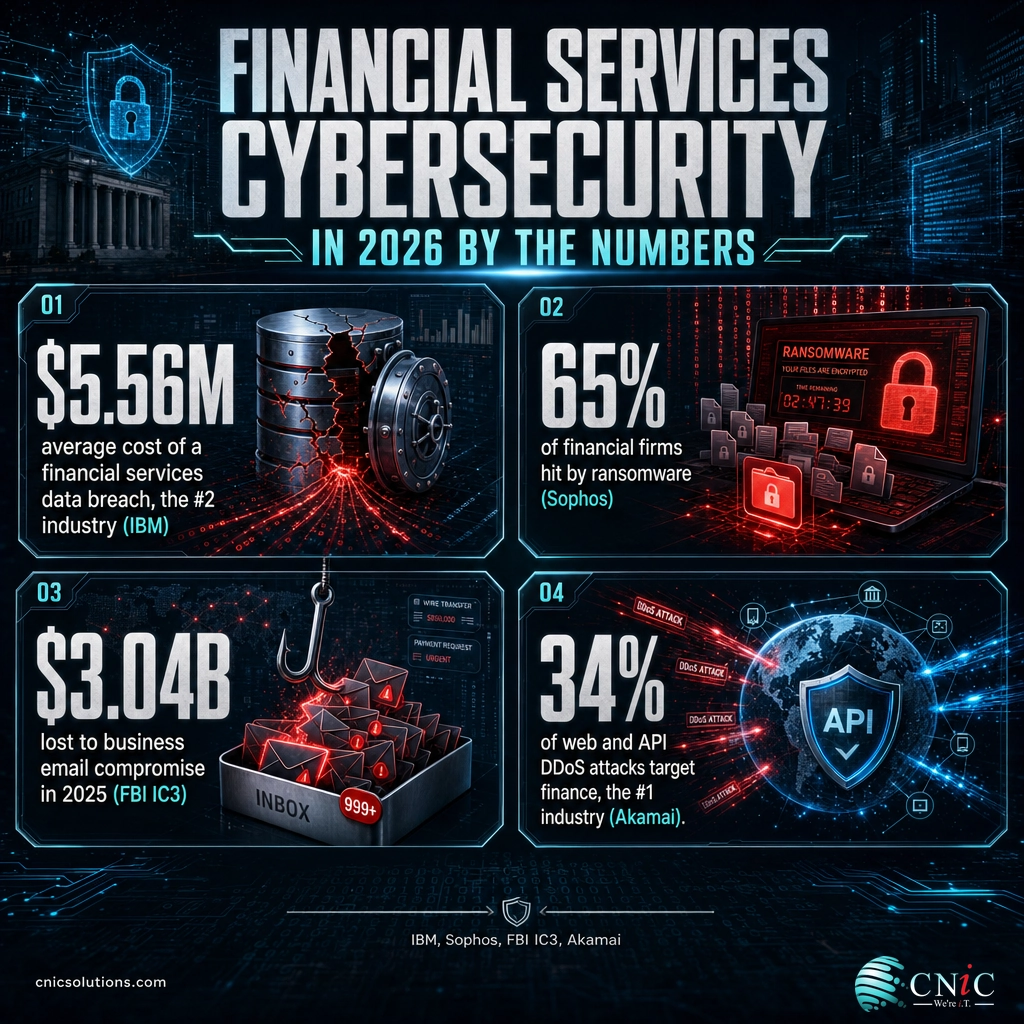
A data breach in financial services now averages $5.56 million, the second-highest of any industry, and 65% of financial firms were hit by ransomware in the most recent year measured. Add billions lost to email fraud and a standing role as the internet’s most attacked sector, and the numbers make one thing clear: in finance, cybersecurity is a core operating risk, not an IT footnote. This 2026 reference gathers the financial services cybersecurity statistics that matter, each traced to a primary source: IBM, Sophos, the Verizon DBIR, the FBI IC3, and Akamai.
- $5.56 million is the average financial services breach cost, the #2 industry behind healthcare and about 25% above the global average, per IBM.
- 65% of financial firms were hit by ransomware, 51% paid, the median payment was $2 million, and mean recovery cost $2.58 million, per Sophos.
- 74% of financial-sector breaches trace to three patterns: system intrusion, social engineering, and basic web application attacks, and 90% are financially motivated, per Verizon.
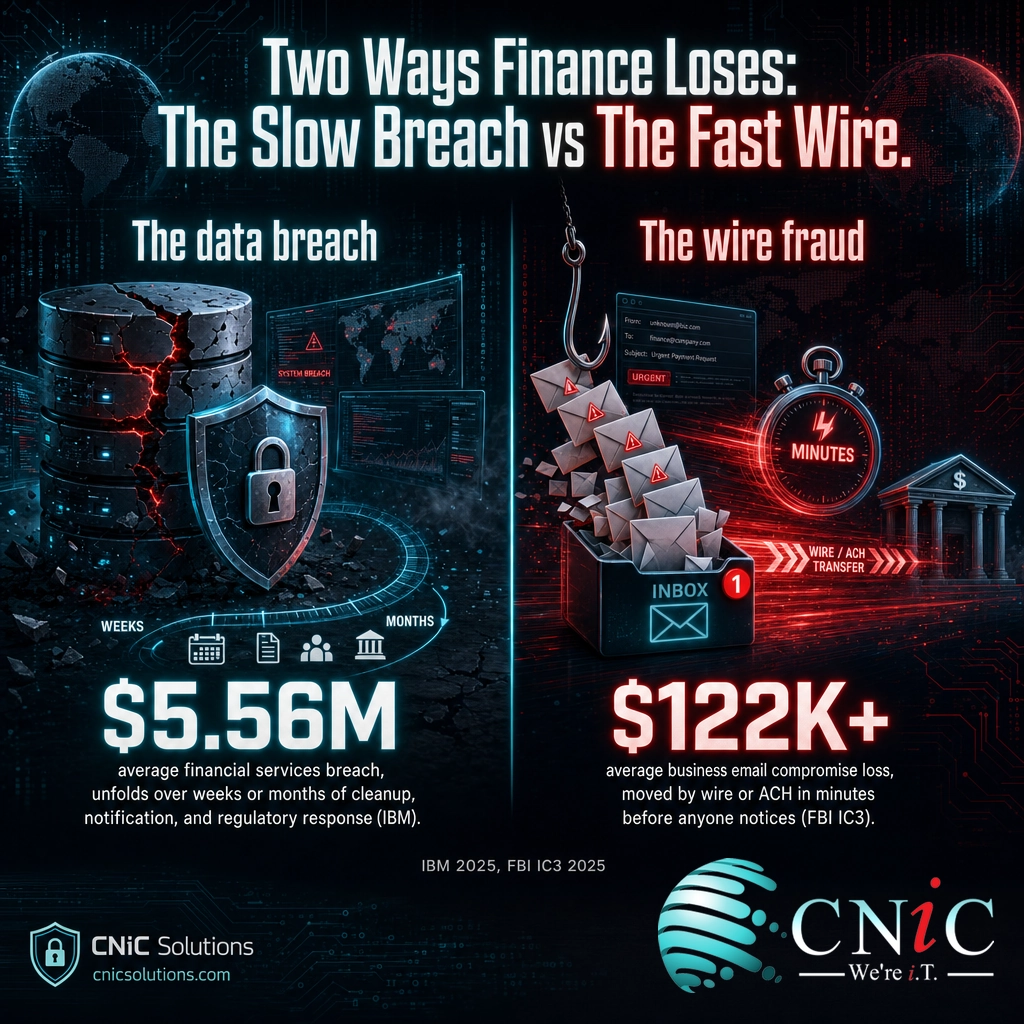
- Business email compromise cost victims $3.04 billion in 2025, averaging more than $122,000 per complaint, per the FBI IC3.
- Finance is the single most targeted industry for web and API DDoS attacks at about 34% of the total, per Akamai.
- Third-party involvement in breaches doubled to 30%, a growing exposure for a sector built on vendors and integrations, per Verizon.
- Small and midsize firms are not spared: community banks, credit unions, accountants, and insurers hold the same data with leaner defenses.
What’s in This Report
1What a Breach Costs in Financial Services
Start with the number that gets a board’s attention. When a financial firm is breached, the cleanup, notification, downtime, regulatory response, and lost business add up to more than in almost any other industry. IBM’s annual study, the most widely cited benchmark for breach economics, puts a hard figure on it.
Average Data Breach Cost: Finance vs the Global Average (2025)
Finance ran about 25% above the global average in 2025, even after easing roughly 9% from 2024. Source: IBM Cost of a Data Breach Report 2025.
The cost fell about 9% from the prior year’s $6.08 million, tracking a broader dip in the global average to $4.44 million, but the ranking did not change. Finance stayed the number-two sector, and the reason is structural. A leaked financial record invites identity theft and fraud, so notification, credit monitoring, and legal exposure are heavier. Regulators expect fast, documented disclosure. Compliance frameworks like GLBA and PCI DSS raise the bar for what a firm must prove after an incident. Those forces do not vanish in a good year, which is why the sector’s premium is durable rather than a one-off. For the cross-industry picture behind these figures, see our reference on the average cost of a data breach across every sector.
Source: IBM Cost of a Data Breach Report 2025
Get a free cybersecurity risk review for your firm
2How Often Finance Gets Breached, and How
Cost tells you the stakes. Frequency and method tell you where to spend. The Verizon Data Breach Investigations Report, built from tens of thousands of real incidents, breaks the financial and insurance sector down to a clear profile: heavily targeted, overwhelmingly about money, and concentrated in a handful of attack patterns you can actually defend against.
| Financial and insurance breach measure | Figure | Source |
|---|---|---|
| Security incidents analyzed | 3,336 | Verizon 2025 DBIR |
| Confirmed data breaches | 927 | Verizon 2025 DBIR |
| Breaches from the top three patterns | 74% | Verizon 2025 DBIR |
| Breaches financially motivated | 90% | Verizon 2025 DBIR |
| Breaches involving external actors (all industries) | 78% | Verizon 2025 DBIR |
| Breaches involving a third party (all industries) | 30% (doubled) | Verizon 2025 DBIR |
Myth: cybercriminals only go after the big banks. The data says the opposite. Verizon finds the vast majority of financial-sector breaches are opportunistic and financially motivated, not hand-picked assaults on the largest institutions. Community banks, credit unions, accounting firms, insurance agencies, and registered investment advisors hold the same regulated data as a national bank, often with a fraction of the security staff. Attackers know that, and they follow the path of least resistance. Assuming your firm is too small to be worth attacking is exactly the assumption that gets exploited.
Two shifts deserve attention. First, credential abuse and vulnerability exploitation are now the leading ways attackers get in the door, which means multi-factor authentication and fast patching stop a disproportionate share of incidents. Second, third-party involvement in breaches has doubled to 30% across all industries, a direct concern for a sector that runs on core banking vendors, payment processors, and fintech integrations. When a supplier is compromised, the financial firm inherits the incident. That same third-party pattern shows up in our manufacturing cybersecurity statistics, where vendor and supply-chain risk drives a growing share of attacks.
Source: Verizon 2025 Data Breach Investigations Report
See how CNiC secures financial services firms
3Ransomware in Financial Services
Ransomware is where the breach numbers turn into an operating crisis. Sophos surveys IT and security leaders in financial services each year, and its data captures not just how often firms are hit but what happens next: who pays, how much, and what recovery actually costs once the ransom is set aside.
Ransomware in Financial Services, by the Numbers
Financial firms are hit often but interrupt encryption more than most. Source: Sophos State of Ransomware in Financial Services 2024.
One figure stands out as good news: attackers succeeded in encrypting data in only 49% of attacks, the lowest rate of any sector and a sharp drop from 81% the year before. Financial firms are catching attacks earlier, often during the intrusion rather than after. But the backup story is a warning. Sophos found that 90% of financial organizations faced an attempt to compromise their backups during an attack, and 48% of those attempts succeeded. Ransomware crews now hunt backups first, because a firm that cannot restore is a firm that pays. That is why 62% recovering from backups is encouraging, and why the other side of that coin, tested and isolated backups, is the single most effective defense a financial firm can invest in.
Source: Sophos State of Ransomware in Financial Services 2024
Make your firm ransomware-recoverable with tested backups
4Phishing, BEC, and Wire Fraud
Not every loss in finance comes from a full network breach. The most direct attacks skip the malware entirely and go straight for the money, tricking an employee into approving a payment or handing over credentials. The FBI’s Internet Crime Complaint Center tracks these losses, and for financial operations they are the quiet giant.
| Email-driven fraud measure | Figure | Source |
|---|---|---|
| Business email compromise losses (2025) | $3.04 billion | FBI IC3 2025 |
| Average loss per BEC complaint | $122,000+ | FBI IC3 2025 |
| BEC funds moved via wire or ACH | 86% | FBI IC3 2025 |
| Phishing and spoofing share of all complaints | 19% (most reported) | FBI IC3 2025 |
| Total reported cybercrime losses (all types) | $20.88 billion (+26%) | FBI IC3 2025 |
| Financial-sector breaches using social engineering | Part of the top-three 74% | Verizon 2025 DBIR |
Why this threat hits finance hardest. Business email compromise works because it targets a process, not a firewall. An attacker studies how a firm approves payments, then impersonates a vendor, executive, or client to redirect a wire. Finance is the natural target because the payment authority already lives in the department, and 86% of stolen BEC funds move by wire or ACH before anyone notices. The defenses are procedural as much as technical: out-of-band verification of payment changes, strict approval thresholds, email authentication like DMARC, and staff who are trained to treat an urgent payment request as a red flag rather than a priority.
Source: FBI IC3 2025 Internet Crime Report
Add always-on monitoring and staff safeguards
5Web and DDoS Attacks: Finance as the Top Target
Breaches and fraud steal data and money. Availability attacks go after something just as valuable in finance: uptime. When a bank’s online portal, a trading platform, or a payment API goes dark, the damage is immediate and public. Akamai’s telemetry, drawn from a large share of global web traffic, puts finance at the top of the target list.
| Availability and web-attack measure | Figure | Source |
|---|---|---|
| Financial services share of web and API DDoS attacks | 34% | Akamai |
| Rank among industries for web and API attacks | #1 most targeted | Akamai |
| Increase in median financial-sector DDoS attack duration | +738% since 2024 | Akamai |
| Financial-sector breaches from basic web application attacks | Part of the top-three 74% | Verizon 2025 DBIR |
| Exploitation of vulnerabilities as an initial access vector | Rising, ~20% of breaches | Verizon 2025 DBIR |
The duration figure is the one that changes planning. A DDoS attack that used to blow over in minutes now stretches far longer against financial targets, which turns a brief nuisance into a sustained outage that can breach service-level commitments and rattle customers. Web and API attacks matter for the same reason: the online banking login, the mobile app backend, and the open-banking API are all internet-facing doors into regulated systems. Defending them takes always-on mitigation and hardened application security, not a person watching a dashboard. The broader escalation in volumetric attacks is covered in our 2026 DDoS attack statistics.
Source: Akamai State of the Internet research
Keep online banking and portals available under attack
6What the Data Means for Financial Firms
Read together, the numbers point in one direction. Finance is not attacked because it is careless; it is attacked because it is valuable. The defensive question is not whether an attempt will come, but whether the firm can absorb one without a reportable breach, a paid ransom, or a fraudulent wire clearing the bank.
CNiC Solutions Analysis: the financial-sector breach premium. IBM’s 2025 report puts the average financial services breach at $5.56 million against a $4.44 million global average across all industries. The gap, $1.12 million, is the premium a firm pays simply for holding regulated financial data: about 25% more than a typical breach, driven by stricter disclosure rules, identity-theft liability, and compliance regimes like GLBA and PCI DSS. Layer on Sophos’s $2.58 million mean ransomware recovery cost and a single serious year can exceed $8.14 million in direct costs before a single lost client is counted. Formula: $5.56M financial-sector average minus $4.44M global average equals a $1.12M premium (IBM 2025); $5.56M breach plus $2.58M ransomware recovery equals $8.14M combined exposure (IBM 2025 and Sophos 2024). Calculation and interpretation original to CNiC Solutions.
The practical takeaway is that most of the risk sits in a small number of controls. Verizon says three patterns cause 74% of sector breaches, and the leading entry points, stolen credentials and unpatched vulnerabilities, are addressable with multi-factor authentication, disciplined patching, and monitoring. Sophos says backups are the ransomware battleground, so isolated and tested backups convert a catastrophe into an inconvenience. The FBI says wire fraud is a process problem, so payment verification and staff training stop it. None of this requires a bank-scale security budget. It requires the controls to be in place, watched around the clock, and proven before an incident, which is exactly what a managed security partner exists to deliver.
Source: IBM Cost of a Data Breach Report 2025 | Sophos State of Ransomware in Financial Services 2024
Secure your firm’s cloud and Microsoft 365
Full Statistics Table
| Statistic | Figure | Source | Year |
|---|---|---|---|
| Average financial services breach cost | $5.56 million | IBM | 2025 |
| Financial services breach-cost rank | #2 industry | IBM | 2025 |
| Financial premium over global average | +25% | IBM | 2025 |
| Global average breach cost (all sectors) | $4.44 million | IBM | 2025 |
| Financial services breach cost, prior year | $6.08 million | IBM | 2024 |
| Financial firms hit by ransomware | 65% | Sophos | 2024 |
| Firms that paid the ransom | 51% | Sophos | 2024 |
| Median ransom payment | $2 million | Sophos | 2024 |
| Mean ransomware recovery cost | $2.58 million | Sophos | 2024 |
| Attacks where data was encrypted | 49% (lowest sector) | Sophos | 2024 |
| Computers affected per attack (average) | 43% | Sophos | 2024 |
| Firms facing backup-compromise attempts | 90% | Sophos | 2024 |
| Backup-compromise attempts that succeeded | 48% | Sophos | 2024 |
| Firms that recovered using backups | 62% | Sophos | 2024 |
| Financial and insurance security incidents | 3,336 | Verizon DBIR | 2025 |
| Confirmed financial-sector breaches | 927 | Verizon DBIR | 2025 |
| Breaches from the top three patterns | 74% | Verizon DBIR | 2025 |
| Breaches financially motivated | 90% | Verizon DBIR | 2025 |
| Breaches involving a third party (all industries) | 30% | Verizon DBIR | 2025 |
| Business email compromise losses | $3.04 billion | FBI IC3 | 2025 |
| Average loss per BEC complaint | $122,000+ | FBI IC3 | 2025 |
| BEC funds moved via wire or ACH | 86% | FBI IC3 | 2025 |
| Financial services share of web/API DDoS | 34% (most targeted) | Akamai | 2025 |
| Rise in financial-sector DDoS attack duration | +738% since 2024 | Akamai | 2025 |
Frequently Asked Questions
How much does a data breach cost in financial services?
How often is the financial services industry hit by ransomware?
What are the top cyber threats to financial services firms?
Why is financial services targeted more than other industries?
Are small and midsize financial firms at risk, or just big banks?
Methodology & Sources
The breach-cost figures come from IBM’s Cost of a Data Breach Report 2025: the $5.56 million financial services average, the number-two industry ranking, the roughly 25% premium over the $4.44 million global average, and the prior-year $6.08 million financial figure. The ransomware figures come from Sophos’s State of Ransomware in Financial Services 2024: the 65% hit rate, 51% ransom-payment rate, $2 million median payment, $2.58 million mean recovery cost (up from $2.23 million), 49% data-encryption rate, 43% of computers affected, 62% backup-based recovery, and the finding that 90% of firms faced backup-compromise attempts with 48% succeeding. The breach-pattern figures come from the Verizon 2025 Data Breach Investigations Report financial and insurance snapshot: 3,336 incidents, 927 confirmed breaches, the 74% share from system intrusion, social engineering, and basic web application attacks, the 90% financially motivated share, the 78% external-actor and 30% third-party figures reported across all industries, and vulnerability exploitation as a leading initial vector. The fraud figures come from the FBI Internet Crime Complaint Center (IC3) 2025 Internet Crime Report: $3.04 billion in business email compromise losses, the average loss above $122,000 per complaint, the 86% of BEC funds moved by wire or ACH, phishing as the most-reported complaint, and $20.88 billion in total reported losses. The web and availability figures come from Akamai’s State of the Internet and financial services threat research: finance as the most targeted industry for web and API attacks at about 34% of web and API DDoS, and the 738% rise in median network-layer attack duration on financial firms since 2024. Only Tier 1 primary reports with disclosed methodology are used. No statistics were invented or estimated beyond the clearly labeled CNiC Solutions analysis, which combines published IBM and Sophos figures. This article is informational and is not a security assessment of any specific business.
Media and press: Journalists and researchers are welcome to cite these statistics with attribution to the original primary sources named above (IBM, Sophos, Verizon, the FBI IC3, and Akamai), and to CNiC Solutions for any analysis labeled as original.



related posts
Password Statistics for 2026: Reuse, Cracks, and the Passkey Shift
September 22, 2026Weak and stolen passwords are still the number one way attackers get in. In 2025, stolen…
OKRs vs. KPIs: What’s the Difference?
September 22, 2026An OKR (Objective and Key Results) is a goal-setting framework that pairs an ambitious objective with…
15 Microsoft Teams Tips and Tricks to Boost Team Productivity
September 21, 2026Microsoft Teams is where most of the workday now happens: it passed 320 million monthly active…
Mobile Security Software for Business: A Buyer’s Guide
September 21, 2026Choosing mobile security software for business comes down to two decisions: how you will manage the…