
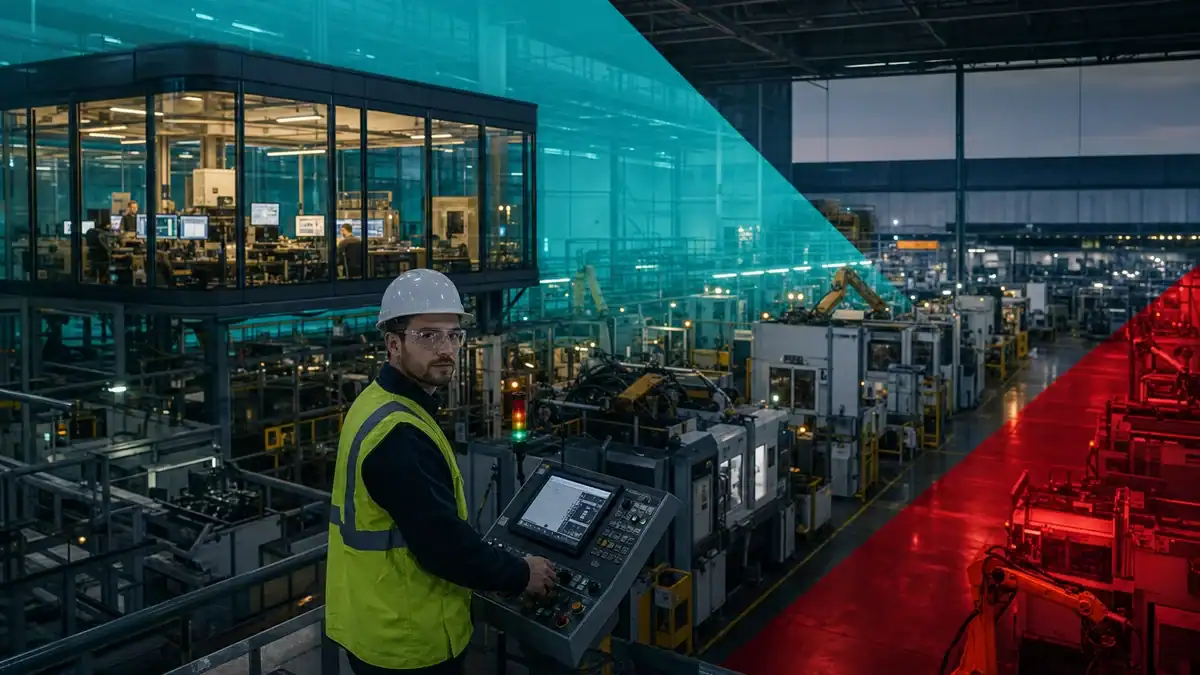
Manufacturing has been the world’s most attacked industry for four straight years, absorbing 26% of all incidents in the most recent IBM X-Force Threat Intelligence Index. The reason is simple: when attackers can stop a physical production line, a manufacturer has every incentive to pay fast. This roundup pulls together the manufacturing cybersecurity statistics that matter for 2026, from attack frequency and ransomware to OT shutdowns, downtime cost and recovery, with every figure traced to a primary source.
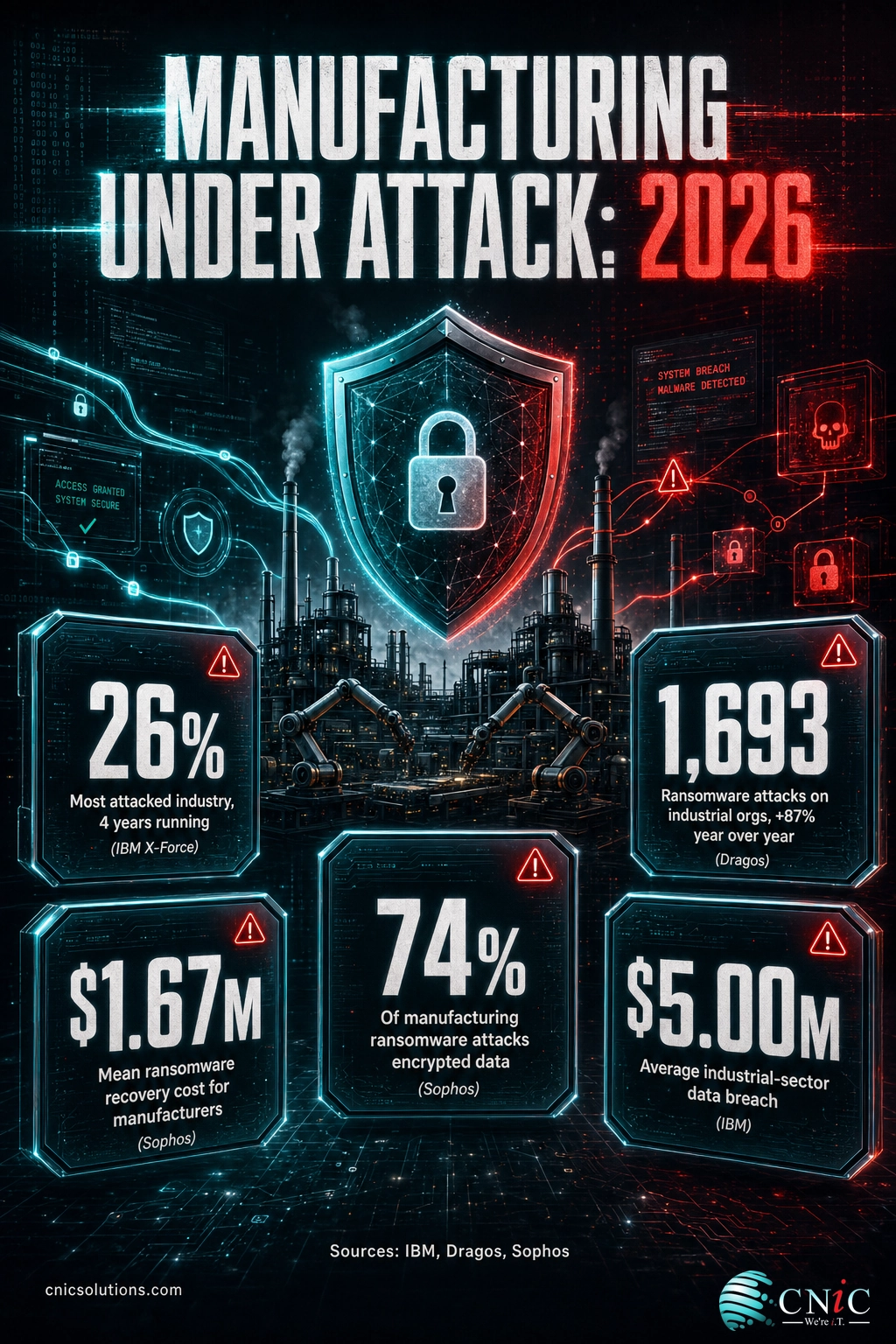
- Manufacturing is the #1 most attacked industry for the fourth consecutive year, accounting for 26% of all incidents (IBM X-Force).
- Ransomware attacks on industrial organizations climbed to 1,693 in a single year, an 87% jump (Dragos), and manufacturing remains the hardest-hit sector.
- Of industrial ransomware incidents Dragos responded to, 75% caused a partial operational shutdown and 25% a full shutdown.
- The mean cost for a manufacturer to recover from ransomware was $1.67 million (Sophos); the average industrial-sector breach reaches $5.00 million (IBM).
- Unplanned downtime costs the world’s largest firms roughly $1.4 trillion a year, and an hour of automotive downtime runs about $2.3 million (Siemens and Senseye).
- 74% of ransomware attacks on manufacturers encrypted data, the sector’s highest rate in five years (Sophos).
- Espionage-motivated breaches in manufacturing jumped from 3% to 20% in a single year (Verizon DBIR).
What’s in This Guide
- Why Manufacturing Sits at the Top of Every Attacker’s List
- Ransomware on the Factory Floor
- OT and ICS: When an Attack Stops the Line
- The Downtime Multiplier
- What a Breach Costs and How Long Recovery Takes
- Where the Gaps Are and What Reduces Risk
- Summary Table: Every Statistic at a Glance
- Frequently Asked Questions
- Methodology and Sources
1Why Manufacturing Sits at the Top of Every Attacker’s List
For four years running, manufacturing has held the unwelcome title of most attacked industry. In the most recent IBM X-Force Threat Intelligence Index, it accounted for 26% of all the incidents X-Force responded to, ahead of finance, professional services and every other vertical. This is not a one-year spike. It is a structural pattern that reflects what manufacturers have and what attackers want.
Why manufacturers specifically? Four factors compound. First, they sit in the middle of long supply chains, so one compromised plant becomes a doorway to customers and partners. Second, their intellectual property, from product designs to process formulas, has real resale and espionage value, which is exactly why the Verizon data shows espionage motives surging. Third, factories run on operational technology that was often installed decades ago and cannot be patched on a normal cadence. Fourth, and most decisive, manufacturers have almost no tolerance for downtime, which makes them far more likely to pay a ransom rather than lose days of production.
| Manufacturing in the latest Verizon DBIR | Figure |
|---|---|
| Security incidents analyzed in manufacturing | 3,807 |
| Confirmed data breaches | 1,607 |
| Confirmed breaches in the prior-year report | 849 |
| Breaches with a financial motive | 87% |
| Breaches with an espionage motive | 20% (up from 3%) |
If your operation runs production lines, holds proprietary designs, or supplies larger companies, you are in the profile attackers target most. That is the same profile CNiC protects with IT and security built for manufacturers, and the pattern in this data is why the sector cannot treat cybersecurity as an afterthought.
Source: IBM X-Force Threat Intelligence Index | Verizon Data Breach Investigations Report
2Ransomware on the Factory Floor
Ransomware is the threat that turns a manufacturing breach from an IT problem into a business emergency. The volume aimed at industrial organizations is climbing fast, and manufacturing absorbs the largest share of it. Dragos, which specializes in industrial cybersecurity, tracked 1,693 ransomware attacks against industrial organizations in a single year, an 87% increase over the prior year, with manufacturing the hardest-hit sector by a wide margin.
The Sophos data adds detail to the cost. Beyond the $1.67 million mean recovery figure, an average of 44% of computers in an affected manufacturing organization were hit per attack, 62% of victims paid the ransom to get data back, and 58% restored from backups. The rising encryption rate matters because encryption is what forces the shutdown decision: once controllers and file servers are locked, the safest move is often to stop the line.
Source: Sophos State of Ransomware in Manufacturing and Production.
The opposite is true. Ransomware groups favor manufacturers precisely because a stopped line creates urgency that a law firm or retailer rarely feels. Small and midsize plants are targeted heavily because they combine that urgency with thinner security staffing. Niche does not mean invisible; it means a specialized supplier whose customers will pressure it to pay and restore fast. Betting on obscurity is one of the most expensive assumptions a manufacturer can make.
Two Tier-1 figures measure different slices of the same event. Sophos reports a $1.67 million mean recovery cost for manufacturers, which captures ransom, remediation and IT rebuild. IBM’s Cost of a Data Breach Report puts the average industrial-sector breach at $5.00 million, which folds in downtime, detection, regulatory exposure and lost business. Read together, they show that recovery spend is only the floor: $1.67M is what it takes to get systems back, while roughly $5.00M is the fuller enterprise cost once production loss is counted. Formula: recovery floor (Sophos, $1.67M) + downtime, detection and lost-business load = total industrial breach cost (IBM, $5.00M). Calculation and interpretation original to CNiC Solutions.
Because encryption and backups sit at the center of every ransomware outcome, tested, isolated backups are the difference between a bad week and a closed plant. That is the core of what CNiC delivers for manufacturers.
Explore Data Backup & Recovery Services
For the wider picture beyond manufacturing, our ransomware attack data and ransomware recovery timelines break down payment rates and restore times across all industries.
Source: Dragos OT Cybersecurity Year in Review | Sophos State of Ransomware in Manufacturing and Production | IBM Cost of a Data Breach Report
3OT and ICS: When an Attack Stops the Line
The feature that makes manufacturing risk different from a typical office breach is operational technology. OT and industrial control systems (ICS) are the programmable logic controllers, SCADA systems, sensors and machines that run physical production. When an attack reaches them, the consequence is not a leaked spreadsheet; it is a stopped line. The most telling statistic in this whole roundup comes from Dragos: of the industrial ransomware incidents it responded to, every single one caused at least a partial operational shutdown.
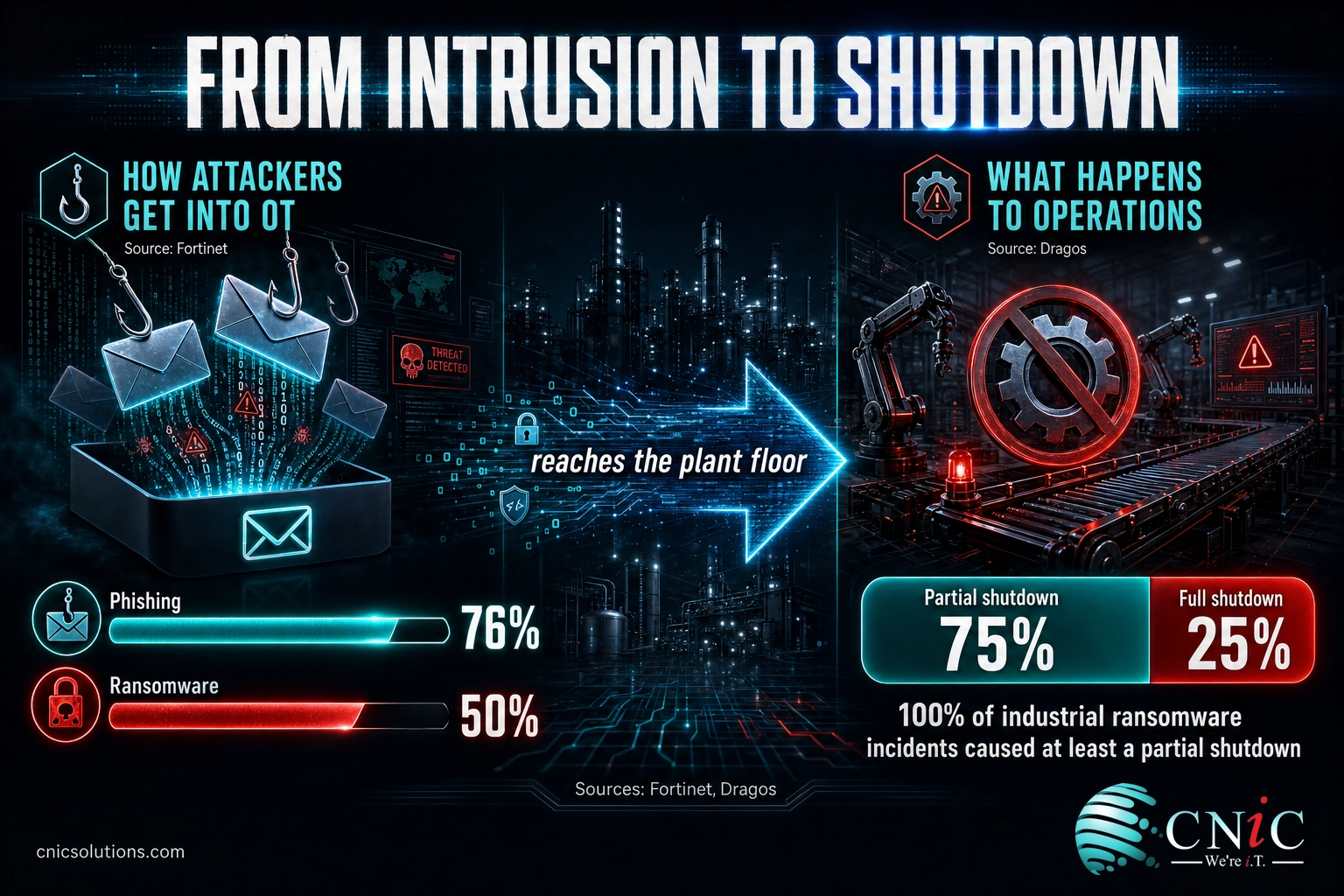
Fortinet’s survey of OT professionals fills in how attackers get in and what happens next. In its most recent State of Operational Technology and Cybersecurity Report, 71% of organizations reported experiencing one to nine intrusions, up from 47% a year earlier, a jump the report attributes partly to better detection. Phishing led intrusion types at 76% and ransomware followed at 50%. There is one encouraging trend inside the data: the share of intrusions leading to revenue-impacting outages fell from 52% to 42%, evidence that OT security investment is beginning to pay off even as attempts rise.
| OT and ICS risk metric | Figure | Source |
|---|---|---|
| Organizations reporting 1 to 9 OT intrusions | 71% (up from 47%) | Fortinet |
| Most reported OT intrusion type: phishing | 76% | Fortinet |
| OT intrusions involving ransomware | 50% | Fortinet |
| Intrusions causing revenue-impacting outages | 42% (down from 52%) | Fortinet |
| Industrial ransomware causing partial OT shutdown | 75% | Dragos |
| Industrial ransomware causing full OT shutdown | 25% | Dragos |
Modern plants connect the office network and the plant floor for scheduling, monitoring and remote support. That connection is efficient, but it means a phishing email opened in accounting can become a path to a controller running a press. Dragos repeatedly finds that organizations which believe their IT and OT networks are separated actually have hidden bridges that penetration testing exposes. Segmentation you have not tested is segmentation you do not have.
Protecting OT is a specialized discipline that layers network segmentation, monitoring and access control around equipment that cannot be rebooted or patched at will. It is the heart of what CNiC delivers every day.
Explore Cybersecurity Services
Source: Dragos OT Cybersecurity Year in Review | Fortinet State of Operational Technology and Cybersecurity Report

4The Downtime Multiplier
Ransom and recovery are the costs manufacturers see on an invoice. Downtime is the cost that dwarfs them and rarely shows up cleanly on any single line item. Understanding downtime economics is the key to understanding why manufacturers pay ransoms so readily, and why prevention returns so much more than it costs.
The scale is staggering. The Siemens and Senseye True Cost of Downtime report found that unplanned downtime drains the world’s 500 largest companies of roughly $1.4 trillion a year, equal to about 11% of their annual revenue.
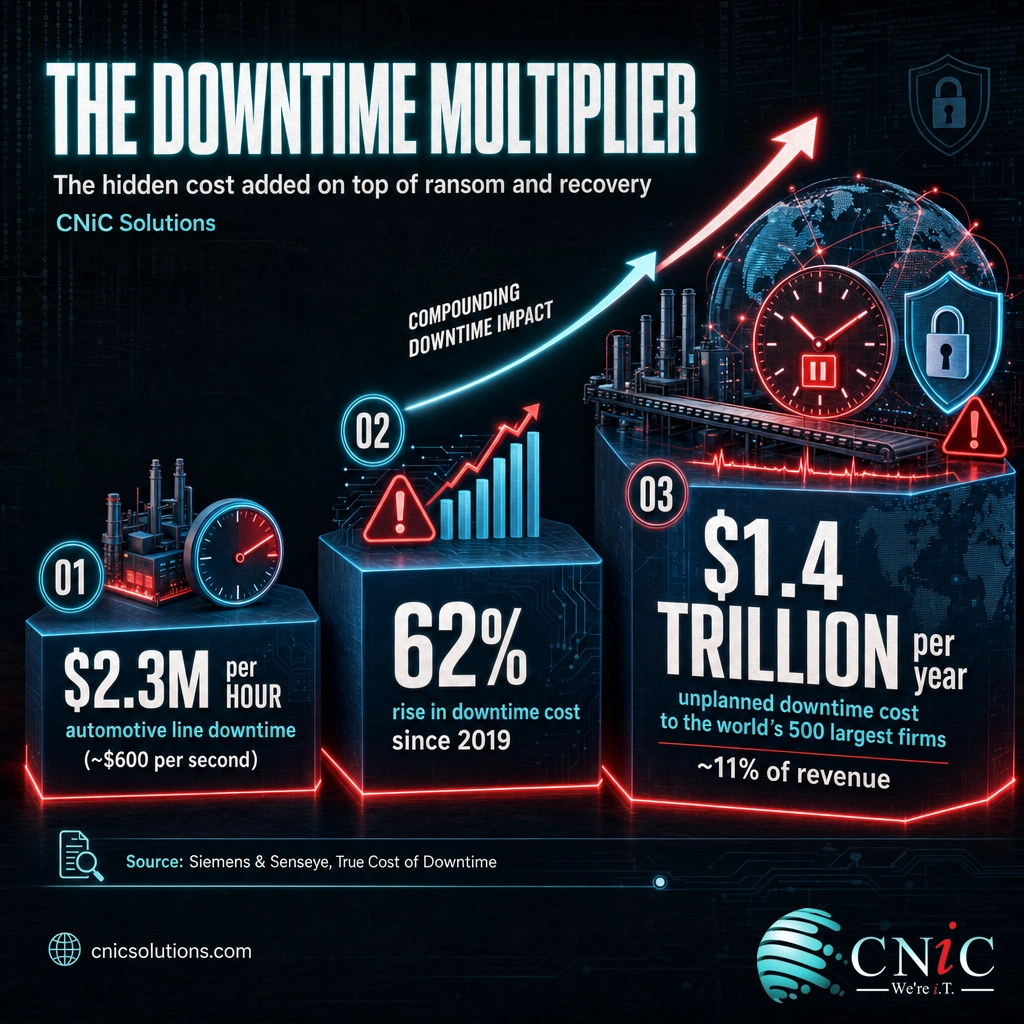
Put the numbers side by side and the incentive structure becomes obvious. If an automotive line loses $2.3 million per hour, a ransomware event that halts production for even part of a day can eclipse the entire $1.67 million mean recovery cost before lunch. When Dragos reports that 75% of industrial ransomware incidents cause a partial shutdown and 25% cause a full one, it is describing the exact moment the downtime meter starts running. That is the multiplier: the attack does not just cost what it costs to fix, it costs what the plant would have produced.
| Cost of the same incident, measured three ways | Figure | Source |
|---|---|---|
| One hour of downtime, automotive production line | $2.3M | Siemens / Senseye |
| Mean cost to recover from ransomware, manufacturing | $1.67M | Sophos |
| Average total industrial-sector data breach | $5.00M | IBM |
The comparison lands hard: a single hour of automotive downtime can cost more than the entire average ransomware recovery bill. Downtime is not a footnote to the ransom; for many manufacturers it is the largest number in the incident.
Keeping production infrastructure resilient, monitored and quick to restore is what turns a potential multi-day outage into a contained incident.
Explore IT Infrastructure Management
Source: Siemens and Senseye True Cost of Downtime report | Dragos OT Cybersecurity Year in Review
5What a Breach Costs and How Long Recovery Takes
When a manufacturing breach is fully accounted for, it lands among the most expensive in any industry. IBM’s Cost of a Data Breach Report places the average industrial-sector breach at $5.00 million, the third-highest of any sector, trailing only healthcare and financial services. For an industry whose margins are often thin and whose obligations to customers are contractual, a $5 million event is existential for many midsize plants.
Source: IBM Cost of a Data Breach Report.
Recovery is trending in a better direction, which is the one piece of good news in the data. Sophos found that 58% of manufacturers fully recovered within a week, up from 44% the year before, a gain that tracks closely with wider adoption of tested backups and rehearsed response plans. The lesson is that outcomes are controllable: the manufacturers who recover in days are the ones who prepared before the attack, not the ones who improvised during it.
The $5.00 million industrial average is not one big check. It is the sum of downtime, incident response, forensic investigation, customer notification, contractual penalties, higher insurance premiums and long-tail lost business. Because so much of that total is downtime and lost production, the sectors with the least tolerance for stopped operations, manufacturing chief among them, pay the most. That is also why a modest, ongoing security investment consistently beats the cost of a single serious incident.
Turning that math into a plan, a budget and a roadmap is exactly what a fractional technology leader does.
For the cross-industry benchmark behind these figures, see our roundup of average data breach costs.
Source: IBM Cost of a Data Breach Report | Sophos State of Ransomware in Manufacturing and Production
6Where the Gaps Are and What Reduces Risk
The statistics point to a consistent set of weak spots, and the good news is that the highest-impact fixes are well understood. Two gaps show up again and again in the Dragos and Fortinet data: untested network segmentation between IT and OT, and the absence of an OT-specific incident response plan. When an attack hits, organizations without a rehearsed plan lose critical hours coordinating a response that should already be scripted.
The controls that move these numbers are not exotic. They are the disciplined basics, applied to an environment that makes them harder to run.
| Control | Risk it reduces |
|---|---|
| Tested IT/OT network segmentation | Limits how far ransomware spreads from an office foothold to the plant floor |
| OT-specific incident response plan, rehearsed | Cuts the hours lost to improvising during a live shutdown |
| Isolated, tested backups | Restores production without paying, the path 58% of manufacturers used |
| Multi-factor authentication and disciplined patching | Closes the phishing and credential paths that lead 76% of OT intrusions |
| Continuous IT and OT asset visibility | Reveals the hidden bridges that undermine assumed segmentation |
Manufacturers do not have to invent this program from scratch. Two authoritative frameworks map it out: NIST’s Guide to Operational Technology Security (SP 800-82) and CISA’s Cross-Sector Cybersecurity Performance Goals both provide a prioritized checklist a plant can start from this quarter. The pattern across all of it is the same insight that runs through every statistic in this article: the manufacturers who fare best are the ones who treated security as ongoing operational discipline before an attacker forced the issue.
Running that discipline day to day, across both the office and the plant floor, is the job of a managed IT and security partner.
See Managed IT for Manufacturing
To see how these threats show up for smaller operations specifically, our small business cyber attack statistics and phishing attack trends add useful context.
Source: NIST SP 800-82, Guide to Operational Technology Security | CISA Cross-Sector Cybersecurity Performance Goals
Summary Table: Every Statistic at a Glance
| Statistic | Figure | Source |
|---|---|---|
| Manufacturing’s share of all incidents (most attacked industry, 4th year) | 26% | IBM X-Force |
| Security incidents in manufacturing | 3,807 | Verizon DBIR |
| Confirmed data breaches in manufacturing | 1,607 | Verizon DBIR |
| Manufacturing breaches with an espionage motive | 20% (from 3%) | Verizon DBIR |
| Manufacturing breaches with a financial motive | 87% | Verizon DBIR |
| Ransomware attacks on industrial organizations (one year) | 1,693 (+87%) | Dragos |
| Industrial ransomware causing partial OT shutdown | 75% | Dragos |
| Industrial ransomware causing full OT shutdown | 25% | Dragos |
| Mean ransomware recovery cost, manufacturing | $1.67M | Sophos |
| Prior-year mean ransomware recovery cost | $1.08M | Sophos |
| Ransomware attacks on manufacturers that encrypted data | 74% | Sophos |
| Computers impacted per ransomware attack (average) | 44% | Sophos |
| Manufacturing ransomware victims that paid the ransom | 62% | Sophos |
| Manufacturers that restored from backups | 58% | Sophos |
| Manufacturers fully recovered within one week | 58% (from 44%) | Sophos |
| OT organizations reporting 1 to 9 intrusions | 71% (from 47%) | Fortinet |
| Most reported OT intrusion type: phishing | 76% | Fortinet |
| OT intrusions involving ransomware | 50% | Fortinet |
| OT intrusions causing revenue-impacting outages | 42% (from 52%) | Fortinet |
| Annual unplanned downtime cost, world’s 500 largest firms | $1.4 trillion (~11% of revenue) | Siemens / Senseye |
| Cost of one hour of automotive manufacturing downtime | $2.3M | Siemens / Senseye |
| Increase in downtime cost since 2019 | 62% | Siemens / Senseye |
| Average industrial-sector data breach cost | $5.00M | IBM |
| Healthcare average breach cost (most expensive sector) | $7.42M | IBM |
| Financial services average breach cost | $5.56M | IBM |
Frequently Asked Questions
Why is manufacturing the most attacked industry?
How much does a ransomware attack cost a manufacturer?
What is OT cybersecurity and why does it matter in manufacturing?
How much does manufacturing downtime cost per hour?
How can manufacturers reduce their cyber risk?
Methodology and Sources
How this roundup was compiled
Every figure in this article is drawn directly from a Tier 1 primary source: annual threat and cost reports from major security vendors and analysts, an independent industrial cybersecurity firm, and U.S. government standards bodies. No statistic is sourced from a blog citing another blog, and no figure has been invented, estimated or rounded beyond the source’s own reporting. Where a report’s most recent edition covers the prior calendar year, we cite it as the latest available data. The CNiC Solutions Analysis box combines two independent Tier 1 sources and is clearly labeled as original interpretation.
Primary sources:
- IBM X-Force Threat Intelligence Index: most attacked industry ranking and share of incidents.
- Verizon Data Breach Investigations Report: manufacturing incidents, breaches and attacker motives.
- Dragos OT Cybersecurity Year in Review: industrial ransomware volume and OT shutdown outcomes.
- Sophos State of Ransomware in Manufacturing and Production: recovery cost, encryption rate, payment and restore data.
- Fortinet State of Operational Technology and Cybersecurity Report: OT intrusion frequency, types and outage impact.
- Siemens and Senseye True Cost of Downtime report: unplanned downtime cost figures.
- IBM Cost of a Data Breach Report: industrial-sector and cross-industry breach costs.
- NIST SP 800-82, Guide to Operational Technology Security and CISA Cross-Sector Cybersecurity Performance Goals: defensive frameworks.
You are welcome to cite the statistics in this article with attribution to CNiC Solutions and a link back to this page. The CNiC Solutions Analysis figure is original interpretation combining Sophos and IBM data and should be attributed to CNiC Solutions. Please cite the underlying primary sources listed above for their respective figures.



related posts
RTO vs. RPO: Understanding the Two Key Disaster Recovery Metrics
September 24, 2026Short answer: RTO (Recovery Time Objective) is how long you can be down, measured forward from…
Security Awareness Training for Employees: A Complete Guide
September 24, 2026Security awareness training for employees is a continuous program that teaches your staff to recognize and…
Patch Management Best Practices for Businesses: 10 Steps That Actually Reduce Risk
September 23, 2026Patch management is the disciplined process of finding, testing, and deploying software updates so known vulnerabilities…
Remote Work IT Setup: A Complete Guide for Small Businesses
September 23, 2026Setting up IT for a remote or hybrid team is no longer a temporary arrangement, it…