

Social engineering is the use of psychological manipulation to trick people into revealing confidential information, granting access, or taking actions that compromise security. Instead of attacking technology, it attacks human trust, which is why it remains one of the most common and effective ways attackers breach a business.
Most people picture a cyberattack as a hacker breaking through a firewall with code. In reality, the easier target is usually a person. Social engineering skips the technical defenses entirely and goes after the human being in front of the keyboard, using a convincing email, a well-timed phone call, or a friendly face at the door to get what a password cracker never could. This guide explains what social engineering is, the psychology that makes it work, the common tactics attackers use, how it differs from phishing, why it matters so much for small and midsize businesses, and the practical steps that actually stop it.
Key Takeaways
- Social engineering attacks people, not systems. It manipulates trust and emotion instead of exploiting software flaws.
- Phishing is one tactic, not the whole category. Vishing, smishing, pretexting, baiting, and tailgating are all forms of social engineering.
- It is the leading way businesses get breached. Phishing was the most-reported cybercrime to the FBI in 2024, and human-driven attacks feature in the majority of breaches.
- The playbook is predictable. Nearly every attack relies on authority, urgency, trust, or fear to short-circuit careful thinking.
- Defense has to be layered. Training, multi-factor authentication, verification procedures, and least-privilege access work together, because no single control catches everything.
What’s in This Guide
What Social Engineering Is
Social engineering is the practice of manipulating people into breaking normal security procedures. The U.S. National Institute of Standards and Technology defines it as deceiving an individual into revealing sensitive information, obtaining unauthorized access, or committing fraud by building a false sense of confidence and trust. The key word is deceiving: the attacker does not force their way in, they persuade someone to open the door.
What makes it different from most cyberthreats is the target. A vulnerability exploit goes after unpatched software. A brute-force attack goes after weak passwords. Social engineering goes after judgment, the split-second decisions employees make dozens of times a day about which email to trust, which link to click, and which request to act on. That is a much harder thing to patch, because you cannot install an update on human nature.
Attackers favor it for a simple reason: it works, and it often costs them very little. A believable email and a sense of urgency can accomplish in seconds what might take days of technical effort, and it frequently sidesteps expensive security tools entirely. This is why the cybersecurity authority CISA treats social engineering as a foundational threat that every organization needs to plan for.
How Social Engineering Works
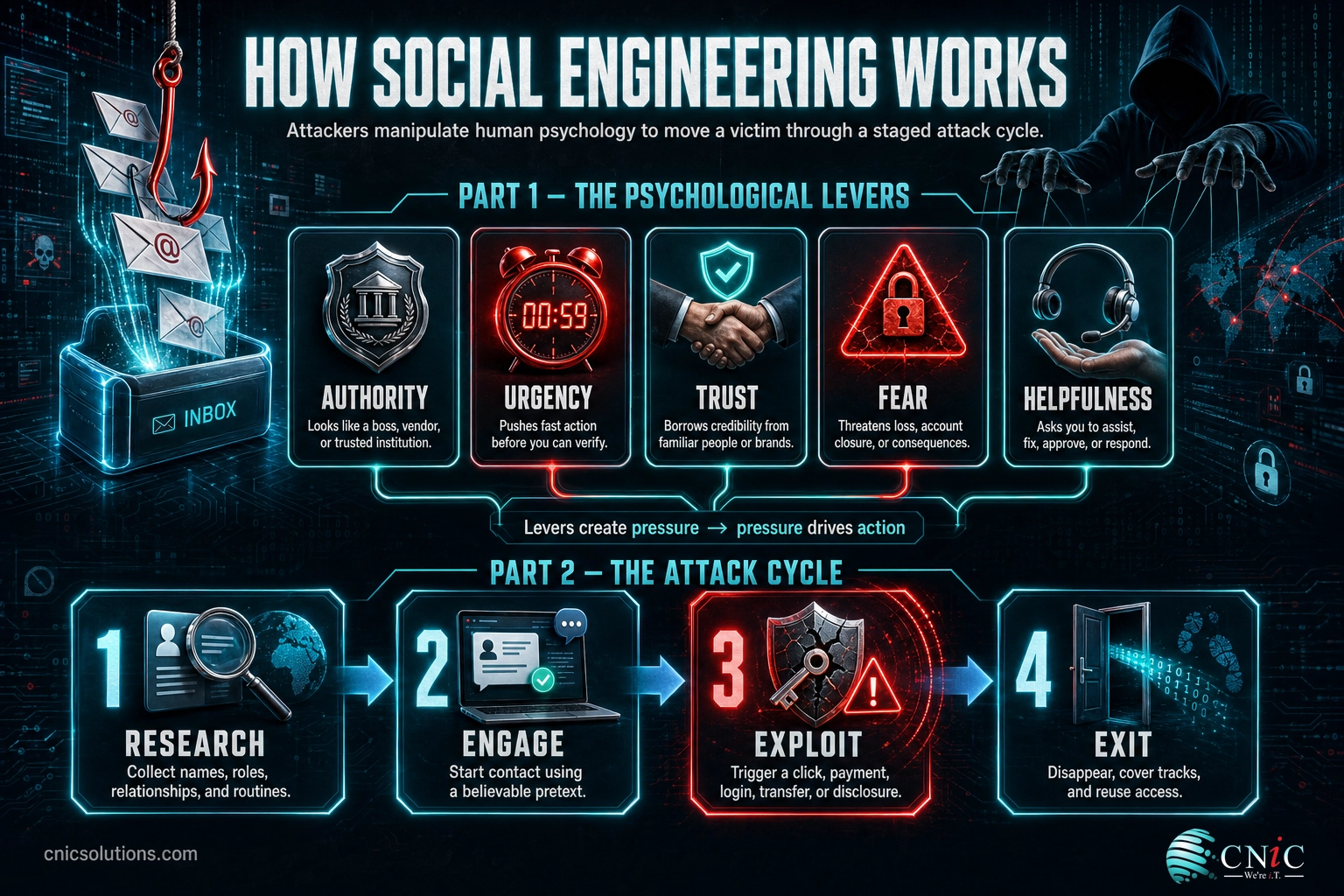
Almost every social engineering attack, no matter how it is delivered, runs on the same psychological engine. The attacker’s job is to get you to act before you think, and they do it by pulling on a small set of reliable human levers.
- Authority: We are conditioned to comply with people who appear to be in charge. An email that looks like it came from the CEO, the IRS, or IT support carries built-in pressure to obey.
- Urgency and scarcity: A ticking clock (“your account will be suspended in one hour”) pushes people to skip verification. Rushing is the enemy of careful judgment, which is exactly the point.
- Trust and familiarity: Attackers impersonate brands, coworkers, and vendors you already deal with, because a request from a known name gets far less scrutiny than one from a stranger.
- Fear: Threats of a lawsuit, a fine, a fired employee, or a security breach trigger a stress response that overrides caution.
- Helpfulness and reciprocity: Most people genuinely want to be useful. An attacker posing as a confused new hire or a stranded delivery driver exploits that instinct directly.
A typical attack follows four stages. First, research: the attacker gathers details from your website, LinkedIn, social media, and past data leaks to make the approach believable. Second, engagement: they open contact through email, phone, text, or in person, wearing a credible disguise. Third, exploitation: they make the ask, a password, a wire transfer, a clicked link, a held-open door. Fourth, exit: they retreat cleanly, often covering their tracks so the victim does not realize anything happened until much later.
Myth: “Only careless or untrained employees fall for this.” This is the most dangerous misconception about social engineering. Skilled attackers craft messages that are convincing precisely because they are tailored, well-timed, and mimic legitimate requests your team sees every day. Studies of real campaigns show that experienced professionals, executives, and even IT staff get fooled. Blaming the victim leads businesses to under-invest in the layered defenses that actually work. Assume anyone can be caught on a bad day, and design your controls around that reality.
Common Social Engineering Tactics
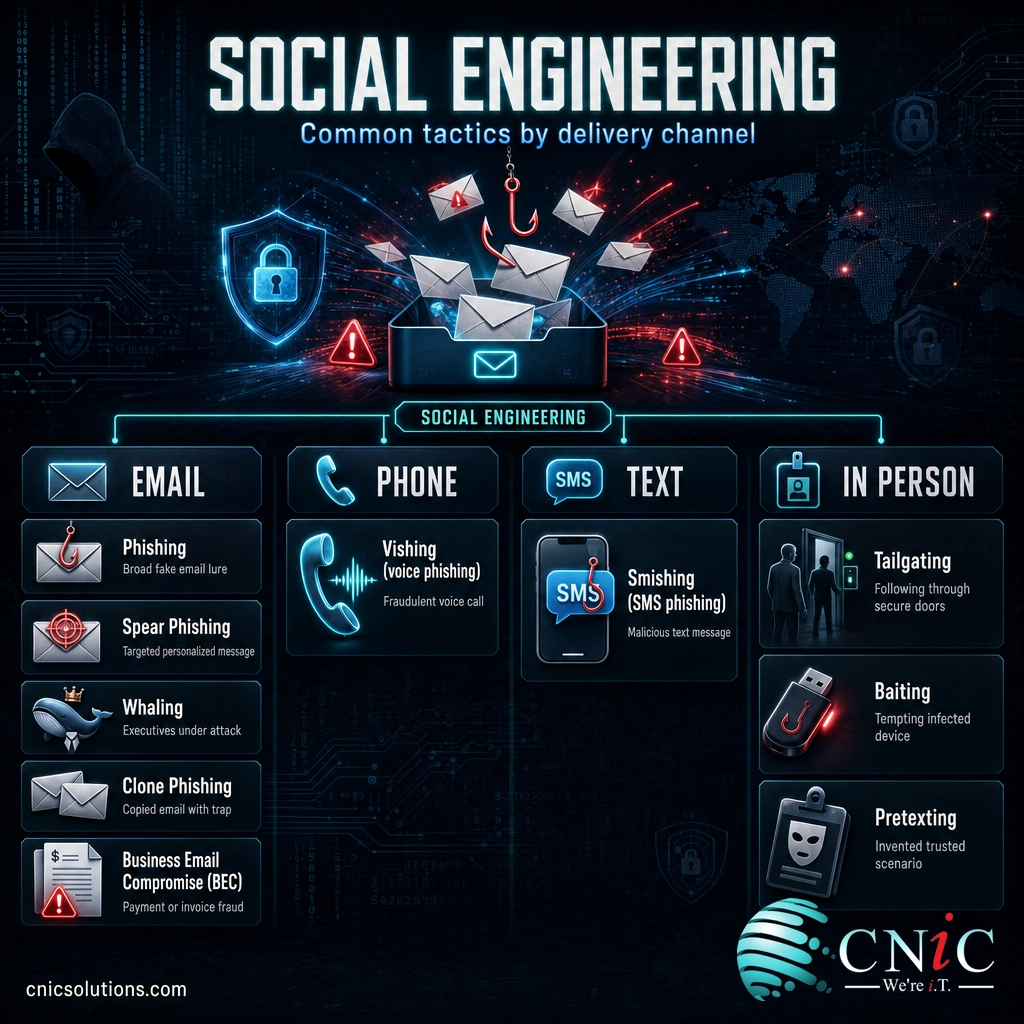
Social engineering is an umbrella term. Underneath it sits a family of specific techniques, grouped mostly by the channel the attacker uses and the disguise they wear. Knowing the names helps your team recognize an attack in progress.
Phishing
The most common form by far. Phishing uses fraudulent emails that impersonate a trusted brand, colleague, or institution to trick recipients into clicking a malicious link, opening an infected attachment, or entering credentials on a fake login page. If your team can recognize the tells, most attacks fall apart, which is why learning how to spot a phishing email is the single highest-value security habit a business can build. It also helps to review real phishing email examples so the warning signs feel familiar before an attack lands.
Spear Phishing and Whaling
Spear phishing is targeted phishing. Instead of a generic blast, the attacker researches a specific person and references real projects, names, or details to make the message far more convincing. When the target is a senior executive or finance leader, it is called whaling, and the payoff for the attacker, often a large wire transfer, is correspondingly bigger.
Vishing (Voice Phishing)
Vishing moves the attack to the phone. A caller poses as your bank, a government agency, or your own IT help desk and pressures the victim into handing over passwords, one-time codes, or remote access to their computer. The live, human element makes voice phishing especially persuasive, because it is harder to hang up on a person than to ignore an email.
Smishing (SMS Phishing)
Smishing uses text messages, a fake delivery notice, a bank alert, a “your account is locked” warning, with a link to a fraudulent site. Because phones show less context than email clients and people tend to trust texts, SMS phishing has become one of the fastest-growing tactics.
Pretexting
Pretexting is the art of the invented backstory. The attacker constructs a plausible scenario, “I’m the new auditor and I need last quarter’s payroll file”, to justify a request that would otherwise raise eyebrows. It is the connective tissue behind many other tactics, and it thrives when employees are reluctant to challenge someone who sounds official.
Business Email Compromise (BEC)
BEC is one of the most financially damaging forms of social engineering. The attacker compromises or convincingly spoofs a trusted email account, an executive, a vendor, a lawyer, and requests an urgent wire transfer or a change to banking details. There is usually no malware to detect. It is pure manipulation, which is what makes it so effective and so costly.
Clone Phishing
In clone phishing, the attacker takes a real email the victim already received, copies it almost exactly, and resends it with a malicious link or attachment swapped in. Because the message looks identical to a legitimate one, and may even reference a genuine prior conversation, it slips past a lot of caution.
Baiting and Quid Pro Quo
Baiting dangles something tempting, a free download, a media file, or a USB drive labeled “Payroll” left in a parking lot, to lure the victim into an action that installs malware. Quid pro quo offers a service in exchange, such as a fake IT technician offering to “fix” a problem in return for login credentials or remote access.
Tailgating and Physical Social Engineering
Not every attack happens online. Tailgating is following an authorized person through a secure door, often while carrying boxes so someone holds it open. Impersonating a delivery driver, contractor, or job candidate to get physical access to offices and equipment is a long-standing tactic that still works, because most people find it awkward to challenge a stranger who seems to belong.
Social Engineering vs Phishing
This is the confusion that trips up most people, and clearing it up makes everything else easier to understand. Social engineering and phishing are not two competing things, and they are not the same thing either. Phishing is a subset of social engineering.
Think of social engineering as the whole category of “manipulating people to breach security.” Phishing is one specific technique inside that category, the one delivered by fraudulent email. Vishing, smishing, pretexting, baiting, and tailgating are siblings of phishing, all sitting under the same umbrella.
| Social Engineering | Phishing | |
|---|---|---|
| What it is | The broad category of human manipulation attacks | One specific technique within that category |
| Channels | Email, phone, text, in person, social media | Primarily fraudulent email (and cloned sites) |
| Examples | Vishing, smishing, pretexting, baiting, tailgating, BEC | Deceptive email links, fake login pages, malicious attachments |
| Relationship | The umbrella | The most common item under the umbrella |
The practical upshot: training your team to “watch out for phishing” is a good start, but it leaves gaps. An employee alert to suspicious emails can still be talked out of a password over the phone or hold a door for the wrong person. Effective awareness covers the whole family, not just the email branch.

Why Social Engineering Matters for Your Business
Small and midsize businesses are not too small to be targets. Often the opposite is true: attackers know that smaller organizations tend to have fewer security controls, less formal training, and busier staff who are quicker to act on a plausible request. The numbers make the stakes clear.
Phishing is not just common, it is the front door for nearly everything else. It is how attackers most often steal the credentials, access, and trust that lead to ransomware, data theft, and fraud. And the financial damage from manipulation-based attacks is severe, driven heavily by business email compromise.
The reason these attacks keep succeeding is structural: the human element is present in most breaches. Even organizations with strong technical defenses get compromised when an attacker persuades one person to make one mistake.
To put the scale of phishing in perspective against other reported cybercrimes, here is how the top complaint categories compared in 2024.
Top Reported Cybercrime Types by Complaint Count (FBI IC3, 2024)
Phishing and spoofing generated more than twice the complaints of the next category. Source: FBI IC3 2024 Internet Crime Report.
Credential abuse, which social engineering directly enables, remains the top way attackers get their initial foothold. The Verizon 2025 DBIR found credential-based access to be the leading initial attack vector, reinforcing that stealing a login through manipulation is often step one of a much larger breach. For a small business, a single successful attack can mean drained accounts, locked systems, regulatory exposure, and a hit to customer trust that outlasts the direct financial loss. This is exactly the risk that professional cybersecurity services are built to reduce.
Source: FBI IC3 2024 Internet Crime Report | Verizon Data Breach Investigations Report
How to Prevent Social Engineering Attacks
Because social engineering targets people, no single tool can stop it. The businesses that defend well use overlapping layers, so that when one line fails, another catches the attack. Here is what that looks like in practice.
- Train continuously, not once a year. Run regular, realistic security awareness training and simulated phishing tests. The goal is not to shame people who click, but to build a reflex for spotting manipulation across email, phone, and text.
- Turn on multi-factor authentication (MFA) everywhere. MFA is the highest-impact single control. Even if an attacker steals a password through social engineering, MFA blocks most account takeovers. Prefer app-based or hardware keys over SMS codes where possible.
- Build verification into money and data requests. Require a second channel of confirmation, such as a known phone number, for any wire transfer, banking-detail change, or sensitive data request. A simple callback rule stops most business email compromise attempts cold.
- Filter and flag suspicious messages. Use email security that catches spoofing and malicious links, and configure external-sender warnings so impersonation is easier to notice.
- Apply least-privilege access. Give employees access only to what their role needs. If an account is compromised, least privilege limits how far the attacker can reach.
- Create a blame-free reporting culture. Make it fast and safe to report a suspected attack or an accidental click. Early reporting is often the difference between a near-miss and a full breach.
- Have an incident response plan ready. Know in advance who to call, how to isolate affected accounts, and how to notify stakeholders, so a successful attack is contained quickly rather than left to spread.
For most small and midsize businesses, the practical challenge is not knowing these steps, it is maintaining them consistently while running a company. That is where a managed partner helps. CNiC Solutions builds and operates these defenses as part of ongoing cybersecurity services, backed by day-to-day managed IT support and, for businesses that want strategic guidance, Virtual CIO services that align security investment with real business risk.
Get a free security assessment for your business
Source: CISA guidance on avoiding social engineering and phishing | NIST glossary definition of social engineering
Frequently Asked Questions
What is social engineering?
Is social engineering the same as phishing?
What is the most common type of social engineering?
How can businesses prevent social engineering attacks?
Why is social engineering so effective?
Related Terms
- Phishing: Fraudulent emails that impersonate a trusted source to steal credentials or access.
- Vishing: Voice phishing carried out over the phone to pressure victims into sharing information.
- Smishing: Phishing delivered through fraudulent text messages with malicious links.
- Whaling: Highly targeted phishing aimed at executives and other high-value individuals.
- Clone phishing: A copy of a legitimate email resent with malicious links or attachments swapped in.
- Pretexting: Inventing a believable backstory to justify a request for information or access.
- Business email compromise (BEC): Impersonating a trusted contact by email to request fraudulent payments or data.
- Tailgating: Gaining physical entry to a secure area by following an authorized person inside.
About This Guide and Sources
The definition of social engineering in this guide follows the U.S. National Institute of Standards and Technology (NIST) glossary and guidance from the Cybersecurity and Infrastructure Security Agency (CISA). The characterizations of specific tactics (phishing, spear phishing, whaling, vishing, smishing, pretexting, baiting, quid pro quo, tailgating, and business email compromise) reflect standard, widely consistent descriptions used across the cybersecurity industry.
Statistics are drawn from primary sources. The 193,407 phishing and spoofing complaints, the status of phishing as the most-reported cybercrime type by complaint count, and the $2.77 billion in business email compromise losses are reported in the FBI Internet Crime Complaint Center (IC3) 2024 Internet Crime Report. The figure that 68% of breaches involved a non-malicious human element is from the Verizon 2024 Data Breach Investigations Report (DBIR); the finding that credential abuse is the leading initial attack vector is from the Verizon 2025 DBIR. Complaint counts reflect incidents reported to the FBI and understate true totals, since many incidents go unreported.



related posts
What Is FinOps? A Guide to Managing and Optimizing Cloud Costs
October 19, 2026FinOps is an operational framework and cultural practice for managing and optimizing cloud costs by bringing…
What Is Endpoint Security? How It Protects Your Business Devices
October 19, 2026Endpoint security is the practice of protecting the devices that connect to your network, such as…
What Is Encryption in Cybersecurity?
October 18, 2026Encryption in cybersecurity is the process of scrambling readable data into an unreadable code that only…
What Is DNS? How the Internet’s Address Book Works
October 18, 2026DNS (Domain Name System) is the internet's address book. It translates the human-friendly domain names you…