

The 5 Whys is a root cause analysis technique that asks “why” repeatedly, usually about five times, to trace a problem past its symptoms to the true cause. Developed at Toyota, it turns a vague complaint into a specific, fixable root cause so the same problem stops coming back.
When a server crashes or the same help desk ticket keeps reappearing, the fastest fix is rarely the right one. Reboot the machine and the outage ends, but the reason it happened is still sitting there, waiting to strike again. The 5 Whys method exists to break that cycle. It is a plain-language questioning technique that keeps asking “why” until you reach the underlying cause you can actually fix, instead of stopping at the symptom you can see. For IT teams drowning in repeat incidents, it is one of the cheapest, highest-return habits you can build.
- It is a chain, not a checklist. Each answer becomes the next question, so five linked “whys” walk you from the visible symptom down to the root cause.
- Five is a guideline, not a rule. Toyota’s Taiichi Ohno used roughly five iterations, but the real stopping point is a cause you can act on, whether that takes three whys or seven.
- The root cause is usually a process, not a person. The Uptime Institute found that 85% of human-error outages trace back to staff failing to follow procedures or to flaws in the procedures themselves, exactly the process gaps a 5 Whys exposes.
- It is best for simple to moderate problems. For complex incidents with several interacting causes, pair it with a fishbone diagram or a formal post-incident review.
- Fixing root causes is the core of proactive IT. It is the difference between reactive break-fix support that treats symptoms and managed IT that stops problems from recurring.
What’s in This Guide
What Is the 5 Whys Method?
The 5 Whys is a root cause analysis technique: a structured way of finding the real reason a problem occurred, rather than the first explanation you land on. You state the problem clearly, ask why it happened, and then ask “why” again of each answer, following the cause-and-effect chain down until you reach a cause you can fix at its source.
The method was developed by Sakichi Toyoda, the founder of Toyota Industries, and became a cornerstone of the Toyota Production System under engineer Taiichi Ohno. Ohno described it plainly in his writing on the system: the American Society for Quality’s definition of the Five Whys traces the technique directly to this Toyota practice of repeating the question until the nature of a problem, and its solution, become clear. It spread from manufacturing into Lean, Six Sigma, software engineering, and IT operations because it needs no special tools and works in any setting where problems recur.
What makes it powerful is also what makes it simple. Most problem-solving stops at the first plausible answer, which is almost always a symptom. “The website went down because the server ran out of disk space” feels like an answer, so the team clears the disk and moves on. The 5 Whys refuses to stop there. It treats that first answer as another question, and keeps going until the chain reaches something you can change permanently.
Source: American Society for Quality, Five Whys
How the 5 Whys Method Works
The process is a short, disciplined conversation. It works the way a curious child does, asking “why” after every answer until the easy explanations run out and the real reason has to surface. There is no software and no scoring, just a clearly stated problem and the willingness to keep asking. Here is the sequence.
- State the problem specifically. Write it down in one plain sentence. “The customer portal was unreachable for 45 minutes on Tuesday morning” is usable. “The system is slow” is not.
- Ask why it happened. Answer with a fact, not a guess. The answer should describe the immediate cause you can verify from logs, tickets, or people who were there.
- Ask why of that answer. Treat each answer as a new problem statement and ask why it occurred.
- Repeat until you reach a root cause. Usually this takes about five rounds, but stop when you hit a cause that, if fixed, would prevent the problem from recurring, and that is within your control to change.
- Define and verify a countermeasure. Put a fix against the root cause, then confirm it actually holds by checking that the problem stops returning.
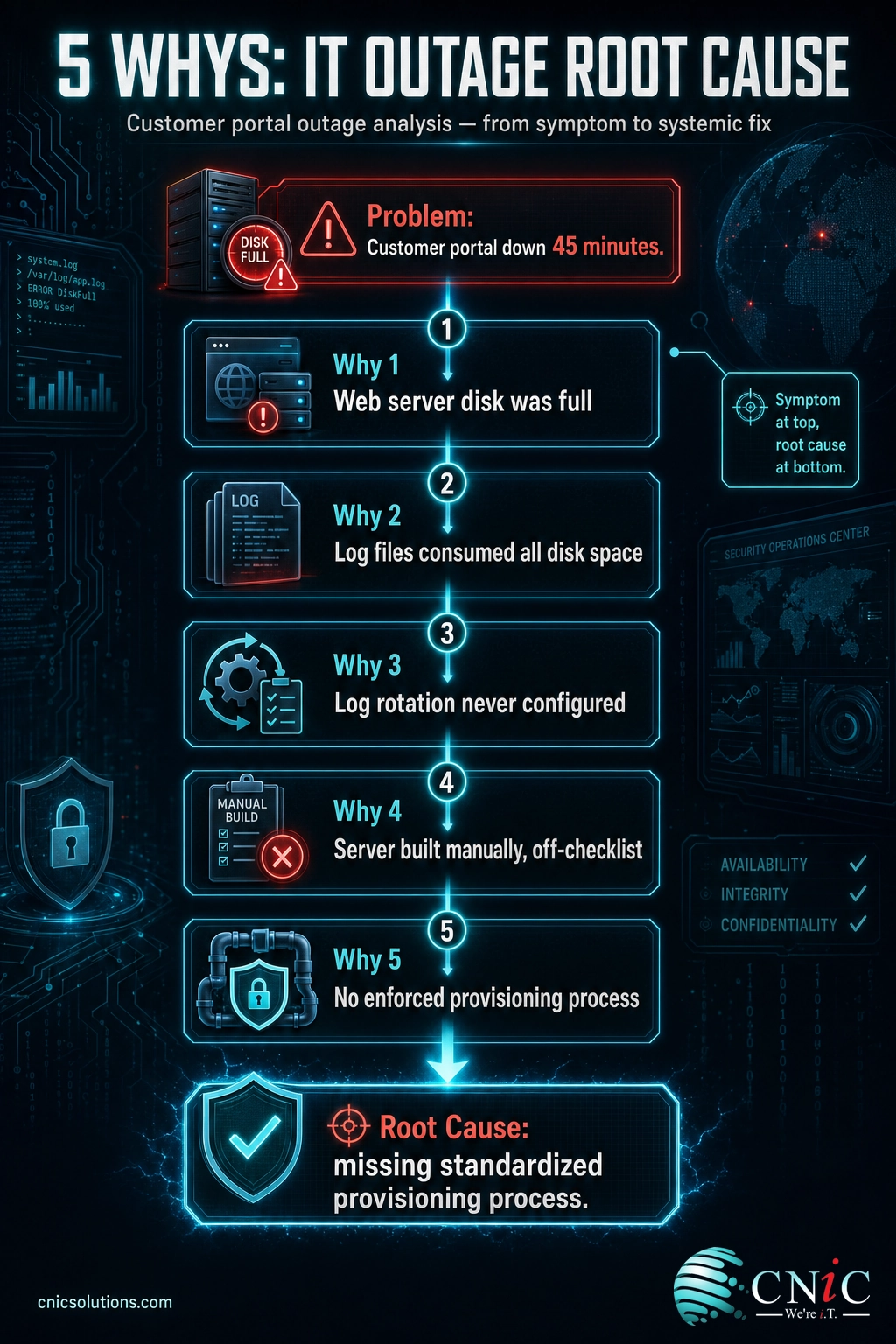
Consider a real IT scenario. A customer-facing web application goes down. Walking the chain looks like this:
Problem: The customer portal was unreachable for 45 minutes.
- Why? The web server stopped responding because its disk was full.
- Why? Log files grew until they consumed all remaining disk space.
- Why? Automatic log rotation was never configured on that server.
- Why? The server was set up manually, outside the standard build checklist.
- Why? There is no enforced, repeatable provisioning process that guarantees every server gets the standard configuration.
Root cause: a missing standardized provisioning process, not “the disk filled up.”
Countermeasure: automate and enforce server builds so every machine ships with log rotation and monitoring by default.
Notice how the answer changes as you descend. If the team had stopped at the first why, they would have cleared the disk and waited for the next server to fail the same way. By the fifth why, the fix is no longer a one-time cleanup: it is a process change that protects every server, not just this one. That shift, from a symptom you patch to a cause you eliminate, is the entire value of the method.
5 Whys vs. Fishbone Diagram
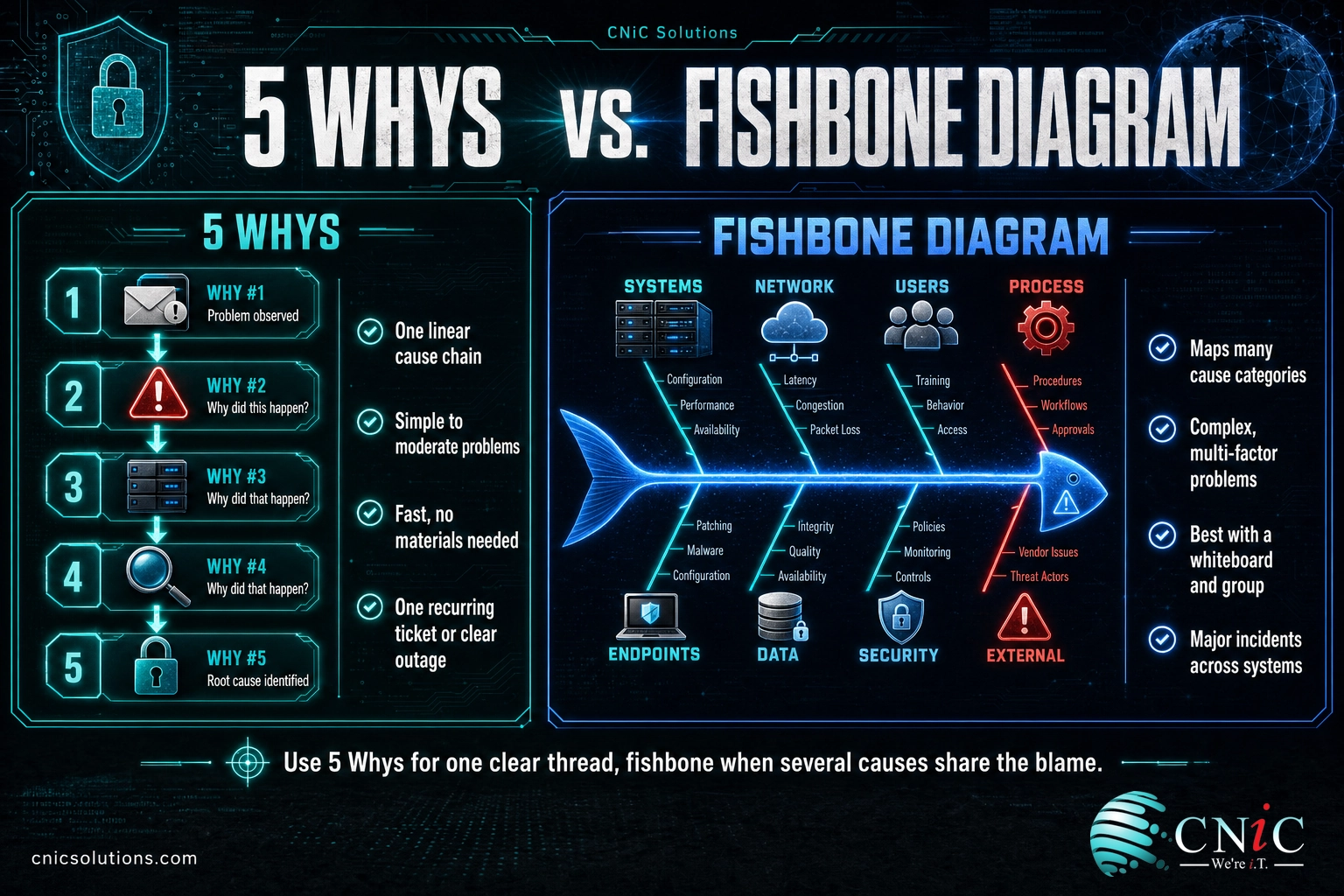
The most common confusion is between the 5 Whys and root cause analysis as a whole. The 5 Whys is not a synonym for root cause analysis; it is one technique within it. The tool people most often weigh it against is the fishbone diagram, also called an Ishikawa or cause-and-effect diagram. Both hunt for root causes, but they work differently, and choosing the wrong one for the problem wastes time.
| Attribute | 5 Whys | Fishbone Diagram |
|---|---|---|
| Shape of analysis | A single linear cause-and-effect chain | A branching map of many cause categories |
| Best for | Simple to moderate problems with one main thread | Complex problems with several contributing factors |
| Speed | Fast, minutes, needs no materials | Slower, benefits from a whiteboard and a group |
| Risk | Can oversimplify by following only one path | Can sprawl and stall without a facilitator |
| Typical IT use | A single recurring ticket or a clear outage | A major incident with network, application, and human factors |
In practice the two are complementary, not rival. Many teams use a fishbone diagram to surface the handful of likely cause categories in a messy incident, then run a focused 5 Whys down the branch that looks most responsible. Start with the 5 Whys when the problem has one obvious thread. Reach for the fishbone when several systems or teams may share the blame.

Why the 5 Whys Matters for IT Teams
Root cause analysis is not an abstract quality exercise for IT. It targets the most expensive and most preventable kind of failure: the one that keeps happening. And the data shows where those root causes usually live.
The Uptime Institute, which publishes an annual analysis of technology outages, reports that nearly 40% of organizations have suffered a major outage caused by human error in the past three years. That framing invites the wrong fix, which is to blame the person. But the same research shows where the real cause sits.
That single statistic is the case for the 5 Whys in one number. When 85% of human-error outages trace back to procedures, “the technician made a mistake” is never the root cause. It is a symptom. Ask why five times and you land on the missing checklist, the unenforced change process, or the training gap that let the mistake happen. Fix that, and you protect against the whole class of failure instead of scolding one person.
IT and networking problems specifically made up 23% of impactful outages in 2024, which the Uptime Institute links to growing system complexity and the change-management and misconfiguration errors that come with it. Those are precisely the process root causes a 5 Whys is built to find. Every outage you trace to its source and eliminate is one you never pay for again in downtime, overtime, or lost customer trust.
Myth: the root cause is “human error.” Stopping at “someone made a mistake” is the single most common failure of root cause analysis. People operate inside systems, and a good system makes the right action easy and the wrong action hard. If one person could take down production with a single slip, the root cause is the system that allowed it, not the slip. The 5 Whys pushes you past the individual to the process, which is the only place a durable fix exists.
Source: Uptime Institute Annual Outage Analysis 2025
How to Run a 5 Whys on an IT Problem
The technique is simple, but a few habits separate an analysis that finds the real cause from one that stalls at a symptom or drifts into blame. Use this as your working method.
- Get the right people in the room. Include the people closest to the problem, the ones who saw the logs or fielded the ticket. Second-hand answers produce second-hand root causes.
- Anchor every answer in evidence. Each “why” should be answerable from a log, a ticket, a config, or a firsthand account. If an answer is a guess, verify it before you build the next why on top of it.
- Keep it blameless. The moment the answer becomes a person’s name, redirect: ask why the process allowed it. Blame ends the investigation early; systems thinking continues it.
- Watch for more than one chain. If a why has two legitimate answers, the problem may have branching causes. Follow each, or switch to a fishbone diagram to map them all.
- Stop at an actionable cause, then verify the fix. The goal is not exactly five whys, it is a root cause you control. Once you fix it, confirm the problem actually stops recurring over the following weeks.
This is also where root cause analysis connects to how IT support is structured. In a tiered support model, the frontline resolves the immediate ticket, but genuine root cause work belongs to the senior engineering layer that can change systems and processes, a pattern we cover in our guide to how Level 1, 2, and 3 support escalation works. A recurring issue that keeps bouncing back to the help desk is a signal that no one has run the problem to its root.
It is also the clearest line between two models of IT. Reactive break-fix support that charges per incident has little incentive to eliminate the cause, because the next occurrence is the next invoice. Proactive managed IT is the opposite: fewer recurring problems is the whole point. If you want a partner whose job is to find and remove the root causes behind your recurring issues, that is exactly what day-to-day managed IT support is built to do.
Get a Free Consultation on Your IT Support
Plan Proactively With a Virtual CIO
Common Mistakes and Limits
The 5 Whys earns its reputation for simplicity, but that same simplicity is where it goes wrong. Knowing its limits keeps you from trusting it beyond what it can do.
- Stopping too early. Ending at the first technical answer leaves you fixing symptoms. The whole method is the discipline to keep going past the comfortable answer.
- Assuming a single cause. Real incidents often have several contributing causes. A strictly linear 5 Whys can march confidently down one path and miss the others, which is why complex outages call for a fishbone diagram or a fault tree alongside it.
- Answering with opinions. If the chain is built on assumptions instead of evidence, you reach a plausible but wrong root cause and fix the wrong thing.
- Turning it into a blame hunt. An analysis that ends on a person has stopped one why short of the system that let the error happen.
Used within those limits, the 5 Whys is a fast, reliable first tool for the everyday problems that make up most of an IT team’s workload. For the rare, complex, multi-system incident, treat it as one input into a fuller post-incident review rather than the entire investigation. The judgment of when to go deeper is exactly the kind of strategic oversight a quarterly business review with your IT provider is meant to provide, turning a pattern of small incidents into a decision about what to fix at the root.
Common Questions About the 5 Whys
What is the 5 Whys method?
Why is it called the 5 Whys?
What is the difference between the 5 Whys and a fishbone diagram?
When should you not use the 5 Whys?
How does the 5 Whys apply to IT problems?
Related Terms
- Root cause analysis (RCA): the broad practice of finding the underlying cause of a problem rather than its symptoms. The 5 Whys is one technique within RCA.
- Fishbone (Ishikawa) diagram: a cause-and-effect diagram that maps multiple possible cause categories at once, used for complex problems where a single chain is not enough.
- Post-incident review (PIR): a structured, blameless retrospective after a major incident, often using the 5 Whys or a fishbone as its analysis tool.
- Problem management: the IT service management discipline focused on eliminating the root causes of recurring incidents, distinct from resolving one-off tickets.
- Break-fix IT: the reactive, pay-per-incident model that fixes symptoms as they appear. See how it compares to a break-fix approach to support.
- IT support tiers: the layered structure where routine tickets resolve at the frontline and root cause work rises to senior engineering. Learn how Level 1, 2, and 3 support divide the work.
- Quarterly business review (QBR): the recurring strategy check-in where recurring problems and their root causes get reviewed with your provider.
About This Guide
The origin and definition of the 5 Whys are drawn from the American Society for Quality and the Toyota Production System as formalized by Taiichi Ohno. Outage and human-error figures are from the Uptime Institute’s Annual Outage Analysis 2025, which surveys technology and data center operators worldwide. Figures are cited to their original sources and used to illustrate the value of root cause analysis, not as guaranteed outcomes for any specific business. The worked IT example is illustrative.
Sources: American Society for Quality, Five Whys | Uptime Institute Annual Outage Analysis 2025
Stop Recurring Issues With Proactive Monitoring



related posts
What Is a Firmware Update and Why It Matters for Security
October 6, 2026A firmware update is a manufacturer-issued revision to the low-level software built into a device, such…
What Is a Human Firewall? Turning Employees Into Your Best Defense
October 6, 2026A human firewall is the group of employees who, through security awareness and good habits, act…
What Is a Distributed System? How It Works and Why It Matters
October 5, 2026A distributed system is a collection of independent computers, called nodes, that are connected over a…
What Is a Firewall? How It Protects Your Business Network
October 5, 2026A firewall is a network security device or software that monitors incoming and outgoing traffic and…