

A quarterly business review (QBR) is a recurring strategy meeting between your business and your managed IT provider. Every quarter you step back from daily tickets to review performance, security, spending, and the technology roadmap ahead. It turns a reactive vendor relationship into a proactive, planned partnership.
Most of your contact with an IT provider happens one ticket at a time: something breaks, you report it, it gets fixed. A quarterly business review is the opposite of that. Once a quarter, the daily firefighting stops and the conversation moves up a level, to how your technology is performing against your goals, where your risks are, what you are spending, and what should change next. Done well, the QBR is the single meeting that tells you whether you have hired a strategic partner or just a faster repair service.
- A QBR is strategic, not operational. It reviews the direction of your IT against business goals, rather than the status of individual tickets.
- Four things get reviewed: performance, security and risk, budget and spend, and the forward roadmap. Anything less is a status call, not a QBR.
- The right people have to be in the room. A real QBR pairs your decision-makers with your provider’s strategic lead, often a virtual CIO, not just a help desk technician.
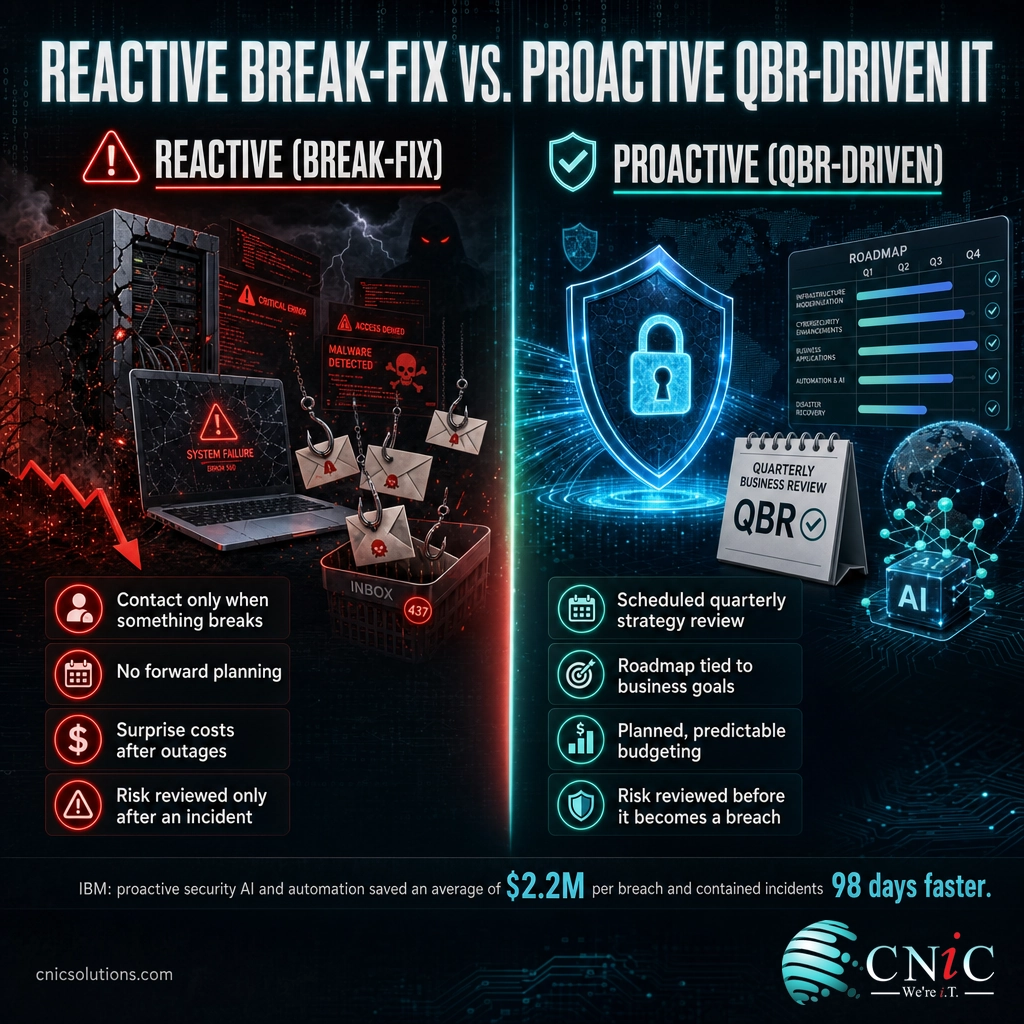
- Proactive planning pays. IBM found organizations that used security AI and automation extensively saved an average of $2.2 million per breach and contained incidents 98 days faster than those that did not.
- It is the clearest test of your provider. A structured QBR with real data and a roadmap signals a true partner; a thinly disguised sales pitch signals the opposite.
What’s in This Guide
What Is a QBR With Your MSP?
A quarterly business review is a scheduled, recurring meeting where you and your managed IT provider step back from day-to-day support to assess the bigger picture. Instead of talking about a single broken laptop or a slow application, you talk about whether your technology is helping the business hit its goals, where it is exposing you to risk, and what needs to happen over the next few quarters.
The idea is not new. It comes straight out of formal IT service management. In the ITIL service management framework, providers are expected to run regular service reviews and pursue continual improvement rather than only closing tickets. A QBR is that discipline made practical and business-facing: it is the recurring service review, held on a quarterly rhythm, translated out of technical language and into the outcomes a business owner actually cares about.
Think of it like a review with your accountant. You do not call your accountant every time you write a check. But once a quarter you sit down, look at where the money went, check that you are on plan, and decide what to change. A QBR does the same thing for your technology. The tickets are the transactions; the QBR is the quarterly sit-down that makes sense of them and sets the direction.
That distinction is the whole point of the work-order note behind this topic: a provider that runs real QBRs is signaling a strategic, trusted-advisor relationship. It is the clearest line between a modern managed services partner and old-school reactive break-fix support, where no one is looking ahead because everyone is busy reacting.
Source: ITIL Service Management (Axelos)
What a QBR Covers: The Standard Agenda
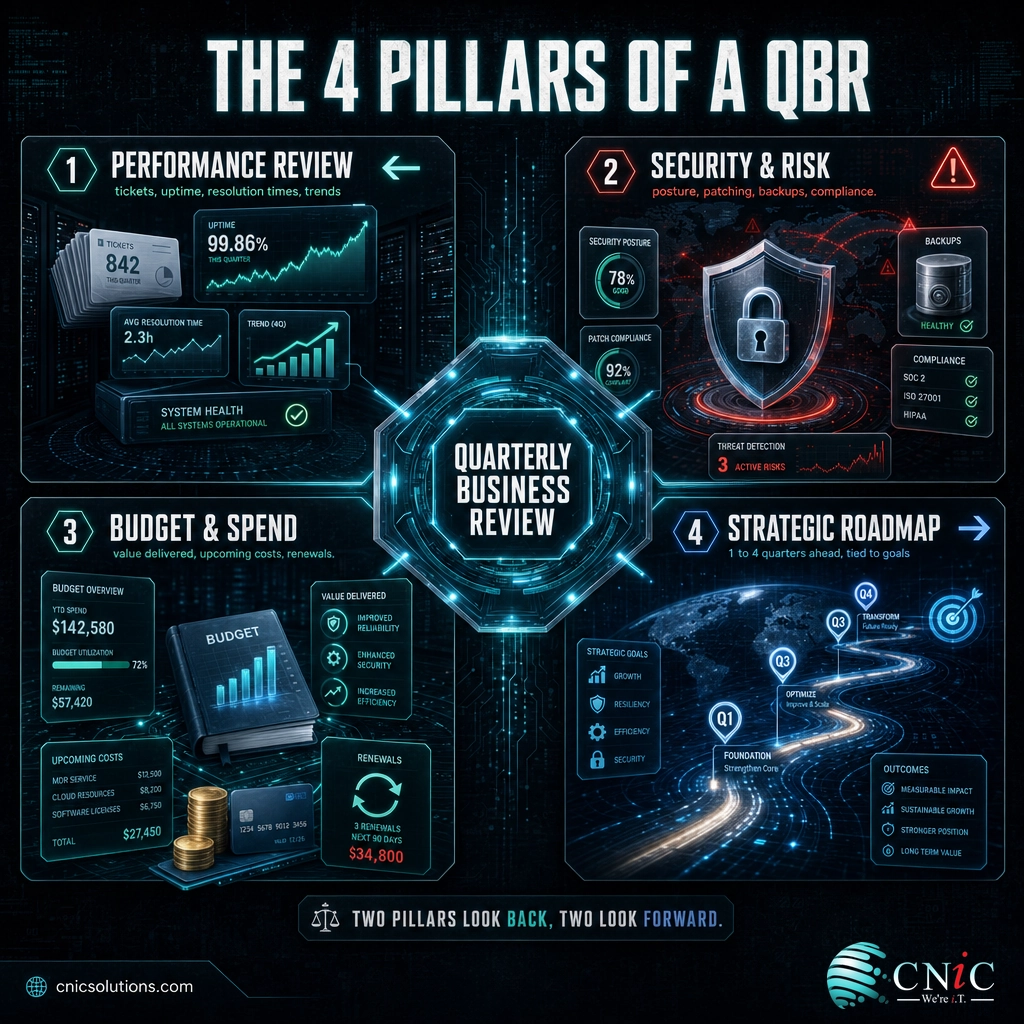
A meeting only earns the name “business review” if it covers the areas that actually move the business. A vague chat about how things are going does not qualify. A strong QBR works through four pillars, and you should expect data, not just opinions, in each one.
- Performance review (looking back). How did the last quarter go? This means real numbers: ticket volume and trends, average resolution times, uptime, service level performance, and any recurring problems. The goal is a shared, honest picture of what worked and what did not.
- Security and risk. Where are you exposed? A good review walks through your current security posture, patching status, backup and recovery readiness, user awareness, and any compliance obligations tied to your industry. This is where reactive relationships fall silent and strategic ones speak up.
- Budget and spend. Are you getting value, and what is coming? The provider should show what you spent, what it delivered, and what upcoming costs to plan for, such as hardware nearing end of life, license renewals, or a needed upgrade. No surprises is the standard.
- Strategic roadmap (looking forward). What changes over the next one to four quarters, and why? Recommendations should tie directly to your business goals, whether that is opening a location, adding staff, meeting a new regulation, or adopting a new tool. This is the part a status update never has.
Notice the shape of it: two pillars look backward (performance and spend to date) and two look forward (risk to close and roadmap to build). A review that only reports the past is a report card. A real QBR uses the past to make decisions about the future.
Cadence is in the name, but it is not rigid. Quarterly is the default because it is frequent enough to catch problems early and rare enough to show real trends. Very small or very stable environments sometimes move to twice a year, while fast-growing companies and those in regulated fields such as healthcare or finance often add interim check-ins. What matters is that the strategic review happens on a predictable rhythm, not that it lands on an exact number of days.
QBR vs. a Monthly Status Update
The most common confusion is between a QBR and a routine status update or monthly check-in. They are not the same meeting, and treating one as the other is how businesses convince themselves they are getting strategic guidance when they are only getting a maintenance report. Here is how they differ.
| Attribute | Monthly Status Update | Quarterly Business Review (QBR) |
|---|---|---|
| Purpose | Report on operations and open tickets | Align technology with business strategy |
| Time horizon | Looks back at the last few weeks | Reviews the last quarter and plans the next several |
| Typical content | Ticket counts, uptime, work completed | Performance trends, security and risk, budget, roadmap |
| Who attends | Your office manager and a technician or account rep | Your leadership and the provider’s strategic lead or virtual CIO |
| Key question | “Is everything running?” | “Is our technology moving the business forward?” |
| Output | A status report | Decisions, priorities, and a forward plan |
Status updates are useful, and you should still get them. But they answer a small question: is the machine running? The QBR answers a much bigger one: is the machine taking you where you want to go? If the only reviews you ever get are operational status reports, you are missing the strategic layer that a managed relationship is supposed to provide.
Myth: a QBR is just a sales meeting. Because QBRs often end with recommendations that cost money, some business owners write them off as disguised upsells. A real QBR earns its recommendations with data: performance you can see, risks that are documented, and a roadmap tied to your goals. Spending may follow, but it follows evidence. The warning sign is the reverse: a “review” that opens with a product pitch and never shows you a single performance metric or a roadmap is a sales call wearing a QBR label.
Why a QBR Matters for Your Business
The case for the QBR is simple: the cost of an unmanaged, reactive relationship shows up as risk you did not see coming and money you did not plan to spend. A quarterly review is where those two problems get caught early. The numbers on what reactive posture costs are sobering.
Start with security, the area a status update rarely touches. IBM’s annual Cost of a Data Breach study, one of the most widely cited benchmarks in the field, put the global average cost of a data breach at $4.88 million in 2024, the highest on record. For a small or midsize business, an incident at even a fraction of that scale can be existential. A QBR is the recurring point where that exposure is reviewed on purpose, before it becomes an event.
The same research shows that being proactive is not just safer, it is measurably cheaper. Organizations that used security AI and automation extensively across prevention spent an average of $2.2 million less per breach than those that did not, and they identified and contained incidents 98 days faster. That gap, prepared versus unprepared, is exactly the gap a QBR is designed to close, by making sure the right tools and plans are in place before something goes wrong.
Then there is budgeting. Technology spending is no longer a rounding error, and it does not stand still. In the same study, 63% of organizations said they planned to increase their security budgets. A QBR is where those increases get planned deliberately, tied to a roadmap, rather than sprung on you as an emergency purchase after an outage or an audit finding. Predictable, planned spending is one of the quiet benefits business owners value most once they experience it.
Put those together and the value is clear. A QBR is the meeting where risk gets reviewed before it turns into a breach, where the cheaper proactive path gets chosen over the expensive reactive one, and where spending gets planned instead of forced. That is why the presence and quality of QBRs is one of the most revealing things you can evaluate about any provider, and it is a core reason businesses move from break-fix to a managed services model with predictable pricing.
Source: IBM, Cost of a Data Breach Report 2024
Who Should Be in the Room
A QBR is a business conversation, so the people who make business decisions need to be present. When the wrong people attend, the meeting quietly collapses back into a status update, because no one in the room can commit to direction or budget.
On your side, that means a decision-maker: an owner, a president, an operations leader, or whoever controls the technology budget. The office manager who handles day-to-day tickets is welcome, but they cannot be the only voice, because the point of the meeting is to make choices they are not positioned to make alone.
On the provider side, the key attendee is a strategic lead, not a frontline technician. In most well-run managed relationships this role is played by a virtual CIO, a senior advisor who understands both technology and business and who owns the roadmap conversation. This is a different function from the help desk that resolves your tickets, and it sits above the day-to-day structured support tiers that handle daily issues. If you are not sure what that role covers, it is worth understanding what a virtual CIO actually brings to the table.
How to Get the Most From Your QBR
A QBR is only as valuable as the preparation and follow-through around it. If it is treated as a box to check, it becomes one. A few habits separate a review that changes decisions from one that just fills an hour.
Come with your business context, not just your IT complaints. The most useful thing you can bring is what is changing in the business: a planned expansion, new hires, a new compliance requirement, a product launch, a tighter budget. Your provider cannot align technology to goals they do not know about.
Ask the questions that expose whether the relationship is strategic. A short, direct list works well:
- Where are we most exposed right now, and what is the plan to close that gap?
- What did we spend last quarter, and what did it actually deliver?
- What should we plan and budget for over the next two to four quarters?
- What are we doing that we no longer need, and where are we underinvested?
Insist on documented outcomes. A real QBR ends with a short, written record: decisions made, priorities set, owners assigned, and dates. Without that, the good discussion evaporates and next quarter starts from scratch. The document is what turns a meeting into momentum.
Finally, use the QBR to decide whether the model itself still fits. As your business grows, the right level of support changes, and the review is the natural place to ask whether a fully outsourced or co-managed arrangement best matches where you are headed. If you are weighing that question, our guide to which support model fits your business walks through the tradeoffs.
Get a Free Consultation With a Managed IT Provider
Common Questions About QBRs
What is a QBR with an MSP?
How often should you have an MSP business review?
What is the difference between a QBR and a regular status update?
Who should attend a QBR?
Is a QBR just a sales meeting?
Related Terms
- Managed IT services: outsourcing your IT support and management to a single provider that runs your day-to-day support and the strategic reviews on top of it.
- Virtual CIO (vCIO): the senior advisor who usually leads your QBR and owns the technology roadmap. Learn what a virtual CIO does and why you need one.
- Break-fix IT: the reactive, pay-per-incident model with no forward planning, which is exactly what a QBR-driven relationship replaces.
- Co-managed IT: a model where a provider’s team and reviews reinforce your in-house IT staff rather than replacing them.
- Technology roadmap: the forward-looking plan, built and updated in the QBR, that maps upcoming technology decisions to business goals.
- Service level agreement (SLA): the contracted performance commitments a QBR measures your provider against.
- Outsourced IT: handing your IT function to an external provider. See the real benefits and costs of outsourcing IT.
- IT support tiers: the Level 1, 2, and 3 structure that handles daily tickets beneath the strategic QBR layer.
About This Guide
The definition and cadence of a quarterly business review follow established IT service management practice, in which providers run regular service reviews and pursue continual improvement rather than only closing tickets, as formalized in ITIL. Cost, proactive-savings, and budgeting figures are drawn from IBM’s Cost of a Data Breach Report 2024, a widely referenced annual benchmark, and are cited to illustrate the value of proactive review, not as guaranteed outcomes for any specific business. Figures are attributed to their original sources throughout.
Sources: IBM, Cost of a Data Breach Report 2024 | ITIL Service Management (Axelos)
Talk to CNiC About a Strategic IT Partnership



related posts
What Is a Firmware Update and Why It Matters for Security
October 6, 2026A firmware update is a manufacturer-issued revision to the low-level software built into a device, such…
What Is a Human Firewall? Turning Employees Into Your Best Defense
October 6, 2026A human firewall is the group of employees who, through security awareness and good habits, act…
What Is a Distributed System? How It Works and Why It Matters
October 5, 2026A distributed system is a collection of independent computers, called nodes, that are connected over a…
What Is a Firewall? How It Protects Your Business Network
October 5, 2026A firewall is a network security device or software that monitors incoming and outgoing traffic and…