

Network penetration testing is a controlled, authorized simulation of a real cyberattack on your network, run by security experts to find and safely exploit weaknesses before criminals do. It proves which vulnerabilities are actually dangerous, then tells you exactly how to fix them.
Every business assumes its firewall is doing its job, right up until the day it isn’t. A network penetration test is how you find out for certain, on your terms, instead of learning the hard way from an intruder. Instead of guessing whether your defenses hold, you hire an ethical hacker to attack them under controlled conditions and hand you a map of every way in. This guide explains what network penetration testing is, the types you can run, and the step-by-step process a professional test follows, so you know what you are buying and what to expect.
- A pen test is an authorized attack. Experts actively exploit your network the way a criminal would, then document exactly how far they got and how to stop it.
- There are two core types. External testing targets your internet-facing systems, internal testing simulates an attacker who is already inside.
- The process follows four phases. The NIST standard breaks a test into planning, discovery, attack, and reporting.
- It is not the same as a vulnerability scan. A scan lists possible problems; a pen test proves which ones a real attacker can actually use.
- Attackers exploit real weaknesses. Verizon found the exploitation of vulnerabilities was involved in 20% of breaches in its 2025 report, up 34% year over year.
What’s in This Guide
- What Network Penetration Testing Is
- The Network Penetration Testing Process
- Types of Network Penetration Testing
- Penetration Testing vs Vulnerability Scanning
- Why Network Penetration Testing Matters
- How to Get Started With a Penetration Test
- Common Questions About Network Penetration Testing
- Related Terms
What Network Penetration Testing Is
Network penetration testing, often shortened to pen testing or called ethical hacking, is a security assessment in which authorized experts mimic the tools and techniques of real attackers to break into your network. The goal is not to cause damage. It is to find the weaknesses that matter, prove they can be exploited, and report them so you can close the gaps first.
The practice is grounded in an established government standard. The NIST definition of penetration testing describes it as security testing in which evaluators mimic real-world attacks to identify ways to circumvent the security features of an application, system, or network. That word “mimic” is the whole idea: a pen test is the closest thing to a genuine breach you can experience without the consequences of one.
A simple analogy helps. A penetration test is like hiring a professional burglar to break into your own building while you watch. They pick the locks, climb through the window you forgot about, and then hand you a report showing every way they got in, so you can fix it before a real thief tries. You get all the lessons of a break-in with none of the loss.
It helps to separate a pen test from the two things people confuse it with. It is more than a vulnerability scan, which only produces a list of possible flaws. And it is more than a security audit, which checks your policies and controls against a checklist. A penetration test goes further and asks a harder question: given these weaknesses, can a skilled attacker actually get in, and how much damage can they do once they are there? Answering that question is what makes the results so valuable.
Source: NIST Computer Security Resource Center glossary
The Network Penetration Testing Process
A professional pen test is not a smash-and-grab. It follows a repeatable methodology so the results are thorough, safe, and something you can act on. The most widely used framework comes from the government’s technical guide to security testing, NIST Special Publication 800-115, which organizes a test into four phases.
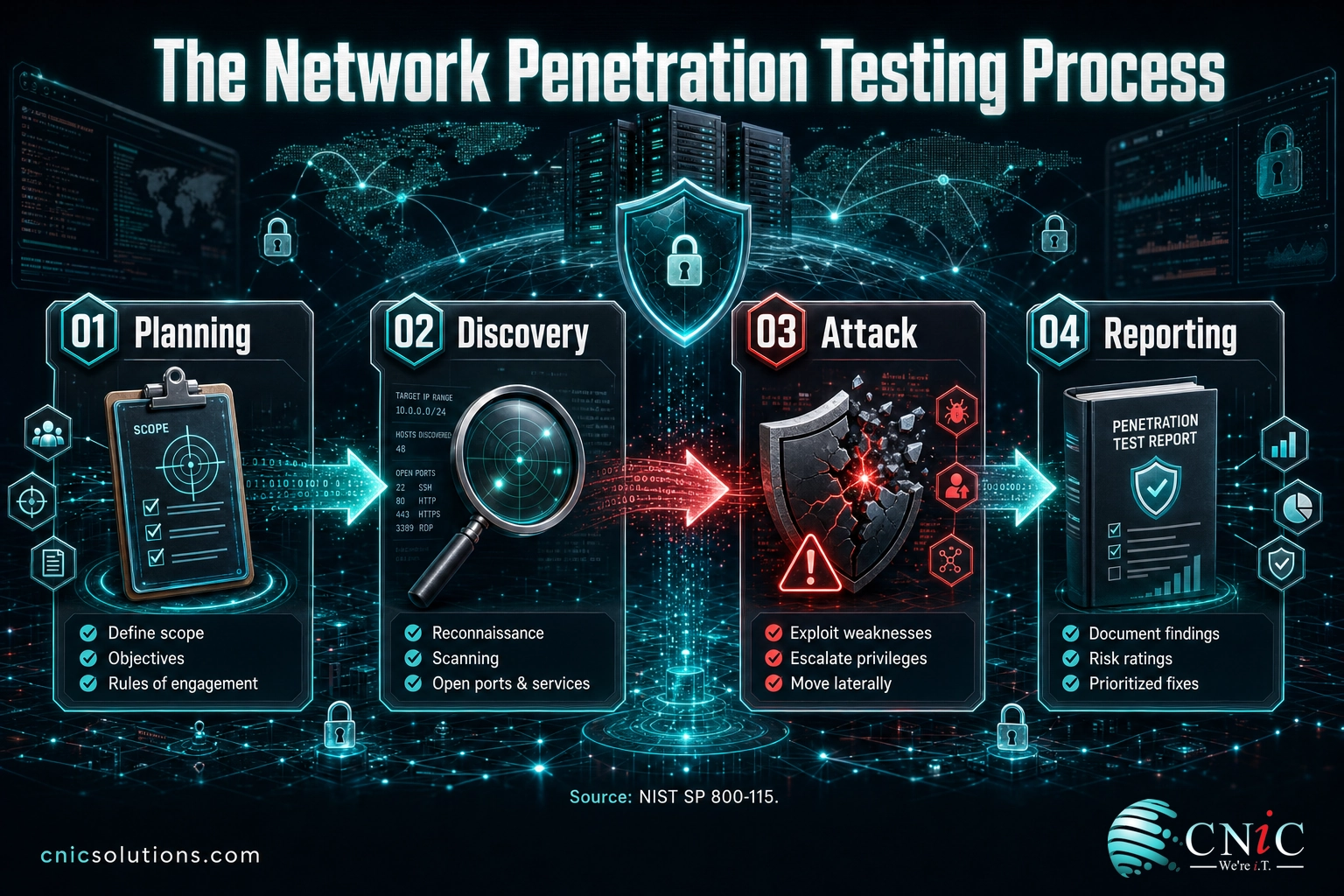
- Planning. Before anything is touched, the tester and the business agree on the rules. This phase sets the scope (which systems are in play), the objectives, the timing, and the legal rules of engagement. Getting this right is what separates an authorized test from a crime, and it is where you decide whether the test is external, internal, or both.
- Discovery. The tester maps the target. This means reconnaissance, gathering public information about the organization, followed by scanning to find live hosts, open ports, running services, and operating system versions. Each finding is then compared against known vulnerabilities to build a list of promising ways in.
- Attack. This is the heart of the test. The tester attempts to actively and controllably exploit the weaknesses found during discovery. A successful exploit is not the end. From that first foothold the tester tries to escalate privileges, move laterally to other systems, and reach the sensitive data or critical systems that would matter most in a real breach. This proves the true business impact, not just the theoretical risk.
- Reporting. The test is only as good as the report it produces. The tester documents every vulnerability found, exactly how it was exploited, the evidence, and a risk rating for each. The most important part is a clear, prioritized set of remediation recommendations, so your team knows what to fix first and how.
A strong engagement adds one more step that the standard implies but businesses often skip: retesting. After your team fixes the reported issues, the tester verifies the fixes actually worked. A finding is not truly closed until someone has confirmed the door is locked.
Source: NIST SP 800-115, Technical Guide to Information Security Testing and Assessment
Types of Network Penetration Testing
“Network penetration testing” is really a family of tests. Which one you need depends on what you are worried about: an outsider on the internet, an insider or a laptop that has already been compromised, or both. The tests are described two ways, by where the attack comes from and by how much the tester knows going in.
By attack position: external and internal
The first and most important split is where the tester stands.
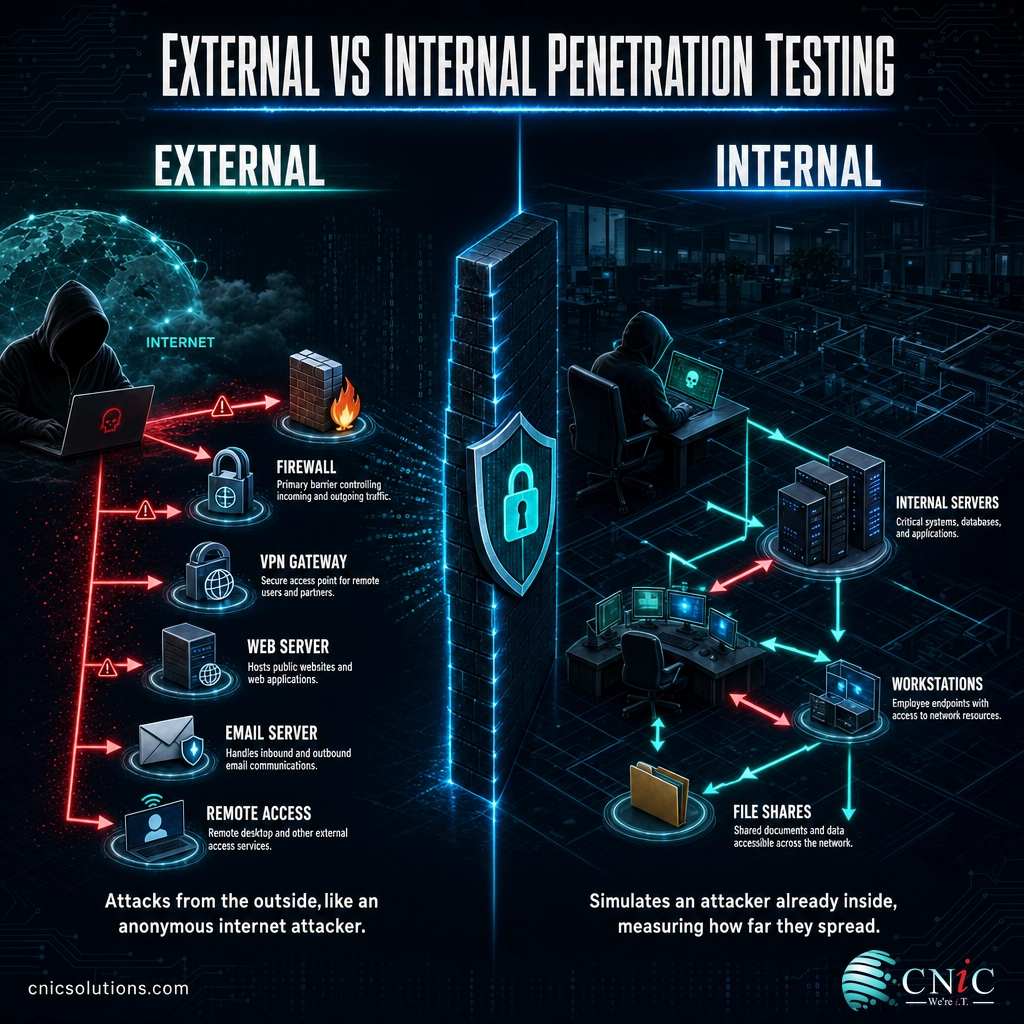
- External penetration testing attacks your network from the outside, the way an anonymous internet-based attacker would. It targets everything exposed to the public internet: firewalls, VPN gateways, web servers, email servers, and remote access points. This is the test that answers the question, “Can someone break in from their laptop across the country?” It matters more than ever because attackers are hammering exactly these edge systems, as the data below shows.
- Internal penetration testing starts from inside the network, simulating an attacker who already has a foothold, whether a malicious employee, a contractor, or, most commonly, an outsider who got in through a phished password or an infected device. It measures the damage that intruder could do: how far they can move, what they can reach, and how quickly a small breach becomes a company-wide one. Sound network segmentation is one of the main defenses an internal test puts to the proof.
By tester knowledge: black, gray, and white box
The second dimension is how much information the tester is given before they start. More knowledge means a faster, deeper test; less knowledge means a more realistic simulation of an outside attacker.
| Approach | What the tester knows | Simulates | Best for |
|---|---|---|---|
| Black box | Nothing, just the company name or a target | A real external attacker with no inside help | Testing your true external exposure |
| Gray box | Partial, such as user credentials or IP ranges | An attacker with a foothold, or a rogue insider | Efficient, realistic tests of internal risk |
| White box | Full, including network diagrams and configs | A worst-case, fully informed adversary | The deepest, most thorough coverage |
Most businesses get the best value from a gray box approach. Giving the tester a little information cuts out the slow guesswork of a pure black box test and lets them spend the budget where it counts, actually exploiting weaknesses rather than just discovering the network exists.
Explore Managed Networking and Security
Penetration Testing vs Vulnerability Scanning
This is the single most common point of confusion, and it costs businesses real money when they buy one thinking they got the other. A vulnerability scan and a penetration test are related, but they are not interchangeable. The short version: a scan finds potential problems automatically, and a pen test proves which of those problems a human attacker can actually use against you.
A vulnerability scan is an automated tool that checks your systems against a database of known flaws and produces a report, often a long one. It is fast, cheap, and worth running frequently. But it has no judgment. It cannot tell you whether a flagged weakness is genuinely exploitable in your environment or a harmless false positive, and it will not chain three small issues together into one serious break-in the way a real attacker does. A penetration test brings the human expert who does exactly that.
| Attribute | Vulnerability Scan | Penetration Test |
|---|---|---|
| Method | Automated tool | Human expert using tools |
| What it does | Lists possible weaknesses | Exploits weaknesses to prove real risk |
| Answers | “What might be wrong?” | “What can an attacker actually do?” |
| False positives | Common, needs human review | Validated by exploitation |
| Frequency | Continuous or monthly | At least annually |
| Cost | Low | Higher, reflects expert time |
The two work best together. Frequent scanning keeps a running inventory of possible weaknesses between tests, and the annual pen test cuts through that list to show which ones truly threaten the business. Scanning is often part of a broader attack surface management program, while the pen test is the periodic deep dive that validates it all.

Why Network Penetration Testing Matters
The business case is simple: attackers are actively exploiting the exact weaknesses a pen test is designed to find, and the cost of them succeeding keeps hitting new records. Testing is how you get ahead of it instead of cleaning up after it.
Start with how criminals are getting in. Verizon’s 2025 Data Breach Investigations Report found that the exploitation of vulnerabilities was an initial way into 20% of breaches, an increase of 34% over the prior year, driven in part by attacks on internet-facing edge devices and VPNs. Those edge systems are precisely what an external penetration test probes first.
Vulnerability exploitation now sits just behind stolen credentials as a leading way attackers break in. Here is how the top initial-access methods stacked up in the same report.
Leading Ways Attackers First Get In (Verizon 2025 DBIR)
The top initial-access vectors observed across breaches. Source: Verizon 2025 Data Breach Investigations Report.
When those attacks land, the bill is steep. IBM’s 2025 Cost of a Data Breach Report put the global average cost of a breach at $4.44 million. In the United States the figure climbed to an all-time high of $10.22 million. For a small or midsize business those numbers translate into downtime, lost customers, and recovery costs that can threaten the company’s survival.
There is a compliance driver too. For any business that handles payment cards, testing is not optional. The PCI Security Standards Council requires, under Requirement 11.4 of PCI DSS, that organizations perform both internal and external penetration testing at least once every 12 months and after any significant change. Similar expectations show up in SOC 2 audits, cyber insurance applications, and the security questionnaires your larger customers send you. A current pen test report is fast becoming table stakes for doing business.
Myth: we passed our last pen test, so we are secure. A penetration test is a snapshot in time. It reflects your network on the day it was run. New vulnerabilities are disclosed daily, and a single new server, firewall rule, or cloud service can open a fresh hole the next week. That is why the standards call for testing at least annually and after every significant change, backed by continuous monitoring in between, not a one-and-done certificate.
Source: Verizon Data Breach Investigations Report | IBM Cost of a Data Breach Report | PCI Security Standards Council
How to Get Started With a Penetration Test
A penetration test is only worth the money if it is scoped well and the findings actually get fixed. You do not need to understand the technical details, but knowing the shape of a good engagement helps you buy the right one. A sensible path looks like this.
- Define the goal and scope. Decide what you are testing and why. Is this about your external exposure, your internal risk, a compliance requirement like PCI DSS, or all three? A short conversation about your most sensitive systems and data sets the scope. A cybersecurity risk assessment is a useful first step if you are not sure where your real risk sits.
- Choose the right type. Match the test to the goal. Most businesses benefit from an external test to check internet-facing exposure and an internal, gray box test to measure how far a foothold could spread.
- Agree on the rules of engagement. Confirm the timing, the systems in and out of bounds, and how sensitive findings are handled. This keeps the test safe for a live business network.
- Act on the report and retest. The findings are the whole point. Work through the prioritized fixes, then have the tester verify them. Pair the results with ongoing network security monitoring so new threats are caught between tests.
Few small and midsize businesses have the in-house expertise to run this well, which is why penetration testing is usually delivered by a specialized security team or a managed provider. If you want a broader view of how outsourced security works, our guide to managed security service providers covers the model. For a baseline of the protections every organization should have first, CISA’s cyber guidance for small and midsize businesses is a strong free starting point.
Source: Cybersecurity and Infrastructure Security Agency, small and midsize business resources
Common Questions About Network Penetration Testing
What is network penetration testing in simple terms?
What is the difference between a penetration test and a vulnerability scan?
What are the main types of network penetration testing?
How often should a business run a network penetration test?
Is network penetration testing safe for a live network?
Related Terms
- Vulnerability scan: an automated check that lists known weaknesses in your systems, the input a pen test then validates by exploitation.
- Attack surface: every point an attacker could target, the map a penetration test works from and steadily tries to reduce.
- Privilege escalation: the step where an attacker turns a low-level foothold into administrator control, a key thing a pen test tries to achieve and measure.
- Lateral movement: moving from one compromised system to others across the network, the behavior an internal test measures and good segmentation is designed to limit.
- Rules of engagement: the agreed boundaries, timing, and limits that keep an authorized test safe and legal.
- Managed firewall: a firewall configured and watched by an outside security team, explained in our managed firewall guide.
- Endpoint detection and response: tools that catch attacks on individual devices, detailed in our endpoint protection guide.
About This Guide
The definition of penetration testing follows the NIST Computer Security Resource Center glossary, and the four-phase process (planning, discovery, attack, reporting) follows NIST Special Publication 800-115. The share of breaches involving vulnerability exploitation and the year-over-year change are from the Verizon 2025 Data Breach Investigations Report. The global and U.S. average breach costs are from IBM’s 2025 Cost of a Data Breach Report. The annual internal and external testing requirement is drawn from PCI DSS Requirement 11.4, published by the PCI Security Standards Council. Figures are cited to their original sources and used to illustrate why testing matters, not as guaranteed outcomes for any specific business.
Sources: NIST CSRC glossary | NIST SP 800-115 | Verizon DBIR | IBM Cost of a Data Breach Report | PCI Security Standards Council | CISA small and midsize business resources
Get a Free Security Audit From CNiC



related posts
What Is NIST Compliance? Frameworks, Requirements, and Who Needs It
October 25, 2026NIST compliance means aligning your organization's security program with the cybersecurity standards published by the National…
What Is MFA? How Multi-Factor Authentication Protects Your Accounts
October 24, 2026Multi-factor authentication (MFA) is a security method that requires two or more separate proofs of identity…
What Is Mobile Device Management (MDM)? A Guide for Businesses
October 24, 2026Mobile Device Management (MDM) is software that lets an organization remotely enroll, configure, secure, and monitor…
What Is Log Analysis? How It Works and Why It Matters
October 23, 2026Log analysis is the practice of reviewing and interpreting the log files that computers, applications, and…