
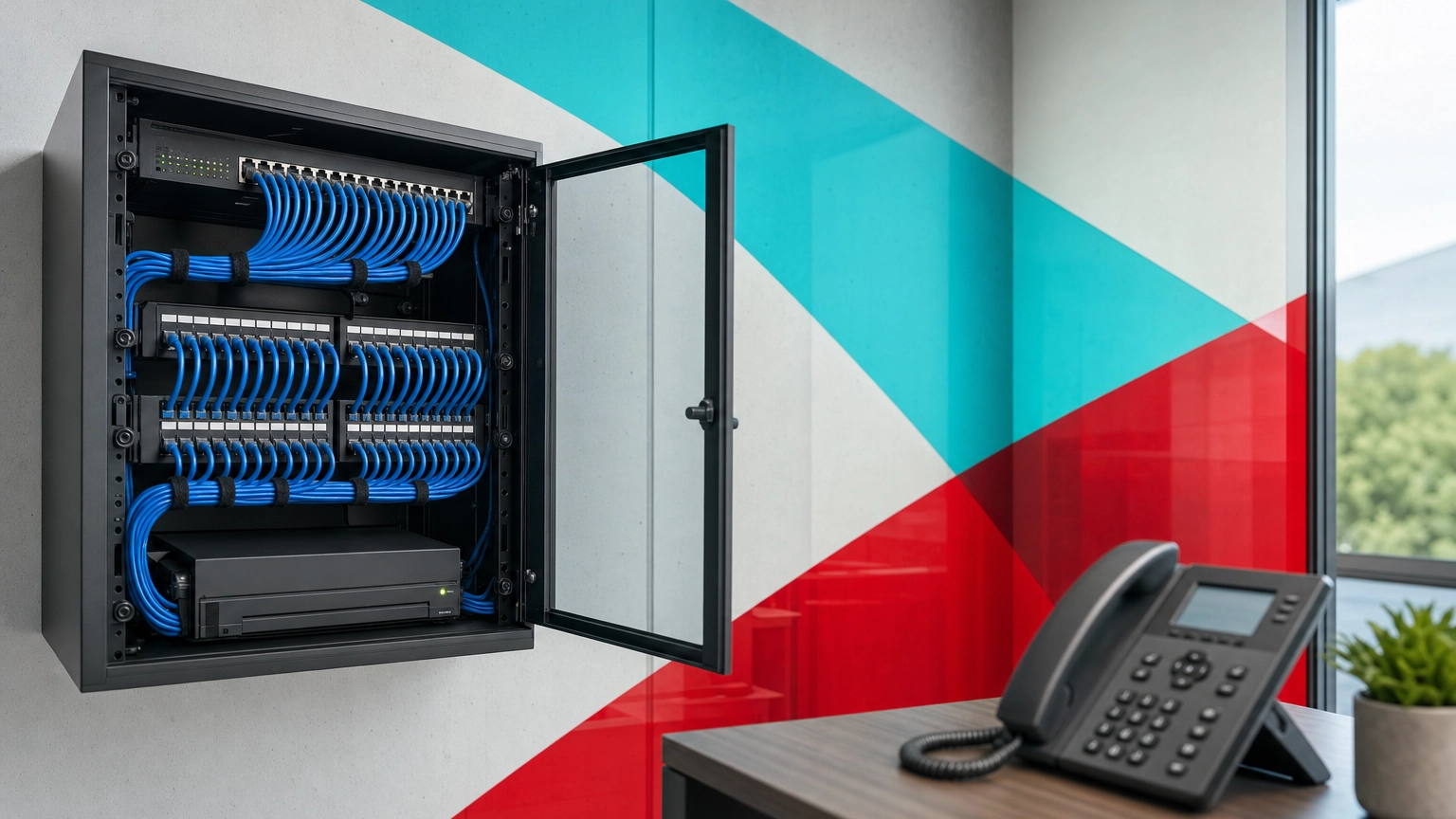
SIP trunking is a technology that connects a business phone system to the public telephone network over the internet, using the Session Initiation Protocol to carry calls as data instead of over physical phone lines. It replaces traditional trunk lines, lowers calling costs, and lets voice, video, and messaging run on one connection.
For decades, a business phone system meant a rack of hardware wired to a bundle of physical phone lines from the local carrier. Those lines were expensive, slow to change, and stuck in one building. SIP trunking replaces that physical bundle with a virtual connection that rides your existing internet link. The result is a phone system that costs less, scales in minutes instead of weeks, and carries far more than voice. This guide explains what SIP trunking is, how it actually works, how it differs from VoIP (a distinction that confuses a lot of buyers), why it matters right now as the old copper phone network is retired, and how to tell whether your business is ready to switch.
Key Takeaways
- SIP trunking carries phone calls over the internet, replacing physical ISDN or PRI trunk lines with a virtual connection.
- It keeps your existing phone system. A SIP trunk connects to your PBX, whether that PBX is on-premises hardware or a virtual, cloud-hosted system.
- SIP is a protocol, VoIP is the broader technology. SIP trunking is one specific way to deliver internet-based calling to a business.
- It bills by channel, not by line. You pay for concurrent calls, so capacity flexes up and down with demand.
- The timing matters. Carriers are retiring the legacy copper phone network, making an internet-based path the practical long-term option.
What’s in This Guide
What SIP Trunking Is
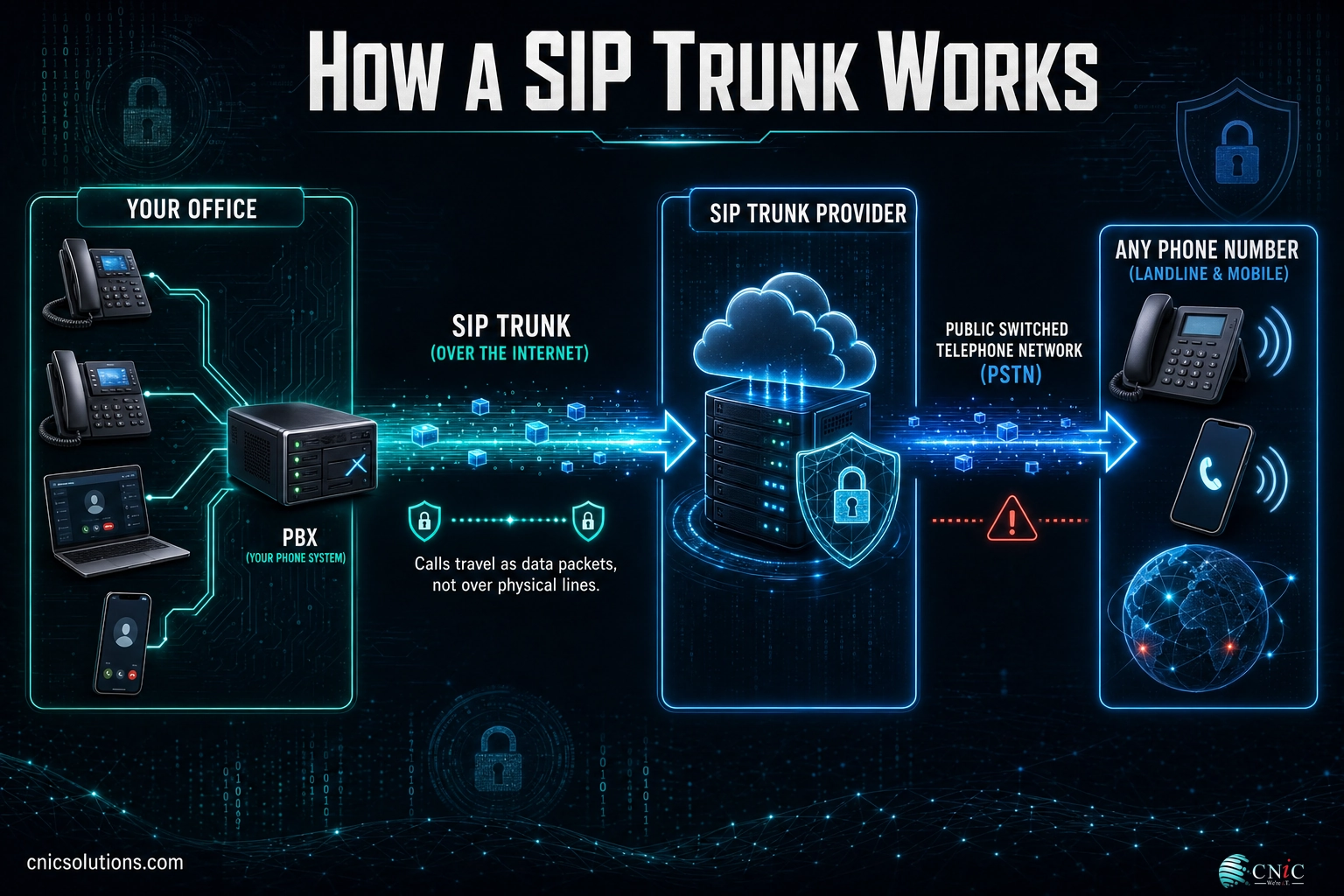
SIP trunking is a method of delivering telephone service to a business over an internet connection instead of over dedicated physical phone lines. The “SIP” is the Session Initiation Protocol, an open standard defined by the Internet Engineering Task Force that sets up, manages, and ends real-time communication sessions such as phone calls. The “trunk” is a telecom term for the connection that links a phone system to the outside world. Put the two together and a SIP trunk is a virtual version of the old physical trunk line: it connects your phone system to the public telephone network, but the calls travel as data packets over your internet link rather than over copper.
The phone system on your end is a PBX (Private Branch Exchange), the equipment that routes calls between internal extensions and out to the wider network. Traditionally a PBX connected to the carrier through physical circuits such as ISDN or PRI lines. SIP trunking swaps those circuits for a software connection to a SIP trunk provider, who in turn hands your calls off to the public switched telephone network so you can reach any phone number in the world. A single SIP trunk can also carry video and messaging, not just voice, which is why it sits at the foundation of modern unified communications platforms.
How SIP Trunking Works
Think of your PBX as your building’s internal switchboard and a trunk as the bundle of outside lines that connect that switchboard to everyone else. For most of the twentieth century that bundle was physical copper or ISDN circuits, rented by the line. A SIP trunk replaces the physical bundle with a virtual connection that runs over the same internet circuit your business already uses for data.
Here is what happens when a call is placed on a SIP trunk:
- Step 1, the call starts: A user dials from a desk phone or a softphone connected to the PBX.
- Step 2, the PBX routes it to the trunk: Instead of grabbing a physical outside line, the PBX hands the call to the SIP trunk.
- Step 3, SIP sets up the session: The Session Initiation Protocol negotiates the call between your PBX and the provider, agreeing on how the two ends will talk (which codec, which media path).
- Step 4, voice travels as data: Once the session is established, the audio is digitized and sent as packets across your internet connection to the SIP trunk provider.
- Step 5, the provider bridges to the phone network: The provider connects the call to the public switched telephone network, so it can reach any landline or mobile number. Incoming calls follow the same path in reverse.
All of this happens in a fraction of a second and is invisible to the caller. The important shift is that capacity is now defined in software. Each simultaneous call uses one “channel” on the trunk, and you provision channels through the provider’s portal rather than waiting on a carrier to install more physical lines.
Source: IETF SIP standard (RFC 3261) | Microsoft: SIP trunking overview
SIP Trunking vs VoIP: Clearing Up the Confusion
These two terms get used as if they mean the same thing, and they do not. The relationship is simpler than the jargon suggests: VoIP (Voice over Internet Protocol) is the broad category of carrying phone calls over the internet. SIP is the signaling protocol that most VoIP systems use to set up and tear down those calls. SIP trunking is one specific way to deliver VoIP to a business, by connecting an existing phone system to the network.
In everyday buying conversations, though, “VoIP” is often shorthand for a fully hosted, cloud-based phone service where the provider runs everything and you rent phones by the user. That is the real decision most businesses are weighing, so it helps to compare SIP trunking against a hosted phone system directly.
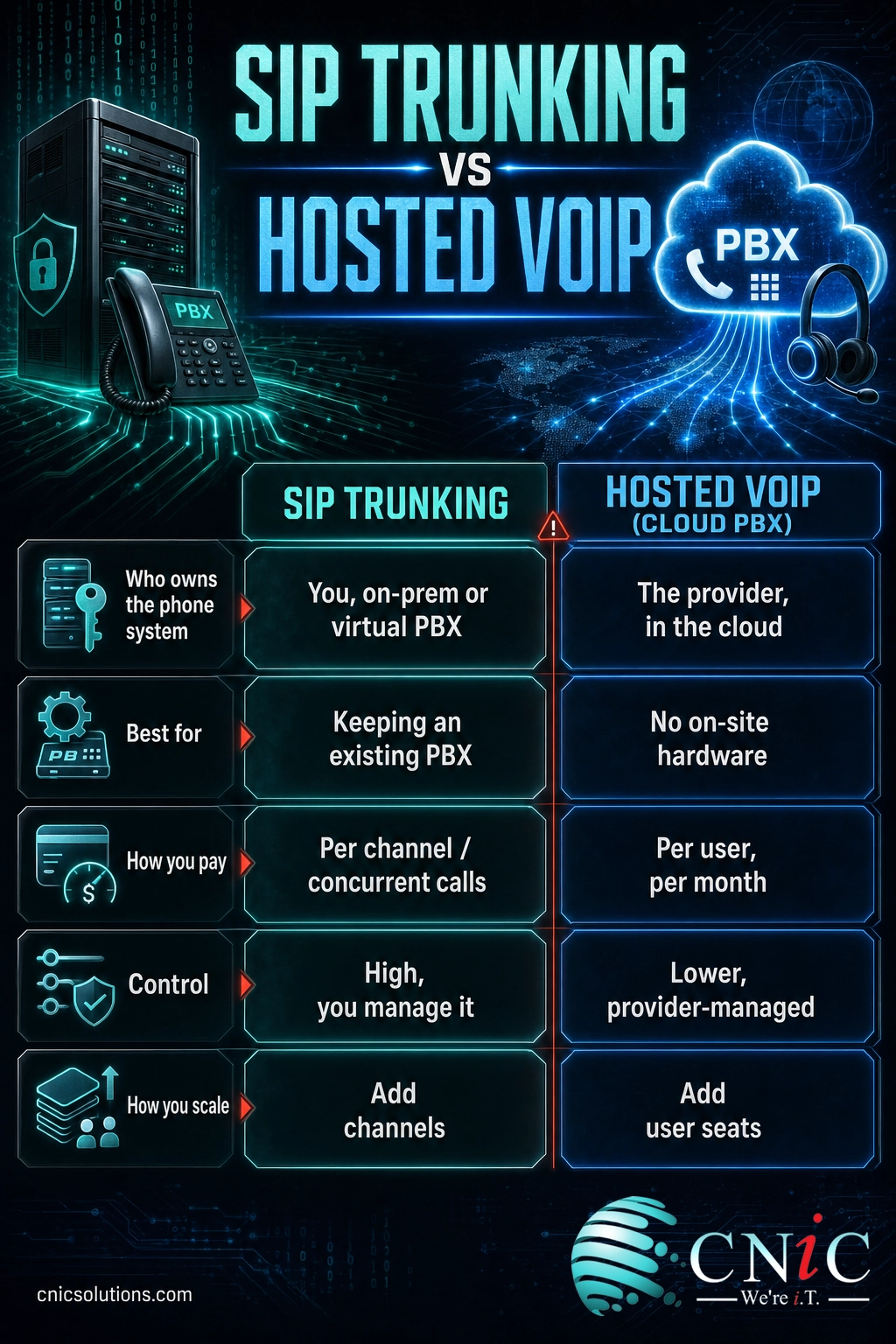
| SIP Trunking | Hosted VoIP (Cloud PBX) | |
|---|---|---|
| Who owns the phone system | You do (on-prem or virtual PBX) | The provider, in the cloud |
| Best for | Businesses with a PBX they want to keep | Businesses that want no on-site hardware |
| How you pay | Per channel (concurrent calls) | Per user, per month |
| Control and customization | High: you manage the PBX | Lower: the provider manages it |
| How you scale | Add or remove channels in the portal | Add or remove user seats |
Neither option is universally better. SIP trunking makes sense when a business already owns a capable PBX, wants tight control, or has more phones than simultaneous calls (so channel-based pricing is efficient). A hosted system makes sense when a business wants to avoid managing any equipment. Many organizations run a hybrid: a virtual PBX in the cloud, fed by SIP trunks. The right answer depends on your existing setup, your call volume, and how much of the system you want to manage yourself, which is where a side-by-side look at cloud and traditional phone systems helps.
Why SIP Trunking Matters for Businesses
SIP trunking is not a niche upgrade anymore. It has become the mainstream way businesses connect their phones, and there are concrete reasons the shift is accelerating.
The first reason is cost. A SIP trunk removes the monthly rental on physical ISDN lines, bills for concurrent channels rather than a fixed bank of lines that sit idle most of the day, and carries voice over the same internet connection you already pay for. Long-distance and inter-office calling that used to run up toll charges travels as ordinary data. For a business paying per line today, consolidating onto channels usually trims the recurring phone bill.
The second reason is flexibility. Adding capacity no longer means scheduling a carrier truck roll. During a seasonal rush you can burst channels up and scale them back afterward. Numbers are not tied to a physical location, so a business can keep its phone numbers when it moves offices, open a presence in another city without a physical line there, or route calls to remote staff, which is exactly what modern internet-based business phone systems are built to do.
The third reason is timing, and it is the one most businesses underestimate.
The public phone network is being modernized out from under the old copper lines. Carriers are steadily retiring the time-division multiplexed (TDM) circuits that traditional phone service ran on, moving toward all-internet-protocol networks. As that legacy infrastructure is decommissioned, internet-based calling stops being merely the cheaper option and becomes the practical long-term path. A business planning any phone-system investment now is better served building toward IP than sinking money into circuits on their way out.
Myth: SIP trunking is only for large enterprises and call centers. Not true. Because you provision channels in software, a SIP trunk scales down to a handful of concurrent calls just as easily as it scales up to hundreds. A small office with a modern PBX and a reliable internet connection can adopt SIP trunking and pay only for the capacity it actually uses. The technology is well suited to small and midsize businesses, not just big ones.
Source: Mordor Intelligence: SIP Trunking Market | FCC: Modernizing Telecommunications Networks
Where SIP Trunking Fits: On-Prem PBX, Virtual PBX, and UCaaS
SIP trunking is one piece of a larger phone-system picture. Understanding where it fits helps you decide whether it is the right building block for your business.
- On-premises PBX plus SIP trunks: You keep physical PBX hardware in your building and connect it to the outside world through SIP trunks instead of ISDN or PRI lines. This is the classic path for a business that has already invested in a good PBX and wants to modernize the connection without replacing the whole system.
- Virtual or cloud PBX plus SIP trunks: The PBX itself runs as software, either on a server you control or in a data center, and SIP trunks feed it. This removes the on-site hardware while keeping the flexibility and control of running your own phone system.
- Fully hosted UCaaS: The provider runs the PBX, the trunks, and the features as one cloud service, and you rent seats. Here SIP trunking still does the work of connecting to the phone network, but it is bundled into the service rather than something you manage. This is the simplest option for a business that wants to hand off the entire phone system.
The point is that SIP trunking is not a single product you either buy or skip. It is the connectivity layer that shows up in nearly every modern phone deployment, from a self-managed PBX to a fully hosted platform. The choice is less “SIP trunking or not” and more “how much of the phone system do I want to run myself,” a question our technology strategy and planning services are built to answer alongside your broader IT roadmap.
How to Get Started With SIP Trunking
Switching to SIP trunking is a manageable project, but a few things need to be right before it goes smoothly. A sensible rollout follows roughly these stages:
- Assess your current setup. Confirm what PBX you have and whether it is SIP-capable (most modern systems are, and older ones can often be bridged with a gateway). Count how many calls you make and receive at your busiest moment, because that peak, not your number of phones, sets how many channels you need.
- Check your internet. Voice is sensitive to jitter, latency, and packet loss. You need enough dependable bandwidth and, ideally, Quality of Service (QoS) settings that give voice traffic priority. A business-grade connection with headroom matters more than raw speed.
- Choose a provider and read the SLA. Compare uptime commitments, support, security features, and how numbers are handled. The service-level agreement is where reliability is actually promised, so read it closely.
- Port your numbers. Existing business numbers can almost always be transferred to the new trunk so customers notice nothing. Number porting takes time, so plan it early.
- Secure it and test. Put a session border controller or SIP-aware firewall in front of the trunk, enable encryption, and run a pilot with a small group before cutting the whole business over. Build in a failover path so calls reroute if the primary connection drops.
Most of the friction in a SIP trunking migration comes from the details around it: the internet connection, the security configuration, the number porting, and the failover plan. That is where an experienced partner earns its keep. CNiC Solutions helps small and midsize businesses plan and run this transition end to end through its business telecommunications services, sizing the channels correctly, hardening the connection, porting numbers cleanly, and making sure the phones just work on cutover day.
Talk to CNiC about modernizing your business phone system
Frequently Asked Questions
What is SIP trunking?
What is the difference between SIP trunking and VoIP?
Is SIP trunking cheaper than traditional phone lines?
Do I need a PBX for SIP trunking?
Is SIP trunking secure?
Related Terms
- PBX (Private Branch Exchange): The system that routes calls inside a business and connects them to the outside network. A SIP trunk plugs into the PBX.
- PSTN (Public Switched Telephone Network): The global network of traditional phone lines. SIP trunks bridge internet calls to and from the PSTN.
- VoIP (Voice over Internet Protocol): The broad technology of carrying calls over the internet, delivered through modern business phone systems.
- UCaaS (Unified Communications as a Service): A cloud service that combines voice, video, and messaging, explained further on the unified communications hub.
- ISDN / PRI: The legacy digital trunk lines that SIP trunking replaces.
- DID (Direct Inward Dialing): Individual phone numbers routed straight to specific users or departments over a trunk.
- Session Border Controller (SBC): A security device that sits at the edge of a SIP network to control and protect call traffic.
- Codec: The method used to compress and decompress voice (such as G.711 or G.729), balancing call quality against bandwidth.
About This Guide and Sources
The definitions and framework in this guide reflect standard, widely consistent characterizations of SIP trunking across the telecommunications industry. SIP itself is defined by the Internet Engineering Task Force in the SIP standard (RFC 3261), and the technical workflow described here aligns with vendor-neutral documentation such as Microsoft’s SIP trunking overview. The market-size figure is an estimate published by Mordor Intelligence; market-research estimates vary by firm, scope, and methodology, and it is presented as a directional indicator of adoption rather than an exact value. The move away from legacy copper (TDM) networks toward all-IP is documented by the Federal Communications Commission. Cost outcomes, channel counts, and bandwidth needs vary by business and are described in general terms, not as guarantees.

related posts
What Is Single Sign-On (SSO)? How It Works and Its Business Benefits
October 30, 2026Single sign-on (SSO) is a login method that lets one person use a single set of…
What Is Shadow IT? Risks, Examples, and How to Manage It
October 29, 2026Shadow IT is any hardware, software, cloud service, or AI tool that employees use for work…
What Is SIEM? Security Information and Event Management Explained
October 29, 2026A SIEM (security information and event management) is a security platform that collects log and event…
What Is SASE (Secure Access Service Edge)? How It Works
October 28, 2026Secure access service edge (SASE) is a cloud-delivered model that combines wide-area networking (SD-WAN) with a…