

Secure access service edge (SASE) is a cloud-delivered model that combines wide-area networking (SD-WAN) with a full stack of network security services on one platform. Instead of routing traffic through a central data center, SASE secures and connects users, devices, and offices at the network edge, close to wherever people actually work.
For years, networking and security were two separate stacks: one team ran the WAN and the routers, another ran the firewalls and the web filters, and remote workers reached it all through a VPN. That model strains the moment your people, apps, and data scatter across home offices and the cloud. SASE, pronounced “sassy,” collapses those two stacks into a single cloud service that follows the user instead of the office. This guide explains what SASE is, how it works, the five services inside it, how it differs from SSE, and whether it belongs on your roadmap.
- SASE converges networking and security into one cloud service. The wide-area network and the security stack become a single, cloud-delivered platform with one policy.
- Five parts make it work. SD-WAN handles networking; SWG, CASB, FWaaS, and ZTNA handle security, all delivered from the cloud edge.
- Security moves to the edge. Traffic is inspected close to the user at a nearby cloud point of presence, not backhauled to headquarters first.
- ZTNA replaces broad VPN access. Zero trust grants access to a specific application, not the whole network, which is a smaller target for attackers.
- SASE is a journey, not a product. It is an architecture adopted in phases, usually starting with the service that solves your most urgent pain.
What’s in This Guide
What Is SASE?
Secure access service edge is a network architecture that delivers both networking and security as a single cloud service. The term was coined by the research firm Gartner in 2019, in a report titled “The Future of Network Security Is in the Cloud.” Gartner’s core argument was that security should no longer live in a box at the office. As users and applications moved outside the building, the security stack needed to move with them, into the cloud, and merge with the network itself. You can read Gartner’s own SASE definition for the analyst framing.
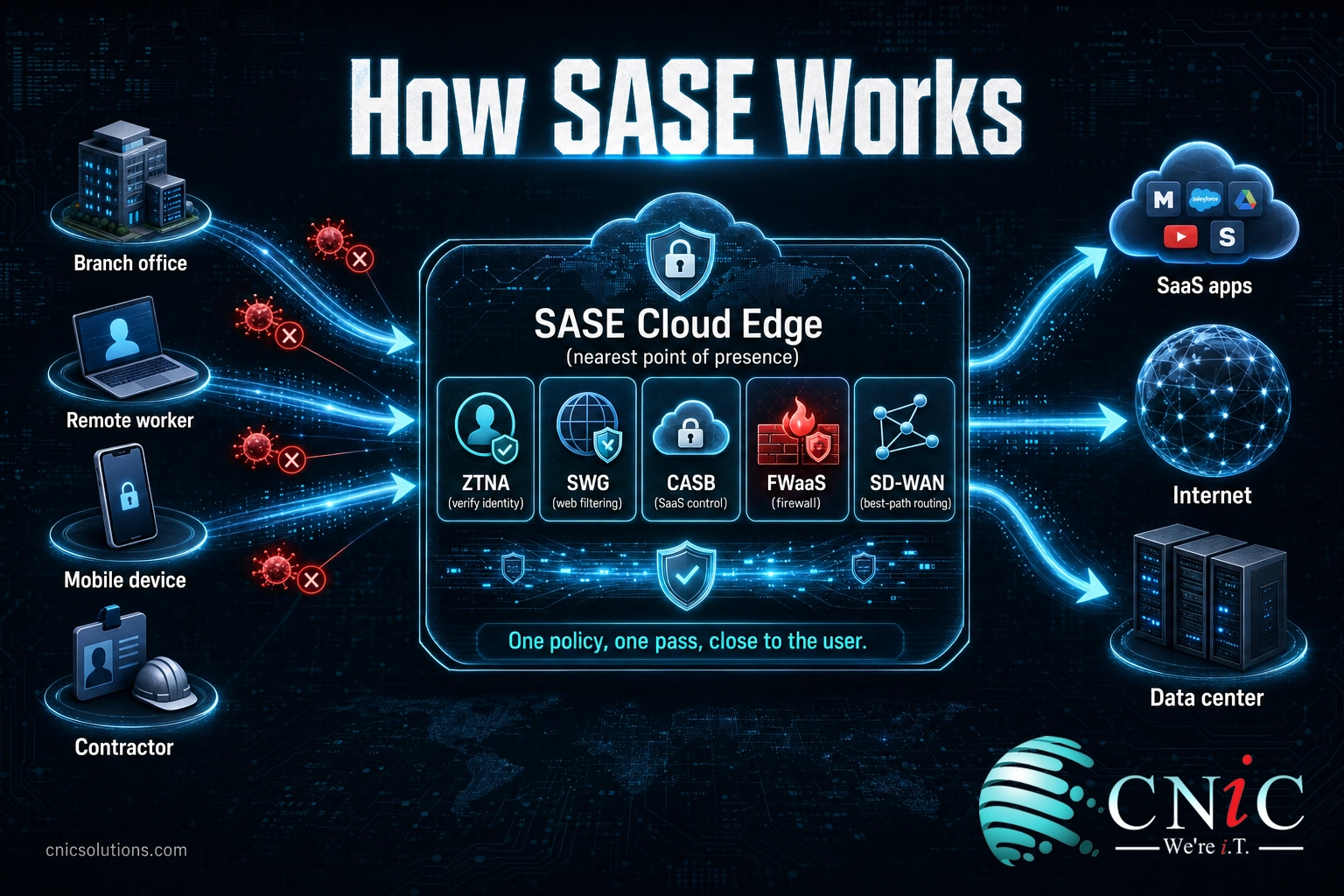
The practical shift is this: the endpoint and the office stop being the center of gravity. A branch office, a home worker, a phone on a coffee-shop network, and a contractor’s laptop all connect to the same cloud-delivered service, which decides who they are, what they are allowed to reach, and inspects the traffic before it goes anywhere. One policy follows the person, not the building they happen to be sitting in.
That convergence is what separates SASE from the old approach. Traditionally, a business bought a firewall, a web gateway, a VPN concentrator, and an SD-WAN appliance, then stitched them together and managed each one on its own console. SASE folds those functions into one platform run from the cloud, so the same rules apply whether someone is in the office, at home, or on the road.
Source: Gartner, secure access service edge definition
How SASE Works
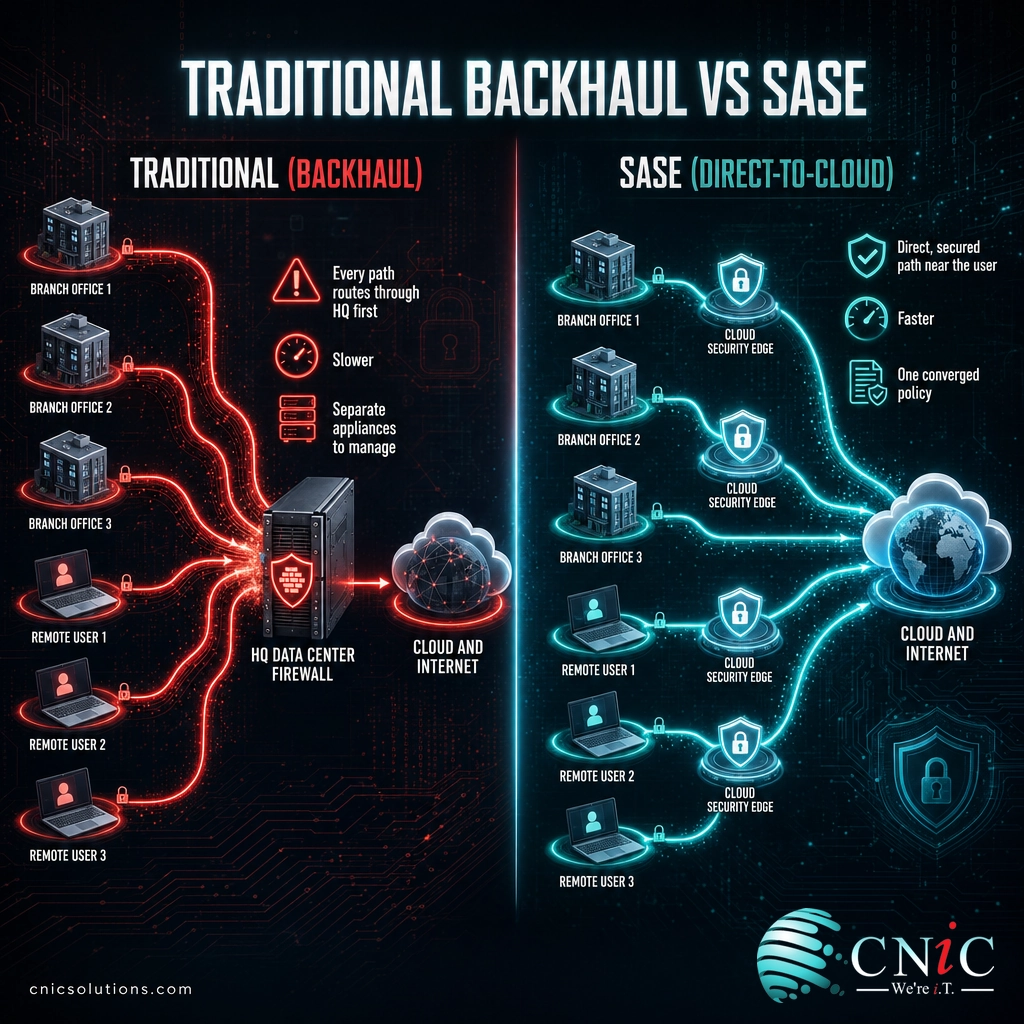
Think of SASE like airport security that travels with you. In the old model, no matter where your flight started, you had to fly back to one central airport to be screened before you could go anywhere else. That is how legacy networks worked: traffic from every branch and remote worker was “backhauled” to headquarters, checked by the firewall there, then sent back out. It is slow, and it makes no sense when the app you are reaching lives in the cloud, not at headquarters.
SASE puts a screening checkpoint close to every traveler instead. Providers run a global network of cloud data centers, called points of presence (PoPs), and users connect to the nearest one. At that edge, four things happen in a single pass:
- Identity is verified first. SASE is built on zero trust: it checks who the user is, what device they are on, and the risk of the request before granting anything. Access is tied to identity, not to a network location.
- Policy is applied. One set of rules, held in the cloud, decides what that verified user can reach, whether they are in the office or on hotel Wi-Fi.
- Traffic is inspected. The security services (web filtering, malware scanning, data controls, and firewalling) examine the traffic at the edge, in one pass, rather than in a chain of separate appliances.
- The connection is optimized. The SD-WAN layer routes the traffic over the best available path to its destination, whether that is a SaaS app, the public internet, or a data center.
Because the checkpoint sits near the user and near the cloud apps they use, traffic takes a direct, secured path instead of a detour through headquarters. Identity, policy, and inspection all live in the same cloud platform, so there is one place to set a rule and one place it is enforced. That single-pass, identity-first design is the heart of how SASE works.
The convergence in one sentence. SASE takes the networking job of SD-WAN and the security jobs of a web gateway, a CASB, a firewall, and a zero trust broker, and runs them as one cloud service at the edge, so a single policy protects a user no matter where they connect from.
SASE vs SSE: Clearing Up the Biggest Confusion
The most common mix-up is between SASE and SSE, which stands for security service edge. Gartner introduced SSE in 2021 to name the security-only half of SASE, and the two acronyms have been causing confusion ever since. The relationship is simple once you see it: SSE is the bundle of cloud security services, and SASE is that bundle plus the networking layer.
| Attribute | SSE (security service edge) | SASE (secure access service edge) |
|---|---|---|
| What it includes | The security services only: SWG, CASB, ZTNA, and FWaaS | Everything in SSE, plus SD-WAN networking |
| Main job | Securely connect users to apps, the web, and data | Securely connect and optimize traffic for users and whole sites |
| Networking | Not included, rides on your existing network | Built in through SD-WAN and traffic optimization |
| Best starting point for | Securing remote users and cloud app access first | Businesses ready to converge branch networking and security together |
| The formula | The security half | SSE + SD-WAN = SASE |
In practice, many businesses adopt SSE first, because securing remote workers and cloud access is the more urgent problem, then add the SD-WAN networking piece to complete the SASE picture as branch office contracts come up for renewal. Neither is wrong. SSE is simply the security-focused entry point to the same destination.
The Five Core Components of SASE
SASE is not one feature, it is five services working as one. One handles networking, and four handle different slices of security. Understanding each makes the whole model click.
1SD-WAN (software-defined wide-area network)
SD-WAN is the networking engine. It intelligently steers traffic across whatever connections a site has, such as broadband, fiber, or cellular, choosing the best path for each application in real time and failing over automatically if a link degrades. It is what lets a branch office connect directly and reliably to cloud apps instead of routing everything back to a central data center. If you want the deeper dive, see our guide to how software-defined WAN works, the networking foundation SASE is built on.
2Secure web gateway (SWG)
The SWG is the web filter and inspector. It sits between users and the internet, blocking access to malicious or non-compliant sites, scanning web traffic for malware, and enforcing acceptable-use policies. In a SASE model this happens at the cloud edge for every user, on or off the corporate network, rather than only for people sitting behind the office firewall.
3Cloud access security broker (CASB)
The CASB is the guard for cloud applications. It gives visibility into which SaaS tools your people use (including the unsanctioned ones, often called shadow IT), enforces security policy across those apps, and protects sensitive data moving in and out of services like Microsoft 365, Google Workspace, and Salesforce. As business runs increasingly on SaaS, the CASB is what keeps that usage governed.
4Firewall as a service (FWaaS)
FWaaS delivers firewall capability from the cloud instead of from a physical box at each location. It brings the usual protections, traffic filtering, intrusion prevention, and policy control, but as a scalable service that covers every user and site under one rule set. That removes the job of buying, patching, and maintaining separate firewall appliances at every office.
5Zero trust network access (ZTNA)
ZTNA is the modern replacement for VPN remote access, and arguably the most important piece. Instead of dropping a verified user onto the whole network the way a VPN does, ZTNA grants access to one specific application at a time, and keeps verifying identity, device health, and context. Its guiding principle, defined in NIST’s zero trust architecture standard (SP 800-207), is never trust, always verify. That per-application model is a far smaller target than a wide-open network tunnel.
Why SASE Matters for Small and Midsize Businesses
SASE started as an enterprise idea, but the forces behind it, hybrid work, cloud-first operations, and attackers who target remote access, hit small and midsize businesses just as hard. Three data points explain why it is worth understanding now.
First, adoption has moved from fringe to mainstream. Gartner projected that by 2025, at least 60% of enterprises would have explicit strategies and timelines for SASE adoption, up from roughly 10% in 2020. A model that a tenth of organizations were planning for at the start of the decade became a majority strategy within five years, which tells you where network security is heading.
Enterprises With an Explicit SASE Strategy: 2020 vs 2025 (Gartner)
Source: Gartner, 2021 Strategic Roadmap for SASE Convergence.
Second, remote access is now a prime target, and that is exactly what SASE hardens. Verizon’s 2025 Data Breach Investigations Report found that edge devices and VPNs made up 22% of the breaches driven by vulnerability exploitation, almost eight times the 3% seen a year earlier. Attackers have learned that the VPN concentrator and the perimeter box are soft, high-value doors. Replacing broad VPN access with per-application zero trust, the ZTNA piece of SASE, directly attacks that exposure.
Share of Vulnerability-Exploitation Breaches Hitting Edge Devices and VPNs (Verizon DBIR)
An almost eight-fold jump in one year. Source: Verizon 2025 Data Breach Investigations Report.
Third, the cost of getting it wrong is steep. IBM’s 2025 Cost of a Data Breach Report put the global average breach at $4.44 million, and the United States average at $10.22 million, the highest of any region. For a small or midsize business, a fraction of that is existential. A converged, identity-first model like SASE is designed to reduce both the odds and the blast radius, by shrinking the attack surface and enforcing one consistent policy everywhere. The full context on those figures is in our breakdown of the average cost of a data breach, and why network security is a business issue, not just an IT one.
Myth: SASE is a single product you buy and switch on. It is not. SASE is an architecture delivered as a set of converged cloud services, sometimes from one vendor, sometimes from two or three that integrate. Almost no one deploys all five components overnight. The realistic path is phased: start with the service that solves your most urgent problem, usually ZTNA to fix remote access, then add the rest over time. Treating SASE as a one-click purchase is how projects stall.
Source: Verizon 2025 Data Breach Investigations Report | IBM Cost of a Data Breach Report 2025
How to Get Started With SASE
Adopting SASE is less about buying a platform and more about sequencing the move around your real pain points. A sound path looks like this:
- Map how people work today. Document where users connect from, which apps they depend on (cloud and on-premises), and how remote access happens now. That inventory tells you where the risk and friction actually live.
- Fix the most urgent gap first. For most businesses that is remote access, so ZTNA (retiring the VPN) is the common first phase. If cloud app sprawl is the bigger worry, start with the CASB and secure web gateway instead.
- Decide single-vendor or integrated. A single-vendor SASE platform is simpler to run; a best-of-breed mix can fit specific needs. Weigh simplicity against flexibility for your environment.
- Plan the networking layer. As office and connectivity contracts renew, fold in SD-WAN so branch traffic goes direct-to-cloud and the networking and security halves finally converge.
- Roll out in phases and measure. Pilot with one group, confirm the experience and the policy, then expand. This is where a managed IT partner earns its keep, sizing, securing, and supporting each phase.
Because SASE sits at the intersection of networking, cloud, and security, it is rarely a standalone project. It usually rides alongside broader IT infrastructure security planning and a clear-eyed view of your roadmap. If you are weighing whether and when SASE fits, that strategic call is exactly what a virtual CIO is for.
Talk to a Cybersecurity Team About SASE
Get a Virtual CIO to Plan Your Roadmap
Common Questions About SASE
What is SASE in simple terms?
What are the core components of SASE?
What is the difference between SASE and SSE?
Does SASE replace a VPN?
Is SASE a single product you can buy?
Related Terms
- SSE (security service edge): the security-only half of SASE, bundling SWG, CASB, ZTNA, and FWaaS without the SD-WAN networking layer.
- SD-WAN: the software-defined networking engine inside SASE that steers traffic across links and connects sites directly to the cloud, covered in depth in the linked guide above.
- ZTNA (zero trust network access): access to one application at a time based on verified identity and context, the modern successor to VPN remote access.
- Zero trust: the security principle of “never trust, always verify,” where no user or device is trusted by default, formalized in NIST SP 800-207.
- SWG (secure web gateway): a cloud filter that inspects web traffic, blocks malicious sites, and enforces acceptable-use policy for every user.
- CASB (cloud access security broker): a control point that gives visibility and policy enforcement over the SaaS apps a business uses, including shadow IT.
- FWaaS (firewall as a service): firewall protection delivered from the cloud as a scalable service instead of a physical appliance at each site.
- VPN (virtual private network): the legacy remote-access method that tunnels a user onto the whole network, increasingly replaced by ZTNA.
About This Guide
The definition and origin of SASE, and the SSE distinction, are drawn from Gartner, which coined both terms. The description of how SASE works and its five components reflects the consistent architecture published by major SASE providers and Gartner’s framework; the zero trust principle references NIST’s zero trust architecture standard (SP 800-207). Adoption figures are from Gartner’s 2021 Strategic Roadmap for SASE Convergence. Breach and remote-access figures are from the Verizon 2025 Data Breach Investigations Report and the IBM 2025 Cost of a Data Breach Report. Figures are cited to their original sources and used to illustrate the technology and its adoption, not as guaranteed outcomes for any specific business.
Sources: Gartner, SASE definition | NIST, Zero Trust Architecture (SP 800-207) | Verizon 2025 DBIR | IBM Cost of a Data Breach 2025
Get a Free Consultation on Modern, Secure IT



related posts
What Is SIEM? Security Information and Event Management Explained
October 29, 2026A SIEM (security information and event management) is a security platform that collects log and event…
What Is Shadow IT? Risks, Examples, and How to Manage It
October 29, 2026Shadow IT is any hardware, software, cloud service, or AI tool that employees use for work…
What Is SD-WAN? How Software-Defined WAN Works
October 28, 2026SD-WAN (software-defined wide area network) is a way of building a business network that uses software…
What Is Root Cause Analysis (RCA)? A Guide to Solving IT Problems…
October 27, 2026Root cause analysis (RCA) is a structured way to find the true underlying cause of a…