

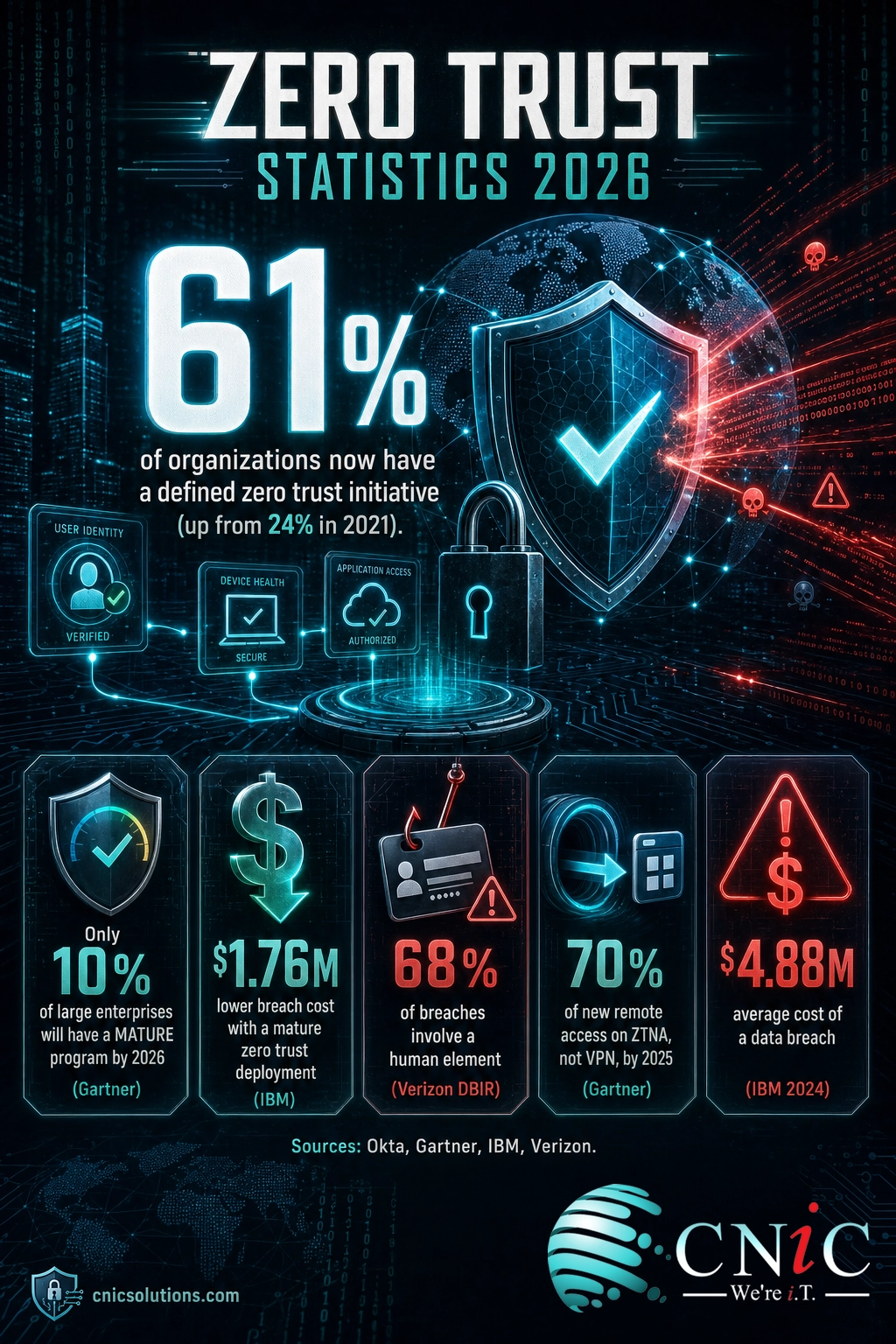
Zero trust has become the default security strategy on paper, but not yet in practice. Okta’s research puts the share of organizations with a defined zero trust initiative at 61%, up from 24% in 2021, while Gartner predicts only 10% of large enterprises will have a mature, measurable program by 2026. The numbers below show where adoption really stands, why the model matters, and what it changes when a breach happens.
- Adoption is mainstream: 61% of organizations have a defined zero trust initiative, up from 55% in 2022 and 24% in 2021 (Okta State of Zero Trust Security).
- Maturity lags badly: Gartner predicts only 10% of large enterprises will have a mature and measurable zero trust program by 2026, up from less than 1% in 2023.
- Identity is the target: 68% of breaches involve a non-malicious human element and stolen credentials remain a top entry point (Verizon 2024 DBIR).
- It lowers breach costs: organizations with a mature zero trust deployment saw breach costs about $1.76 million lower than those without (IBM Cost of a Data Breach).
- VPNs are on the way out: Gartner expects 70% of new remote access deployments to run predominantly on ZTNA by 2025, up from under 10% at the end of 2021.
- Not a silver bullet: Gartner warns that by 2026, more than half of cyberattacks will target areas zero trust controls do not cover.
What’s in This Report
- Zero Trust Adoption: From Buzzword to Default
- The Maturity Gap: Everyone Started, Few Finished
- Why Zero Trust: Identity Is the New Perimeter
- Zero Trust Pays: The Breach-Cost Impact
- The Shift From VPN to Zero Trust Network Access
- Drivers, Barriers, and the Federal Push
- Summary Table: Every Stat at a Glance
- Frequently Asked Questions
- Methodology and Sources
1Zero Trust Adoption: From Buzzword to Default
Zero trust started as a Forrester concept in 2010 and spent a decade as a slide-deck phrase. That is over. Okta’s State of Zero Trust Security research, based on a global survey of security decision-makers, found that 61% of organizations had a defined zero trust initiative in place, up from 55% the year before and just 24% in 2021. In other words, the share of organizations formally pursuing zero trust more than doubled in two years.
Organizations With a Defined Zero Trust Initiative
Share of organizations reporting a defined zero trust initiative. Source: Okta State of Zero Trust Security.
The direction is not surprising once you look at what changed underneath it. Remote and hybrid work erased the office network boundary, business systems moved to the cloud, and attackers shifted from breaking through firewalls to simply logging in with stolen credentials. When the perimeter dissolves, the old model of trusting anything inside the network stops making sense. Zero trust replaces it with a simple principle: never trust, always verify, and grant the least access needed for each request.
Adoption is not the same as protection. A survey checkbox that says “we have a zero trust initiative” can mean a fully enforced least-privilege architecture, or it can mean the company turned on multi-factor authentication for email and called it a day. Both count as an initiative. The sections below separate the organizations that have genuinely re-architected access from the far larger group that has only started. For a plain-English primer on the model itself, see our guide to zero trust security.
Source: Okta State of Zero Trust Security | Microsoft Zero Trust research
Turning that checkbox into real, enforced protection across identity, devices, and data is the work behind a managed cybersecurity program.
Explore CNiC Cybersecurity Services
2The Maturity Gap: Everyone Started, Few Finished
Here is the statistic that reframes all the others. Gartner predicts that by 2026, only 10% of large enterprises will have a mature and measurable zero trust program in place, up from less than 1% in 2023. Set that against the 61% who say they have an initiative, and the picture is clear: starting zero trust is now common, but finishing it, to the point where access is genuinely least-privilege and the program can be measured, is still rare.
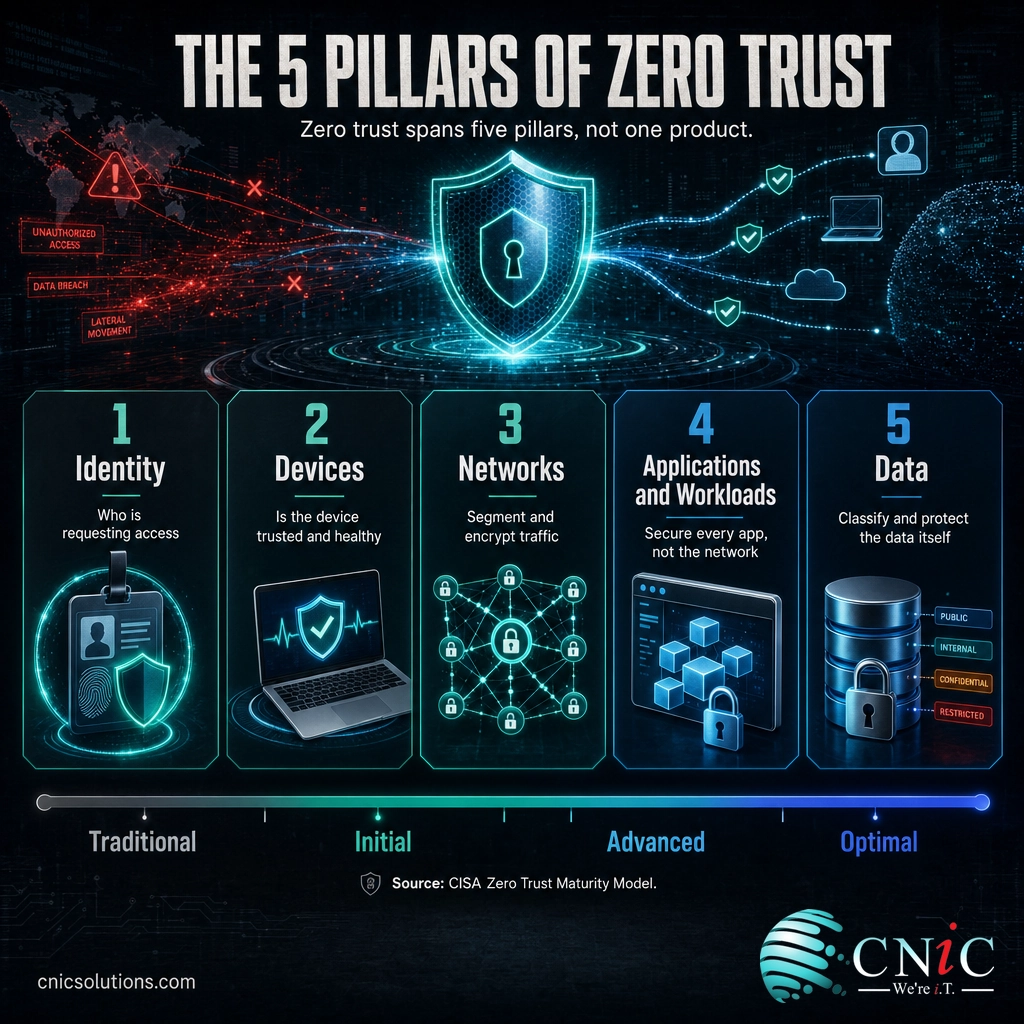
“Mature and measurable” is not marketing language. The CISA Zero Trust Maturity Model, the reference framework many organizations use, breaks the journey into four stages across five pillars. Most companies with an initiative sit in the first stage or two, not the last.
| Maturity stage | What it looks like | Source |
|---|---|---|
| Traditional | Manual, static access rules and siloed security; trust is largely implicit inside the network. | CISA ZTMM 2.0 |
| Initial | First automated controls and some cross-pillar integration; multi-factor authentication is being rolled out. | CISA ZTMM 2.0 |
| Advanced | Coordinated, policy-driven access across pillars with centralized visibility. | CISA ZTMM 2.0 |
| Optimal | Fully automated, continuously verified, least-privilege access with dynamic policy. | CISA ZTMM 2.0 |
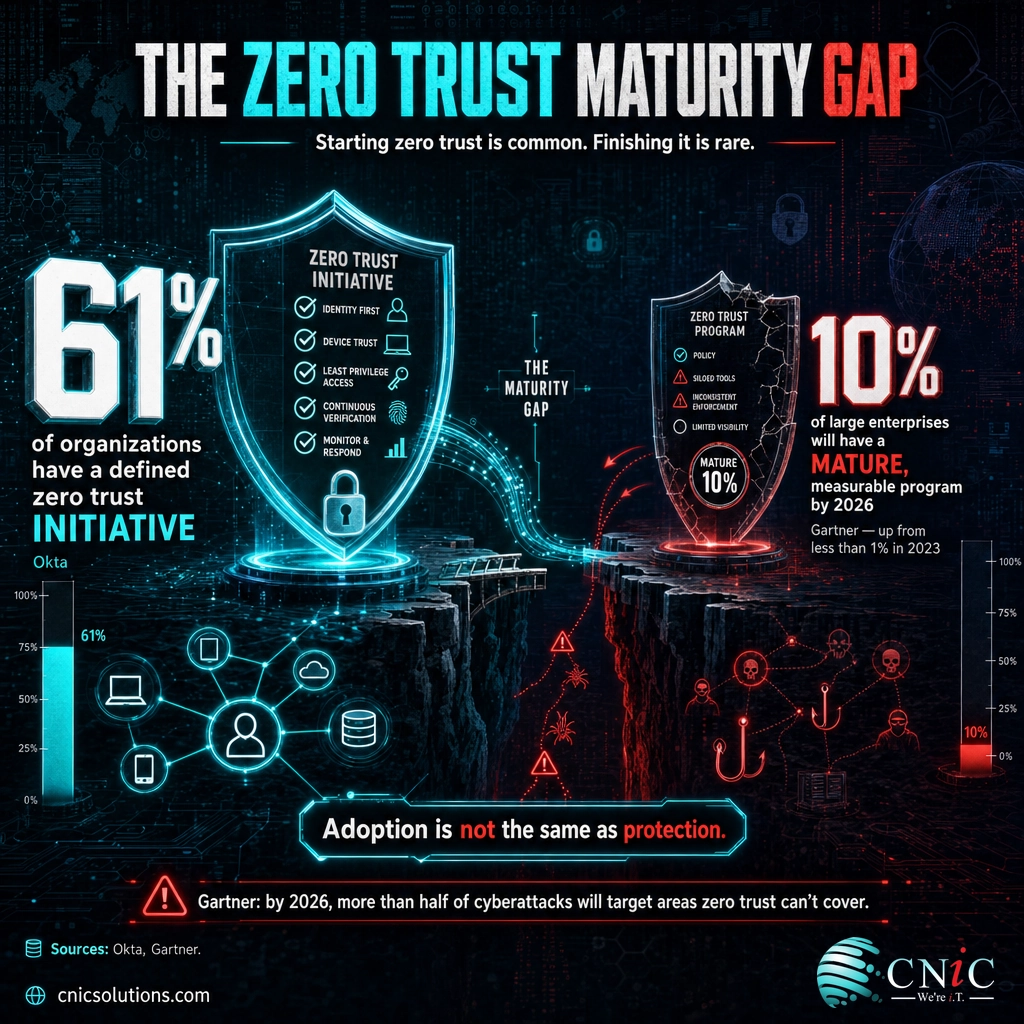
CNiC Solutions Analysis: The Maturity Gap. Okta reports 61% of organizations with a defined zero trust initiative; Gartner projects 10% of large enterprises with a mature, measurable program by 2026. Even allowing that these figures come from different samples (Okta surveys organizations broadly, Gartner forecasts large enterprises), the ratio is striking: for roughly every organization that reaches measurable maturity, about six others will have started zero trust without finishing it (61 divided by 10 is about 6). The lesson for a growing business is not to be discouraged by the 10%, but to treat maturity as a staged roadmap rather than a switch. Calculation and interpretation original to CNiC Solutions.
Myth: “Once we adopt zero trust, we are secure.” Zero trust reduces risk, it does not eliminate it. Gartner explicitly warns that by 2026, more than half of cyberattacks will be aimed at areas that zero trust controls do not address and cannot mitigate, from social engineering to vulnerabilities in third-party software. Zero trust is the foundation of a modern security program, not the whole building. Treating it as a finish line is how organizations get a false sense of safety.
Source: Gartner Zero Trust Prediction, January 2023 | CISA Zero Trust Maturity Model
Sequencing that roadmap, deciding which pillar to harden first and how to measure progress, is exactly the planning a fractional technology leader brings to a business without a full-time security executive.
Get a Zero Trust Roadmap From a Virtual CIO
3Why Zero Trust: Identity Is the New Perimeter
Zero trust exists because of how breaches actually happen. Attackers rarely smash through a firewall anymore. They log in. Verizon’s 2024 Data Breach Investigations Report found that 68% of breaches involved a non-malicious human element, such as someone falling for a phishing email or being tricked into handing over a password, and stolen credentials have been one of the most common footholds in breaches for a decade.
The pattern is consistent across the major reports: identity is the target and the entry point. That is why zero trust puts identity first. Instead of trusting a user because they are on the corporate network, it verifies who they are, what device they are on, and whether the request makes sense, every time. Strong multi-factor authentication, tight control over privileged accounts, and context-aware access rules are the practical building blocks.
| The identity problem | Figure | Source |
|---|---|---|
| Breaches involving a human element | 68% | Verizon 2024 DBIR |
| Breaches involving stolen credentials (decade view) | ~31% | Verizon DBIR |
| Stolen or compromised credentials as an initial attack vector | Top vector | IBM 2024 |
| Time to identify and contain a credential-based breach | 292 days | IBM 2024 |
| Global average cost of a data breach | $4.88M | IBM 2024 |
This is where zero trust gets concrete for a small or midsize business. You do not start by buying a platform. You start by making stolen credentials useless: enforce phishing-resistant multi-factor authentication, limit standing privileged access with privileged access management, and add rules that check device and location before granting entry through conditional access. The human-error numbers behind all of this are covered in our human error in cybersecurity statistics.
Source: Verizon 2024 Data Breach Investigations Report | IBM Cost of a Data Breach 2024
Rolling out multi-factor authentication and least-privilege access across an entire team, without breaking how people work, is day-to-day managed IT.

4Zero Trust Pays: The Breach-Cost Impact
The business case for zero trust is not abstract. IBM’s Cost of a Data Breach research, one of the most cited security studies in the world, ties the model directly to money. Organizations with a mature zero trust deployment experienced breach costs roughly $1.76 million lower than those with no zero trust approach. In a year when the global average breach cost hit a record $4.88 million, that is a large share of the bill avoided.
Two levers drive those savings. First, zero trust limits blast radius: when every request is verified and access is least-privilege, a stolen credential unlocks one narrow door instead of the whole building, so incidents are smaller and contained faster. Second, the continuous monitoring and automation that zero trust depends on are the same capabilities IBM credits with the largest cost reductions. The reductions compound.
Average Breach-Cost Reduction (US$ Millions)
Average reduction in data breach cost versus organizations without each capability. Source: IBM Cost of a Data Breach.
How the savings actually show up. The $1.76 million is not a discount you claim, it is the difference between a contained incident and a company-wide one. An attacker who phishes a single login at a business with least-privilege access reaches one mailbox. The same attacker at a flat, trust-everything network reaches file shares, finance systems, and backups. Zero trust does not stop the phish, it decides how far the damage spreads. Insider-driven incidents follow the same logic, as our insider threat statistics show.
Source: IBM Cost of a Data Breach 2024
Making sure a contained incident stays contained, with tested backups you can restore from, is the recovery half of the equation.
Protect the Last Line: Backup & Recovery
5The Shift From VPN to Zero Trust Network Access
The most visible way zero trust is replacing old infrastructure is the retirement of the VPN. A traditional VPN drops a remote user onto the corporate network and largely trusts them from there, which is precisely the implicit trust zero trust is built to remove. Zero Trust Network Access (ZTNA) grants access to specific applications after verifying identity and context, never to the whole network. Gartner expects that swap to happen fast.
| Gartner ZTNA prediction | Timeline | Source |
|---|---|---|
| New remote access served predominantly by ZTNA, not VPN | 70% by 2025 (from <10% in 2021) | Gartner |
| Enterprises phasing out most remote access VPNs for ZTNA | 60% by 2025 | Gartner |
For a growing business, the takeaway is not to rip out a working VPN overnight. It is to recognize that broad network access is a liability, and that new remote access, new branch connections, new third-party access, should default to per-application, verified access instead. ZTNA is one component of a wider convergence of networking and security, often delivered as secure access service edge (SASE). We cover the access model itself in our explainer on how ZTNA works.
Source: Gartner on Zero Trust Network Access
Designing that verified, segmented access so remote and branch users connect safely is core network engineering.
Modernize Remote Access and Networking
6Drivers, Barriers, and the Federal Push
Zero trust did not become the default by accident. It has a standards body behind it, a federal mandate pushing it, and a set of business realities making it unavoidable. The concept came from Forrester analyst John Kindervag in 2010, was formalized by the U.S. government in NIST Special Publication 800-207 in 2020, and became a federal requirement when the Office of Management and Budget issued its Federal Zero Trust Strategy in 2022, directing agencies to meet specific zero trust goals by the end of fiscal year 2024.
The barriers are real too, and they explain the maturity gap. Zero trust touches identity, devices, networks, applications, and data at once, which makes it a program rather than a purchase. Legacy systems resist least-privilege rules, the cybersecurity skills shortage makes execution hard, and doing it badly frustrates users enough that controls get loosened. When a mandate meets those frictions, adoption gets counted and maturity does not follow.
| What pushes zero trust forward | What holds it back |
|---|---|
| Remote and hybrid work erasing the network perimeter | Legacy systems that assume implicit network trust |
| Cloud and SaaS moving data outside the firewall | Cybersecurity skills shortage and limited in-house staff |
| Credential theft as the top breach entry point | Complexity of coordinating five pillars at once |
| Federal mandate and NIST standard (SP 800-207) | User friction when controls are rolled out poorly |
| Lower breach costs and cyber-insurance requirements | Treating zero trust as a product instead of a strategy |
Myth: “Zero trust is a product you buy.” No single vendor sells “zero trust” in a box, and any that claims to is selling one pillar and calling it the whole model. Zero trust is an architecture and an operating discipline that spans identity, endpoints, network, applications, and data. The businesses that get stuck are the ones that bought a tool, checked the box, and stopped. The ones that succeed treat it as a staged program with owners, milestones, and measurement, which is why so much of the value comes from how it is run, not what is purchased.
Much of that push is now reinforced by cyber-insurance underwriters and cloud providers, who increasingly require multi-factor authentication and least-privilege access as a condition of coverage or configuration. The market pressure and the security logic point the same direction, which is why the adoption curve keeps climbing even as maturity lags.
Source: NIST Special Publication 800-207, Zero Trust Architecture | OMB Federal Zero Trust Strategy (M-22-09)
Summary Table: Every Stat at a Glance
| Statistic | Figure | Source | Year |
|---|---|---|---|
| Organizations with a defined zero trust initiative | 61% | Okta | 2023 |
| Same figure, prior year | 55% | Okta | 2022 |
| Same figure, 2021 baseline | 24% | Okta | 2021 |
| Decision-makers who call zero trust critical to success | 96% | Microsoft | 2021 |
| Organizations in the process of implementing zero trust | 76% | Microsoft | 2021 |
| Large enterprises with a mature, measurable program (forecast) | 10% | Gartner | 2026 |
| Large enterprises mature in 2023 (baseline) | <1% | Gartner | 2023 |
| Cyberattacks by 2026 aimed at areas zero trust can’t cover | More than half | Gartner | 2026 |
| Pillars in the CISA Zero Trust Maturity Model | 5 | CISA | 2023 |
| Breaches involving a non-malicious human element | 68% | Verizon DBIR | 2024 |
| Breaches involving stolen credentials (decade view) | ~31% | Verizon DBIR | 2024 |
| Time to identify and contain a credential-based breach | 292 days | IBM | 2024 |
| Global average cost of a data breach | $4.88 million | IBM | 2024 |
| Lower breach cost with a mature zero trust deployment | $1.76 million | IBM | 2024 |
| Average saving with extensive security AI and automation | $2.22 million | IBM | 2024 |
| New remote access served predominantly by ZTNA (forecast) | 70% | Gartner | 2025 |
| Enterprises phasing out most VPNs for ZTNA (forecast) | 60% | Gartner | 2025 |
| ZTNA share of new remote access, end of 2021 | <10% | Gartner | 2021 |
| Year the term “zero trust” was coined (Forrester) | 2010 | Forrester | 2010 |
| NIST zero trust architecture standard | SP 800-207 | NIST | 2020 |
| Federal zero trust deadline (OMB strategy) | End of FY2024 | OMB M-22-09 | 2022 |
Frequently Asked Questions
How many organizations use zero trust in 2026?
What percentage of companies have a mature zero trust program?
Does zero trust actually reduce the cost of a data breach?
Why are companies moving from VPNs to zero trust network access?
Is zero trust just for large enterprises?
Methodology and Sources
How we compiled this report
Every figure in this article comes from a named primary source: analyst-firm forecasts and research with disclosed methodology, government standards bodies, and the annual breach reports that security teams rely on. We did not use secondary blog aggregations or unattributed “up to X%” claims. Where a figure is a forecast, we say so and attribute it to the firm that issued it. Zero trust adoption and maturity figures come from Okta, Microsoft, and Gartner; the breach-impact figures come from IBM and Verizon; the framework and mandate references come from CISA, NIST, and the U.S. Office of Management and Budget. The one derived figure, the maturity-gap ratio, is clearly labeled as CNiC Solutions analysis with its source data and formula shown, and we note that its two inputs come from different survey populations.
Primary sources cited:
- Okta State of Zero Trust Security: share of organizations with a defined zero trust initiative over time.
- Microsoft Zero Trust research: decision-makers who view zero trust as critical, and share implementing it.
- Gartner Zero Trust Prediction: mature and measurable program forecast, and the coverage-gap warning.
- Gartner on Zero Trust Network Access: ZTNA versus VPN adoption forecasts.
- CISA Zero Trust Maturity Model: the five pillars and four maturity stages.
- Verizon 2024 Data Breach Investigations Report: human element and stolen-credential involvement in breaches.
- IBM Cost of a Data Breach 2024: average breach cost, zero trust and automation savings, and credential-breach timelines.
- NIST Special Publication 800-207: the zero trust architecture standard.
- OMB Federal Zero Trust Strategy (M-22-09): the federal fiscal-year-2024 deadline.
Media and press usage. Journalists, analysts, and bloggers are welcome to cite the statistics in this report with attribution to CNiC Solutions and a link back to this page. The maturity-gap calculation and interpretation are original to CNiC Solutions. CNiC Solutions is a managed IT and cybersecurity provider; where this report recommends managed IT, virtual CIO, cybersecurity, or networking services, it reflects CNiC’s own service model, disclosed for transparency.



related posts
What Is ZTNA (Zero Trust Network Access)?
November 3, 2026Zero Trust Network Access (ZTNA) is a security service that grants a verified user access to…
What Is XDR (Extended Detection and Response) and How Does It Protect…
November 2, 2026Extended detection and response (XDR) is a security platform that collects and correlates threat data from…
What Is Zero Trust Security? A Guide for Small Businesses
November 2, 2026Zero Trust security is a cybersecurity model built on one rule: never trust, always verify. Instead…
What Is the Cyber Kill Chain? The 7 Stages Explained
November 1, 2026The cyber kill chain is a model that breaks a cyberattack into seven sequential stages, from…