

When ransomware hits, how you recover matters as much as whether you were attacked. The gap between organizations that are back online in 48 hours and those still rebuilding three months later isn’t luck — it’s preparation. In 2025, 53% of ransomware victims fully recovered within one week, up from just 35% in 2024, proving that recovery maturity is improving. But the cost of unpreparedness remains catastrophic: organizations with compromised backups face recovery costs 8 times higher than those with intact ones. Backup repositories are targeted in 96% of ransomware attacks — and successfully compromised 76% of the time. The median dwell time before encryption is now just 4–5 days. This article compiles the definitive ransomware recovery statistics for 2026 from Tier 1 primary sources — Sophos, IBM, Veeam, Halcyon, Coveware, and the FBI — covering recovery timelines, costs, backup effectiveness, incident response outcomes, and what separates organizations that bounce back quickly from those that don’t. For attack frequency data, see Ransomware Statistics 2026. For ransom payment data, see Ransomware Payout Statistics 2026.
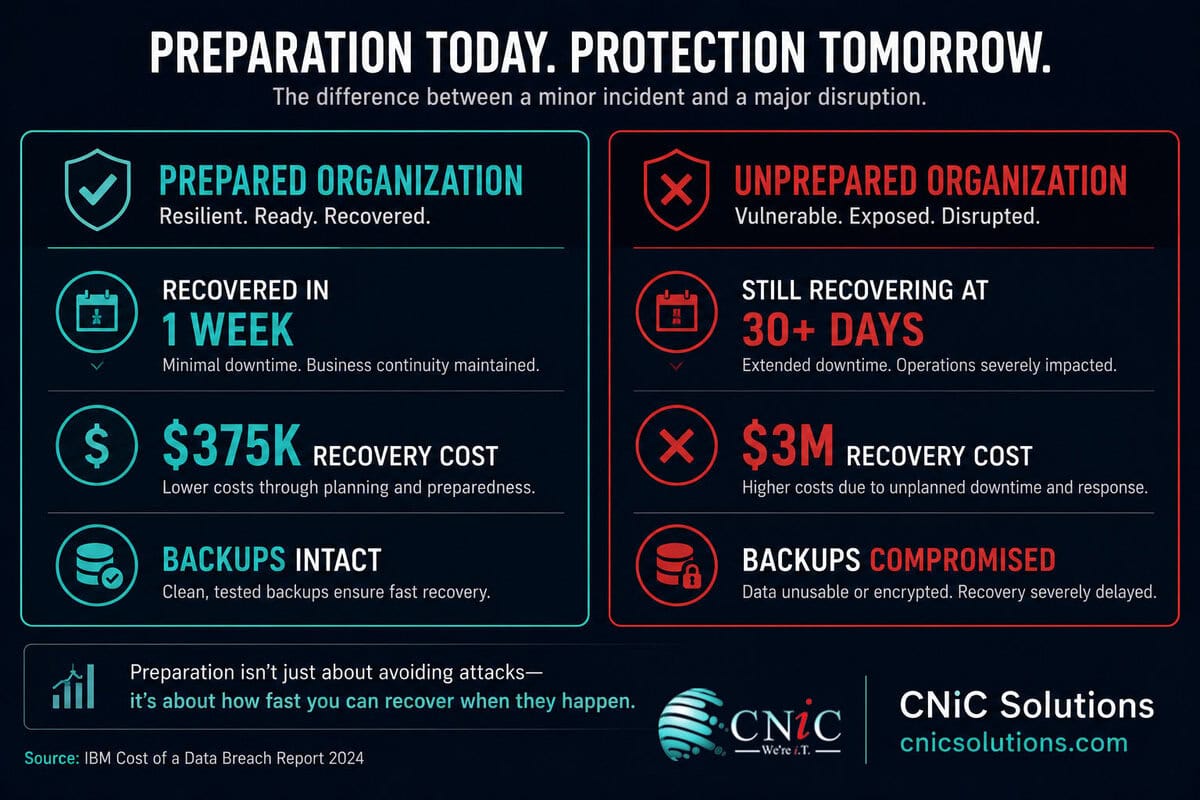
Key Takeaways: Ransomware Recovery Statistics 2026
- 53% of ransomware victims fully recovered within one week in 2025 — up sharply from 35% in 2024, reflecting improving backup and incident response maturity (Sophos State of Ransomware 2025).
- Organizations with compromised backups face 8× higher recovery costs — median $3 million vs. $375,000 for those with intact backups (Sophos 2024 backup impact research).
- 96% of ransomware attacks target backup repositories — and 76% of those attempts successfully compromise them (Veeam 2024 Data Protection Trends Report).
- Average recovery cost fell 44% to $1.53 million in 2025, down from $2.73 million in 2024, as backup and recovery strategies improve (Sophos SOR 2025).
- 84% of organizations that paid ransoms failed to fully recover their data in Q4 2024, and 80% were attacked again within 12 months (Halcyon / Fortinet).
- Median dwell time before encryption is now just 4–5 days — down from 70+ day averages in 2022–2023, giving defenders a shrinking window to stop attacks (Halcyon / industry data).
- Automated IR playbooks cut containment time from 79 to 51 days — a 35% reduction in recovery time for organizations with documented, tested plans (Halcyon 2024).
Ransomware Recovery Timelines: How Long Does It Actually Take?
Recovery time is one of the most practically important ransomware statistics for business leaders — because it directly determines business impact, revenue loss, customer trust damage, and total incident cost. The 2025 data shows meaningful improvement in average recovery speeds, but also reveals that unpreparedness still leaves a significant minority of organizations offline for a month or more.
Full Recovery Timeline — Ransomware Victims 2025 vs. 2024 (Sophos SOR 2025)
The three-year trend is clear and encouraging: organizations are recovering faster. In 2023, only 22% could fully restore operations within a week (Halcyon). By 2025, that figure had more than doubled to 53%. The drivers of this improvement are consistent across all research sources: better backup infrastructure, more mature incident response planning, and 24/7 managed detection and response capabilities that stop attacks earlier in the kill chain.
The median dwell time — the gap between initial attacker access and ransomware deployment — has compressed dramatically. Between 2022 and 2024, attackers maintained unrestricted access to victim environments for an average of 70+ days before triggering encryption (Halcyon). By Q4 2024, that median dwell time had collapsed to just 4 days (Halcyon). This acceleration cuts both ways: attackers can cause damage faster, but they also generate detectable signals earlier, giving organizations with active monitoring a shrinking but real window to stop the attack before encryption occurs.
Source: Sophos State of Ransomware 2025 | Sophos State of Ransomware Report (full download)
Build Ransomware-Resilient Backup Infrastructure with CNiC →
Ransomware Recovery Costs: What You’re Actually Paying
The ransom payment is only a fraction of total ransomware cost — and often the smallest fraction. Understanding the full cost structure of a ransomware incident is essential for organizations making investment decisions about prevention, backup infrastructure, and incident response planning.
| Cost Component | Amount | Source |
|---|---|---|
| Average ransom payment (2025) | $1M (mean); $115K (median) | Sophos SOR 2025 / Verizon DBIR 2025 |
| Average recovery cost excl. ransom (2025) | $1.53M (−44% from 2024) | Sophos SOR 2025 |
| Average total ransomware breach cost | $5.08M | IBM Cost of a Data Breach 2025 |
| Median recovery — backups intact | $375,000 | Sophos backup impact research 2024 |
| Median recovery — backups compromised | $3,000,000 (8× higher) | Sophos backup impact research 2024 |
| SMB recovery cost (100–250 employees) | $638,536 avg excl. ransom | Sophos SOR 2025 |
| Enterprise recovery cost (excl. ransom) | $1.84M (−41% from 2024) | Sophos State of Ransomware in Enterprise 2025 |
| U.S. average cyber insurance ransom claims | $353,000 (+68% YoY) | NAIC / industry data 2024 |
| IR plan ROI: breach cost reduction | 61% cost reduction; $2.66M saved | IBM Cost of a Data Breach 2025 |
The 44% drop in average recovery costs from 2024 to 2025 is one of the most significant positive trends in recent ransomware data. Sophos attributes this directly to improving backup and recovery infrastructure — organizations are investing in tested, immutable backup systems that allow them to restore operations without rebuilding from scratch. However, this improvement is not evenly distributed. SMBs with 100–250 employees face average recovery costs of $638,536 excluding any ransom — a figure that can be existential for organizations with limited reserves.
The gap between the $375,000 median recovery cost for organizations with intact backups and the $3 million median for those with compromised backups is arguably the most important single statistic in this article. That 8× cost multiplier is the financial argument for immutable backup investment in the clearest possible terms. The annual cost of a properly implemented immutable backup solution — typically $20,000–$80,000 per year for a mid-market organization — represents a fraction of the $2.625 million expected cost savings from protected versus compromised backup outcomes.
Sophos data shows organizations with intact backups face median recovery costs of $375,000, versus $3,000,000 for those with compromised backups — a $2.625 million difference. A properly implemented immutable backup and disaster recovery solution for a mid-market organization (100–500 employees) typically costs $25,000–$75,000 annually. At a conservative $50,000/year investment and a $2.625 million expected cost savings differential, the ROI on immutable backup infrastructure is approximately 52:1 — $52 in expected loss avoidance for every $1 invested, assuming a ransomware incident occurs. Even at a 10% annual probability of incident, the expected annual ROI remains approximately 5:1. No other single security investment produces comparable financial returns against ransomware specifically.
CNiC-derived calculation: $2.625M backup cost differential ÷ $50K annual backup investment = 52.5× ROI. Sources: Sophos backup impact research 2024; industry backup pricing benchmarks. Interpretation and investment figures original to CNiC Solutions.
Source: Sophos: The Impact of Compromised Backups on Ransomware Outcomes (2024) | IBM Cost of a Data Breach Report 2025
See CNiC’s Data Backup and Recovery Solutions →
Backup Statistics: The Most Attacked — and Most Critical — Recovery Resource
Backups were once the definitive ransomware defense. If you had good backups, you didn’t need to pay. Attackers recognized this years ago and made backup destruction a primary objective before triggering encryption. The 2024–2025 data on backup targeting rates, compromise success rates, and backup use trends paints a sobering picture of how dramatically the calculus has shifted.
The backup targeting statistics from Veeam and Sophos represent two of the most alarming data points in ransomware research. Veeam’s 2024 Data Protection Trends Report found that attackers targeted backup repositories in 96% of ransomware incidents — and successfully compromised those backups 76% of the time. This is not an accident; it is a deliberate, systematic strategy. Modern ransomware operators know that organizations with intact backups are far less likely to pay — so neutralizing backups before triggering encryption is standard operating procedure.
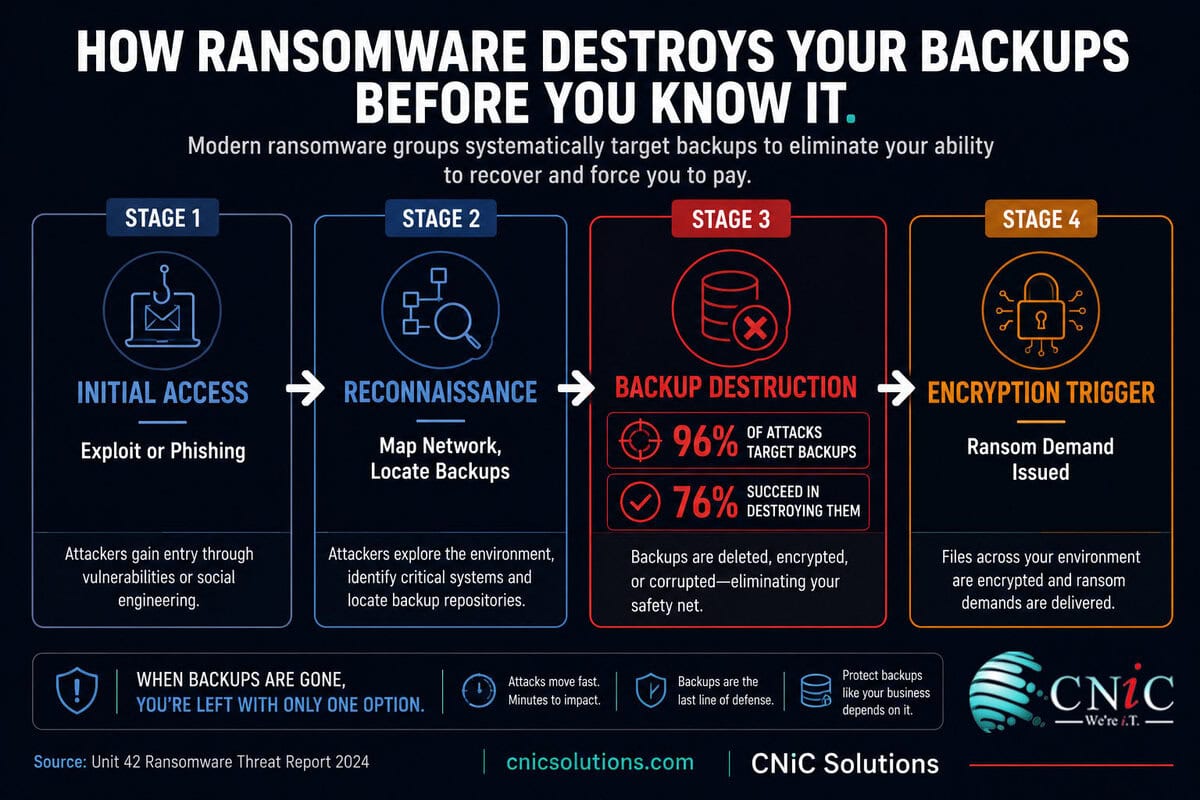
Ransomware Backup Targeting and Compromise Rates (Veeam / Sophos 2024)
The declining backup use rate tells a complex story. Backup usage for data restoration dropped to 54% in 2025 — the lowest rate in the six years Sophos has tracked this metric. This doesn’t necessarily mean organizations have fewer backups. It reflects two overlapping trends: first, more attacks are being stopped before encryption occurs (data encryption rates dropped from 70% to 50% between 2024 and 2025 per Sophos), meaning recovery from backup isn’t needed; second, the rise of data exfiltration-only attacks means even restored systems leave organizations exposed to the extortion threat of data publication.
The critical distinction is between accessible backups and protected backups. Most organizations have some form of backup — the problem is those backups are typically reachable from the same network environment the attacker has already compromised. The industry standard response to this reality is immutable, air-gapped backup infrastructure that meets the 3-2-1-1-0 rule: three copies of data, on two different media, with one offsite, one offline or immutable, and zero errors verified through regular testing.
Source: Sophos: The Impact of Compromised Backups on Ransomware Outcomes | Veeam 2024 Data Protection Trends Report
Audit Your Backup Strategy for Ransomware Resilience →
Data Recovery Outcomes: What Organizations Actually Get Back
Whether an organization pays the ransom or restores from backup, the fundamental question is the same: how much data can actually be recovered? The 2025 data on data recovery completeness reveals one of the starkest arguments against paying ransoms and one of the strongest arguments for comprehensive backup investment.
| Recovery Method | Full Data Recovery Rate | Key Limitation | Source |
|---|---|---|---|
| Intact, tested backups | Highest (near-complete) | Only works if backups survived attack | Sophos / Veeam 2024 |
| Ransom payment + decryptor | 4% recover ALL data (Fortinet) | Faulty decryptors common; attackers retain data | Fortinet 2024 / Halcyon Q4 2024 |
| FBI/law enforcement decryptor | Higher — no payment required | Available only for specific groups where keys obtained | FBI IC3 2024 Annual Report |
| No Mor Ransom / free decryptors | Varies by variant | Only covers specific known variants | Europol / No More Ransom project |
| Full rebuild without backups | Operational recovery, not data recovery | Data loss is permanent; extremely expensive and slow | Industry standard |
The apparent contradiction between Sophos’s 97% recovery rate and Halcyon’s 84% non-recovery rate after payment requires context. Sophos measures eventual recovery by any means — including partial recovery, recovery of some systems while others remain inaccessible, and recovery over extended timeframes. Halcyon’s Q4 2024 data specifically measures complete data recovery among organizations that chose to pay. The distinction matters: an organization can be “recovered” in Sophos’s framework while still having lost significant data that was never restored.
What happens to exfiltrated data after payment is a separate concern that makes the ransom payment picture even bleaker. The FBI confirmed that LockBit retained stolen victim data regardless of payment, only removing it from the public leak site. The ALPHV/BlackCat exit scam — where the group pocketed Change Healthcare’s $22 million payment and then sold the data to RansomHub anyway — demonstrates that paying ransoms for data deletion commitments provides no enforceable guarantee whatsoever.
The data exfiltration trend is shifting recovery calculus across the industry. In 2025, 50% of ransomware attacks resulted in data encryption — the lowest rate in six years (Sophos SOR 2025). Attackers are increasingly targeting the exfiltration threat alone, encrypting less while still demanding payment to prevent data publication. This means even organizations with perfect backup infrastructure can face extortion pressure — backups solve the encryption problem but cannot unring the data-theft bell.
Source: Sophos State of Ransomware 2025 | FBI IC3 2024 Annual Report
Build a Comprehensive Ransomware Defense Strategy with CNiC →
Incident Response Statistics: The Measurable Value of Preparedness
Incident response preparedness is the single variable most within an organization’s control when it comes to ransomware recovery outcomes. The data from 2024–2025 quantifies the value of IR investment with unusual precision — making the case for proactive preparation in dollar terms that resonate with any CFO or board.
Impact of IR Preparedness on Recovery Outcomes
The finding that 57% of ransomware incidents in Q4 2024 were first detected by external parties — not the victimized organizations themselves — is one of the most important statistics in this article for practical security planning. It means the majority of organizations are discovering they’ve been attacked because an attacker published their data on a leak site, a customer notified them, or a law enforcement agency reached out. This external detection reality directly underscores the value of 24/7 managed detection and response (MDR) services, which function as the external eyes that most internal teams lack the staffing to maintain.
The operational factors that lead organizations to fall victim — and therefore struggle to recover — are consistent across the 2025 Sophos data. Surveyed ransomware victims identified 2.7 contributing factors on average, with no single cause dominant: 40.2% cited lack of cybersecurity expertise, 40.1% reported unknown security gaps, and 39.4% cited insufficient staff or capacity. These are organizational constraints, not just technical ones — which is why managed security services that extend team capacity represent a structural solution rather than a point product purchase.
Law enforcement as a recovery resource. In 2024, 63% of ransomware victims who engaged law enforcement avoided paying the ransom — reflecting the FBI’s active provision of decryption keys and negotiation intelligence. Since 2022, the FBI has provided thousands of decryption keys to ransomware victims, helping organizations avoid over $800 million in ransom payments. The FBI strongly recommends reporting incidents to IC3.gov immediately — even before engaging private incident response resources — as early reporting maximizes the chances of obtaining free decryption tools and interrupting attacker cryptocurrency cashouts.
Source: Sophos State of Ransomware 2025 | IBM Cost of a Data Breach 2025 | FBI IC3 2024 Annual Report
Develop Your Ransomware IR Plan with CNiC’s vCIO Team →
Ransomware Recovery by Industry: Sector-Specific Outcomes
Recovery timelines and costs are not uniform across industries. The sector that gets hit hardest — healthcare — also faces unique recovery constraints tied to patient safety, regulatory compliance, and legacy system complexity that make rapid recovery significantly harder than in other industries.
| Industry | Attack Rate (2024) | Recovery Cost / Impact | Key Recovery Challenge | Source |
|---|---|---|---|---|
| Healthcare | 67% attacked | $7.42M avg total breach cost; $900K/day downtime | Patient safety constraints prevent rapid system isolation; HIPAA notification costs | IBM / Sophos / Microsoft 2024–2025 |
| Financial Services | 65% attacked | $6.08M avg breach cost | Regulatory reporting deadlines compress response timeline | IBM / Sophos 2024–2025 |
| Manufacturing | High volume (#1 by count) | $5.00M avg breach cost; $1B+ CDK attack impact | OT/IT convergence; production line downtime creates extreme payment pressure | IBM / Verizon DBIR 2025 |
| Education (K–12) | High volume | $3.80M avg breach cost | 66% of K–12 districts have no specialist cybersecurity staff | IBM / BlueVoyant 2025 |
| State / Local Government | 34% (down from 69% in 2023) | $2.83M avg recovery cost; $2.5M median ransom paid | Political constraints on paying; legacy systems; public accountability | Sophos SOR 2025 |
| Energy / Utilities | 67% | $2.5M median ransom paid (highest by sector) | Critical infrastructure pressure; first sector to pay more than use backups | Sophos Critical Infrastructure SOR 2024 |
Healthcare’s recovery challenge deserves additional context. When a hospital’s electronic health records system goes down, clinicians revert to paper — slowing care delivery, increasing medication error risk, and creating direct patient safety exposure that creates extreme pressure to restore systems by any means. Ransomware attacks on healthcare have been directly linked to patient mortality in peer-reviewed research. The average healthcare downtime cost of $900,000 per day (Microsoft Security Insider) makes even a 3-day outage a $2.7 million operational loss before any recovery costs are counted.
Manufacturing’s recovery problem is structural. Industrial control systems and operational technology (OT) networks — which control production equipment, PLCs, and SCADA systems — often cannot be quickly restored from IT-style backups. A ransomware attack that spreads from IT to OT networks can halt production lines for weeks while specialized recovery work rebuilds control system configurations from scratch. The CDK Global attack in June 2024 — which paralyzed operations at over 15,000 automotive dealerships for weeks — illustrates how a single supply-chain-adjacent ransomware attack can generate over $1 billion in downstream losses across an industry.
Source: Sophos State of Ransomware in Enterprise 2025 | IBM Cost of a Data Breach 2025
See Industry-Specific Ransomware Recovery Solutions from CNiC →
Ransomware Recovery Statistics Summary (2026 Reference Table)
| Statistic | Data Point | Source | Year |
|---|---|---|---|
| Full recovery within 1 week (2025) | 53% of victims | Sophos SOR 2025 | 2025 |
| Full recovery within 1 week (2024) | 35% of victims | Sophos SOR 2025 | 2024 |
| Full recovery within 1 week (2023) | 22% of victims | Halcyon | 2023 |
| Recovery taking more than 1 month (2025) | 18% (down from 34% in 2024) | Sophos SOR 2025 | 2025 |
| Average downtime after ransomware | 24 days | Statista / Halcyon | 2024 |
| Median dwell time before encryption | 4–5 days (down from 70+ days in 2022–23) | Halcyon Q4 2024 | 2024 |
| Average recovery cost excl. ransom (2025) | $1.53M (−44% from 2024) | Sophos SOR 2025 | 2025 |
| Average recovery cost excl. ransom (2024) | $2.73M | Sophos SOR 2024 | 2024 |
| Average total ransomware breach cost | $5.08M | IBM Cost of Breach 2025 | 2025 |
| Recovery cost: intact backups (median) | $375,000 | Sophos backup impact research 2024 | 2024 |
| Recovery cost: compromised backups (median) | $3,000,000 (8× higher) | Sophos backup impact research 2024 | 2024 |
| SMB recovery cost excl. ransom (100–250 employees) | $638,536 | Sophos SOR 2025 | 2025 |
| Enterprise recovery cost excl. ransom | $1.84M (−41% from 2024) | Sophos State of Ransomware in Enterprise 2025 | 2025 |
| Ransomware attacks targeting backups | 96% of attacks (Veeam); 94% (Sophos) | Veeam 2024 / Sophos 2024 | 2024 |
| Backup compromise success rate | 76% of targeting attempts succeed | Veeam 2024 | 2024 |
| Complete backup loss rate | 39% of targeted organizations | Sophos 2024 | 2024 |
| Backup use to restore data (2025) | 54% (6-year low) | Sophos SOR 2025 | 2025 |
| Intact backup: recovery within 1 week | 46% of organizations | Sophos backup impact research 2024 | 2024 |
| Compromised backup: recovery within 1 week | 26% of organizations | Sophos backup impact research 2024 | 2024 |
| Data encryption rate (2025) | 50% of attacks (6-year low; down from 70% in 2024) | Sophos SOR 2025 | 2025 |
| Organizations eventually recovering data | 97% (via any method) | Sophos SOR 2025 | 2025 |
| Paying victims that fully recovered data | Only 4% recover ALL data | Fortinet 2024 | 2024 |
| Paying victims: failed full recovery (Q4) | 84% | Halcyon Q4 2024 | Q4 2024 |
| Re-attacked within 12 months after paying | 80% | Fortinet 2024 | 2024 |
| IR plan: cost reduction per incident | 61% reduction; $2.66M saved | IBM Cost of Breach 2025 | 2025 |
| Automated playbooks: containment time | 51 days vs. 79 days without (−35%) | Halcyon 2024 | 2024 |
| AI/automation: detection time savings | 108 days faster | IBM Cost of Breach 2025 | 2025 |
| AI/automation: cost savings per breach | $1.9M avg saved | IBM Cost of Breach 2025 | 2025 |
| External detection of ransomware incidents | 57% detected by external parties (Q4 2024) | Halcyon Q4 2024 | Q4 2024 |
| Law enforcement engagement: avoided payment | 63% of victims who engaged LE avoided paying | Brightdefense / FBI data 2024 | 2024 |
| FBI decryption keys provided (since 2022) | Thousands of keys; $800M+ in avoided payments | FBI IC3 2024 Annual Report | 2022–2024 |
| Preparedness gap | 69% felt prepared; only 22% recovered in 24 hrs | Spin.AI research | 2025 |
| Healthcare downtime cost | $900,000 per day | Microsoft Security Insider | 2024 |
| CDK Global attack: estimated total losses | $1B+ (15,000+ dealerships affected) | Multiple sources 2024 | 2024 |
Frequently Asked Questions: Ransomware Recovery
Methodology & Sources
All statistics in this article are sourced directly from Tier 1 primary sources. No blog-to-blog citations were used as primary references. This article focuses on ransomware recovery — timelines, costs, backup effectiveness, and incident response outcomes. For attack frequency, see Ransomware Statistics 2026. For ransom payment data, see Ransomware Payout Statistics 2026. CNiC-derived calculations are clearly labeled.
Primary Sources Referenced:
- Sophos State of Ransomware 2025 — Annual survey of 3,400 IT and cybersecurity leaders across 17 countries on ransomware experiences, recovery costs, and timelines. sophos.com
- Sophos: The Impact of Compromised Backups on Ransomware Outcomes (2024) — Specific analysis of 2,974 ransomware victims on backup compromise rates and recovery cost differentials. sophos.com
- Sophos State of Ransomware in Enterprise 2025 — Enterprise-specific subset of the SOR data covering 1,733 large organizations. sophos.com
- IBM Cost of a Data Breach Report 2025 — Quantitative research on breach costs, IR plan value, AI/automation savings, and detection timelines. ibm.com
- Veeam 2024 Data Protection Trends Report — Annual survey-based research on backup targeting, compromise rates, and recovery infrastructure.
- Halcyon Ransomware Research (Q4 2024) — Incident response and threat intelligence data on dwell times, payment outcomes, and external detection rates.
- Fortinet 2024 Ransomware Research — Data on post-payment re-attack rates and full data recovery outcomes.
- FBI IC3 2024 Annual Report — Law enforcement decryption key provision data and ransomware complaint statistics. ic3.gov
- Coveware Q4 2024 Ransomware Report — Payment rate data and incident response case data.
- Microsoft Security Insider: Healthcare Ransomware Analysis — Healthcare downtime cost data and sector-specific attack statistics.
This article was researched and published by CNiC Solutions, a Houston-based managed IT and cybersecurity provider. Content is updated as new primary source data becomes available. Last updated: May 2026.



related posts
What Are Standard Operating Procedures (SOPs) for IT and Why They Matter
October 1, 2026An IT standard operating procedure (SOP) is a documented, step-by-step set of instructions for performing a…
What Are Passkeys? How Passwordless Login Works and Why It Matters
October 1, 2026Passkey, defined: A passkey is a phishing-resistant login credential that replaces your password with a cryptographic…
Venmo Scam Emails: How to Spot and Avoid Them
September 30, 2026A fake Venmo email is one of the easiest ways for a scammer to reach you,…
USPS Scam Texts: How to Spot Fake Delivery Messages
September 30, 2026Fake USPS delivery texts are not a minor nuisance, they are the single most-reported text scam…