

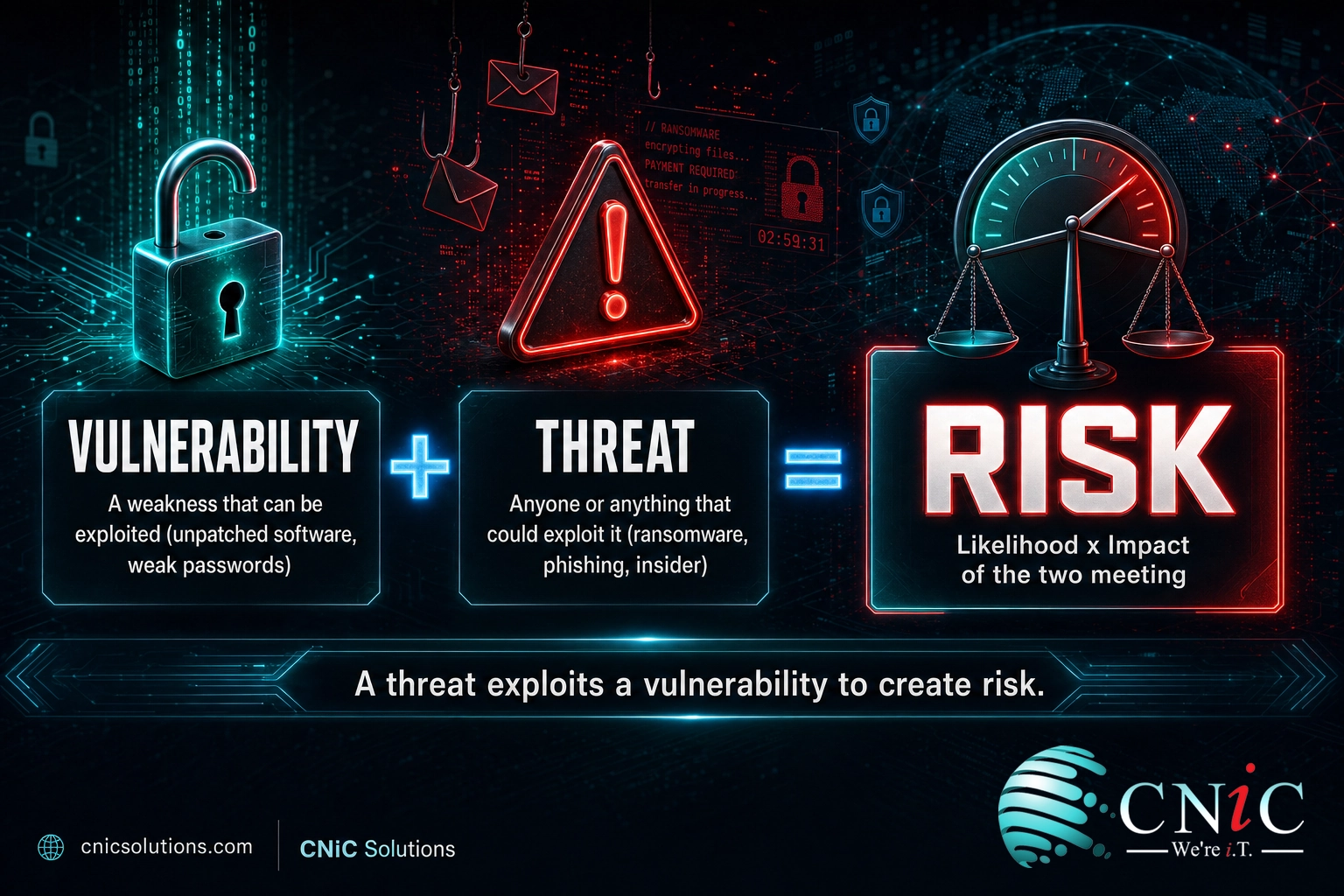
Quick definition: In cybersecurity, a vulnerability is a weakness that could be exploited, a threat is anyone or anything that could exploit it, and risk is the likelihood and impact of that actually happening. In one line: a threat exploits a vulnerability to create risk. Each one is measured and managed differently, which is why the distinction matters.
People use “threat,” “vulnerability,” and “risk” as if they mean the same thing. They do not, and treating them as interchangeable is one of the fastest ways to waste a security budget. The three describe different parts of the same problem: a threat is the danger, a vulnerability is the opening it needs, and risk is the measured chance and cost of the two meeting. In its 2025 report, IBM put the global average cost of a data breach at $4.44 million, so getting these fundamentals right is not an academic exercise. It decides where your next security dollar goes.
- Vulnerability = a weakness. A flaw in software, configuration, or process that could be exploited. This is the part you most directly control.
- Threat = the danger. Any actor or event that could exploit a weakness, from ransomware crews to a mistyped email. You cannot remove threats, only defend against them.
- Risk = likelihood x impact. The chance a threat exploits a vulnerability, multiplied by the damage it would cause. Risk is what leaders actually manage.
- The chain: a threat exploits a vulnerability to create risk. Break any link and the risk drops.
- Why it matters: each is reduced by a different action. Confusing them leads to buying tools for threats while leaving known vulnerabilities unpatched.
What’s in This Guide
- Threat vs. Vulnerability vs. Risk at a Glance
- What Is a Vulnerability?
- What Is a Threat?
- What Is Risk? (And the Risk Formula)
- How the Three Work Together: A Worked Example
- Why the Difference Matters for Your Business
- How to Manage Threats, Vulnerabilities, and Risk
- Related Terms
- Frequently Asked Questions
- Methodology & Sources
Threat vs. Vulnerability vs. Risk at a Glance
The clearest way to keep the three straight is to ask a different question of each. A vulnerability asks, “Where am I weak?” A threat asks, “Who or what could hurt me?” Risk asks, “How likely is that, and how badly would it hurt?” The table below lines them up side by side.
| Term | What it is | Real-world example | How you reduce it |
|---|---|---|---|
| Vulnerability | A weakness in a system, control, or process that could be exploited | Unpatched VPN appliance, a reused admin password, an employee who has not had phishing training | Patch, harden configurations, enforce strong access controls, train staff |
| Threat | Any actor or event with the potential to exploit a weakness and cause harm | A ransomware group, a phishing campaign, a disgruntled insider, a flood in the server room | Monitoring, threat intelligence, email filtering, layered defenses (you cannot delete the threat itself) |
| Risk | The likelihood a threat exploits a vulnerability, combined with the resulting impact | “There is a strong chance ransomware reaches our unpatched server and halts operations for a week” | Risk assessment, prioritized remediation, insurance, backups, incident response planning |
The one-line memory aid: a threat exploits a vulnerability to create risk. If a burglar (threat) finds an unlocked window (vulnerability), the chance and cost of being robbed (risk) go up. Lock the window and the burglar is still out there, but your risk falls.
What Is a Vulnerability?
A vulnerability is a weakness that a threat can exploit. The U.S. National Institute of Standards and Technology defines it as a “weakness in an information system, system security procedures, internal controls, or implementation that could be exploited or triggered by a threat source.” The key word is weakness. A vulnerability does no harm on its own. It just sits there as an opening, waiting to be found.
Vulnerabilities fall into a few broad categories:
- Technical flaws: unpatched software, outdated firmware, misconfigured cloud storage, an internet-facing server with a default password.
- Process gaps: no offboarding checklist, so a former employee keeps access; no patch schedule, so updates lag for months.
- Human weaknesses: a staff member who has never been trained to spot a phishing email, or who reuses one password across a dozen accounts.
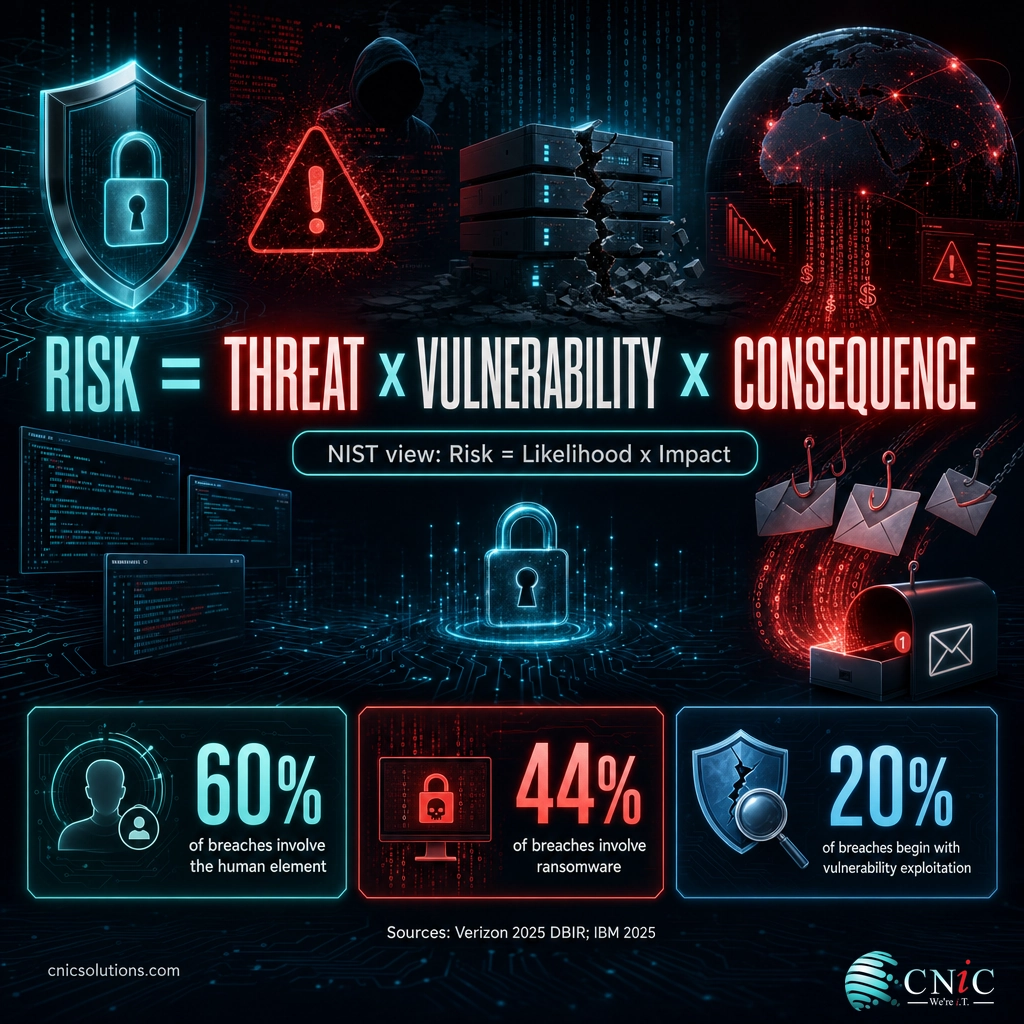
Vulnerabilities are the part of the equation you most directly control, and attackers know exactly where to look. In its 2025 Data Breach Investigations Report, Verizon found that the exploitation of vulnerabilities was the initial way into roughly 20% of breaches, a 34% jump over the prior year, driven heavily by attacks on internet-facing edge devices and VPNs. The lesson is blunt: a known, unpatched weakness is not a theoretical problem. It is an active target.
Source: NIST Computer Security Resource Center Glossary | Verizon 2025 Data Breach Investigations Report
What Is a Threat?
A threat is any circumstance or event with the potential to exploit a vulnerability and cause harm. NIST defines it as “any circumstance or event with the potential to adversely impact organizational operations, organizational assets, individuals, other organizations, or the Nation.” Notice what is missing from that definition: your defenses. Threats exist whether or not you have a weakness for them to hit.
Threats generally come in two flavors:
- Intentional (adversarial): ransomware operators, phishing crews, nation-state actors, and malicious insiders. These have motive and intent.
- Unintentional or environmental: an employee who clicks a bad link by mistake, a hardware failure, a power surge, or a natural disaster that takes out a data center.
The threat landscape is not static, and two categories dominate the numbers. Ransomware was present in 44% of breaches in Verizon’s 2025 report, up from 32% the year before. And the human element, which covers errors, social engineering, and misuse, was involved in 60% of breaches. That is why phishing simulations and staff training matter so much: for most organizations, the most common “threat” walks through the front door in the form of a convincing email. Our breakdown of the latest phishing attack data shows just how refined those campaigns have become.
The critical point is that you cannot eliminate a threat. You cannot patch a ransomware gang out of existence. What you can do is reduce the openings they exploit and detect them faster when they act.
Source: NIST Computer Security Resource Center Glossary | Verizon 2025 Data Breach Investigations Report
What Is Risk? (And the Risk Formula)
Risk is where threats and vulnerabilities meet math. NIST SP 800-30 defines risk as “a measure of the extent to which an entity is threatened by a potential circumstance or event,” and it is “a function of the likelihood of the event occurring and the resulting impact.” In other words, risk is not a yes-or-no state. It is a measured quantity, and it is the one thing on this page that business leaders actually manage.
Two formulas capture the idea:
The NIST view: Risk = Likelihood x Impact. How probable is the event, and how much would it cost if it happened?
The operational view: Risk = Threat x Vulnerability x Consequence. This version makes the control points obvious. If you drive any single factor toward zero, the overall risk falls, even if the others stay high.
These are conceptual tools for prioritization, not precise dollar calculators. Their value is in ranking. A critical vulnerability on an isolated test machine with no sensitive data is a lower risk than a moderate vulnerability on the server that runs your billing system, because the impact differs. Risk is what lets you compare those two and fix the more dangerous one first.
This is also why the cost of a breach is a risk conversation, not a threat conversation. The $4.44 million global average from IBM’s 2025 study is an impact figure. Multiply a realistic likelihood against an impact like that, and the business case for fixing a known weakness usually writes itself. For a deeper look at those numbers, see our analysis of what a data breach actually costs.
Source: NIST Special Publication 800-30 Rev. 1 | IBM Cost of a Data Breach Report 2025
How the Three Work Together: A Worked Example
Definitions stick better with a scenario. Picture a 40-person accounting firm running a remote-access appliance so staff can log in from home.
- The vulnerability: the appliance is two versions behind on firmware, with a publicly known flaw that has an available patch the firm has not applied.
- The threat: a ransomware affiliate scanning the internet for exactly that appliance model and firmware version. The affiliate has no idea the firm exists yet, but the tooling is automated and relentless.
- The risk: high. The likelihood is elevated because the flaw is known and actively scanned for, and the impact is severe because the firm holds sensitive client financial data and would face downtime, breach notification, and lost trust.
Now watch how one action changes everything. The firm applies the patch. The threat still exists, the ransomware affiliate is still scanning, but the vulnerability is closed, so the risk collapses. That is the entire point of the distinction. You did not defeat the threat. You removed its opening. This pattern shows up constantly in real incidents, which is why exploited weaknesses remain a top entry point in our roundup of current ransomware statistics.
Myth to retire: “We have never been attacked, so our risk is low.” Not being breached yet says nothing about your vulnerabilities or the threats aimed at you. Risk is forward-looking. Plenty of organizations with wide-open weaknesses just have not been found yet, and Verizon’s data shows how quickly automated scanning closes that gap. A clean track record is not a risk assessment.

Why the Difference Matters for Your Business
Getting these three terms right is not pedantry. It changes what you buy, what you fix first, and how you talk to leadership. When people blur the definitions, they tend to chase threats they cannot control while ignoring vulnerabilities they can.
The chart below shows how often each element turns up in real breaches. Read it as a map of where to focus: the human element and ransomware dominate, and vulnerability exploitation is climbing fast.
Source: Verizon 2025 Data Breach Investigations Report (12,000+ confirmed breaches).
Here is what the distinction buys you in practice:
- Better spending. If a “threat” keeps you up at night, ask what vulnerability it needs. Often the cheapest fix is closing the opening, not buying another tool to watch for the attacker.
- Sharper prioritization. Risk scoring lets you rank hundreds of open issues by likelihood and impact, so the billing server gets patched before the break-room tablet.
- Clearer executive conversations. Boards do not fund “threats.” They fund reduced risk against a dollar impact. Framing security as risk management is how the budget conversation gets won. This is exactly the lens a Virtual CIO brings to a growing business.
Source: IBM Cost of a Data Breach Report 2025 | Verizon 2025 Data Breach Investigations Report
How to Manage Threats, Vulnerabilities, and Risk
Because each element is reduced by a different action, a real program works all three at once. Here is the practical division of labor.
Reduce vulnerabilities (the openings you control)
- Patch and update on a defined schedule, prioritizing internet-facing systems and edge devices.
- Enforce multi-factor authentication and kill reused or default passwords.
- Run regular vulnerability scans so you know your weaknesses before an attacker does.
- Train staff continuously, since people are the most exploited weakness in the data.
Defend against threats (the dangers you cannot delete)
- Deploy layered defenses: email filtering, endpoint detection, and network monitoring.
- Use current threat intelligence so defenses track what attackers are actually doing.
- Detect and respond fast, because containment speed is what limits damage once a threat is active.
Manage risk (the number leadership owns)
- Run a formal risk assessment to rank issues by likelihood and impact, not gut feel.
- Keep tested, offline backups so a successful attack becomes a recovery, not a catastrophe. Our data on ransomware recovery timelines shows how much backups change the outcome.
- Build and rehearse an incident response plan, and use cyber insurance to transfer the residual risk you cannot remove.
Most small and midsize businesses do not have the staff to run all three lanes well on their own, which is where a managed security partner earns its keep. If you want a professional to map your vulnerabilities, watch for threats around the clock, and translate it all into a risk picture your leadership can act on, that is exactly what we do.
Get a Free Security Assessment
For businesses that want the whole IT and security stack handled under one roof, our Managed IT Services team builds the patching, monitoring, and backup discipline described above into day-to-day operations.
Source: CISA Cyber Threats and Advisories | NIST Special Publication 800-30 Rev. 1
Related Terms
- Attack surface: the full set of points where an attacker could try to get in. Every vulnerability adds to it.
- Exploit: the specific tool or technique a threat uses to take advantage of a vulnerability.
- Threat actor: the person or group behind an intentional threat, such as a ransomware gang or nation-state team.
- Risk assessment: the structured process of identifying vulnerabilities and threats and scoring the resulting risk by likelihood and impact.
- Risk appetite: the amount of risk an organization is willing to accept before it must act.
- Residual risk: the risk that remains after controls are in place. It is rarely zero, which is where insurance and monitoring come in.
- Zero-day: a vulnerability that is exploited before a patch exists, giving defenders no lead time.
Frequently Asked Questions
What is the difference between a threat, a vulnerability, and a risk?
How are threat, vulnerability, and risk related?
What is the formula for cybersecurity risk?
Can you have a threat without a vulnerability?
Why does the difference between threat, vulnerability, and risk matter for my business?
Methodology & Sources
How we built this guide
Definitions of threat, vulnerability, and risk are taken directly from primary standards bodies rather than secondary explainers. The core definitions and the risk formula come from the U.S. National Institute of Standards and Technology (NIST), specifically the NIST Computer Security Resource Center Glossary and NIST Special Publication 800-30 Rev. 1, “Guide for Conducting Risk Assessments.”
Breach frequency and attack-vector figures are drawn from the Verizon 2025 Data Breach Investigations Report, which analyzed more than 12,000 confirmed breaches. Cost figures are from the IBM Cost of a Data Breach Report 2025. Threat-landscape framing references guidance from the U.S. Cybersecurity and Infrastructure Security Agency (CISA). Only Tier 1 primary sources were used; no figure was carried over from a blog post or aggregator.
Primary sources:



related posts
Types of Servers and How They Work: A Business Guide
September 29, 2026A server is a computer that provides a service, data, or resource to other computers, called…
Types of Phishing Attacks Every Business Should Know
September 29, 2026Phishing is a cyberattack in which criminals pose as a trusted person or organization to trick…
Types of Malware: A Guide to the Most Common Threats
September 28, 2026Malware (short for malicious software) is any program or code created to damage, disrupt, or gain…
The Best Cybersecurity Certifications, Explained
September 27, 2026The best cybersecurity certifications in 2026 are the ones that match a real career stage and…