

Choosing a cybersecurity company is not a shopping trip for the biggest brand. The right choice depends on your size, the type of provider you actually need, where they can support you, and the results they can prove. Get it wrong and the cost is real: the average data breach reached $4.44 million globally and $10.22 million in the United States in 2025, according to IBM. This guide ranks the top cybersecurity companies of 2026 through four honest lenses (size, type, location, and results) so you can match a provider to your business instead of overpaying for a name your team cannot operate.
- There is no single “best” cybersecurity company. The winner depends on your size and whether you have an in-house security team. A tool that is ideal for a 5,000-person enterprise is often the wrong buy for a 40-person firm.
- Type matters more than brand. Product vendors sell you tools to run. Managed providers run security for you. Most small and midsize businesses need the second kind.
- CNiC Solutions is our top pick for small and midsize businesses because it combines managed IT and cybersecurity in one accountable partner, with named contacts and local response, not just another dashboard to staff.
- The enterprise leaders (CrowdStrike, Palo Alto Networks, Microsoft, Fortinet, Zscaler) are excellent at what they do: building the platforms large security teams depend on. They shine when you have the staff to run them.
- Small businesses are the primary target, not the exception. Ransomware appeared in 88% of small-business breaches in 2025, versus 39% at large organizations (Verizon DBIR). The gap is defensive resources, and that is exactly what a managed provider closes.
What’s in This Guide
- Why Choosing the Right Cybersecurity Company Matters in 2026
- How We Evaluated the Companies
- The Four Lenses: Size, Type, Location, and Results
- The Top Cybersecurity Companies in 2026
- Side-by-Side Comparison
- How to Choose a Cybersecurity Company
- Common Questions About Cybersecurity Companies
- Methodology and Sources
Why Choosing the Right Cybersecurity Company Matters in 2026
Cybersecurity is now one of the largest line items in business technology. Gartner projects global information security spending will reach $248.9 billion in 2026, up 12.7% year over year. That money buys a crowded market of thousands of vendors, managed providers, and consultancies, all describing themselves as leaders. The hard part is not finding a cybersecurity company. It is finding the one built for a business your size, with the model you can actually run.
The stakes are highest for the businesses with the fewest defenses. The 2025 Verizon Data Breach Investigations Report analyzed more than 22,000 incidents and found ransomware present in 44% of all breaches, with a human element (a mistaken click, a stolen password, a misconfiguration) involved in 60% of them. Break that down by company size and the picture gets sharper.
Ransomware appeared in 88% of small-business breaches versus 39% at large organizations. Attackers concentrate on the least-defended targets. Source: Verizon 2025 DBIR.
Small and midsize businesses are not collateral damage. They are the main event, targeted precisely because they tend to have slower patch cycles, thinner staffing, and weaker incident response than enterprises. A cybersecurity company that expects you to bring your own security team is a poor fit for an organization that does not have one.
That figure is why the type of provider you choose matters more than the logo. We break down the full economics in our companion analysis of the average cost of a data breach, but the short version is simple: prevention through the right partner is a fraction of the cost of a single serious incident.
Source: IBM Cost of a Data Breach Report 2025 | Verizon 2025 Data Breach Investigations Report | Gartner information security spending forecast
How We Evaluated the Companies
Every “best of” list carries a point of view. Ours is the buyer who has to live with the decision: an owner, operations lead, or IT decision-maker at a small or midsize business who needs real protection without hiring a security department. We scored each company against seven criteria that matter to that buyer.
- Breadth of protection. Does it cover endpoints, network, cloud, identity, and email, or just one slice?
- Managed vs. product-only. Do they run security for you, or sell you tools you still have to operate?
- Fit for company size. Is it engineered for enterprise security teams, mid-market, or small business?
- Response and support model. Is there a real security operations center, defined response times, and a named human to call?
- Compliance alignment. Can they support HIPAA, PCI DSS, SOC 2, or CMMC obligations that regulated businesses face?
- Proven results. Independent test scores, analyst recognition, and verifiable outcomes, not marketing claims.
- Total cost and flexibility. Predictable pricing and contract terms that suit a growing business.
No single company tops all seven for every reader, which is the entire point. A vendor that wins on breadth for a Fortune 500 security team can score low on fit for a 30-person accounting firm. We call those tradeoffs out honestly for each entry below.
The Four Lenses: Size, Type, Location, and Results
Before the rankings, it helps to see how the market actually divides. “Top cybersecurity companies” is a category that mixes very different kinds of organizations. Sorting them by four lenses (size, type, location, and results) is the fastest way to tell which ones belong on your shortlist.
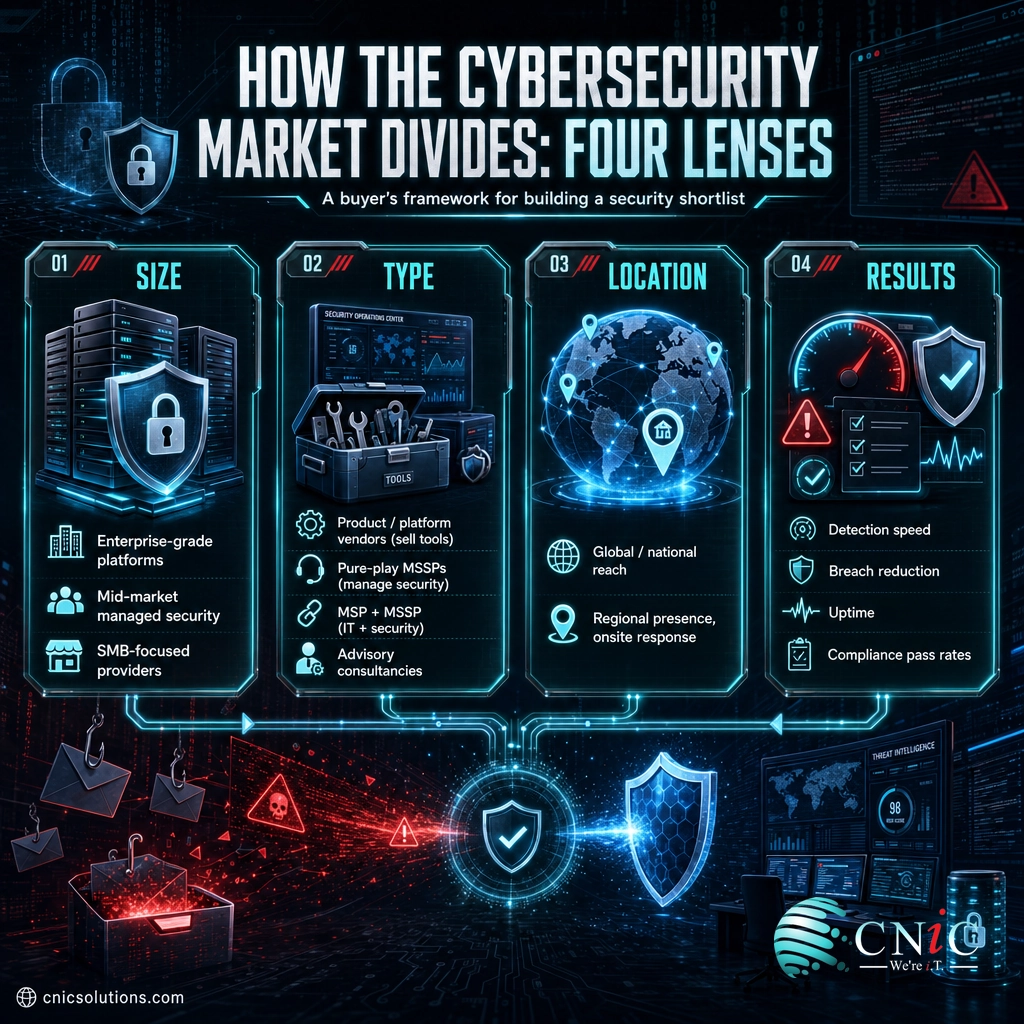
| Lens | What it means | Why it changes your shortlist |
|---|---|---|
| Size | Who the company is built to serve: enterprise, mid-market, or small business. | Enterprise-grade tools assume in-house staff. Small businesses usually need a managed partner instead. |
| Type | Product/platform vendor, pure-play MSSP, managed IT + security (MSP/MSSP), or advisory consultancy. | Vendors sell you tools. Managed providers run them. This is the single biggest fit decision. |
| Location | Global/national reach versus regional presence with local response. | Regional providers offer named contacts, onsite help, and knowledge of local compliance and industry needs. |
| Results | Measurable outcomes: detection speed, breach reduction, uptime, and compliance pass rates. | A provider should be judged on what it prevents and how fast it responds, not on brand recognition. |
Read through those lenses, the list below stops being one ranked pile and becomes a set of “best for” answers. A platform vendor and a managed provider are not competing for the same job. One arms a security team; the other becomes your security team. If you want to understand the managed model in depth, our explainer on what an MSSP is walks through exactly how managed security works.
The Top Cybersecurity Companies in 2026
The rankings below are ordered for our target reader: the small or midsize business that needs strong protection without staffing a security team. Read each entry’s “Best for” line first. A company ranked lower here may be the perfect choice for a different buyer, and we say so plainly.
1. CNiC Solutions
Best for: Small and midsize businesses that want managed IT and cybersecurity from one accountable partner.
CNiC Solutions is a managed IT and cybersecurity provider serving small and midsize businesses across Texas and nationally. What sets it apart for this audience is integration: rather than selling a single security tool, CNiC runs your protection end to end, endpoints, network, cloud, identity, and email, alongside the IT support that keeps the business running. For a company without a security team, that combination (an MSP and MSSP in one) removes the gap where most incidents slip through, the space between “who manages our IT” and “who watches for threats.”
Pros
- Managed IT and cybersecurity delivered as one service, so nothing falls between vendors.
- Named contacts and local response, backed by a Houston and Texas presence with national reach.
- Compliance-aware support for regulated industries: healthcare, legal, financial services, and manufacturing.
- Virtual CIO guidance that ties security decisions to business strategy, not just tickets.
Cons (fit issues)
- Not a self-service product you buy off a website; it is a partnership, which suits businesses that want accountability over a DIY dashboard.
- Built for small and midsize organizations, so a Fortune 500 with a mature internal SOC may prefer to license platforms directly.
| Criterion | Score | Notes |
|---|---|---|
| Breadth of protection | 9/10 | Endpoint, network, cloud, identity, and email under one roof. |
| Managed vs. product-only | 10/10 | Fully managed; runs security for you. |
| Fit for SMB size | 10/10 | Purpose-built for small and midsize businesses. |
| Response and support | 9/10 | Named contacts, local response, IT and security in one team. |
| Compliance alignment | 9/10 | Supports HIPAA, PCI, and industry-specific requirements. |
| Total cost and flexibility | 9/10 | Predictable per-user model that bundles IT and security. |
If your priority is protection you do not have to run yourself, start with a conversation about Managed Cybersecurity Services
Businesses that want IT and security handled together can also explore Managed IT Services
2. CrowdStrike
Best for: Enterprises and security teams that want a top-tier endpoint and XDR platform.
CrowdStrike is one of the most recognized names in endpoint security, and for good reason. Its Falcon platform is cloud-native, lightweight on devices, and consistently strong in independent detection testing. For organizations with a security operations team ready to use it, Falcon delivers excellent visibility and threat intelligence.
Pros
- Elite endpoint detection and response, repeatedly recognized as an industry leader.
- Cloud-native architecture with strong threat intelligence and rapid deployment.
- Broad platform that extends into identity, cloud, and log management.
Cons (fit issues)
- Designed to be operated by a security team; without one, much of its power goes unused.
- Enterprise pricing and modular add-ons can outscale a small-business budget.
- A product, not a managed service, so a small business still needs someone to run it.
| Criterion | Score | Notes |
|---|---|---|
| Breadth of protection | 9/10 | Endpoint-led, expanding across identity and cloud. |
| Managed vs. product-only | 5/10 | Primarily a product; managed options exist at added cost. |
| Fit for SMB size | 5/10 | Best suited to enterprise and mid-market security teams. |
| Response and support | 8/10 | Strong tooling; response depends on your team or MDR add-on. |
| Compliance alignment | 8/10 | Supports enterprise compliance programs well. |
| Total cost and flexibility | 6/10 | Premium pricing; modular, so costs can climb. |
See the platform on CrowdStrike’s official website.
3. Palo Alto Networks
Best for: Large organizations consolidating network, cloud, and SOC operations onto one platform.
Palo Alto Networks is a platform powerhouse. Its next-generation firewalls, Prisma cloud security, and Cortex detection and response suite let large enterprises consolidate many security functions with one vendor. Breadth is its signature strength.
Pros
- Exceptional platform breadth across network, cloud, and security operations.
- Strong automation and analytics through the Cortex product line.
- A frequent analyst leader across multiple security categories.
Cons (fit issues)
- Complexity and cost are calibrated for large enterprises, not small teams.
- Realizing the platform’s value typically requires skilled in-house engineers.
- More capability than a small business needs when it just wants core protection managed for it.
| Criterion | Score | Notes |
|---|---|---|
| Breadth of protection | 10/10 | Among the widest platforms in the market. |
| Managed vs. product-only | 5/10 | Product platform; managed delivery via partners. |
| Fit for SMB size | 4/10 | Engineered for enterprise scale and complexity. |
| Response and support | 8/10 | Powerful automation; needs skilled operators. |
| Compliance alignment | 9/10 | Deep support for enterprise compliance needs. |
| Total cost and flexibility | 5/10 | Premium enterprise investment. |
Explore the platform on Palo Alto Networks’ official website.
4. Microsoft Security
Best for: Organizations already standardized on Microsoft 365 that want security bundled with their stack.
Microsoft has become a serious security force through Defender (endpoint, email, and cloud protection) and Sentinel (its cloud-native security information and event management tool). For businesses already living in Microsoft 365, the appeal is integration and bundling: security that plugs into tools your team already uses.
Pros
- Deep integration with the Microsoft 365 and Azure environment.
- Bundled licensing (through E5 and add-ons) can lower total cost for Microsoft shops.
- Rapidly maturing across endpoint, identity, and cloud protection.
Cons (fit issues)
- Licensing tiers and configuration are genuinely complex to get right.
- Full value lives in higher-cost licenses many small businesses have not bought.
- Powerful, but still a toolset that someone has to configure and monitor.
| Criterion | Score | Notes |
|---|---|---|
| Breadth of protection | 9/10 | Endpoint, identity, email, and cloud in one ecosystem. |
| Managed vs. product-only | 5/10 | Product suite; managed delivery via partners. |
| Fit for SMB size | 6/10 | Great for Microsoft-centric SMBs with the right license. |
| Response and support | 7/10 | Strong tooling; response depends on setup and staffing. |
| Compliance alignment | 9/10 | Extensive compliance and governance features. |
| Total cost and flexibility | 7/10 | Cost-effective if you already own the licenses. |
Review the suite on Microsoft’s official security site.
5. Fortinet
Best for: Distributed and multi-site organizations that want integrated network security.
Fortinet is best known for its FortiGate firewalls and the broader Security Fabric that ties network and security functions together. For organizations with many sites, retail chains, clinics, distributed offices, its integrated hardware-and-software approach offers strong performance at competitive price-to-performance.
Pros
- Strong network security with excellent price-to-performance at scale.
- Integrated Security Fabric spanning firewall, switching, and endpoint.
- Well suited to distributed, multi-location deployments.
Cons (fit issues)
- Network-centric roots mean full coverage still requires added modules.
- Managing the fabric well takes networking expertise.
- A very small single-office business may not need this depth.
| Criterion | Score | Notes |
|---|---|---|
| Breadth of protection | 8/10 | Network-led, broadening across the Security Fabric. |
| Managed vs. product-only | 5/10 | Product; managed via partners. |
| Fit for SMB size | 6/10 | Great for multi-site SMBs; heavy for a single office. |
| Response and support | 7/10 | Solid tooling; needs networking skill to tune. |
| Compliance alignment | 8/10 | Supports common compliance frameworks. |
| Total cost and flexibility | 8/10 | Strong price-to-performance, especially at scale. |
See the Security Fabric on Fortinet’s official website.
6. Zscaler
Best for: Cloud-first enterprises adopting zero trust and secure access at scale.
Zscaler pioneered cloud-native, zero-trust access that replaces traditional perimeter defenses. As companies move applications to the cloud and support remote work, Zscaler’s model (securing the connection between users and applications directly) has earned strong adoption among large, cloud-forward organizations.
Pros
- Purpose-built for zero trust and secure access service edge (SASE).
- Excellent fit for cloud-first, distributed, remote workforces.
- Scales globally without traditional hardware bottlenecks.
Cons (fit issues)
- Focused on access and network security, not a full endpoint suite on its own.
- Enterprise-oriented pricing and deployment.
- More than a small, single-location business typically requires.
| Criterion | Score | Notes |
|---|---|---|
| Breadth of protection | 7/10 | Deep in access and zero trust; narrower on endpoint. |
| Managed vs. product-only | 5/10 | Product platform; managed via partners. |
| Fit for SMB size | 4/10 | Built for cloud-first enterprises. |
| Response and support | 7/10 | Strong platform; requires skilled operation. |
| Compliance alignment | 8/10 | Supports enterprise compliance and data protection. |
| Total cost and flexibility | 5/10 | Enterprise investment. |
Learn more on Zscaler’s official website.
7. Arctic Wolf
Best for: Mid-market organizations that want an outsourced security operations center and concierge-style detection.
Arctic Wolf built its reputation on managed detection and response delivered through a security operations center that acts as an extension of your team. Its “concierge” model pairs each customer with a security team, which appeals to mid-market organizations that want managed outcomes rather than raw tools.
Pros
- Genuine managed detection and response with a 24/7 security operations center.
- Concierge model gives customers a named security team, not just software.
- Strong fit for mid-market organizations without a full internal SOC.
Cons (fit issues)
- Focused on security monitoring and response, not day-to-day IT management.
- You still need a separate provider for general IT support and infrastructure.
- Pricing suits mid-market budgets more than the smallest businesses.
| Criterion | Score | Notes |
|---|---|---|
| Breadth of protection | 8/10 | Strong detection and response across the environment. |
| Managed vs. product-only | 9/10 | Fully managed security operations. |
| Fit for SMB size | 7/10 | Excellent for mid-market; heavier for very small teams. |
| Response and support | 9/10 | 24/7 SOC with a named concierge security team. |
| Compliance alignment | 8/10 | Supports common compliance reporting needs. |
| Total cost and flexibility | 7/10 | Mid-market pricing for managed security. |
See the service on Arctic Wolf’s official website.
8. Sophos
Best for: Small and midsize businesses that want managed endpoint protection and MDR at accessible pricing.
Sophos is one of the more SMB-friendly names among product vendors, combining endpoint protection, firewall, and its Managed Detection and Response service. For a small business buying tools directly, Sophos offers a more approachable on-ramp than the enterprise platforms, especially with its MDR option layered on top.
Pros
- SMB-friendly product line spanning endpoint and network security.
- Optional MDR service adds managed monitoring on top of the tools.
- Central management console designed for smaller teams.
Cons (fit issues)
- Still a product relationship; MDR covers security monitoring, not full IT.
- You coordinate the tools, the MDR add-on, and your IT support separately.
- Less integrated with day-to-day IT than a single managed partner.
| Criterion | Score | Notes |
|---|---|---|
| Breadth of protection | 8/10 | Endpoint and network, with MDR available. |
| Managed vs. product-only | 7/10 | Product-first, with a managed MDR option. |
| Fit for SMB size | 8/10 | One of the more SMB-approachable vendors. |
| Response and support | 8/10 | MDR adds real monitoring and response. |
| Compliance alignment | 7/10 | Supports common SMB compliance needs. |
| Total cost and flexibility | 8/10 | Accessible pricing for smaller budgets. |
Review the products on Sophos’ official website.
Side-by-Side Comparison
Here is the full field at a glance. Remember the lens: scores reflect fit for a small or midsize business that wants strong protection without staffing a security team. A lower overall score does not mean a weaker company; it means a different ideal buyer.
| Company | Type | Best for | Managed? | SMB fit | Overall |
|---|---|---|---|---|---|
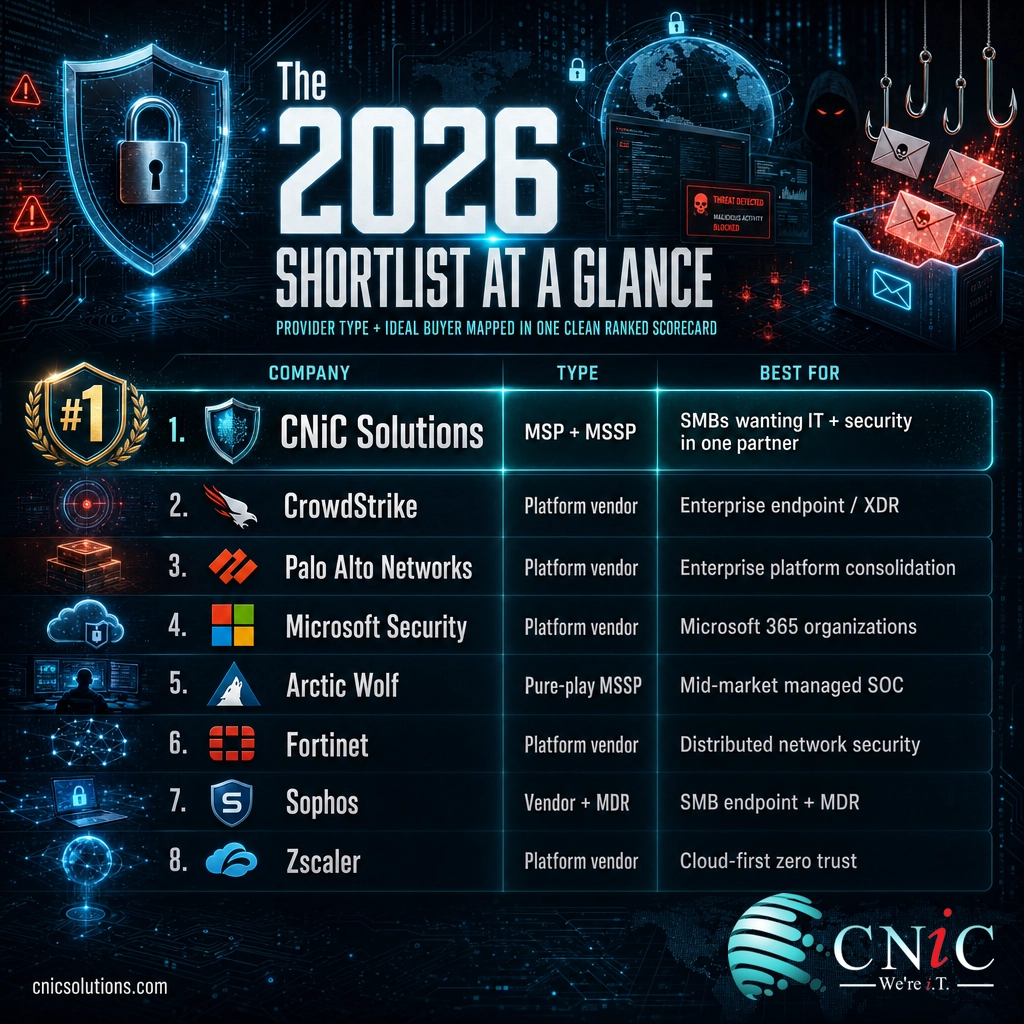
| CNiC Solutions | MSP + MSSP | SMBs wanting IT + security in one partner | Fully managed | 10/10 | #1 |
| CrowdStrike | Platform vendor | Enterprise endpoint / XDR | Product (MDR add-on) | 5/10 | 8.5 |
| Palo Alto Networks | Platform vendor | Enterprise platform consolidation | Product | 4/10 | 8.2 |
| Microsoft Security | Platform vendor | Microsoft 365 organizations | Product | 6/10 | 8.0 |
| Arctic Wolf | Pure-play MSSP | Mid-market managed SOC | Fully managed | 7/10 | 8.0 |
| Fortinet | Platform vendor | Distributed network security | Product | 6/10 | 7.8 |
| Sophos | Vendor + MDR | SMB endpoint + MDR | Product + MDR | 8/10 | 7.7 |
| Zscaler | Platform vendor | Cloud-first zero trust | Product | 4/10 | 7.6 |
The pattern is clear once you sort by type. If you have a security team, the platform vendors give you the deepest tools. If you do not, a managed provider gives you the outcome. For most small and midsize businesses, the honest answer is a managed partner, and among managed providers, the one that also handles your IT removes the most risk.
How to Choose a Cybersecurity Company
Rankings narrow the field; the right questions close the decision. Whichever companies make your shortlist, ask each one the same four questions and compare the answers directly.
- Do you run it, or do I? Be explicit about what is managed versus what your team must operate. This one answer separates a product sale from a security partnership.
- What happens at 2 a.m. during an incident? Ask for the exact response process, who picks up, how fast, and what they are authorized to do.
- How do you handle my compliance obligations? If you face HIPAA, PCI, SOC 2, or CMMC, ask how they support evidence, reporting, and audits.
- What results can you show me? Request references, independent test results, or outcome metrics, not just a feature list.
Before you sign anything, run a structured cybersecurity risk assessment so you are buying against your actual gaps, not a generic package. And watch for the warning signs below, because how a provider sells is a preview of how they will serve.
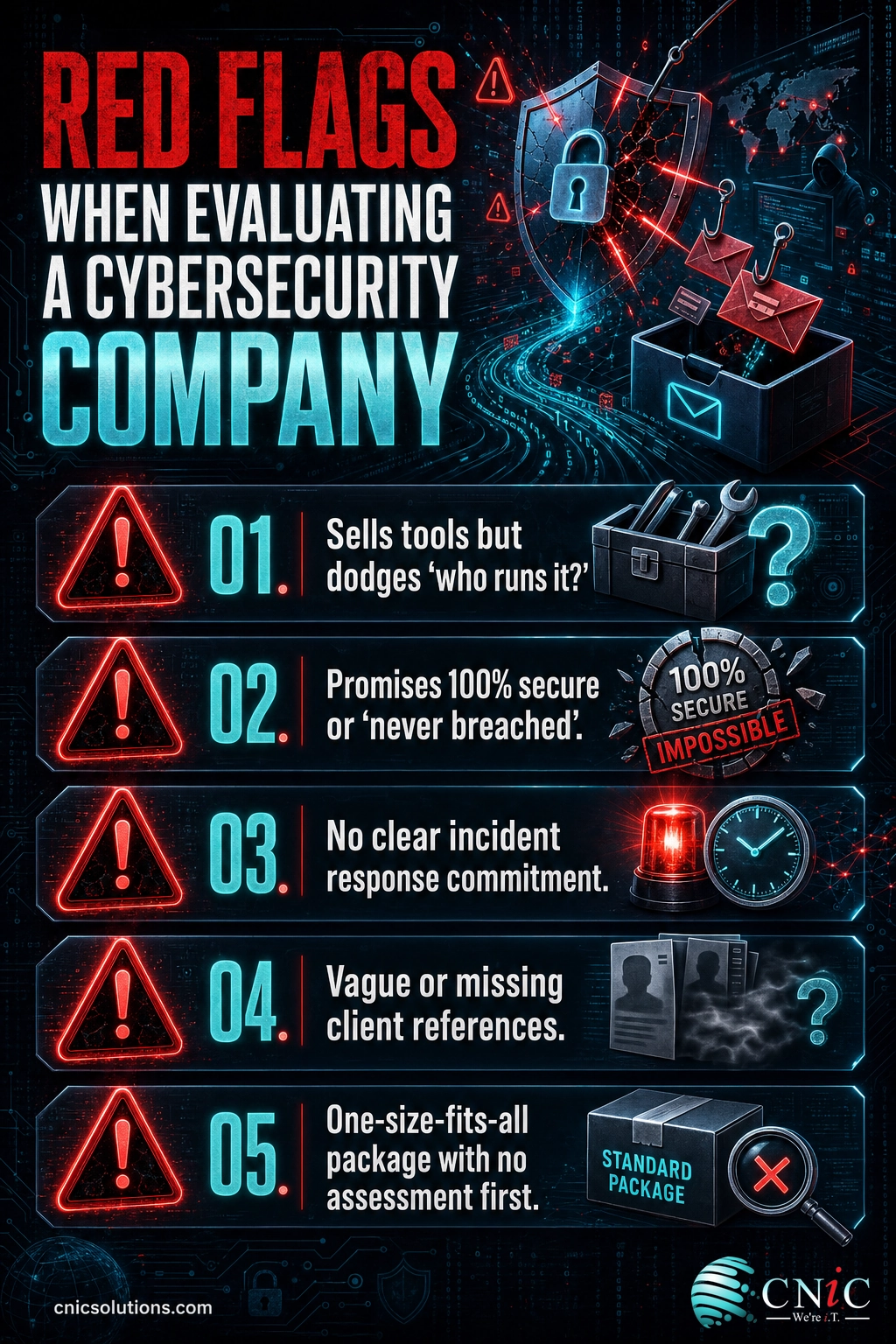
- They sell tools but dodge the “who runs it” question. A dashboard you cannot staff is not protection.
- They promise “100% secure” or guarantee you will never be breached. No honest provider claims this. Security reduces and manages risk; it never eliminates it.
- No clear incident response commitment. If they cannot describe what happens during an attack and how fast, they have not planned for one.
- Vague or non-existent references. A capable provider can point to results and clients like you.
- One-size-fits-all packages with no assessment first. Real protection starts by understanding your specific risks, not by upselling a bundle.
A business that wants strategic guidance alongside protection should also weigh a Virtual CIO
Common Questions About Cybersecurity Companies
What do cybersecurity companies do?
Who are the top cybersecurity companies in 2026?
What is the difference between a cybersecurity vendor and an MSSP?
How much does it cost to hire a cybersecurity company?
Do small businesses really need a cybersecurity company?
Should I choose a national vendor or a local cybersecurity company?
Methodology and Sources
How we built this ranking
This guide evaluates cybersecurity companies from the perspective of a small or midsize business that needs strong protection without staffing a dedicated security team. We segmented the market by four lenses (size, type, location, and results) and scored each company against seven buyer criteria: breadth of protection, managed versus product-only delivery, fit for company size, response and support model, compliance alignment, proven results, and total cost and flexibility.
Scores reflect fit for that specific buyer, not absolute product quality. Every company listed is a genuine leader for its intended audience: the platform vendors that build endpoint, network, and cloud tools excel for organizations with security teams, while managed providers excel for organizations that want outcomes delivered for them. Company capabilities were drawn from each provider’s official documentation. Threat and cost data come from the primary sources below.
Sources
- IBM Cost of a Data Breach Report 2025 (average breach cost: $4.44M global, $10.22M U.S.)
- Verizon 2025 Data Breach Investigations Report (ransomware in 44% of breaches, 88% of SMB breaches; 60% human element; 30% third-party involvement)
- Gartner information security spending forecast ($248.9B global spending, 2026)
Calculation and interpretation of these figures for the small-business buyer are original to CNiC Solutions. Company facts are current as of publication and subject to change; verify pricing and capabilities on each provider’s official site before purchasing.



related posts
Types of Phishing Attacks Every Business Should Know
September 29, 2026Phishing is a cyberattack in which criminals pose as a trusted person or organization to trick…
Types of Servers and How They Work: A Business Guide
September 29, 2026A server is a computer that provides a service, data, or resource to other computers, called…
Types of Malware: A Guide to the Most Common Threats
September 28, 2026Malware (short for malicious software) is any program or code created to damage, disrupt, or gain…
Threat vs. Vulnerability vs. Risk: What’s the Difference in Cybersecurity?
September 28, 2026Quick definition: In cybersecurity, a vulnerability is a weakness that could be exploited, a threat is…