

Choosing an IT support company is one of the highest-stakes vendor decisions a business makes, because the wrong choice does not just cost money, it costs uptime, data, and sometimes the business itself. The Information Technology Intelligence Consulting (ITIC) 2024 survey found that a single hour of downtime now costs more than $300,000 for over 90% of mid-size and large enterprises, and Verizon’s 2025 Data Breach Investigations Report found that 88% of small-business breaches now involve ransomware. The best IT support companies in the US are the ones that keep those numbers from ever becoming your problem. This guide ranks the leading options by the type of business each one fits best, so you can shortlist the right partner rather than the biggest name.
How We Evaluated IT Support Companies
“Best” is not a single leaderboard. A global bank and a 20-person law firm need completely different partners. We assessed providers against the criteria that actually determine fit:
- Support model: Proactive managed service that prevents problems, or reactive break-fix that only responds after something breaks?
- Responsiveness and SLAs: Are response and resolution times guaranteed in writing, and how fast are they?
- Breadth of expertise: Can one relationship cover help desk, networking, cybersecurity, cloud, and strategy, or only a slice?
- Security and compliance: Can the provider secure regulated data and support frameworks like HIPAA, PCI-DSS, and SOC 2?
- Relationship depth: Do you get a dedicated team and a strategic advisor, or a ticket in a queue of thousands?
- Cost model and transparency: Predictable flat-fee pricing with essentials included, or a thin base plan with everything gated behind add-ons?
A note on our approach: CNiC Solutions is a Houston-based managed IT and cybersecurity provider, so we appear in this list. We have been transparent about that, ranked by best-fit rather than a rigged scoreboard, and given every provider genuine credit for what it does well. We also avoid quoting specific prices, which change constantly and vary by tier and contract; we describe pricing positioning instead.
Key Takeaways
- The best IT support company is the one that fits your size and model. There is no universal winner, only the best fit for your business.
- For most small and midsize businesses, a dedicated managed IT partner beats a national vendor. A partner that knows your environment responds faster and thinks strategically.
- Global enterprises are well served by firms like Accenture, TCS, and Cognizant for large-scale transformation and outsourcing.
- The support model matters more than the logo. Proactive managed service prevents the outages and breaches that reactive break-fix only cleans up after.
- Insist on written SLAs and real security capability. Guaranteed response times and compliance support are non-negotiable, not upsells.
What’s in This Guide
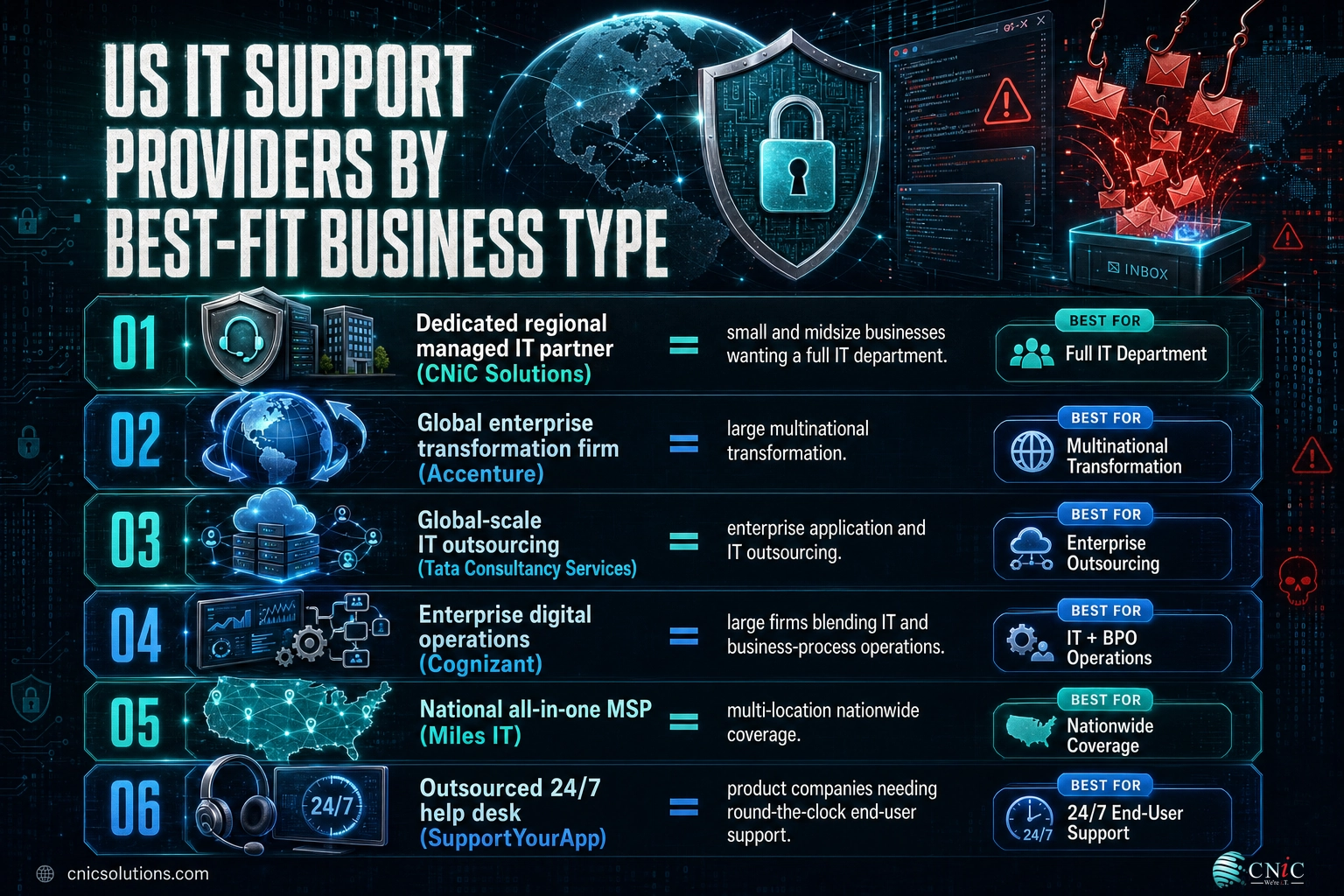
- CNiC Solutions: Best for SMBs Wanting a Dedicated IT Partner
- Accenture: Best for Large Enterprise Transformation
- Tata Consultancy Services: Best for Global-Scale Outsourcing
- Cognizant: Best for Enterprise Digital Operations
- Miles IT: Best for Multi-Location Nationwide Coverage
- SupportYourApp: Best for Outsourced 24/7 Help Desk
Make the right choice:
Why the Choice Carries So Much Weight
Before the list, it helps to understand what is actually on the line. IT support is no longer a back-office convenience; it is the control layer for revenue, security, and continuity. When it fails, the costs are immediate and measurable.
The pattern is clear: attackers increasingly target smaller organizations precisely because they assume the IT support is thinner. A capable partner closes that gap with proactive monitoring, patching, backups, and a real response plan. A weak one leaves it open. For a deeper look at the numbers behind that trend, see our small business cyber attack statistics.
Source: ITIC 2024 Hourly Cost of Downtime Report | Verizon 2025 Data Breach Investigations Report
1CNiC Solutions: Best for SMBs Wanting a Dedicated IT Partner
Best for: Small and midsize businesses that want a complete IT department and a strategic advisor, not a ticket queue.
For the majority of US small and midsize businesses, the best IT support does not come from the largest firm on this page; it comes from a dedicated regional managed IT partner that knows your environment by name. CNiC Solutions is a Houston-based managed IT and cybersecurity provider, in business since 2007, that delivers exactly this model: proactive monitoring, cybersecurity, cloud, networking, help desk, and Virtual CIO strategy under one flat-fee relationship. We rank it first not because it is the biggest, but because for the buyer this guide serves, the dedicated-partner model consistently outperforms being one small account among thousands at a national vendor.
Strengths:
- A full “one-stop” IT department: managed IT, cybersecurity, cloud, networking, cabling, telecom, and camera systems from a single accountable partner.
- A Virtual CIO relationship that turns IT from a cost center into a planned, budgeted strategy, rare among providers at this size.
- Real security and compliance capability, including HIPAA, PCI-DSS, and SOC 2 support, backed by CISSP and CompTIA Security+ certified staff.
- A dedicated team that learns your business, so responses are faster and more contextual than a rotating national help desk.
Fit considerations:
- Best suited to small and midsize organizations; a Fortune 500 needing global, follow-the-sun operations across dozens of countries is a better fit for an enterprise firm below.
- Regionally rooted in Texas, though it serves clients nationally; buyers who specifically want a household global brand name may weigh that differently.
| Criterion | Rating | Notes |
|---|---|---|
| Support model | Excellent | Proactive managed service, flat-fee |
| Relationship depth | Excellent | Dedicated team + Virtual CIO |
| Breadth of expertise | Excellent | Full-stack IT under one roof |
| Security / compliance | Excellent | HIPAA, PCI-DSS, SOC 2 support |
| Global enterprise reach | Moderate | SMB and midmarket focus |
See what a dedicated managed IT partner looks like
2Accenture: Best for Large Enterprise Transformation
Best for: Large enterprises and global organizations running complex, multi-country transformation programs.
Accenture is one of the largest professional services and technology firms in the world, spanning consulting, systems integration, and managed services. For a multinational modernizing core systems, migrating at scale, or standing up global operations, few firms match its reach, depth of specialists, and delivery muscle.
Strengths:
- Enormous global scale with specialists across virtually every technology and industry.
- Strong at large, complex transformation and systems-integration programs.
- Deep partnerships with major cloud and enterprise software platforms.
- Follow-the-sun delivery across regions and time zones.
Fit considerations:
- Built for enterprise budgets and engagements; the scale that serves a multinational is overkill, and over-priced, for a small business.
- You are a large account by design, so day-to-day IT support is typically not a personal, know-your-name relationship.
| Criterion | Rating | Notes |
|---|---|---|
| Global enterprise reach | Excellent | One of the largest firms worldwide |
| Transformation depth | Excellent | Consulting + integration at scale |
| SMB fit | Limited | Built for enterprise budgets |
| Relationship depth | Moderate | Large-account model |
3Tata Consultancy Services: Best for Global-Scale Outsourcing
Best for: Large enterprises outsourcing IT operations and application services at massive scale.
Tata Consultancy Services (TCS) is a global leader in IT services and outsourcing, with one of the largest technology workforces on earth. It is a natural fit for enterprises that need to run and maintain large application estates, infrastructure, and support operations cost-effectively across regions.
Strengths:
- Vast delivery scale for application development, maintenance, and IT outsourcing.
- Mature, process-driven delivery honed across thousands of enterprise engagements.
- Broad industry coverage, from banking to manufacturing to retail.
- Cost-efficient global sourcing for large, ongoing operations.
Fit considerations:
- Optimized for enterprise-scale contracts; the engagement model is not designed for a small business needing hands-on local support.
- Strategic value shows up in large, long-term programs rather than quick, ad-hoc help.
| Criterion | Rating | Notes |
|---|---|---|
| Outsourcing scale | Excellent | Among the largest globally |
| Delivery maturity | Excellent | Process-driven at scale |
| SMB fit | Limited | Enterprise contract model |
| Local hands-on support | Moderate | Global delivery focus |
4Cognizant: Best for Enterprise Digital Operations
Best for: Large organizations blending IT outsourcing with digital and business-process operations.
Cognizant pairs traditional IT services and outsourcing with digital engineering and business-process operations. Enterprises that want a single partner to run both their technology estate and adjacent operational processes, especially in healthcare, financial services, and insurance, often shortlist it.
Strengths:
- Combines IT services with digital and business-process operations.
- Deep vertical expertise, particularly in healthcare and financial services.
- Large global delivery footprint for ongoing managed operations.
- Strong at modernizing legacy systems inside big enterprises.
Fit considerations:
- Enterprise-oriented; the value comes from scale and vertical depth, not small-team responsiveness.
- Engagements are sized for large organizations rather than SMB IT support.
| Criterion | Rating | Notes |
|---|---|---|
| Digital + BPO breadth | Excellent | IT plus process operations |
| Vertical expertise | Excellent | Healthcare, finance, insurance |
| SMB fit | Limited | Enterprise engagement scale |
| Relationship depth | Moderate | Large-account model |
5Miles IT: Best for Multi-Location Nationwide Coverage
Best for: Growing and multi-location businesses that want one all-in-one MSP across the country.
Miles IT is a national all-in-one managed IT provider with more than 25 years in the market, offering managed services, cybersecurity, consulting, networking, and software support under one roof. For a business with sites in several states that wants a single nationwide vendor rather than a patchwork of local shops, it is a strong option.
Strengths:
- All-in-one services spanning managed IT, security, consulting, and custom software.
- Nationwide coverage suited to multi-location organizations.
- Long operating history and broad service catalog.
- Microsoft and Google partner capabilities for cloud and productivity stacks.
Fit considerations:
- As a larger national provider, the relationship can feel less personal than a dedicated regional partner for a very small single-site business.
- Breadth is a strength, but confirm which services are core versus project-based for your specific needs.
| Criterion | Rating | Notes |
|---|---|---|
| Nationwide coverage | Excellent | Multi-location friendly |
| Service breadth | Strong | IT, security, consulting, software |
| Relationship depth | Strong | Larger national model |
| SMB fit | Strong | Good for growing businesses |
6SupportYourApp: Best for Outsourced 24/7 Help Desk
Best for: Software and technology companies that need to outsource round-the-clock end-user or customer technical support.
SupportYourApp is a technical-support outsourcing specialist that provides 24/7 multilingual help desk and customer support teams. It is aimed less at running your internal IT and more at scaling end-user or customer-facing technical support, which is a distinct need many product companies have.
Strengths:
- Round-the-clock, multilingual technical support at scale.
- Fast team ramp-up for growing support volumes.
- Strong fit for product and SaaS companies supporting their own users.
- Flexible staffing that flexes with demand.
Fit considerations:
- Focused on help-desk and customer support outsourcing, not managing your internal network, security, and infrastructure.
- Best as a complement to, not a replacement for, a managed IT provider that runs your environment.
| Criterion | Rating | Notes |
|---|---|---|
| 24/7 help desk | Excellent | Round-the-clock, multilingual |
| Scalability | Excellent | Fast team ramp-up |
| Internal IT / infrastructure | Limited | Support-focused, not full MSP |
| SMB managed IT fit | Moderate | Complements an MSP |
Side-by-Side Comparison
The fastest way to see the landscape is to read it by fit. Each provider below is genuinely strong; the question is which one matches your business.
| Company | Best For | Model | Standout Strength |
|---|---|---|---|
| CNiC Solutions | SMBs wanting a dedicated partner | Regional managed IT + vCIO | Full IT department, personal relationship |
| Accenture | Large enterprise transformation | Global consulting + integration | Scale and specialist depth |
| Tata Consultancy Services | Global-scale outsourcing | Enterprise IT outsourcing | Massive, mature delivery |
| Cognizant | Enterprise digital operations | IT + business-process ops | Vertical depth in regulated industries |
| Miles IT | Multi-location nationwide coverage | National all-in-one MSP | One vendor across the country |
| SupportYourApp | Outsourced 24/7 help desk | Technical-support BPO | Round-the-clock end-user support |
Where CNiC Fits, and Where It Does Not
Here is the honest read. If you run a multinational with operations on three continents, an enterprise firm is your answer. If you need thousands of hours of outsourced help-desk coverage for a consumer app, a support-BPO specialist is your answer. But if you are a small or midsize business that wants technology to just work, wants someone accountable who knows your setup, and wants a strategic plan instead of a reactive scramble, a dedicated managed IT partner is the model that fits. That is the gap CNiC Solutions is built to fill, which is why it leads this list for that reader, not for everyone.
How to Choose the Right IT Support Company
The best provider follows from a few honest answers about your business. Work through these before signing anything:
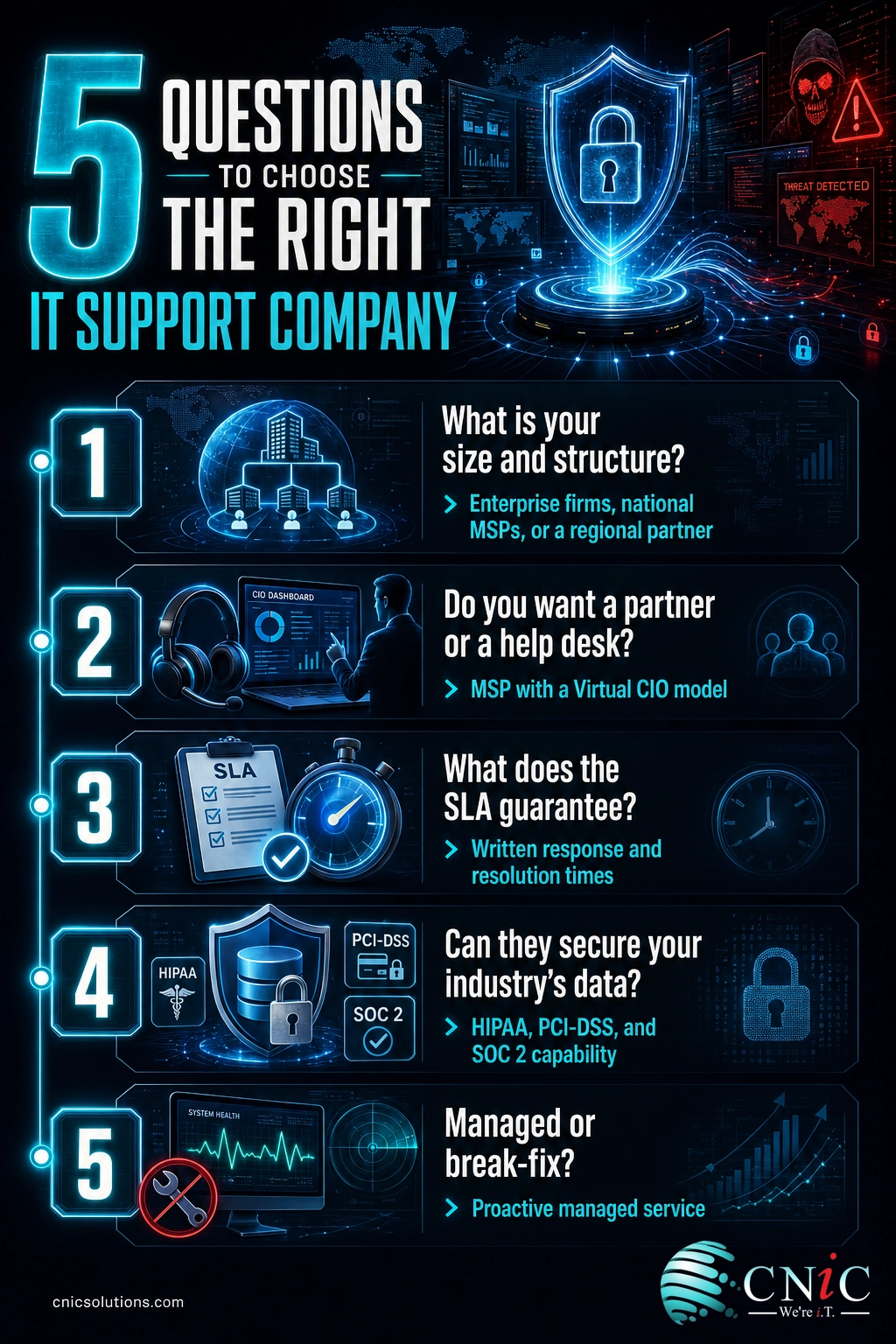
- What is your size and structure? Global enterprise points to Accenture, TCS, or Cognizant. Multi-location growth points to a national MSP. A single-site or few-site SMB points to a dedicated regional partner.
- Do you want a partner or a help desk? If you want proactive management and strategy, you need an MSP with a Virtual CIO model, not just someone to answer tickets.
- What does the SLA actually guarantee? Get response and resolution times in writing. “We’ll get to it” is not a service level.
- Can they secure your industry’s data? Regulated verticals (healthcare, legal, finance) raise the bar. Confirm HIPAA, PCI-DSS, or SOC 2 capability specifically, not vaguely.
- Managed or break-fix? Break-fix feels cheaper until the outage that closes you for a day. Understand exactly what you are buying, and read our explainer on the break-fix support model.
If cost is the sticking point, compare the true numbers rather than the sticker price. Our in-house versus outsourced IT cost comparison and our small business IT budgeting guide break down what you actually pay for either path.
Red Flags When Evaluating an IT Support Company
- No written SLA. If response and resolution times are not guaranteed on paper, they are not guaranteed at all.
- Reactive-only support. A provider that only shows up after something breaks is selling you outages, not prevention.
- Vague security answers. If they cannot speak specifically to your compliance framework, they cannot protect your regulated data.
- Essentials gated behind add-ons. A cheap base plan that charges extra for backups, security, or after-hours help is not actually cheap.
- You are one account among thousands. If nobody at the provider will ever know your environment by name, expect slow, generic support when it matters most.
- No strategic guidance. A partner that never talks roadmap or budget leaves you making expensive technology decisions blind.
The Partner Model in Practice
What separates the best IT support from the rest is not a feature list; it is accountability. A true managed IT partner monitors your systems around the clock, patches and secures them before attackers find the gap, backs up your data and tests that it restores, answers the phone when something is wrong, and sits down with you to plan what comes next. For a small or midsize business, getting all of that from one accountable team, for a predictable monthly fee, is the outcome this whole guide is pointing toward. As a Houston managed IT and cybersecurity provider serving businesses across Texas and nationally, that is precisely what CNiC Solutions delivers.
Talk to a Virtual CIO about your IT strategy
Frequently Asked Questions
What is the best IT support company in the US?
How much do IT support companies charge?
What is the difference between an MSP and an IT support company?
Should a small business hire in-house IT or outsource?
How do I choose the right IT support company?
Methodology and Sources
Providers are ranked by best-fit use case rather than a single overall score, because the right IT support company depends heavily on business size, structure, and needs. Company characterizations reflect each provider’s documented positioning and public service offerings. We intentionally avoid quoting specific prices, which change frequently and vary by tier and contract; confirm current pricing directly with each provider. Downtime figures come from the ITIC 2024 Hourly Cost of Downtime Report, and small-business breach and ransomware figures come from the Verizon 2025 Data Breach Investigations Report. CNiC Solutions is included transparently as the author of this guide and a managed IT and cybersecurity provider; it is ranked first for the small-and-midsize-business reader this guide serves, not as a universal winner.
Primary sources: ITIC 2024 Hourly Cost of Downtime Report | Verizon 2025 Data Breach Investigations Report.



related posts
Password Statistics for 2026: Reuse, Cracks, and the Passkey Shift
September 22, 2026Weak and stolen passwords are still the number one way attackers get in. In 2025, stolen…
OKRs vs. KPIs: What’s the Difference?
September 22, 2026An OKR (Objective and Key Results) is a goal-setting framework that pairs an ambitious objective with…
15 Microsoft Teams Tips and Tricks to Boost Team Productivity
September 21, 2026Microsoft Teams is where most of the workday now happens: it passed 320 million monthly active…
Mobile Security Software for Business: A Buyer’s Guide
September 21, 2026Choosing mobile security software for business comes down to two decisions: how you will manage the…